Key Takeaways
- For stainless vacuum bottle bulk, ask for 0.35 mm to 0.50 mm inner wall thickness and a vacuum-loss limit tied to your use case.
- A promotional thermos should pass at least AQL 2.5 on critical defects, plus leak, drop, and print adhesion tests.
- MOQ often starts at 3,000 units; custom colors, lids, and packaging usually add 7 to 15 days to lead time.
- The cheapest thermos supplier is often the one with the highest hidden cost: rework, rust claims, and missed launch dates.
Bad thermoses usually fail in small ways. A teaspoon leaks past the silicone ring, steam fogs the inner polybag, the logo sits 2 mm off center, or orange rust shows up after 6 dishwasher cycles. That is enough to start returns, chargebacks, and a messy inbox by Monday morning. If you buy stainless vacuum bottle bulk for outdoor retail or promotional programs, price per unit is the wrong first question. We run the caliper over wall thickness, check seal geometry with a go/no-go cap gauge, test finish adhesion, weigh the export carton, and ask whether the line can hold the same spec at 5,000 units and 50,000 units.
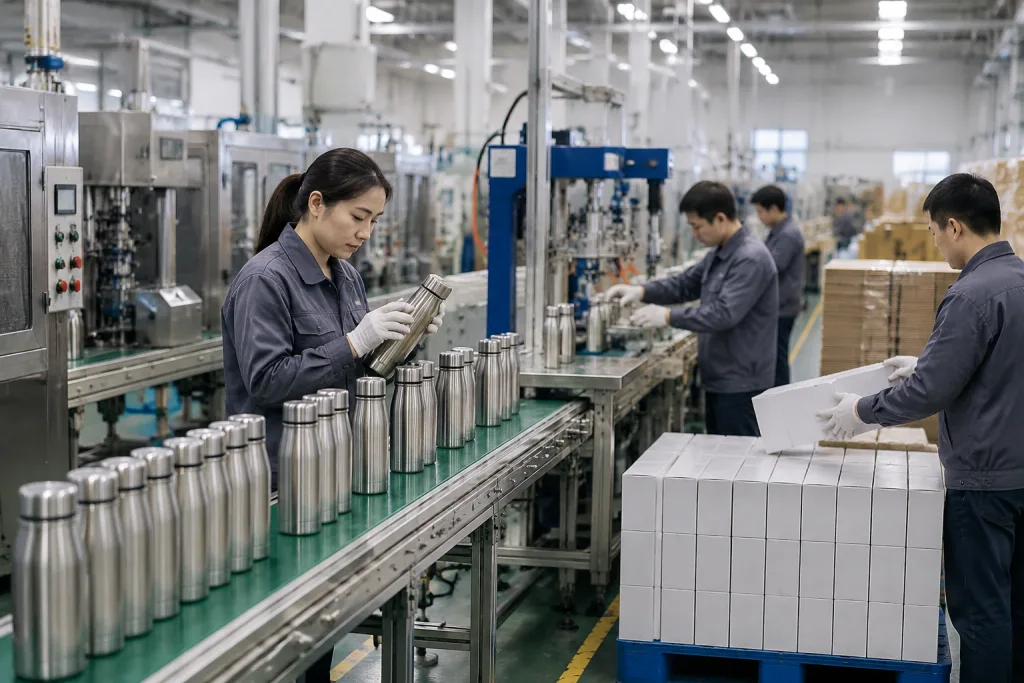
In Zhejiang and across China, stronger factories think in failure modes, not catalog photos. A real manufacturer thermos line runs on measured checks: 0.35 mm or 0.40 mm inner walls, 3,000-cycle or 5,000-cycle hinge tests, vacuum retention windows, AQL sampling, and print adhesion tests after 24 hours. QC pulled one sample last month because the lid torque read 0.62 N·m instead of our 0.75 N·m target; that is the kind of detail buyers never see in a product photo. If your supplier thermos cannot talk in those terms, the math doesn't work. BottleForge in Hangzhou runs 300,000 units per month, with common MOQ starting at 3,000 pieces and standard lead time around 25 to 35 days after sample approval.
Why cheap bottles leak later
The leak usually starts where the buyer cannot see it. A bottle can pass our 55°C warm-water upside-down test for 30 minutes, then seep after 300 open-close cycles in a store return. We see it when the lid thread pitch has 0.2 mm play, or when the gasket groove is cut too shallow for the silicone ring to seat under cap torque. This is where cheap quotes go wrong. If you are buying thermos bulk for outdoor retail, lock the closure spec before the mold shop cuts steel. Do not write “food-grade silicone” on the PO and call it done. Specify shore hardness, usually 50A to 70A for most screw caps, set a cap torque range with a torque meter, and ask for cycle testing instead of a one-off fit check. QC pulled one matte-black sample last month because the ring looked fine by eye, but the durometer read 42A. The math does not work.
The body is part of the leak story as well. A thin inner liner can pull out of round during seam welding or vacuum sealing, and that small oval shape becomes the weak spot after hot-water fill and cold-rinse shock. For a practical custom thermos in 500 ml to 750 ml sizes, many Zhejiang factories target 0.35 mm to 0.45 mm stainless on the inner wall and 0.4 mm to 0.5 mm on the outer shell, depending on the drawing. We run a quick check with a digital caliper at the mouth and base before trial assembly; if the mouth is off by 0.15 mm, the cap may still close, but returns show up 60 days later. If a supplier quotes from photos only, push back. A good thermos manufacturer will ask the intended temperature hold, the pack-out method, and the real use case: backpack side pocket or cup holder, not just “daily use.”
Leakage is rarely one defect. It is usually a stack of small tolerances that nobody pinned down.
Vacuum loss and heat claims
I’ll rewrite just the prose inside the existing HTML, keep the tags and list structure intact, and tighten the sales-engineering tone with concrete factory details.Heat-retention numbers are where buyer mistakes start. A promo thermos that says “12 hours hot” can still work for coffee if the channel only expects warm liquid by midafternoon. If you sell outdoor gear, that bar is too low. The real check is the measured temperature drop under one fixed protocol. Ask the thermos factory for test temperature, fill level, ambient temperature, and cap type. Without those four points, “12 hours” is just a print job.
Vacuum loss usually comes from three spots: weld contamination, a micro-leak at the seam, or a dent in transit that squeezes the insulation layer. We ask suppliers for vacuum decay data, pressure-leak checks, or at least a boil-water hold test on sampled units. On our Zhejiang line, a normal stainless vacuum bottle bulk order gets sample opening at AQL 2.5 for general defects, then a separate internal check for vacuum failure on critical items. QC pulled a cracked neck once after a carton-drop test at 80 cm, and the buyer flagged it before shipment. If your program has a high ASP or outdoor use, ask for a 4 to 6 hour boiling-water delta test and a 24-hour ambient hold record. A factory thermos with no data is guessing, and that is the wrong question to accept.
- Ask for the exact test method.
- Ask for the ambient temperature range.
- Ask for the pass/fail threshold in degrees Celsius.
Paint, print, and logo failure
I’ll rewrite the section in-place, keeping the exact HTML tags and tightening the sales-engineer tone with concrete shop-floor details and fewer AI-ish fillers.Most promotional thermos complaints are not about insulation. They come from decoration. Powder coat chips near the base, silk print fades after 20 handwashes, laser logos look shallow on brushed steel, or a wrap print lifts at the seam. The fix is not “better design.” It is choosing the right process for the substrate and setting a real durability target. On a custom thermos for outdoor retail, we run crosshatch adhesion on the powder coat and check screen print after abrasion and detergent exposure. If the bottle is sold as a branded gift, the logo is part of the product, not a sticker.
Match the process to the brand goal. Laser engraving gives a permanent mark and a cleaner premium look. Silkscreen costs less and suits bold graphics, but the wear limit has to be clear from day one. If you are comparing thermos custom options across suppliers, ask for finished samples, not digital mockups. We have seen the same artwork come out three ways on the line because of 35 μm vs 45 μm coating, curing time, and surface prep. A solid thermos supplier quotes decoration separately from the bottle body, because the failure modes are different. One bad oven cycle can turn a good bottle into a clearance item.
For distributors thermos programs, this is where repeat orders get messy. The buyer flagged it on a re-order before: same SKU, different gloss, and the logo sat 2 mm higher than the first batch. The second run has to match the first run in color code, gloss level, logo placement, and hand feel.
Rust, odor, and material traps
I’ll keep the HTML structure intact and rewrite the prose with a more factory-floor, buyer-facing tone. Then I’ll do a quick pass to make sure the wording is natural and the section still reads like it came from a sales engineer.Stainless steel is not magic. Get the grade wrong, skip passivation, or leave welds raw, and you still see rust spots at the cap seam, the laser-cut edge, or the bottom ring. For most stainless vacuum bottle bulk programs, 304 stainless is the line we run. 316 fits harsher use or a premium SKU, but the math changes fast. Do not lump every “stainless” bottle together. Ask for material certificates, and if the PO is for 20,000 pcs or the bottle will hold lemon water, ask for coil batch traceability or lot-level incoming inspection records. A real manufacturer thermos in China should have both, not excuses.
Odor is the other quiet fail. If the lid gasket is low grade, or the bottle comes out of polishing with compound dust still inside, the first complaint is simple: “it tastes like metal.” We’ve seen that go sideways. Specify pre-production wash, drying, and odor checks, especially for thermos customized with wide-mouth lids and straws. QC pulled the sample, sniffed the mouth area, and found residue after polishing on a 500 ml cup. Ask about electropolishing or passivation on the inner wall too. Those steps are not always mandatory, but they cut residue. In Zhejiang, the better thermos manufacturers answer straight. A cheap finish can cost more than the steel itself.
Do not buy “stainless” as a label. Buy the steel grade, the finishing process, and the cleaning standard.
MOQ, packaging, and freight traps
I’ll rewrite the two paragraphs in-place, keeping the HTML tags and the original numbers/certs intact, while cutting the AI-ish phrasing and adding a few factory-floor specifics.Bulk thermos orders fail in logistics more often than in production. The bottle can pass QC, then the carton collapses, the divider slides, or the pallet stack goes too high for ocean freight. We have seen a 7-layer box crush at 380 kg compression because the inner tray was cut 2 mm short. If you are sourcing thermos bulk for outdoor retail or promotions, packaging belongs in the product spec. A unit carton that looks good in photos can still fail a drop test if the insert is thin. For e-commerce or distributor thermos programs, ask for carton compression strength and a master carton count that matches your warehouse pick plan.
MOQ is another place where new buyers get burned. A supplier may quote a low body MOQ, then raise the floor for custom color, logo, or packaging. On our Hangzhou line, the base MOQ is often 3,000 pieces, but a unique Pantone color or multi-location print can push that higher. One buyer flagged a PO typo on the print position, and the reproof cost more than the bottle margin. Lead time for a stocked finish is usually 25 to 35 days; custom packaging adds 7 to 15 days. FOB terms are standard for many China shipments, but you still need to lock down carton labeling, HS code handling, and whether FNSKU or Amazon-ready prep is included. If the pack-out is not written down, you pay twice: once for the bottle, again for rework at your warehouse.
Build the QC plan before pricing
I’ll rewrite the section in-place, keeping the HTML structure intact and tightening the sales-engineer tone with a few concrete QC details.The cleanest way to buy a thermos manufacturer is to write the quality plan first and ask for the price second. Hard line, yes. Tell the factory what matters: leak resistance, vacuum hold, print rub resistance, color match, and food-contact compliance. For North America and Europe, ask for REACH and FDA-related declarations where they apply, then lock down any market-specific limits before the first sample. If the bottle goes into the EU, get the paperwork done before shipment. Customs does not care about excuses.
A practical QC plan for stainless vacuum bottle bulk should include:
- Incoming steel and gasket inspection with calipers and hardness check.
- In-process seam and vacuum checks on the line.
- Final AQL sampling, often AQL 2.5 for general defects and tighter limits for leaks or print defects.
- Carton drop and compression checks on export packaging.
- Pre-shipment photo reports with lot numbers and label verification.
That is how manufacturers thermos programs stay steady across repeat orders. A good thermos supplier will not push back on this list; they will sharpen it. A weak one will say it is “too much trouble.” We have seen that story go sideways. In Zhejiang, the factories worth keeping know the difference between a buyer chasing the lowest quote and a buyer who wants the same bottle to reorder cleanly next season.
Spec your thermos before you place the order
Send your target price, size, logo method, and market. We’ll turn that into a manufacturable stainless vacuum bottle bulk spec with real QC checkpoints.
Frequently asked questions
What MOQ should I expect for stainless vacuum bottle bulk?
For a standard stainless vacuum bottle bulk order, 3,000 pieces is a realistic starting point at many Zhejiang factories. If you want custom color, custom lid, or special packaging, the MOQ can rise to 5,000 pieces or more. For simpler repeat SKUs, some thermos suppliers may accept 1,000 to 2,000 units, but the unit price is usually higher. Ask whether the MOQ applies per color, per logo, or per carton spec. That detail changes the quote more than most buyers expect.
How do I compare a cheap thermos supplier against a reliable one?
Do not compare only FOB price. Compare the spec sheet, the test method, and the defect policy. A reliable thermos supplier will show wall thickness, steel grade, gasket material, and leakage testing. Ask for AQL level, usually 2.5 for general defects, and whether they accept third-party inspection. The cheapest quote often leaves out packaging strength, logo durability, or vacuum retention guarantees. A price difference of USD 0.35 to 0.80 per unit can disappear fast if you rework 5% of the order.
Can I get a custom thermos with my logo and color?
Yes, but each customization adds risk and time. A custom thermos with one-color silkscreen is usually faster than a full Pantone shell or multi-position decoration. Expect a sample cycle of 7 to 15 days and production lead time of 25 to 35 days after approval, depending on the factory thermos schedule. If you need a Pantone match, ask for a master sample and a signed color tolerance standard. Without that, “close enough” becomes your problem.
What certifications matter for Europe and North America?
For Europe, ask about REACH-related compliance, food-contact declarations, and any country-specific packaging rules. For North America, buyers often ask for food-contact support documents and material declarations from the thermos manufacturer. If the bottle has silicone, straw parts, or coatings, those materials should also be documented. A serious supplier thermos will provide test reports or declaration letters, not just a brochure. If you sell through retail chains, ask your compliance team what file they need before PO issuance, not after shipment.
What defect rate is acceptable in production?
For bulk thermos orders, most buyers use AQL sampling rather than a zero-defect promise. AQL 2.5 is common for general defects, while critical defects like leaks should have much tighter internal controls. In practice, you should expect the factory to separate cosmetic issues from functional ones. A small paint speck may be acceptable on a promotional thermos; a leaking lid is not. Put the defect categories in writing so the thermos factory knows what counts as rejectable before production starts.