Key Takeaways
- MOQ for a custom stainless Tritan order is commonly 1,000 pcs per SKU; sample lead time is 7 to 10 days.
- Target unit prices usually land around USD 2.80 to 6.40 FOB depending on size, lid, and decoration.
- A practical QC plan uses AQL 2.5 for critical defects and 4.0 for major defects.
- Most production runs need 25 to 35 days after sample sign-off, plus 18 to 35 days ocean transit from China.
You are not buying “a bottle.” You are buying a margin line that needs the same defect rate, freight class, compliance file, and complaint pattern every time. That is why stainless tritan bottle wholesale needs a buyer’s process, not a catalog glance. If you handle procurement or own the brand, the real job is not finding a supplier in Zhejiang or anywhere else in China; it is locking the specs so the first 5,000 units match the last 5,000.
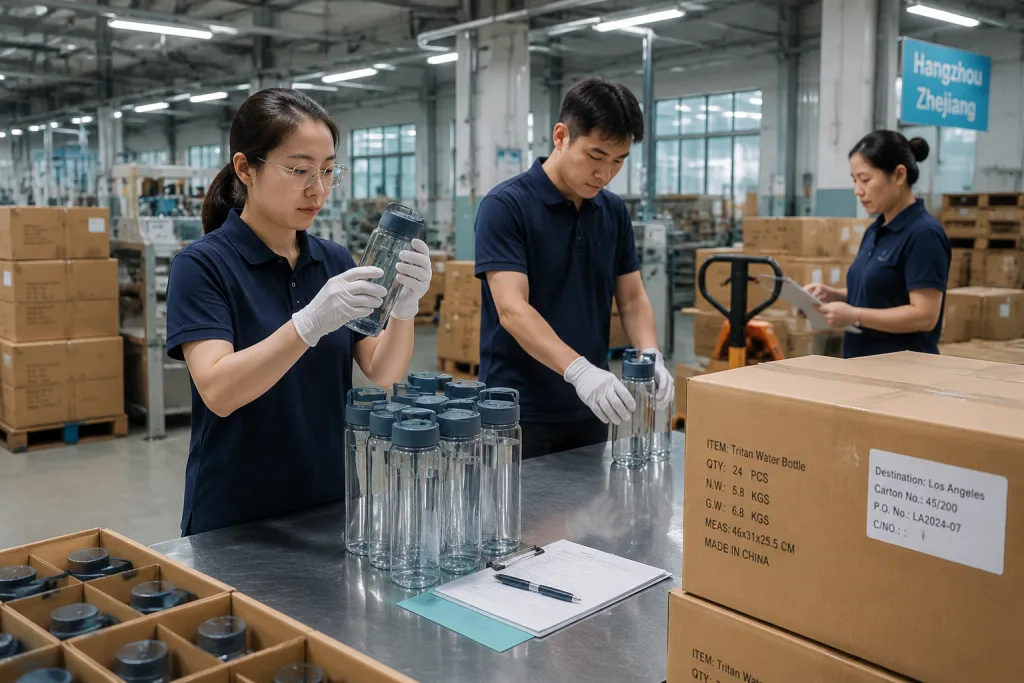
At BottleForge Industrial in Hangzhou, Zhejiang, we run this order type every week: stainless outer shell, Tritan inner bottle or drinking part, custom logo, retail carton, and a shipping plan that has to fit Amazon, distributors, or direct wholesale. Our monthly output is above 300,000 units, MOQ usually starts at 1,000 pieces per SKU, and lead time is 25 to 35 days after sample approval. QC pulled a sample last week on a 0.2 mm wall-thickness drift, and that is where these jobs go sideways; the buyer flags the wrong thing if they only ask for a cheaper price, because the math does not work without seal fit, drop test, REACH paperwork, and a clean pallet count.
Start With the Retail Job
I’ll rewrite the section in-place, keeping the HTML tags and structure untouched while making the copy sound like it came from a factory-side sales engineer.Before you ask for stainless tritan bottle wholesale pricing, lock the retail job first. A bottle for a gym chain is not the same as one for a corporate gift run or a warehouse club order. If the buyer just says “best wholesale drink bottle,” that is too loose to quote. We need capacity, lid type, print method, carton spec, and the target market before we run the line.
For a normal buyer brief, we usually spec a 500 ml or 650 ml bottle with a 304 stainless outer shell, Tritan drinking-contact part, silicone seal, and PP or Tritan lid. On the line, wall thickness usually lands at 0.4 to 0.5 mm for an economy build and 0.5 to 0.6 mm for a heavier retail piece. If the order is for wholesale drinkware in North America, ask for FDA-style material declarations early, check LFGB for Europe, and screen REACH input limits before sampling. A buyer once sent a PO with “500ML” in one place and “550ml” in another; QC pulled the sample, and the quote had to be reworked. The math does not work if the brief is fuzzy.
Good sourcing starts with a use case, not a logo file.
Lock the Build Before Quoting
The quickest way to burn margin is to compare quotes that do not describe the same build. Stainless Tritan bottles look straightforward on the shelf, but the price moves fast with steel grade, lid stack-up, and decoration. One-color silk screen on a smooth body is cheap. A wrap print, laser logo, and custom box are not. If you are also buying bulk canteen, wholesale canteen, or drinkware wholesale, keep the spec wording tight so the line does not quote three different assumptions.
Here is the quote sheet we run: outer shell material, inner contact material, capacity, mouth diameter, lid material, seal count, finish, logo method, carton drop test, and master carton quantity. On a basic stainless Tritan bottle wholesale order, FOB China pricing usually lands around USD 2.80 to 3.40 at 1,000 pcs. A branded version with a premium lid and gift box can reach USD 4.80 to 6.40. We had a buyer flag a PO once because the carton spec said 24 pcs, then the packing list said 12; the math does not work. The same discipline applies if you are quoting canteen bulk or canteen wholesale. Do not accept a vague “bulk drinkware” line item and call it clean.
- 304 stainless shell: standard choice for retail and food service.
- 316 stainless shell: better corrosion resistance, and the buyer pays for it.
- Tritan contact part: gives clarity and BPA-free positioning.
- Custom carton: usually adds USD 0.15 to 0.45 per unit.
Sample Like a Real Buyer
I’ll rewrite the section in a more buyer-side, factory-floor voice, keep the HTML intact, and make sure the wording sounds human and specific.Don’t approve a factory photo. Approve a physical sample, then test it the way your customer will use it. We run this process in Zhejiang all the time. A solid stainless tritan bottle wholesale sample path starts with a blank working sample, then a decorated pre-production sample, then one golden sample sealed off by both sides.
Check cap torque, seal leak, odor, logo adhesion, and hand feel. If the bottle will go into a gym bag, do a 24-hour leak check with water at room temperature, then drop it from 1 meter on the cap side and base side. We’ve seen buyers skip that and regret it later. For wholesale growler or beer growler bulk programs, the same approach works, but pressure and closure integrity carry more weight. If your line also covers beer tumbler bulk, beer tumbler wholesale, or alcohol flask wholesale, the question changes fast: labeling, age-gating, and market rules can shift by country, and the buyer flagged it after the PO was already signed. A good sample process saves you from “it looked fine in the PO” fights.
Ask for 7 to 10 days for the sample, then request a pre-production sign-off photo set showing print placement, box code, and accessory count. QC pulled the sample, checked the carton mark, and found a typo on one PO last month. If the seller cannot handle that, they are not set up for drinkware bulk work.
QC the First Production Run
I’ll rewrite just the prose inside the existing HTML, keep the tag structure intact, and make it sound like a sales engineer on the shop floor.Your first order is a controlled trial, not a reorder. For a 1,000 to 5,000 piece run, we ship with AQL inspection and hard numbers. We usually run AQL 2.5 for critical defects and AQL 4.0 for major defects on wholesale drinkware orders. Critical defects cover leakage, sharp edges, wrong capacity, and missing food-contact compliance. Major defects cover print shift, dents past tolerance, and a lid color miss.
Build the QC checklist around the buyer’s actual use. Retail launch? Check carton print, barcode scan rate, and inner pack protection. Institutional canteen supply? Focus on stackability, wash durability, and carton efficiency. We’ve had buyers ask for “general QC” and that is the wrong question to ask. For stainless Tritan bottles, QC pulled the sample and this is the spec we’d write down:
- Leak test: 100% on sample bottles from each lot.
- Drop test: at least 5 units per carton style.
- Dimension check: 3 to 5 units per production line.
- Carton compression: verify master carton integrity for export stacking.
Do not accept “factory standard” as a substitute for measurable QC. One PO typo on a 350 ml bottle can turn into a carton rework on the line, and we’ve seen that go sideways fast. The best Zhejiang factories will take exact numbers because that is what they can hold.
Price the Freight, Not Just the Bottle
I’ll rewrite the three paragraphs in place, keep every tag exactly as-is, and tighten the sales-engineer tone with concrete freight details and fewer AI-style phrases.Many buyers stare at the FOB quote and miss the landed cost. That is where margin leaks out. A stainless Tritan bottle wholesale order that prints at USD 3.10 FOB can turn expensive once you add inner packing, 2-hour inland trucking, export docs, ocean freight, and destination handling. We’ve seen a buyer approve first, then lose 18% margin on the first container. If you sell into Europe or North America, price the landed cost before sign-off, not after the boxes are on the water.
For a standard 20-foot container from China, freight changes with season, port choice, and carton density. Dense drinkware bulk cartons move well, but custom gift boxes and oversized lids cut pallet count fast. We had one PO typo where the buyer wrote 24 cm cartons instead of 34 cm, and the whole load plan had to be redone. If you are buying beer growler wholesale bulk or beer growler in bulk, the pack size can hurt more than the bottle price. That is why we ask for carton dimensions at quote stage. The better question is not “what is the unit price?” but “how many units fit, how many cartons ride a pallet, and what is the damage rate?”
Use FOB China when you control freight. Use DDP only when the supplier runs a tight logistics desk. For a new program, I push FOB plus your own forwarder; the math is cleaner and QC can track the load list against the packing sheet. A distributor buying wholesale drinkware in volume should know what each pallet costs before it lands, down to the 10 mm spacer and the last carton tape job.
Plan the Reorder Path Early
I’ll rewrite the prose in place, keep the HTML untouched, and tighten it to sound like a factory-side sales engineer. Then I’ll return just the finished HTML.The smart buyers do not wait for stock to hit the floor. They reorder off sell-through data and keep the spec locked. That matters in stainless Tritan bottle wholesale because one spec change resets the mold, the color chip, and QC risk. If the first run sells 80% in eight weeks, we place the next PO while that line is still warm. The cap torque, 12 mm neck finish, and carton print stay matched.
We see buyers move from one bottle into adjacent lines: bulk growler, growler wholesale, wholesale growler, beer growler wholesale, or drinkware wholesale across 3 to 5 SKUs. Fine, if the sourcing file stays clean. One plant should own the spec sheet, photo standard, and test records. We run this out of Hangzhou and the wider Zhejiang base all the time, but sloppy paperwork will blow it up. Keep one master file with approved sample photos, AQL results, compliance documents, and reorder notes; QC pulled the sample twice on a 24 oz run because the PO had a cap-code typo. If you need alcohol flask in bulk or alcohol flask wholesale bulk later, use the same vendor, but do not assume the same spec carries across categories.
When the second order is set early, lead time drops because the supplier already knows your tolerances, packaging, and claim language. We’ve seen it go sideways when buyers wait for the last pallet to leave, then rush a new finish and ask for a 7-day slot. That is the wrong question to ask. Plan the reorder path early, and drinkware wholesale stops being a one-off buy and starts acting like a stable supply line.
Request a factory quote with your spec sheet
Send capacity, lid type, logo method, carton size, and target market. We’ll quote fast from Hangzhou, Zhejiang with clear MOQ, pricing, and QC steps.
Frequently asked questions
What is the usual MOQ for stainless tritan bottle wholesale?
For a custom stainless Tritan bottle wholesale order, MOQ is commonly 1,000 pcs per SKU. Some simple stock colors can start lower, but once you add custom logo, carton print, or special lid parts, 1,000 pcs is the realistic floor. For multiple colors, the factory may ask 1,000 pcs per color or a combined MOQ of 3,000 pcs across one model. In Zhejiang, well-run plants usually confirm this after checking raw material and decoration capacity, not before.
How much should I budget per unit?
For FOB China pricing, a basic stainless Tritan bottle often lands around USD 2.80 to 3.40 at 1,000 pcs. A better-finished retail version with upgraded lid, nicer coating, and custom carton can reach USD 4.80 to 6.40. The biggest price drivers are lid complexity, print method, packaging, and whether you choose 304 or 316 stainless. If you want bulk drinkware economics, request a line-item quote so you can see where each cent goes.
What testing should I request before shipment?
At minimum, ask for leak testing, visual inspection, dimension checks, and carton drop testing. For production control, use AQL 2.5 for critical defects and 4.0 for major defects. If the order is for Europe, ask for REACH-related material declarations and, when needed, LFGB-compliant component statements. For North America, confirm food-contact material documentation. A good supplier in China will already know how to structure these files.
How long does production take?
Sample lead time is usually 7 to 10 days. After sample approval, mass production for stainless tritan bottle wholesale is commonly 25 to 35 days, depending on decoration and packaging. If you add special colors, custom molds, or heavy gift-box work, plan for the upper end of that range. Ocean freight from China to Europe or North America usually adds another 18 to 35 days, depending on route and season.
Can I combine bottles with growlers or flasks in one order?
Yes, but only if the supplier has the right tooling and process control. Many buyers group wholesale drinkware, bulk growler, beer growler bulk, or alcohol flask bulk lines to save time on vendor management. That can work well if each SKU has its own spec sheet, artwork file, and QC standard. Do not assume a factory that handles a canteen wholesale order can automatically manage beer tumbler wholesale bulk or alcohol flask wholesale bulk without separate checks.