Key Takeaways
- A realistic MOQ for a custom thermos is 500-1,000 pcs, not 50 pcs.
- FOB China pricing for a 500 ml stainless thermos often starts around USD 2.80-5.20 depending on lid, coating, and print.
- Vacuum insulation QC should target 6-12 hour hot-hold and 24-hour cold-hold testing on sampled lots.
- For Europe and North America, ask for REACH, food-contact declarations, and AQL 2.5 / 4.0 inspection terms before PO.
You are not buying a product line on a website. You are buying a production decision: 2,000 units for a fall promotion, 5,000 units for a retail refill, or 10,000 units that must land on time with the right logo, lid, and box. If you work with a stainless thermos manufacturer in China, the real risk is not “can they make it?” It is whether they can make your specification without drifting on vacuum performance, coating, or print quality. We have seen buyers send a PO with the lid code off by one digit; that kind of typo turns into a week lost on the line.
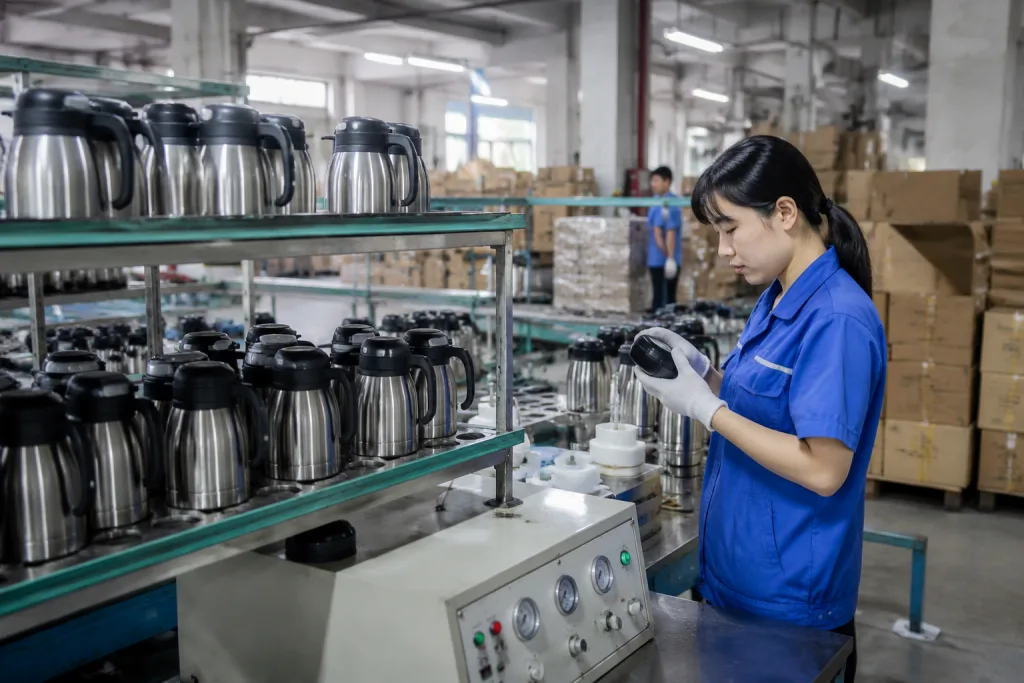
That is why the smart way to source a custom thermos is to walk one order from brief to shipment. At BottleForge in Zhejiang, our stainless line runs about 300,000 units per month, with a standard MOQ of 500 pieces for stock-shaped items and 1,000 pieces for full customization. Lead time is usually 20 to 35 days after sample approval. Those numbers matter more than marketing claims when you are comparing thermos manufacturers, thermos suppliers, or a thermos factory in China. QC pulled a 304 stainless sample at 18 days once and found the coating was 0.2 mm thin at the shoulder; the buyer flagged it, and we fixed it before bulk run.
Start With the Use Case
I’ll rewrite the section in place, keep the HTML exactly as-is, and tune the copy to sound like a factory-side sales engineer.Before you talk to a stainless thermos manufacturer, pin down the buyer reality. A promo thermos for a 3-day trade show is not the same thing as a retail thermos on an outdoor shelf. If you are a brand owner, you care about print edge, box feel, and whether the sample opens clean on the line. If you are a distributor, price band, repeat order consistency, and carton loading matter more. If you are ordering thermos bulk for a campaign, shipping date and defect rate beat fancy packaging every time.
For a real order, we can use a 500 ml stainless steel vacuum flask with a powder-coated body, screw lid, and one-color logo. That spec sits in a sane middle ground for outdoor retailers and promo buyers. It is easy to brief to a supplier thermos team in China or Zhejiang without hand-waving. Tell them the target market, drink temperature target, shelf price, and whether the bottle must fit a 75 mm cup holder or a bike cage. The buyer flagged that detail on one PO, and the math changed fast.
Good buyers send a spec pack with five items: capacity, material grade, finish, logo method, and packaging. We saw quote spread drop by 30-40% when those five were clear, because the QC team did not have to guess lid style or coating thickness. Leave out the lid type or surface finish, and you get apples-to-oranges quotes from thermos suppliers. That is the wrong question to ask if you want a clean factory price.
What the First Quote Really Means
I’ll keep the HTML structure intact and rewrite the prose so it reads like a factory-side sales engineer, with concrete quote details and fewer generic phrases.When a thermos manufacturer sends a quote, read it as a production assumption sheet, not a promise carved in stone. A normal FOB Ningbo or FOB Shanghai quote for a 500 ml stainless thermos sits around USD 2.80 to 5.20 per piece at 1,000 units, depending on 18/8 inner and outer steel, single-wall or double-wall construction, and print setup. We’ve seen a buyer flag a PO because the quote used “matte spray” but the line was set for powder coat. Add USD 0.15 to 0.40 for a better retail carton, and another USD 0.10 to 0.30 for laser logo or 2-color silk screen.
Break the quote into tooling, sample fee, unit price, and packaging. If a thermos supplier says the sample is “free,” ask whether freight is included and whether they deduct it from the order; the math changes fast once DHL lands at the door. A serious thermos factory in China will state MOQ by SKU, not just by color. For example: 500 pcs for a stock shape, 1,000 pcs for a customized thermos with a new lid insert, and 3,000 pcs if you want a branded gift box.
Watch for hidden variables:
- Body steel thickness: 0.35 mm, 0.4 mm, or 0.5 mm changes weight and price.
- Lid material: PP, Tritan, or stainless cap affects cost and temperature retention.
- Surface finish: powder coat, spray paint, or UV print changes reject risk.
- Packing standard: 1 pc/white box versus 1 pc/color box can swing labor cost.
Ask the thermos vendor to quote the same spec with and without logo so you can see where the real money goes. That is the cleanest way to compare manufacturers thermos proposals, and we run that split all the time on the line before QC pulls the sample.
Sampling Before You Commit
I’ll rewrite the section in-place, keeping the HTML structure and tightening the copy to sound like a factory-side sales engineer. I’ll preserve the heading and tags, and make the sample advice more concrete with shop-floor details.For a custom thermos, the sample stage is where bad calls stay cheap. Pay for a pre-production sample if the design is new, especially when you need a custom body shape, a special lid gasket, or a Pantone match that has to hold within ΔE 2.0. One sample round usually takes 7 to 12 days for a stock tooling item and 15 to 25 days if we need a new insert or a fresh mold cut. That is normal for a stainless thermos manufacturer in Zhejiang or anywhere else in China.
Do not approve a sample just because the logo prints clean. Check the thread engagement, lid seal, vent hole, coating evenness, and whether the cap starts by hand without cross-threading. We run a fill test with 95°C water, wait 30 minutes, then QC pulls the sample to look for leaks and hot spots around the neck and base. If the spec claims strong thermal retention, ask for the numbers: a solid thermos maker can usually show 6 hours above 68°C and 12 hours above 55°C on a 500 ml bottle, depending on wall structure and lid design.
For promotional thermos programs, buyers sometimes skip sample review and pay for it later in defects. That math does not work. A sample fee of USD 30-80 is small next to a rework on 5,000 units. If you are a distributor thermos buyer, lock the carton size at the sample stage too. We have seen a PO typo on outer carton dimensions add freight cost fast, and a 2 cm change can blow up pallet loading.
Do not approve a sample on appearance alone. A bottle that looks premium but leaks at the gasket is a failed product, not a good one.
QC Points That Catch Real Problems
I’ll keep the tags intact and rewrite the prose to sound like a factory-side QC note, with concrete shop-floor details and less generic phrasing.A stainless thermos manufacturer should hand over a QC plan before mass production starts. If they cannot, you are buying blind. We check five points on our line: incoming material, vacuum sealing, assembly fit, logo adhesion, and final packing. For export orders, get the AQL terms in writing. AQL 2.5 for major defects and AQL 4.0 for minor defects is a normal starting point for thermos bulk production.
Incoming steel has to match the declared grade, usually 304 inner and outer for premium retail, or 201 outer with 304 inner for cost-sensitive programs. Ask for material certificates, not a sales promise. On the floor, we watch neck roundness, seam consistency, and coating cure. If a powder-coated customized thermos still feels tacky after the cure oven, that batch goes back to QC, no debate.
Final inspection should cover a random leak test, drop test, and lid cycle test. We usually run 3 drops from 1 meter onto a hard surface, then 50 to 100 open-close cycles on the lid. For North America and Europe, ask for food-contact and chemical compliance files too. REACH matters for the EU, and if the buyer wants it, ASTM or LFGB-aligned testing helps settle the risk before shipment. BSCI or a similar social audit is useful when retail chains start asking for supplier qualification.
The point is plain: you do not need lab theater. You need a repeatable factory thermos process that catches the defects customers actually see — leaks, scratches, weak print, and poor heat retention.
Packaging, Labels, and Freight
I’ll rewrite this section in-place, keep the HTML tags intact, and tune the wording to sound like a factory-side sales engineer.Packaging is part of the product, especially if you are selling a thermos for retail shelves or a premium gift set. For a 500 ml bottle, we usually run one inner box per piece, 50 pcs per carton, and keep carton weight under 12 to 15 kg so the line and the warehouse team can move it without drama. If you are shipping to Amazon, we also need FNSKU labels, suffocation warnings, and carton marks that match the PO line by line. A solid thermos supplier should handle that before the goods leave QC, not turn every sticker into a separate job.
Ask for the packed carton size before you approve the order. A carton that drops 20 mm on one side can cut freight by 5-12% if the pallet pattern stacks better. On one 40HQ shipment, that change saved the buyer about $400, and the math does not work if you ignore it. The same rule applies when you run distributor programs across 6 or 8 SKUs: unit price is only one piece of landed cost.
For export, FOB terms are usually the cleanest start. We load the goods, you or your forwarder control the ocean leg. If your buyer is in Europe or North America, check the box print for country of origin, capacity, and care instructions before we start the 4-color carton run. Better to print it once at the thermos factory than relabel 500 cartons in your warehouse later.
What Happens After PO Approval
I’ll rewrite the section in place, keep the HTML tags unchanged, and tighten the prose so it sounds like a factory-side sales engineer.Once the PO is approved, the line starts moving. We confirm the artwork, freeze the sample, buy the 18/8 steel, and issue the production schedule. For a 1,000 to 5,000 piece order, 20 to 35 days from deposit to shipment is the normal run if there is no new mold. If you need a new lid or bottle shape, add 15 to 30 days. That is the timeline we ship from Hangzhou, and the math does not work any other way.
During production, ask for three checkpoints: pre-production confirmation, in-line photo updates, and final inspection photos. QC pulled the sample with a caliper on our side of the line; that is the level of proof you want. You do not need daily chatter. You need evidence the order still matches the approved sample. If the artwork shifts, the cap color changes, or the carton count lands off by 2-3%, stop it before packing. We’ve seen that go sideways fast, and this is the wrong time to be polite.
For repeat orders, track your own numbers: defect rate, on-time shipment rate, and claim ratio. If a factory stays under 1% returns and ships on schedule for three cycles, that is a partner worth growing with. If the buyer flags the same issue twice, the factory has not earned the next PO yet. Keep the spreadsheet. It tells the truth.
Send your thermos spec and get a real quote
We will price your custom thermos, confirm MOQ, and map QC before production starts in Zhejiang.
Frequently asked questions
What MOQ should I expect from a stainless thermos manufacturer?
For stock shapes, a realistic MOQ is 500 pcs. For a fully customized thermos with a new lid, new color, or special box, expect 1,000 pcs or more. Some thermos suppliers will quote 300 pcs, but the unit price is usually poor and the color consistency risk goes up. At BottleForge in Zhejiang, our monthly capacity is about 300,000 units, so we can support small test runs and larger thermos bulk programs, but the MOQ still depends on the SKU structure.
How much does a custom thermos cost FOB China?
A standard 500 ml stainless thermos often starts around USD 2.80 to 5.20 FOB China at 1,000 pcs, depending on steel grade, lid type, finish, and logo process. Laser engraving is usually cheaper than multi-color print for setup, but not always on unit labor. A promotional thermos with simple branding can sit at the lower end; a retail custom thermos with premium box and coating moves higher. Ask for separate quotes for blank, printed, and packed versions.
How do I check insulation performance before shipment?
Ask the thermos factory for sample test data and confirm the test method. A common benchmark for a 500 ml bottle is 6 hours above 68°C and 12 hours above 55°C, though actual results depend on lid design and ambient conditions. For cold retention, many buyers ask for 24 hours below 10°C in controlled testing. For export orders, also request leak testing, lid cycle testing, and a small pre-shipment random sample under AQL 2.5.
Which compliance documents matter for Europe and North America?
For Europe, REACH and food-contact declarations are the starting point, and some retail programs also ask for LFGB-style testing. For North America, buyers often request FDA-related food-contact declarations and supplier social compliance such as BSCI if they are working with larger retail chains. Keep the paperwork tied to the exact customized thermos SKU, not a generic catalog sheet. A thermos supplier should be able to provide those documents without delay.
What is the best way to handle logo and artwork approval?
Approve a digital proof first, then a physical sample if the logo sits near a curve, seam, or lid edge. For a thermos customized with one-color print, check placement tolerance within 1-2 mm and make sure the ink or laser mark survives handling. If you are doing a distributor thermos program across several markets, lock the Pantone code and font size in the PO. That prevents the classic problem of every reorder looking slightly different.