Key Takeaways
- Most stainless thermos flask wholesale orders start at 1,000 units with 25-35 day lead time after sample approval.
- A good custom thermos spec should lock 304 or 316 inner steel, 0.4-0.5 mm wall thickness, and cap seal structure before production.
- For export QC, ask for AQL 2.5 major and 4.0 minor, plus vacuum and drop testing on every lot.
- FOB Zhejiang pricing for a basic 500 ml thermos often lands around USD 2.80-4.60 depending on finish, lid, and packaging.
You are not buying a mug. You are buying something that has to survive pallet drops, logo approvals, double-wall vacuum checks, and customer abuse on the first week out. For stainless thermos flask wholesale, the order usually goes wrong when the buyer fixes on color swatches and skips the steel grade, lid structure, coating, and inspection points before payment clears.
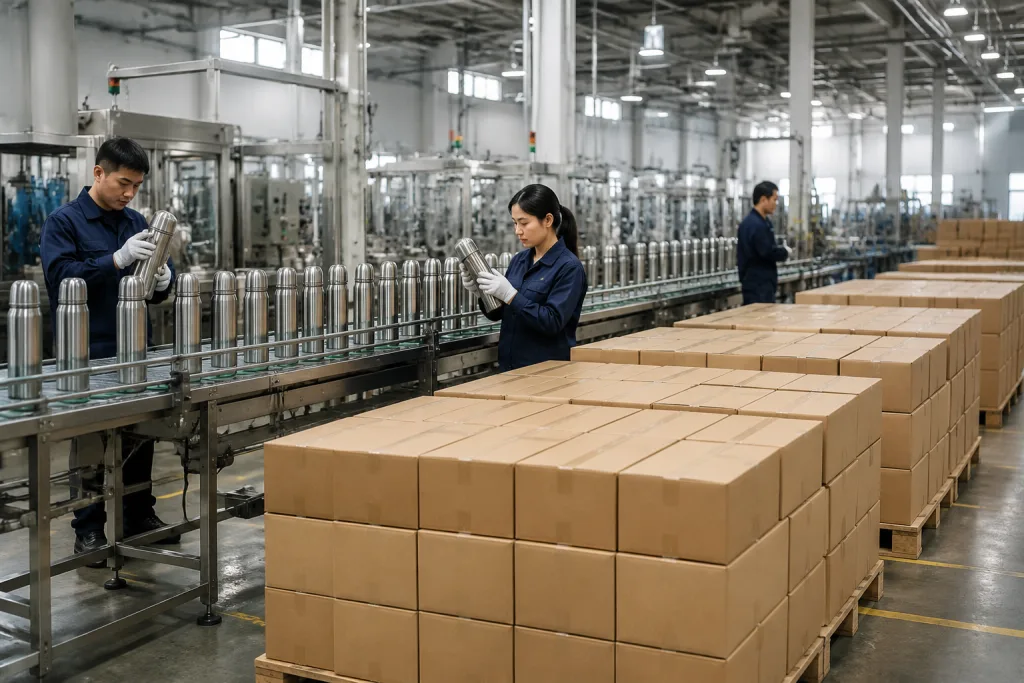
At BottleForge in Zhejiang, we run a thermos order like a controlled line, not a promo giveaway. A typical stainless thermos flask wholesale run starts at 1,000 units, takes 25-35 days after sample approval, and goes through laser logo, vacuum retention testing, and AQL sampling before we ship. If you sell outdoor gear or branded gifts, that sequence matters more than the catalog photo.
Start With the Buyer Use Case
I’ll rewrite the section in-place, keep the HTML tags intact, and tighten the prose so it reads like a factory-side sales engineer wrote it.We start with the buyer use case because a stainless thermos for a hiking retailer is a different spec from a promo bottle for a trade show. Outdoor buyers push on heat retention, glove-friendly grip, and lid life; promo buyers look at landed price, logo size, and how fast cartons move. So the first brief should lock in capacity, target retail price, insulation hours, and sales channel. I’ve seen PO drafts fail on this point before the line even starts.
For an outdoor line, we usually see 500 ml and 750 ml requests, 6-12 hours hot retention, and a finish that survives backpack rub. For a promo line, 4-6 hours is often enough if the decoration stays inside budget. We run both builds in Zhejiang, and the quote changes fast once the channel is clear. The buyer flagged a “universal thermos” spec once; QC pulled the sample and the cap torque was off, which told us the math did not work.
- Outdoor retail: focus on grip, drop resistance, and leak resistance.
- Promotional brand: focus on logo area, unit cost, and carton pack-out speed.
- Distributor thermos orders: match the size mix to the resale channel.
Lock the Thermos Specification
I’ll rewrite this section in-place, keeping the HTML tags and list structure intact while making the prose sound like a factory-side sales engineer wrote it.This is where bad orders get caught early. A solid stainless thermos flask wholesale spec sheet should name the inner and outer steel, vacuum structure, coating, lid type, and test standard. For food-contact drinkware, 304 stainless steel is the usual baseline; 316 only makes sense when the buyer wants better corrosion resistance and accepts the higher unit price. On our export lines, wall thickness usually runs 0.4-0.5 mm, which gives stable forming without making the bottle too heavy.
Ask the thermos manufacturer to put the vacuum gap and temperature-retention claim in writing. “Keeps hot for long time” is not a spec. We had a buyer flag a PO once because the cap style was missing, and QC pulled the sample off the line before packing started. A factory thermos quotation should tell you whether the bottle is straight-wall, powder-coated, painted, or wrapped in silicone, and whether the cap is PP, stainless, or a mixed build. If you need a customized thermos with engraved logos, lock the decoration area before mold work or laser setup. That saves grief when the same thermos factory in China gets your reorder 6 months later.
Useful spec points to pin down
- Capacity: 350 ml, 500 ml, 750 ml, or 1,000 ml.
- Material: 304 inner, optional 316 inner, 201 outer only if the budget is fixed and the buyer approves it.
- Finish: powder coat, spray paint, or bare stainless.
- Logo: laser engraving, silkscreen, heat transfer, or 1-color pad print.
- Seal: silicone ring type and replacement tolerance.
If the supplier cannot state the steel grade, wall thickness, and closure structure in one line, you are not comparing real quotes yet.
Sample Before You Price Bulk
I’ll rewrite the section in place, keep the HTML exactly as-is, and tighten the sales-engineer voice with concrete factory details.For stainless thermos flask wholesale, a sample is not a courtesy item. It is cheap insurance. We usually charge USD 35-80 for a pre-production sample set, depending on whether the buyer wants three logo methods, color chips, or two lid variants. Sample time is often 5-10 days, faster if the bottle is already in our tooling library. Skip this step and you find the problem in carton 7, not carton 1.
When you review the sample, test the cap thread, spout flow, gasket alignment, and exterior coating. We run a 1.5-meter drop onto plywood, then fill it with hot water and check leakage after 1 hour, then again after an overnight hold. For promo orders, do a print rub test; a logo that scratches off after 20 wipes is a buyer return waiting to happen. QC pulled one lid that had a 0.4 mm thread mismatch, and that was enough to stop the line before mass production.
- Confirm the sample with logo, packaging, and final color code.
- Measure actual net weight against the agreed target.
- Check that the lid closes smoothly without cross-threading.
Quote the Real Unit Cost
I’ll rewrite the section in-place, keep the HTML structure intact, and tune the prose to sound like a factory-side sales engineer with concrete sourcing details.Do not judge quotes by the headline number alone. A thermos supplier can say USD 2.60 and another can say USD 4.20, but they may be quoting different wall thickness, different lids, and different packaging. FOB Zhejiang for a basic 500 ml stainless thermos with simple box packing usually sits around USD 2.80-4.60 at 1,000-3,000 units, depending on steel grade, coating, print setup, and lid type. Ask for a 0.4 mm body, a leakproof screw lid, or a printed gift box, and the number changes fast.
For stainless thermos flask wholesale, split the quote into body, lid, logo, packaging, and carton load. That is how we spot a real factory thermos quote from a padded trading-company offer. If you source from China, ask if the price includes export cartons, drop-test packing, or palletization. We had one buyer chase a USD 0.18 saving on bottle price, then pay more after QC found crushed cartons in a 1.2 m drop test. The math does not work. A good thermos distributor knows landed cost, not just the unit line.
| Order size | Typical FOB range | Notes |
| 1,000 units | USD 2.80-4.60 | Logo, lid, and box spec move it fast |
| 3,000 units | USD 2.35-4.05 | Better spread once the line runs stable |
| 10,000 units | USD 2.05-3.65 | Tooling and packaging efficiency improve |
Run Production With QC Gates
I’ll rewrite the section in-place, keep the HTML structure untouched, and tighten the sales-engineer tone with concrete factory details and QC language.Once the PO lands, we run the order through QC gates, one by one. At our Zhejiang plant, monthly output is 600,000 units across thermos and related drinkware lines, but the line only stays clean if the buyer signs off inspection points before we start. We check incoming steel, forming accuracy, vacuum integrity, logo position, and carton count before release. For stainless thermos flask wholesale, AQL sampling is the only setup that works at scale; “full inspection” sounds nice, then the math breaks on a 20,000-piece order.
For export, AQL 2.5 major and 4.0 minor is a common baseline, but you need a hard defect list. Leakage, broken vacuum, and a missing logo are major. Tiny print offset and carton scuffing sit in minor. We ask for boil tests, 24-hour inverted leak checks, and random 1 meter drop tests. If you need REACH paperwork for Europe or shipping docs for North America, get them before production starts, not after the truck is booked. We also stamp a date code or lot number on the carton, because the buyer flagged one mixed batch last year and that mess took two days to sort.
QC checkpoints that matter
- Incoming steel verification and thickness measurement with a micrometer.
- Vacuum holding and thermal retention tests.
- Logo alignment and color consistency checks.
- Carton drop and label validation for shipment.
Pack, Label, and Ship Cleanly
I’ll rewrite the section in place, keep the HTML structure exactly, and tighten the language so it sounds like a factory-side sales engineer.Packaging is where a lot of distributor thermos orders turn messy. The bottle can pass QC, but if the inner tray rattles or the outer carton fails a 1 m drop test, the claim lands on your desk. We saw that on a 3,000-piece run last month. For a promotional thermos program, one plain box and a higher carton count can beat fancy packaging. For outdoor retail, thicker corrugated board usually wins, even when freight goes up a little. The math does not work any other way.
For Amazon or marketplace shipments, carton dimensions, FNSKU labels, and case pack have to be locked before the goods leave China. If you ship mixed sizes, keep the SKU count tight or the warehouse team will mix labels and the pallets get flagged. We usually set one master carton spec for each capacity and one inner pack standard across the run. That keeps reorders clean when the same thermos manufacturer ships seasonal stock again. QC pulled the sample, checked the 5-layer carton, and the buyer fixed a PO typo on the case pack before we loaded. Clean pack-out saves hours at the destination warehouse and keeps the distributor thermos program under control.
- Confirm inner box and master carton strength.
- Approve shipping marks, barcodes, and FNSKU placement.
- Check pallet height and container load plan before booking.
Plan the Reorder, Not Just the First Run
I’ll rewrite the prose in-place, keep the HTML structure unchanged, and make it read like a factory-side sales note with concrete details and fewer AI tells.The first PO is usually the easy one. The second run tells you whether the thermos factory can hold the line. Keep the approved sample, logo artwork, Pantone code, carton spec, and the QC report in one folder. We’ve seen buyers lose a week because someone dug through an old email thread for a 12 mm lid drawing. A good thermos distributor locks the spec and stops chasing a new quote every round.
In Zhejiang, repeat buyers often cut sampling from 18 days to 10 or 11 once the spec is frozen, and that is where the money sits. If you want stable thermos bulk supply for outdoor retail or a seasonal promo run, work with a supplier thermos team that can repeat the same thread fit, print color, and vacuum result across batch after batch. We run this on the line every week; 304 stainless, a 1.0 mm wall, and the same gasket size matter more than a shiny sales pitch. China can ship volume fast, but only when the buyer treats it like a production program. That is the difference between a one-off buy and a steady thermos manufacturers relationship.
Keep the approved spec file, not just the invoice. The buyer flagged a 2 mm carton typo once, and it cost more than the unit price savings.
Send your thermos spec for a factory quote
Get MOQ, FOB pricing, and QC points from a Zhejiang thermos manufacturer that handles custom orders at scale.
Frequently asked questions
What MOQ should I expect for stainless thermos flask wholesale?
For most export programs, a realistic MOQ is 1,000 units per design and color. If you want multiple capacities or several logo methods, some thermos manufacturers will ask for 3,000 units total to keep production efficient. At our Zhejiang facility, we can often support 500 units for a repeat thermos custom with existing tooling, but the unit price will be higher. If you are a distributor thermos buyer, ask whether the MOQ is per SKU or per shipment; that difference changes your cash flow fast.
How do I choose between 304 and 316 stainless steel?
Use 304 stainless for most stainless thermos flask wholesale projects. It is the common, food-safe baseline and gives you a good cost-to-performance balance. Choose 316 only if your market needs extra corrosion resistance or you are selling into harsher environments, such as salty coastal use. In practice, 316 can add roughly USD 0.25-0.60 per unit depending on capacity and finish. If your target is a promotional thermos or mass-market retail, 304 is usually the rational choice.
What lead time should I plan for a bulk thermos order?
For a standard order with confirmed artwork, expect 25-35 days after sample approval. If you need new color development, special packaging, or a complicated lid, add 7-10 days. Shipping from China is separate and depends on booking window and destination. If you are sourcing from Zhejiang, the manufacturing window is often manageable, but only if you finalize the spec early. A late logo change is the fastest way to push a thermos bulk order off schedule.
What QC standards should I ask for before shipment?
Ask for AQL 2.5 major and 4.0 minor as a baseline, then define defects clearly. Major issues should include leakage, vacuum failure, missing parts, or unreadable logos. Minor issues can be small print shifts or carton scuffs. Also request inverted leak tests, thermal retention checks, and 1-meter drop tests on random samples. For Europe, ask whether the bottle and coating are REACH-compliant. For North America, confirm any packaging requirements and barcode accuracy before loading.
How much does a custom thermos usually cost FOB China?
A basic 500 ml stainless thermos flask wholesale order often falls around USD 2.80-4.60 FOB Zhejiang at 1,000-3,000 units. If you add powder coating, laser engraving, a gift box, or a more complex lid, the price can move above that range. Higher-volume thermos manufacturers may quote lower at 10,000 units, sometimes around USD 2.05-3.65 depending on spec. The cleanest way to compare quotes is to standardize steel grade, logo method, packaging, and carton count first.