Key Takeaways
- Vacuum failure is usually caught with 95°C water testing for 6-12 hours, not by visual inspection
- For a custom thermos, lock the lid gasket material and torque before approving pre-production samples
- Typical MOQ for customized thermos colors is 1,000-3,000 units per SKU depending on finish
- AQL 2.5/4.0 inspection should include leak, coating adhesion, logo, carton, and barcode checks
You do not lose money on a custom thermos because stainless steel is hard to understand. You lose money because one production assumption stayed off the PO: lid torque at 0.8–1.2 N·m, 6-hour vacuum test hold, 70–90 μm powder-coat thickness, ISTA 1A carton drop, or which AI logo file is the master. We have seen this go sideways over a file named “final_final_2.ai.”
As a stainless thermos flask manufacturer in Hangzhou, Zhejiang, we see outdoor retailers and promotional brands repeat the same 4 mistakes on bulk thermos orders. The spreadsheet looks clean. Then QC pulled the sample and found a 0.6 mm lid gap, the buyer flagged leaking cartons, or the launch moved from 12 days to 18 days because the color chip was never signed. More trust is the wrong fix. We run better when the spec is tighter, samples come earlier, and QC catches failure before 20,000 units are packed in China.
Vacuum Failure Hides Until Retail
The costliest failure in a stainless thermos is weak insulation, because it can pass final inspection looking clean. Body finish? Fine. Powder coating? Even. Logo position? Inside the ±1 mm mark on the jig. Then the buyer’s customer fills it at 7 a.m., opens it at 12:30, and the coffee is already lukewarm. We’ve seen this go sideways: the line ships, retail complaints land 18 days later, and suddenly a manufacturer thermos issue sits on your brand desk.
For double-wall 304 stainless steel, the vacuum gap has to stay stable after welding, evacuation, and sealing. A common spec is inner 304 stainless steel at 0.4-0.5 mm and outer 201 or 304 stainless steel at 0.45-0.6 mm, depending on price point. Thinner walls cut 18-35 g from a 500 ml body and trim FOB cost, but the math does not work if cartons arrive with side dents. QC pulled one 0.38 mm sample last season after the bottom swelled 1.6 mm during drop testing.
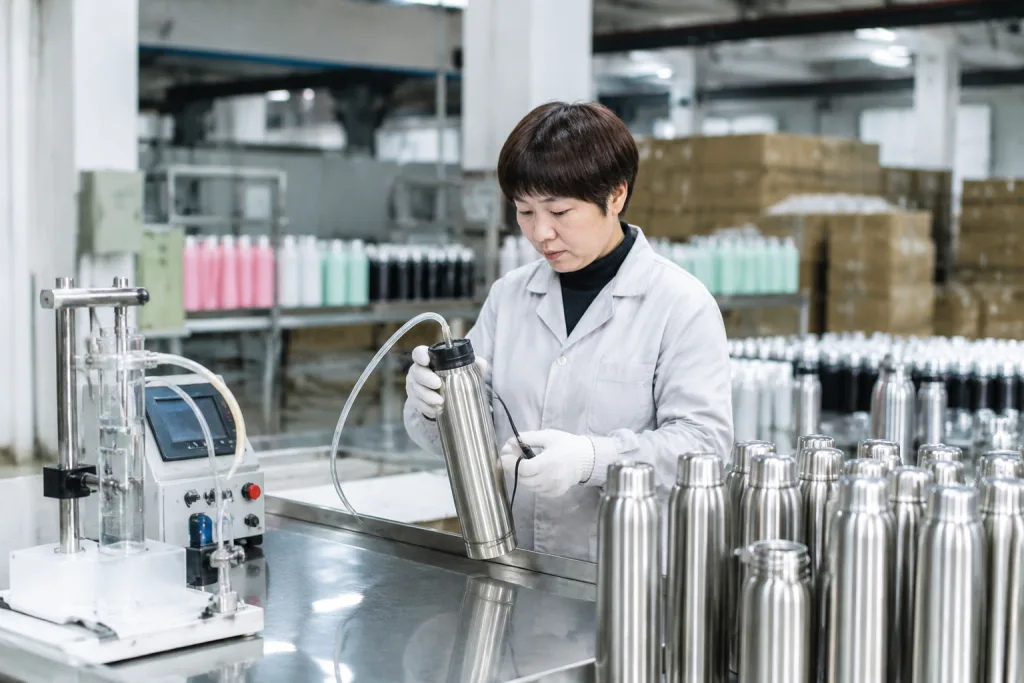
Do not accept a supplier thermos quote that says only “keeps hot 12 hours.” That is the wrong question to ask. Ask how the thermos factory tests it, what thermometer they use, and whether the lid is from mass production or a sales-sample mold. At BottleForge in Zhejiang, we run 95°C water, close the lid, and check temperature drop after 6 hours or 12 hours depending on the model. For a 500 ml flask, a practical 6-hour target is usually above 65°C, but shape, lid design, and mouth diameter matter; a 58 mm wide-mouth bottle loses heat faster than a 42 mm narrow-mouth one.
- Write the test method: list 95°C water, 20-25°C room temperature, 98% fill level, lid torque, and 6-hour or 12-hour duration.
- Test production samples: pull 3-5 pcs from the line after welding and coating, not only hand-made sales samples from the sample room.
- Keep retained samples: seal one sample from each approved run with PO number, date code, and carton mark; one buyer once flagged a PO typo that mixed 500 ml and 530 ml lids.
If you are buying thermos bulk for outdoor retail, insulation is not a marketing line. It is a production result you measure, record, and reject when the data misses spec.
Leaking Lids Start With Assumptions
I’ll rewrite the prose only, keep the HTML tags intact, and tighten the language so it sounds like a factory-side sales engineer.Lid leakage usually comes from a stack of small misses: gasket hardness, thread depth, lid torque, straw insert tolerance, vent hole position, or the wrong silicone grade after sample approval. A promo thermos used at a conference can pass light duty. A hiking buyer’s customized thermos gets tossed sideways in a pack. Spec for that use case, not the easy one.
For most stainless flasks, we run food-grade silicone gaskets around 50-60 Shore A. Too soft, and the seal deforms after heat cycles. Too hard, and the lid feels tight but never compresses cleanly. For screw lids, set a real torque check: hand-tighten to 0.8-1.2 N·m, then invert for 30 minutes after filling with 80°C water. On the line, QC pulled the sample and found the seal still wept at the thread start, so we added a 30-second shake test for flip lids and straw lids, bottle full, horizontal and upside down.
This is where a thermos manufacturer should push back a bit. If you ask for a wide-mouth 750 ml bottle with a one-touch lid, carry handle, and low price, the math does not work cleanly. More moving parts mean more tolerance stack-up. More colors mean tighter gasket and lid matching control.
For thermos custom projects, lock the lid BOM before mass production. That means gasket material, color, hardness, lid plastic type, spring material if used, and spare part policy. If your distributor thermos program needs replacement lids, order 2-3% extra lids with the first shipment. We’ve seen this go sideways when the PO typo said 300 lids and the buyer meant 3,000; air-shipping the missing parts costs more than the margin.
Coating Chips Are Specification Errors
I’ll rewrite just the prose inside the existing HTML, keep all tags intact, and make the wording sound like a factory-side sales engineer wrote it.Powder coating defects are easy to pin on the thermos line, but the real problem usually starts with a loose finish request. “Matte black” is not a spec. It can point to a 5 GU finish, a 15 GU finish, different powder brands, or different pretreatment. For outdoor retailers, the coating has to survive bike cages, car cup holders, gravel, and zipper rub. For promo buyers, one scratch is enough to make a gift look like a giveaway item.
A usable custom thermos coating spec needs a color reference, gloss range, coating thickness, adhesion test, and abrasion target. We usually see powder at 60-90 microns. Go thinner, and the edges show weak coverage. Go thicker, and threads, lid fit, or laser engraving can go off. For adhesion, ask for a cross-cut tape test like ISO 2409. For impact, request sample drops from 1.0 m on the base and side, then set a clear chip limit before the PO lands.
Do not sign off color from a phone photo. For thermos customizable finishes, use a physical color chip, a Pantone reference where it fits, and one signed pre-production sample. If you have 6 SKUs, approve each one separately. White, cream, and fluorescent finishes need tighter control than dark shades, because dust, tint drift, and uneven spray show up fast. QC pulled a white sample once and the buyer flagged a 0.3 mm speck on the shoulder—small, but it stops a shipment.
Cheap coating is not cheap if your warehouse has to sort 8,000 bottles before shipping to retail.
Our Hangzhou, Zhejiang line can run about 450,000 stainless drinkware units per month, but the line only moves fast after the finish spec is fixed. We ship clean when the coating is written right; vague specs slow everything down. The math does not work any other way.
Logo Defects Come From Late Artwork
I’ll keep the HTML exactly as-is and rewrite only the prose so it sounds like a factory-side sales engineer wrote it. Then I’ll do one quick pass for the banned filler phrases and keep the section tight.Logo trouble is the usual promotional thermos headache. The mug is fine, the carton leaves on time, then the buyer flags a mark that sits 3 mm too low, a laser mark that turns brown, or a screen print that rubs off during carton vibration. We saw that on a 5,000-piece run last month. The root cause was not effort. The artwork came in late and nobody locked the proof.
For stainless thermos decoration, we run laser engraving, silk screen printing, heat transfer, UV printing, and, on some lids or sleeves, embossing. Laser engraving gives a clean wear mark, but the final color depends on the coating and the stainless under it. Silk screen works well for one- or two-color logos, but ink adhesion and curing need a proper test on the line. UV printing handles gradients better, though it gets touchy on curved bodies and rough powder coat; QC pulled one sample at 180°C curing because the edge lift was there.
For every thermos customized order, send vector artwork in AI, EPS, or PDF. State the logo size in millimeters, the distance from the base or lid shoulder, the Pantone code, and the allowed tolerance. On cylindrical bottles, ±1.5 mm is a practical position tolerance; tighter only if the fixture can hold it. Ask for a decoration proof and one physical pre-production sample before the full run. A PO typo on one order turned “centered” into “center,” and that cost two days.
If you are a thermos distributor handling several client logos, do not let sales approve screenshots. Make one artwork approval sheet per SKU. Put the model number, finish, logo method, logo dimensions, barcode, carton mark, and final ship-to country on the same page. That sheet saves more disputes than a 30-email thread. The math does not work any other way.
Compliance Gaps Delay The Shipment
I’ll rewrite the section in-place, keep the HTML tags untouched, and tighten the language so it sounds like a factory-side sales engineer.Compliance failures are dull until they stop a container. We’ve seen buyers in Europe and North America ask for the paperwork before the booking, not after the truck leaves the gate. Promo brands also push for customer-specific tests on food contact, restricted substances, and social compliance.
For stainless steel thermos orders, the right checks depend on the market. Europe usually means LFGB or EU food contact rules; the United States usually means FDA food contact expectations; REACH covers coatings, inks, and plastic parts. If the bottle is for kids, ASTM or CPSIA-related requirements may apply based on age grading. Large chains may ask for a BSCI audit or a similar social report. ISO 9001 shows process control, but it does not replace product testing. QC pulled a lid sample once and the PP insert was 0.4 mm off spec.
The real problem is timing. Buyers often request test reports after mass production, then find the coating color, gasket material, or lid plastic does not match the sample that was tested. The report then loses value. We’ve seen this go sideways on a PO that had “matte grey” typed as “matt grey” and the buyer flagged it. Lock the final materials first, test the approved pre-production sample, then freeze any change unless you approve it in writing.
For a manufacturer thermos order, ask your thermos vendor four things early: which parts touch liquid, which materials go into each part, which lab will test them, and how many days the reports need. Normal third-party testing takes 5-10 working days, and retesting can push it past 12 days. Build that into the launch calendar. A lower FOB price does not help if the cartons sit because the docs are still in process.
Cartons Fail After QC Passes
I’ll rewrite the prose in place, keep every HTML tag, and make the section sound like an export sales engineer wrote it.A bottle can pass factory inspection and still land damaged if the export carton is treated like an afterthought. We see this on 500-750 ml thermos bulk orders for distributors, Amazon-style fulfillment, and mixed SKU retail shipments. The flask is tough; powder coating, lids, and spray-printed logos are the weak spots when the line gets vibration, compression, and corner drops.
For a 500-750 ml stainless flask, the usual pack is one polybag or tissue wrap, one white box or kraft box, then 24 units per master carton. For heavier units, 5-ply corrugated beats 3-ply every time. If the bottle has a handle lid, straw lid, or gift box, we add inner padding so the lid does not rub the body in transit. We run that check with a simple rub test on the packing table, and the buyer flagged it fast when a lid scuffed the finish at 18 kg carton weight.
Set carton drop testing before production starts. A practical spec is 1 corner, 3 edges, and 6 faces from 76 cm for cartons under 10 kg, then adjust for carton weight and buyer requirements. After the drop, check dents, lid cracks, coating rub, box deformation, and barcode readability. For thermos promotional orders going to events, carton marks matter too: PO number, SKU, color, quantity, gross weight, net weight, and country of origin. We’ve seen a PO typo on carton marks turn into a warehouse hold; the math does not work when the label says 240 pcs and the carton count is 24 x 12.
If your channel uses FNSKU labels, retail barcodes, or pallet labels, send the label files before final inspection. Don’t ask the factory to “add labels later” unless the label position, size, and scan standard are written down. AQL inspection should include barcode scanning, not just a visual pass. QC pulled the sample on one carton, and the scan failed because the label sat 8 mm off center. Good thermos suppliers treat packaging as part of the product, because your buyer will.
Pricing Fails When Specs Move
I’ll rewrite the prose only, keep the HTML exactly as-is, and tune the voice toward a real factory sales engineer. Next I’m checking the section for any phrases that need a harder, more specific commercial tone.Most custom stainless thermos pricing fights start the same way: the buyer asks for FOB before the product spec is fixed. A 500 ml flask can land at USD 3.20 or USD 5.80 FOB Ningbo/Shanghai, depending on 304 stainless or 201, wall thickness, lid build, coating, logo method, packing, test requests, and order qty. Both numbers can be true. Only one matches the brief.
For a standard bulk thermos on an existing mold, MOQ usually starts at 500-1,000 units per color. For a custom thermos with private color, logo, and box, 1,000-3,000 units per SKU is the number we run with on the line. New mold work changes the math fast; tooling comes in, and development stretches. Our usual sample lead time in Zhejiang is 7-12 days for logo samples and 25-35 days for mass production after deposit and sample approval, and QC pulled one carton at 1.2 kg last week because the lid insert was 0.3 mm off the drawing.
To compare thermos manufacturers the right way, use one quote sheet for every thermos supplier: capacity, dimensions, steel grade, lid structure, finish, logo, packaging, compliance reports, inspection level, Incoterm, and payment terms. If one quote is 12% lower, ask what got cut. We’ve seen the answer turn out to be coating thickness, carton crush strength, gasket grade, or inspection support, and that is the wrong place to save a few cents.
For outdoor retailers and promotional brands, the clean buying rule is simple: approve the final sample, lock the spec, then send the PO. Changes after deposit can happen, but they cost days and sometimes money. A buyer once flagged a PO typo on “vacuum mug” and we still caught the mismatch before production; that is the kind of check that saves a shipment. A good stainless thermos flask manufacturer says no to a risky shortcut before the line starts, not after the cartons are sealed.
Send Your Thermos Spec For Factory Review
Share capacity, lid type, finish, logo, MOQ, and target market. We will flag production risks before you place the PO.
Frequently asked questions
What MOQ should I expect from a stainless thermos flask manufacturer?
For an existing stainless thermos model with one logo, a realistic MOQ is usually 500-1,000 units per design. If you need a custom powder-coated color, private gift box, or multiple lid colors, expect 1,000-3,000 units per SKU. New mold development is different; tooling may require 5,000-10,000 units to make commercial sense. Zhejiang factories can sometimes accept lower trial orders, but the unit price rises because setup, printing fixtures, and QC time are spread across fewer units. For promotional thermos projects, we usually suggest starting with a stock body and custom branding before investing in private tooling.
How long does a custom thermos order take from China?
A normal timeline is 7-12 days for logo samples, 3-5 days for sample approval and revisions, then 25-35 days for mass production after deposit. Add 5-10 working days if you need third-party LFGB, FDA, REACH, or client-specific testing. Sea freight to North America or Europe can add 25-45 days depending on port and season. If you need cartons labeled for retail or FNSKU fulfillment, send files before final inspection. The biggest delay is usually not factory capacity; it is late artwork, unclear packaging, or compliance reports requested after production has already started.
Which stainless steel grade is best for a bulk thermos order?
For the inner wall that contacts liquid, 304 stainless steel is the standard choice for most retail and promotional thermos orders. Some buyers request 316 stainless steel for higher corrosion resistance, but it raises cost and is not always necessary for coffee, tea, or water. The outer wall may be 201 or 304 stainless steel depending on positioning and budget. If you sell through outdoor retailers, specify inner 304 stainless steel, wall thickness around 0.4-0.5 mm, and food-grade silicone gaskets. Ask the thermos manufacturer to list every liquid-contact material on the quote, not just the bottle body.
Can I use different logos on one thermos bulk production run?
Yes, but it must be planned. Multiple logos on the same bottle model can work if the finish, packaging, and lid are identical. The factory will usually set an MOQ per logo because each artwork needs proofing, fixture setup, and separate QC. For laser engraving, split logos may be easier than multi-color screen print. For silk screen or UV printing, each logo and color change adds setup time and potential waste. A practical promotional brand order might run 3,000 units total with three logos at 1,000 units each. Keep one artwork approval sheet per logo to avoid carton and barcode mix-ups.
How should I inspect a customized thermos before shipment?
Use a final random inspection based on AQL, commonly critical 0, major 2.5, minor 4.0, unless your retailer requires another standard. Inspection should cover vacuum performance, leak testing, lid fit, coating defects, logo position, odor, sharp edges, carton drop result, barcode scanning, and quantity count. For a 10,000-unit order, do not inspect only the top cartons; samples should be pulled across finished pallets. Also compare against the signed pre-production sample, not just the purchase order. If your thermos suppliers resist practical leak and insulation checks, that is a warning sign before the goods leave China.