Key Takeaways
- MOQ for a typical 500 ml stainless thermos starts at 3,000 pcs, with 35-45 day lead time after sample approval
- Double-wall 18/8 stainless with 0.45-0.50 mm inner wall is a practical baseline for retail-grade thermos bulk
- A good vacuum target is 60°C+ after 12 hours at 95°C fill, verified on 100% of pilot samples and AQL 2.5
- Decorated promotional thermos orders usually add USD 0.25-0.80 per unit depending on print method and carton spec
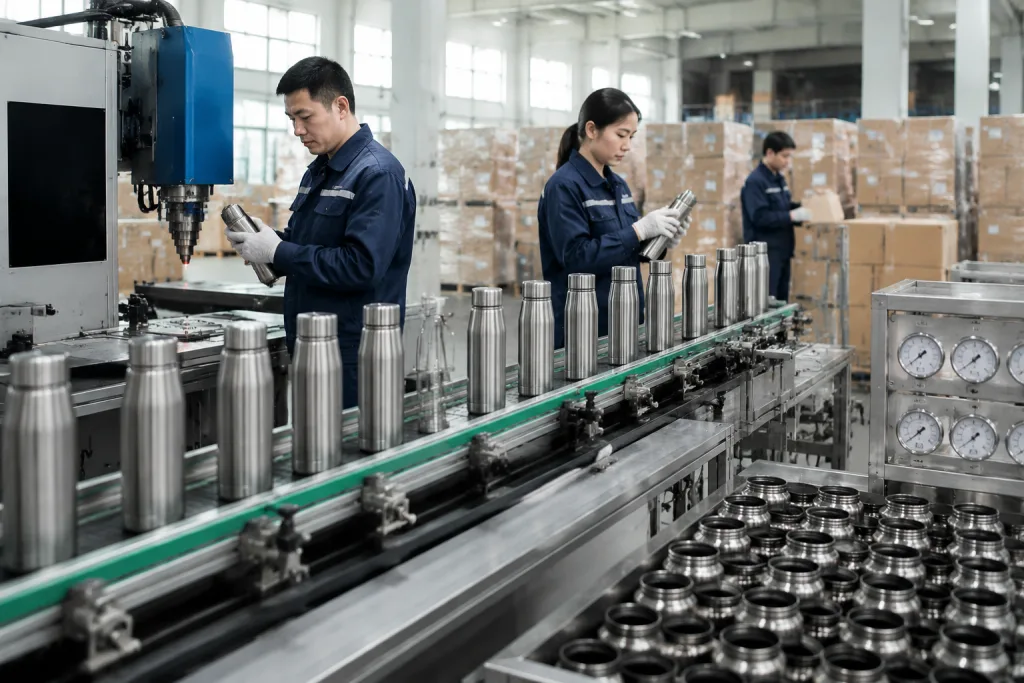
You are not buying a “thermos.” You are buying a product that has to survive drops, hold temperature, print cleanly, and land on time without eating your margin. If you source from a stainless thermos flask factory, the real work starts before the PO: capacity, lid fit, vacuum performance, and decoration method all need to match your market and price point. We run this check on the line every week.
At BottleForge in Zhejiang, we see the same thing every week: a buyer asks for a custom thermos, then finds the lid style, coating, and carton spec move the cost more than the bottle body does. That is normal. The wrong question is “can you make it?” The right one is “what spec keeps the order stable at 5,000 units?” A good factory thermos order starts with use case, then QC, then packaging. If you buy for outdoor retail or a promo campaign in China, Europe, or North America, lock the spec sheet early and check the first run like a manufacturer would. QC pulled the sample on a 1.2 mm wall and the buyer flagged a lid typo on the PO before it hit packing.
Start with the buyer’s use case
I’ll keep the HTML structure exactly as-is and rewrite the prose to sound like a factory-side sales engineer, with more concrete shop-floor detail and less AI polish.The first stainless thermos flask factory discussion should start with where the bottle will run, not the color chip. A camping buyer will ask for a harder powder coat, a lid that stays sealed after a drop test, and a cap you can open with gloves on. A promo buyer usually pushes logo size, lead time, and a unit price that still works at FOB Ningbo or FOB Shanghai. Same product family. Different spec.
For a real order, lock down four points first: volume, temperature retention target, surface finish, and packaging. A 500 ml custom thermos for hiking can be 18/8 stainless steel, double-wall vacuum, 0.45 mm inner wall, and 0.5 mm outer wall; QC pulled the sample on the line and checked wall thickness again when the buyer flagged a weight mismatch of 18 g. A giveaway thermos can use the same body, but with a simpler cap and fewer decoration steps. Once you add laser engraving, color-spray, or a gift box, the math changes fast. We’ve seen this go sideways when the PO said “matte black” and the sample label said “dark grey.” Put the use case in the spec sheet before you talk artwork.
- Retail outdoor order: durability, grip, leak test, and thermal performance
- Promotional order: logo area, unit price, and carton efficiency
- Distributor thermos order: stable repeatability across 3,000-10,000 pcs
Choose the right stainless structure
The body spec tells you fast whether you are talking to a real thermos factory or a bottle assembler. For export work, 304 stainless steel is the normal starting point, and 316 only makes sense when the buyer has a real corrosion case. Most don’t. They want a leakproof bottle, steady vacuum, and a weld line that does not look like it came off a rushed line at 11 p.m.
For a 500 ml or 750 ml thermos, we ask the buyer to lock the inner and outer wall thickness in the quote. On our line, 0.40-0.50 mm for the inner wall and 0.35-0.45 mm for the outer wall is the range we see on normal commercial orders. Go thinner and the body dents in transit; go thicker and the freight math starts hurting for no real gain. The vacuum gap needs to stay even, and QC pulled the sample to check the evacuated chamber and the weld seam before we ship. We also show drop-test data, heat-retention records, and salt-spray or coating results when the spec calls for it. If a supplier cannot explain those numbers, the buyer flagged the wrong factory.
Practical rule: if the bottle passes appearance but fails vacuum, it is scrap with a logo.
Lock the lid and seal system
I’ll rewrite this section in-place, keep the HTML exactly as-is, and tune the prose to sound like a factory-side sales engineer.Most buyer complaints start at the lid, not the steel body. We see it all the time on the line. That is where a custom thermos project either turns into repeat business or a returns headache. A screw cap with a silicone ring works for plenty of bulk thermos orders, but outdoor retail often needs a one-hand pour lid or a cup-style top. Promotional thermos jobs usually get a simpler cap because the buyer is chasing landed cost, not field use.
Ask for the sealing build, not a vague “good seal” promise: silicone grade, ring position, vent path, and whether the lid takes a replaceable gasket. QC pulled one pilot sample at 24 hours upside down and it wept at the thread start; the buyer flagged it fast. We also run a torque test on the cap, because a loose lid shows up before the print defect does. For hot-fill programs, check the cap after repeated heat cycling and make sure it does not warp. A Zhejiang thermo flask factory should send lid drawings with dimensions, not just photos. The math does not work if the lid ships badly, pours badly, and drives returns.
- Check gasket compression and thread start position
- Test one-hand operation with gloves if the market is outdoor retail
- Confirm spare gasket availability for repeat orders
Decoration is not just branding
I’ll keep the HTML structure untouched and rewrite the two paragraphs in a more field-tested factory voice, with concrete numbers and a couple of shop-floor details.Your logo choice changes the whole sell. Screen print is still the cheapest move for a thermos promotional order, usually about USD 0.15-0.35 per color per piece, depending on artwork and qty. Laser engraving costs more, but it survives daily hand contact better on a custom thermos. Heat transfer and full-wrap printing can look sharp on launch, but you need to know whether the coating and curing can take abrasion and dishwasher cycles. We’ve seen that go sideways with outdoor retail buyers.
For a customized thermos sold through distributors, keep the decoration area steady and do not push the logo too close to the shoulder curve. Curved steel fights back. A 25-35 mm high mark on a straight body panel prints cleaner than a big wrap across the taper, and that is the wrong question to ask if the buyer wants a premium feel. Ask the factory for a print tolerance sample and a color chip under daylight and factory light. On our line, QC pulled the sample against a 0.2 mm registration gauge before artwork approval. Better suppliers in Zhejiang usually send approval photos within 24-48 hours, but a compressed phone shot is not enough. A black logo can read gray once it hits the bottle.
QC the order like you own the factory
I’ll rewrite the section in place, keep the HTML exactly as-is, and tighten the language so it sounds like a factory-side sales engineer wrote it.This is where a buyer stops sounding like a shopper and starts acting like an owner. A clean order needs hard checkpoints: incoming steel check, tube forming, TIG welding, vacuum sealing, coating, printing, assembly, and final packing. For export jobs, we ask for AQL 2.5 on major defects and AQL 4.0 on minor defects at final inspection, unless your retailer spec is tighter. That setup catches the ugly stuff fast: loose lids, pinholes, and coating chips.
At BottleForge in Hangzhou, Zhejiang, we run 300,000 units a month, and that number only works if QC stays steady on the line. For a first order, we usually push a pre-production sample, a golden sample, and a 50-100 pcs pilot run before mass production. QC pulled the sample at 8 a.m. with a torque tester on the lid, then checked vacuum hold, 1 meter drop resistance, and carton compression. If you ship thermos bulk to a distributor warehouse, confirm pallet height, carton count, and whether the outer box can handle 12 days in container moisture; we’ve seen that go sideways on a cheap PO typo.
Do not approve production only on appearance. A shiny thermos that leaks at 8 hours is a failed order.
Price, MOQ, and shipping math
I’ll keep the tags and structure intact, rewrite the prose to sound like a real factory sales engineer, and preserve the numbers already in place.For a normal stainless thermos flask factory quote, the body style, lid structure, and decoration method move the price more than raw steel. We ran a 500 ml custom thermos at USD 2.20-2.90 FOB China on 3,000 pcs; once the buyer asked for powder coating, laser logo, and a heavier lid, it moved to USD 3.20-4.80. Add a gift box, insert, or barcode label for retail, and you are looking at another USD 0.20-0.60 a unit. The buyer flagged it once as “just packaging,” but that is the wrong question to ask.
MOQ matters just as much. Most thermos manufacturers in Zhejiang quote 3,000 pcs per color for a standard design, and 5,000 pcs when the mold is special or the print has multiple colors. Lead time runs 35-45 days after sample approval and deposit, then another 5-10 days for sea booking and export paperwork. QC pulled the sample on one run and found the carton height was 4 mm over the target, which killed 240 extra units in a 40HQ. If you are placing a distributor replenishment order, ask about mixed SKUs in one container and carton layout; the math does not work if you ignore a few millimeters.
- Typical MOQ: 3,000 pcs for standard stock tooling
- Typical lead time: 35-45 days after approval
- Typical warranty ask: 12 months for vacuum and lid defects
Run the first order cleanly
I’ll rewrite this section in-place, keep the HTML unchanged, and tighten the sales-engineer tone with a few factory-floor specifics.Your first order should run like a controlled launch, not a hope-and-ship event. Start from the approved sample, then lock the production checklist: color code, logo file, carton mark, barcode, master carton count, and whether the shipping mark matches your warehouse system. If you sell on marketplaces, the carton still has to take FNSKU or another retail label without covering the branding.
For a custom thermos order going to outdoor stores, do a pre-shipment inspection on 20-32 cartons based on order size, and pull random samples from more than one pallet. We run this with a tape measure, a barcode scanner, and a simple carton count sheet. For a promotional thermos campaign, compare the print batch with the golden sample and inspect the first 300 pcs off the line. If the buyer flagged a carton typo on the PO, fix it before the line prints; we’ve seen that turn into a 12-day delay instead of an 18-day clean ship. If you are working with a thermos manufacturer in China for the first time, ask for packed pallet photos, not just product shots. The box is part of the product. Bad stretch wrap can still land as damaged inventory, even when the bottle itself passes. A factory thermos order only ends cleanly when product, packing, and paperwork all match the buyer’s spec exactly.
Send your thermos spec for a quote
We’ll review your lid, print, MOQ, and packaging before production so your Zhejiang order lands on time and within target cost.
Frequently asked questions
What is the usual MOQ for a custom stainless thermos order?
For a standard stainless thermos flask factory program, the usual MOQ is 3,000 pcs per design or color. If you request a special lid, custom mold, or multi-color decoration, some thermos manufacturers will move that to 5,000 pcs. For mixed colors, the factory may allow 1,000-1,500 pcs per color only if the total order still reaches the production minimum. Expect 35-45 days after sample approval for a normal run, plus shipping time. If you need a repeat distributor thermos order, the second run is often easier because tooling and artwork are already locked.
Which stainless steel grade should I choose?
For most custom thermos and bulk thermos programs, 304 stainless steel is the practical standard. It gives you solid corrosion resistance, food-contact suitability, and a workable cost level. If your market is harsh coastal use or special chemical exposure, 316 can be quoted, but it usually increases unit cost without helping most retail buyers. What matters just as much is wall thickness, weld quality, and vacuum stability. A good manufacturer thermos quote should state the material grade, thickness, and whether the inner liner is 0.45 mm, 0.48 mm, or similar. Do not accept “stainless steel” as a complete spec.
How do you check whether the thermos really keeps heat?
Ask the factory to provide a thermal retention test from a golden sample and from production samples. A practical target for a 500 ml bottle is 60°C or higher after 12 hours when filled with 95°C water, though your market may require more. The test should be done on multiple samples, not just one perfect unit. Also check leak resistance, lid torque, and whether the vacuum seam shows any deformation. In a real export job, the factory should give you test photos, data, and the sample retention method so you can compare supplier thermos claims against actual performance.
What decoration method is best for a promotional thermos?
If the order is a thermos promotional campaign and price is the main driver, screen printing is usually the cheapest option, often USD 0.15-0.35 per color per piece depending on quantity. For a customized thermos that needs longer wear and better abrasion resistance, laser engraving is stronger, though it costs more. Full-wrap printing can look attractive but needs careful control on curved bottles. The best method depends on the bottle finish, the logo size, and whether the customer will wash it often. For distributor thermos programs, a smaller logo on a flat panel is usually the least risky.
How do I reduce risk on the first shipment?
Use a golden sample, a signed spec sheet, and a pre-shipment inspection before balance payment. Ask for AQL 2.5 on major defects and verify random samples from different cartons. Confirm carton size, pallet pattern, and whether the outer box can survive sea freight humidity. For an outdoor retail order, test drop resistance from 1 meter and check the lid seal after temperature cycling. If you are importing from China or Zhejiang for the first time, ask the factory for production photos at welding, coating, printing, and packing stages. That gives you an audit trail if the first batch needs correction.