Key Takeaways
- Most stainless thermos flask bulk orders land at MOQ 1,000 pcs and 25-35 day lead time from a Zhejiang thermos factory.
- A 500 ml bottle usually gives 12-24 hours of heat retention; a 750 ml build can hold temperature longer but adds weight and freight cost.
- For outdoor retail, 18/8 stainless with 0.5-0.6 mm inner wall and powder coating is usually the safer commercial spec.
- For promotions, lid style, logo method, and carton packing matter as much as insulation because they control landed cost and breakage rate.
When you buy stainless thermos flask bulk, the mistake usually is not the look. It shows up in the numbers: heat retention, lid seal, powder coat wear, carton drop test results, and whether 3,000 pcs from Zhejiang arrive with dents or seepage. We see this all the time on the line. That is why seasoned buyers treat a thermos order like a product launch, not a catalog choice.
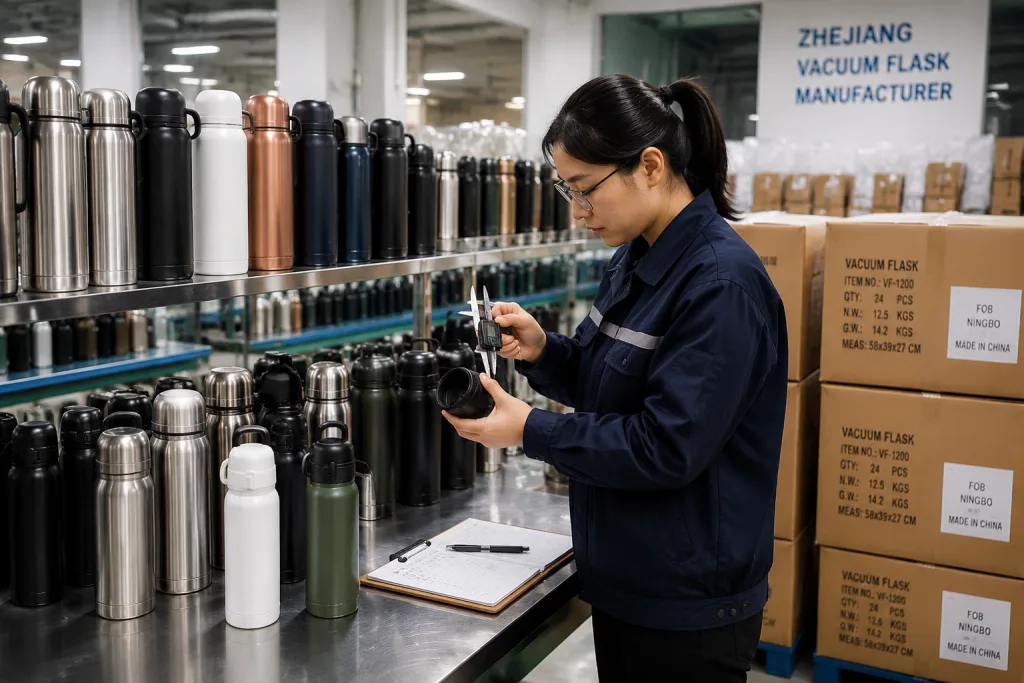
If the order is for outdoor retail or a promo program, the bottle has to fit the channel. A 500 ml vacuum flask with a powder-coated body and tea infuser handles differently from a 750 ml straight-wall bottle with a screw cup lid. At BottleForge in Hangzhou, Zhejiang, we run stainless thermos production at 300,000 units per month, with a standard MOQ of 1,000 pcs per design and a 25-35 day lead time. QC pulled the sample, checked the seal ring, and that is the kind of detail that decides whether a China factory quote holds up.
Compare the main thermos builds
I’ll rewrite the section in place, keep the HTML exactly as-is, and tighten the sales-engineer tone with more concrete factory detail.Buyers often ask for a quote before they pick the build. That is the wrong order. If you are sourcing stainless thermos flask bulk, start with body structure, lid type, and the insulation target. That is how we quote it in Zhejiang after QC pulled the sample and checked the wall thickness with a caliper.
| Build | Best use case | Typical capacity | Insulation | Notes |
|---|---|---|---|---|
| Straight-wall vacuum flask | Promotional thermos, retail bundles | 350-500 ml | 12-18 hours hot | Light, simple, low freight risk |
| Powder-coated outdoor thermos | Retail outdoor shelf | 500-750 ml | 18-24 hours hot | Better grip, better branding, higher unit price |
| Tea infuser thermos | Premium gift or hiking channel | 500-600 ml | 12-20 hours hot | Strainer adds parts, but raises perceived value |
| Large-capacity travel thermos | Camping, road travel | 900 ml-1.2 L | 18-24 hours hot | Heavier carton, stronger drop-test requirement |
If your customer is a distributor thermos buyer serving outdoor retailers, the safe spec is usually 304 or 316 stainless, double-wall vacuum construction, and a 0.5-0.6 mm inner shell. We run into pushback on thinner steel all the time, and the math does not work: you save a few cents, then eat dents, condensation, and seal failures later. A PO typo on lid color can be fixed; a weak weld on the line is a different story.
The decoration should match the shape. A thermos customizable body with a clean powder coat and laser logo sells harder than a busy silhouette with no shoulder line. We saw this go sideways on a 5,000-piece order when the buyer flagged a chunky form as “premium”; the sample looked loud, but it lost shelf balance. That is why most manufacturers thermos buyers now pick function-first designs, then spend the money on the finish.
Spec table that changes the quote
I’ll rewrite the prose only, keep the HTML exactly as-is, and make the pricing/spec copy sound like a factory sales engineer wrote it.Bulk price rarely comes from one line item. It comes from the whole spec stack. For a clean thermos bulk comparison, have the supplier quote wall thickness, surface finish, logo method, lid build, and packing standard. We run this check on the line before final offer; without it, you are comparing two different products.
| Spec | Low-cost version | Commercial version | Why it matters |
|---|---|---|---|
| Steel grade | 201 on some parts | 304 / 18-8 | 304 holds up better for food contact and export paperwork |
| Inner wall thickness | 0.35-0.4 mm | 0.5-0.6 mm | Thicker walls take dents better and keep the vacuum steadier |
| Surface finish | Gloss paint | Powder coat / matte spray | Powder coat takes scuffs better in retail and outdoor use |
| Logo method | Pad print | Laser engraving / silk screen | Laser stays cleaner over time; pad print saves money on promo orders |
| Packing | Single box, weak drop test | Mailer-ready inner box, 3A master carton | Packing sets the breakage rate and the warehouse pace |
For a 500 ml bottle, FOB China usually lands around USD 2.10-4.80, depending on finish and lid build. A premium insulated model with a tea infuser or special cap can move to USD 4.50-7.50. We have seen a buyer push back on a 0.15 mm wall change and lose the quote to dent claims later. The math does not work if the offer is missing a part. If your number is far below this range, ask what got cut.
We see the same mess every season: buyers check logo cost first and lid life second. That is the wrong question to ask. In bulk, the lid is the product.
Outdoor retail versus promo fit
I’ll rewrite the section in-place, keep the HTML exactly as-is, and make the copy sound like a real sales engineer wrote it.Outdoor retailers and promotional brands buy the same category for different jobs, so the spec is different. The outdoor channel wants repeat use, better insulation, and fewer warranty claims. The promo channel wants logo visibility, fast production, and a landed cost that still leaves room for margin.
Outdoor retail fit
For retail, we run a custom thermos with 304 stainless, powder coating, and a lid that holds up after daily opening. On our line, 500 ml and 750 ml sell best because they fit a backpack pocket and still look right on shelf. Retail buyers ask for barcode space, stable carton packing, and a finish that does not chip after one season; the math does not work if the coating fails in month three. For stainless thermos flask bulk on retail programs, ask your manufacturers thermos team for a salt-spray or abrasion test report if the coating is part of the value.
Promo fit
For promotions, a promotional thermos should stay simple. Keep the body straight, use a one-color logo, and hold decoration cost down. A 350-500 ml thermos custom design with a basic screw lid usually beats a premium hiking flask on ad spend versus unit cost. We’ve seen this go sideways when a buyer asked for four-color print and a gift box on a 3,000-piece order; QC pulled the sample, and the quote jumped. If the event is for employees or dealers, a boxed custom logo bottle often lands better than a gadget-heavy build. The goal is use, carry, and recall. No drama.
That split is why the same thermos factory can quote two very different programs from China. One is a retail spec with low defect tolerance and tighter inspection. The other is a volume promo run where the economics depend on decoration, not on features.
Logo methods and decoration reality
I’ll keep the HTML intact and rewrite only the prose, with a more field-tested sales tone and a few concrete production details.Decoration is where buyers overspend or cut too hard. A customizable thermos gives options, but not every option fits every order. For outdoor retail, we usually run laser logo or silk screen on the line. For a 3,000-piece promo drop, pad print or a one-pass screen print can work if the art is simple.
Use the right method for the right message:
- Laser engraving: best for permanent branding, clean on brushed stainless, usually adds a small setup fee, and the mark holds up after 200+ wipe tests.
- Silk screen: good for one- to two-color logos, lower cost at scale, but coating prep needs control or the ink can crawl on a 32 mm shoulder.
- Pad print: fast and cheap for thermos promotional programs, less durable under abrasion, and QC pulled one sample after the logo rubbed off in a 50-cycle rub check.
- Embossed or debossed wrap: premium feel, but tooling cost is higher and MOQ is usually stricter, so the math only works on bigger runs.
In China, a lot of thermos quotes look attractive because the logo is treated like a free add-on, not a process risk. That is the wrong question to ask. A clean logo on a matte 18/8 bottle can lift retail value by a few dollars; a messy print on glossy powder coat can kill the order. We had one buyer flag a PO typo on the logo size, and the rework cost more than the whole print charge. If you are sourcing from a thermos distributor or thermos vendor, ask for logo position drawings before you confirm.
We usually push one primary brand mark and, if needed, a small secondary mark under the lid or on the base. That keeps the bottle from looking overprinted, which we’ve seen go sideways on thermos customized promo orders. Less clutter, cleaner shelf look.
MOQ, lead time, and China sourcing
I’ll rewrite the section in-place, keep the HTML structure intact, and strip the AI-sounding filler while adding concrete factory details and buyer-side specifics.The commercial side of stainless thermos flask bulk is simple once you ask the right questions. A real thermos factory in Zhejiang should hand over MOQ, lead time, carton spec, and test standards before you argue about colors. At BottleForge, our standard MOQ is 1,000 pcs per model, and normal lead time is 25-35 days after sample approval. We run the line faster on repeat orders if the finish code and outer carton stay the same.
When you compare a thermos supplier with other suppliers thermos options in China, use these checks:
- Do they state AQL 2.5 or 4.0 for appearance and function, with the inspection sheet in writing?
- Can they show REACH-compliant coatings and food-contact stainless documents, not just a sales PDF?
- Do they share vacuum retention test data from the lab bench, or only brochure claims?
- Can they quote FOB Ningbo or FOB Shanghai without changing the term halfway through?
- Can they handle more than 100,000 units a month when your program ramps up?
A thermos factory in Zhejiang usually gives more room on tooling, cartons, and logo placement than a trading middleman. That matters when you build a custom thermos line for North America or Europe. QC pulled the sample on a 0.3 mm cap gap once, and the buyer flagged it before shipment; that is the kind of problem a factory can catch early. If you are setting up a distributor thermos program, defect control, packing efficiency, and repeatability beat a small price cut every time.
Buyer checklist before you order
I’ll rewrite the section in-place style, keep the HTML intact, and tune the tone toward a real buyer checklist with a few factory-floor details.Before you place a bulk order, compare samples like a commercial buyer, not like a consumer. Open and close the lid 50 times. Fill the bottle with hot water and check for pressure release, cap leakage, and lid alignment. On our line, QC pulled the sample after a 1.2 mm lid gap showed up on one closure. A practical thermos suppliers review should cover function, finish, and carton performance, not just product photos.
Use this checklist for thermos bulk orders:
- Confirm stainless grade: 304 or 316 for food-contact parts.
- Confirm capacity tolerance: usually ±3% is acceptable on mass production.
- Confirm vacuum performance target: for example, 12 hours above 60°C on a 20°C starting condition.
- Confirm packing: inner box, master carton count, and drop-test method.
- Confirm compliance docs: REACH, LFGB where needed, and factory audit if your buyer requires it.
If you are sourcing from China for an outdoor retail launch, ask for a comparison between two builds: one retail-grade and one promo-grade. We ran this split on a 500-piece sample order, and the buyer flagged the cheaper lid finish in daylight. That head-to-head view makes the decision obvious. The retail version should earn its higher FOB price with better surface durability and longer lid life. The promo version should protect margin and still look like a proper custom thermos, not a giveaway.
That is the real difference between a thermos manufacturer order and a casual gift purchase. One is built for a channel. The other is built for a single event.
Request a bulk thermos quote by spec
Send your capacity, logo method, and target price. We’ll quote the right stainless thermos flask bulk build for China sourcing, retail, or promo use.
Frequently asked questions
What is a normal MOQ for stainless thermos flask bulk?
A normal MOQ from a real thermos factory in Zhejiang is usually 1,000 pcs per model, sometimes 3,000 pcs if you want a custom mold or special lid. For stock shapes with custom logo, some suppliers can start at 500 pcs, but pricing will be higher and color choices may be limited. If you need mixed SKUs for one program, ask whether the supplier can combine capacity across two sizes under one artwork family. That often helps you hit the commercial target without overstocking one capacity.
How much does a bulk thermos cost from China?
For a standard 500 ml stainless thermos, bulk FOB China pricing often sits around USD 2.10-4.80 depending on steel grade, coating, lid, and logo method. A premium tea infuser or double-lid build can reach USD 4.50-7.50. Freight, duties, and carton upgrades are extra. If you are comparing a thermos supplier quote, check whether the price includes individual boxes, silica gel, or drop-test packing. Those hidden items can move landed cost by 8-15%.
Which is better for outdoor retail: laser logo or silk screen?
For outdoor retail, laser engraving usually wins on durability because it does not wear off with abrasion or moisture. Silk screen is fine if you want stronger color presence or a lower unit cost, but it depends on coating adhesion and handling. On a matte powder-coated bottle, laser plus a subtle finish usually looks more premium. On a bright promotional thermos, a one-color silk screen can be enough. If the bottle will see heavy backpack use, avoid fragile print placements near the grip zone.
Can you make a customizable thermos with mixed colors?
Yes, but color mixing changes the economics. If you want a customizable thermos in three body colors, expect extra setup time and possible MOQs per color, often 500-1,000 pcs each depending on stock resin or coating availability. In China, a thermos manufacturer may charge a small color surcharge or require longer lead time if the finish needs separate spraying. If you want speed, keep one body color and vary the logo. That is usually better for thermos promotional programs and distributor thermos projects.
What certifications should I ask a thermos supplier for?
At minimum, ask for stainless material documentation, coating compliance such as REACH, and food-contact declarations. If you sell into the EU, LFGB testing is often requested by buyers even when it is not legally mandatory for every case. For North America, many importers also want traceable packing lists, carton marks, and product test reports tied to the PO. If you work with a thermos supplier in China, ask whether they can support AQL inspection, factory audit paperwork, and batch-level QC records. That is standard for serious repeat programs.