Key Takeaways
- A 500 ml stainless thermos normally ranges from USD 3.20-6.80 FOB Ningbo depending on steel, cap, coating, and carton spec
- For custom thermos orders, confirm 304 inner steel, vacuum loss rate, lid torque, and AQL before paying the mold or sample fee
- A practical MOQ is 1,000 pcs per color for powder coating and 3,000 pcs for full custom packaging
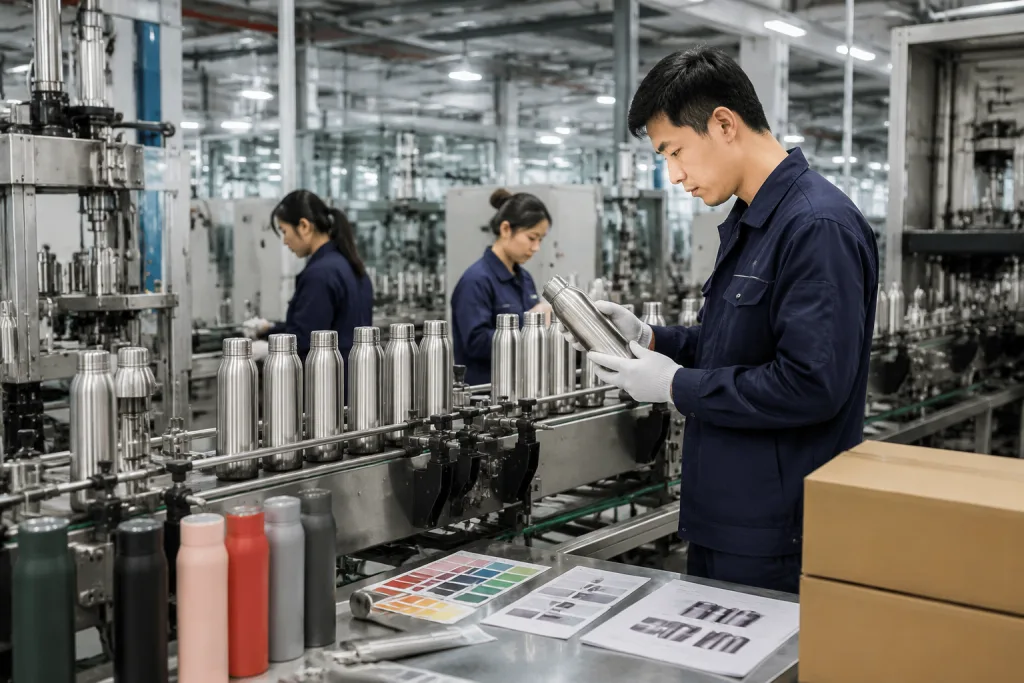
- Our Zhejiang factory capacity is about 420,000 stainless vacuum units/month with 30-45 day mass production lead time
A stainless thermos looks clean on a retail shelf. The purchase order behind it is not simple. If you are buying for an outdoor retailer or a promo brand, one loose spec can turn into a leaking lid, weak heat retention, a scratched powder coat, or a carton that fails a 1 m drop test before it reaches your warehouse.
We run stainless thermos bottle wholesale orders in Hangzhou, Zhejiang, and the hard part is usually not making the bottle. The hard part is locking the spec sheet before tooling, sampling, and bulk thermos production start. We’ve seen two quotes on the same 500 ml flask differ by 18%, just because one factory uses 0.4 mm inner steel, a simpler lid, and plain kraft cartons while another builds in a spring-lock cap, matte coating, and AQL 2.5 inspection.
Start With Capacity And Real Use
I’ll rewrite this section in a tighter sales-engineer voice, keep every HTML tag and the heading structure intact, and preserve the existing technical numbers.The first line on a stainless thermos bottle wholesale spec sheet is capacity: 350 ml, 500 ml, 750 ml, 1 L, or 1.2 L. We’ve seen buyers pick it from a catalog photo, and that is the wrong question to ask. Capacity changes bottle diameter, carton count, unit cost, and whether the item actually works for the channel.
For outdoor retail, 750 ml and 1 L move well. Hikers, campers, and winter-sports buyers want a bottle that feels like it can take a day on the trail. For promotional thermos programs, 500 ml is the safer call because it fits car cup holders more often and keeps freight under control; the line has run that size in 28 mm and 32 mm necks for years. A 1 L factory thermos can look good in a quote, but if the carton goes past courier-friendly dimensions, landed cost can jump 8-15%.
Ask your thermos supplier to list nominal capacity and overflow capacity. A bottle sold as 500 ml may take 520-540 ml to the rim, but retail customers buy usable volume, not lab volume. QC pulled the sample on one run and found the shoulder line gave a cleaner reference point, so we normally specify usable capacity there with a tolerance of ±5%.
Diameter matters too. For North American outdoor channels, 72-85 mm body diameter is common for 750 ml and 1 L bottles. For corporate gifting, 65-72 mm is easier to hold and easier to print; a 66 mm body also passes more cup-holder checks on the bench. If you are building a distributor thermos range, do not load the first order with six capacities. Two body sizes, three colors, one lid family. That math works.
Steel Grade Is Not Decoration
I’ll rewrite the four paragraphs in-place, keep the HTML tags unchanged, and tighten the language so it reads like a factory-side sales engineer wrote it.The steel line should never just say “stainless steel.” That is not a spec, it is a placeholder. For a food-contact custom thermos, the inner wall is normally SUS304 / 18/8 stainless steel. The outer wall can be SUS304 or SUS201, depending on the target price. We run this check on the line because the buyer will flag it the moment the sample arrives and the steel stamp does not match the PO.
For Europe, ask for LFGB or EU food-contact test reports for the parts that touch liquid: inner steel, silicone gasket, PP lid components, and the coating if the mouth area is painted. For North America, FDA food-contact compliance is the usual baseline, and some programs also ask for California Proposition 65 review. If you sell children’s drinkware, ASTM and CPSIA can apply depending on the design and the claim set. QC pulled the sample on a lid with a 1.2 mm gasket groove last month, and that kind of detail is what decides pass or hold.
Wall thickness changes dent resistance and weight. A common build is 0.4 mm inner wall and 0.5 mm outer wall for mid-range manufacturer thermos orders. Lightweight builds may drop to 0.35 mm, but dent complaints go up fast if the bottle is used in outdoor retail. A 0.6 mm outer wall feels solid, yet on a 750 ml bottle the steel cost can add USD 0.25-0.60 per unit. The math does not work if your target margin is already tight.
Be careful with recycled stainless steel claims. They work for sustainable drinkware programs, but only with clean documentation. A thermos manufacturer in China can issue recycled content declarations when the material stream is controlled from coil to finished bottle. If your brand wants “recycled stainless steel” on the carton, get the certificate wording approved before artwork release, not after the cartons are printed. We have seen that go sideways on a 5,000-unit order because the PO had the claim text and the lab file did not.
Vacuum Performance Needs Numbers
I’ll rewrite the section in-place, keep the HTML structure untouched, and tighten the copy so it reads like a factory-side sales engineer.“Keeps hot for 12 hours” is marketing talk. A spec sheet needs a test method. For stainless thermos bottle wholesale, we run a simple internal check: fill with boiling water, hold the bottle at 20°C ambient, then record water temperature at 6, 12, and 24 hours. A 500 ml bottle often stays above 60°C after 12 hours; a 1 L bottle usually does better because the volume-to-surface ratio works in its favor.
Cold retention needs the same treatment, especially for outdoor brands selling summer stock. Use 4°C water, keep the room at 20°C, then read the temperature after 12 or 24 hours. If your catalog says “24 hours cold,” pull that number from the pre-production sample and file it with QC. We’ve seen buyers argue from brochure copy, and that’s the wrong question to ask.
Vacuum failure usually hides in plain sight. The bottle looks clean but loses heat fast. A serious thermos factory should run vacuum detection, either by temperature rise testing or an automated inspector, depending on the line setup. At BottleForge in Zhejiang, QC pulled the sample before coating; once powder coating is on, rework burns time and the math doesn’t work.
For bulk thermos production, ask the supplier thermos team to state the allowed vacuum defect rate and the inspection method in writing. For final inspection, we recommend AQL 2.5 for major defects and AQL 4.0 for minor defects, with critical defects set at 0. A vacuum failure, leaking lid, sharp burr, wrong steel grade, or contaminated interior is a major or critical defect, not a cosmetic miss.
Lids Decide Complaint Rate
I’ll keep the HTML structure intact and rewrite the prose to sound like a factory-side sales engineer, with more concrete shop-floor detail and less generic phrasing.The lid decides the complaint rate. We have seen a stainless thermos bottle wholesale order look clean on paper, then get hit with leak claims because the buyer picked a lid from a catalog photo. That is the wrong question to ask. Lid structure changes leakage, drinking feel, washability, mold cost, and whether the bottle sells as a hiking flask, desk bottle, or promo item.
Common lid types are screw caps, cup caps, flip lids, push-button lids, straw lids, and carry-loop lids. For hot drinks, do not use straw lids unless the user sheet clearly says cold beverage only. For outdoor retail, a screw cap with a secondary cup is dependable, but it adds weight. For promo brands, a plain leakproof screw lid keeps the part count down and the line moves faster.
Ask for gasket material and hardness. Food-grade silicone is standard, usually 50-60 Shore A. We run a durometer check on the bench; at 45 Shore A the gasket can deform after dishwasher cycles, and at 70 Shore A the seal gets jumpy when cap torque shifts by a few N·cm. QC pulled the sample, filled it, torqued the lid to spec, inverted it, then shook it and left it horizontal for a set time.
Spare parts matter for distributor thermos programs. If you sell through outdoor retailers, ask whether replacement gaskets and lids can be ordered separately at 300-500 pcs. We’ve seen this go sideways when a buyer ordered 8,000 units and forgot the spare lid line item, then the after-sales team had nothing to ship. For custom thermos lids with new tooling, budget USD 1,200-4,500 for mold work depending on complexity, and expect 18-25 days for first molded samples.
Finish, Logo, And Shelf Life
I’ll rewrite the section in-place, keep the HTML exactly as-is, and tighten the prose so it reads like a factory sales engineer wrote it.The finish spec needs coating type, color code, logo process, test method, and defect limits. For stainless thermos bottle wholesale, we run powder coating on most outdoor models because it bites the steel well and hides fingerprints. Spray painting can come in cheaper and looks glossy, but the scratch result usually falls off unless the paint system is upgraded. QC pulled one sample with a scuff at the shoulder after a 1 m rub test, and the buyer flagged it right away.
Use Pantone or RAL references, but curved steel never matches the paper sheet exactly. We set Delta E 1.5-2.0 for tight retail programs and Delta E 2.5-3.0 for promotional thermos orders. If the brand color matters, approve a coated steel chip. A PDF mockup is the wrong question to ask. We had a PO typo once that swapped RAL 3028 for 3002, and that 1 line changed the whole batch.
Logo methods include laser engraving, silk screen, heat transfer, water transfer, embossing, and full-wrap digital print. Laser engraving stays clean on powder coat, and the mark holds up, but the logo color comes from the exposed base layer. Silk screen works best for 1 or 2 colors, with a setup cost around USD 40-80 per color. Full-wrap print can look retail-ready, but the artwork alignment and seam tolerance must be signed off on the pre-production sample. We check the jig at 0.3 mm before the line runs.
For a customizable thermos range, keep the decoration zones tight at the start. One front logo, one back care icon block, and one base mark are easier to hold than a wraparound art file at the shoulder. On inspection, define pinholes, dust spots, scratches, color stains, and print misalignment. A 0.5 mm dust point may pass on the lower back side, but not over a retail logo. We’ve seen that go sideways on a 5,000-piece order when the buyer pushed for full-wrap artwork on day one.
Packaging And Compliance Lines
I’ll rewrite the section in-place, keeping the HTML tags and structure intact while tightening the copy to sound like a real export sales engineer.Packaging is not just a box. For stainless thermos bottle wholesale, it sets the damage rate, barcode flow, retailer acceptance, and how the warehouse stacks the line. A plain inner white box usually lands at USD 0.12-0.25. A printed color box with an E-flute insert usually runs USD 0.35-0.75, depending on size and paper grade. If the channel is outdoor retail, the box needs to survive pallet movement, not just sit pretty on a shelf.
Specify carton strength up front. We run 5-ply export cartons a lot, usually around 175-200 lb burst strength or an equivalent edge crush rating. A 500 ml bottle may pack 24 pcs/carton; a 1 L bottle may pack 12 pcs/carton. Ask for carton dimensions and gross weight before you lock FOB, because ocean freight, courier rates, and FBA receiving plans all swing on those numbers.
For Amazon or marketplace programs, put FNSKU labeling, suffocation warning on polybags, carton marks, and master carton barcode placement into the purchase order. For retail distributors, line up hangtags, instruction leaflets, REACH compliance, and country-of-origin marking. “Made in China” has to go where your market wants it, and if the buyer flags it after packing, you pay for rework on every unit. That math does not work.
Factory audits belong on the spec sheet too. BSCI, Sedex, ISO 9001, and social compliance questionnaires show up in buyer RFQs all the time. Not every thermos suppliers network in China holds the same audit status, so check before you promise a retailer. Our Hangzhou, Zhejiang export team normally confirms packaging drawings, carton marks, and compliance file requirements before pre-production; we’ve seen a PO typo on carton size turn into a 3-day delay, and nobody wants that after QC pulled the sample and the vessel is already booked.
MOQ, Sampling, And Price Logic
I’ll keep the HTML exactly as-is and rewrite only the prose with a more field-tested sales tone, tighter pricing logic, and a few factory-floor details.Price is the last line buyers ask for first, but it only means something after the spec is locked. For stainless thermos bottle wholesale, a standard 500 ml double-wall bottle usually sits around USD 3.20-4.50 FOB Ningbo with a one-color logo at 3,000 pcs. A 750 ml custom thermos with powder coating, laser logo, premium lid, and retail box often lands around USD 4.80-6.80 FOB, and steel thickness plus packaging choice move the needle fast.
Our practical MOQ is 1,000 pcs per color for standard shapes, 3,000 pcs for custom color box packaging, and 5,000-10,000 pcs for a new body mold. QC pulled the sample on the line last week: existing mold with a simple logo took 7-10 days, custom coating plus packaging mockup took 12-18 days, and new lid or body tooling pushed it to 25-35 days. Mass production usually runs 30-45 days after deposit and approved pre-production sample. The buyer flagged a typo on the PO before we cut steel; that saved a week.
A low quote from a thermos manufacturer is not automatically bad, but you need to see what got stripped out. We've seen it go sideways on thinner steel, SUS201 outer wall, cheaper paint, loose AQL, no spare gasket, weak carton spec, or no budget for third-party testing. A proper manufacturers thermos quote should list unit price, mold fee, sample fee, packaging cost, logo cost, Incoterm, payment terms, lead time, and quote validity. If it does not, the math does not work.
If you are buying thermos bulk for a seasonal launch, leave room for inspection and shipping. For Europe and North America, ocean freight can add 25-45 days port to port, plus customs and inland movement. Air freight works for urgent promotional thermos replenishment, but it can add more than USD 2.00 per unit on a 750 ml bottle. The cheapest order is rarely the cheapest landed program, and that is the wrong question to ask.
Send your thermos spec sheet for factory review
Share capacity, lid type, logo method, quantity, and target market. We will return practical FOB pricing and production notes within 2 working days.
Frequently asked questions
What MOQ should I expect for stainless thermos bottle wholesale?
For existing molds, a realistic MOQ is 1,000 pcs per color if you use standard powder coating and a simple logo. For printed retail packaging, plan on 3,000 pcs because box factories need efficient print runs. For a new body shape or custom lid, MOQ is usually 5,000-10,000 pcs to spread tooling cost. Some China suppliers will offer 300-500 pcs, but the unit price is higher and color control may be limited because they are using stock bodies. If you are testing a new outdoor retail SKU, start with 2 colors and one capacity rather than spreading 3,000 pcs across too many variants.
How much does a custom thermos sample cost and how long does it take?
For an existing stainless thermos body with your logo, sample cost is usually USD 50-150 including setup, and timing is about 7-10 days after artwork confirmation. If you need custom powder coating, full-wrap artwork, or a printed box mockup, expect 12-18 days. New lid tooling or body tooling takes longer, usually 25-35 days for first samples after 3D drawing approval. We recommend approving one golden sample and one sealed pre-production sample. The golden sample is for your team; the sealed sample stays with the factory QC team as the production reference.
Which logo method is best for outdoor retail thermos bottles?
Laser engraving is usually the safest choice for outdoor retail because it resists abrasion, moisture, and cold-weather handling. It also avoids ink adhesion problems on textured powder coating. Silk screen is fine for promotional thermos orders with one or two colors, but it needs proper adhesion testing. Heat transfer or full-wrap print gives stronger shelf impact, though it requires tighter artwork control and more inspection time. For a 500 ml to 1 L stainless bottle, keep the main logo within a practical flat visual zone, often 45-70 mm wide, unless you have approved a wrap layout on the actual curved body.
What tests should I request before approving bulk thermos production?
At minimum, request vacuum performance, leakage, coating adhesion, lid torque, salt spray if metal accessories are exposed, and food-contact compliance for liquid-contact parts. For vacuum, record temperature after 6, 12, and 24 hours using a defined ambient temperature, commonly 20°C. For coating, cross-hatch adhesion and rub testing are practical checks. For final inspection, use AQL 2.5 for major defects and 4.0 for minor defects, with critical defects at 0. If the order is for Europe, add REACH and food-contact documentation. For North America, confirm FDA food-contact status and any retailer-specific requirements.
Should I buy directly from a thermos factory or through a trading vendor?
Direct factory sourcing gives you better control over tooling, production timing, and root-cause fixes when a defect appears. It is usually better for stainless thermos bottle wholesale programs above 3,000 pcs. A trading thermos vendor can be useful for small mixed orders, especially if you need several drinkware categories in one shipment. The risk is that technical details may get softened between you and the production line. If you use a vendor, still require the same spec sheet: steel grade, wall thickness, lid material, coating process, AQL level, carton strength, and compliance documents. The document matters more than the business card.