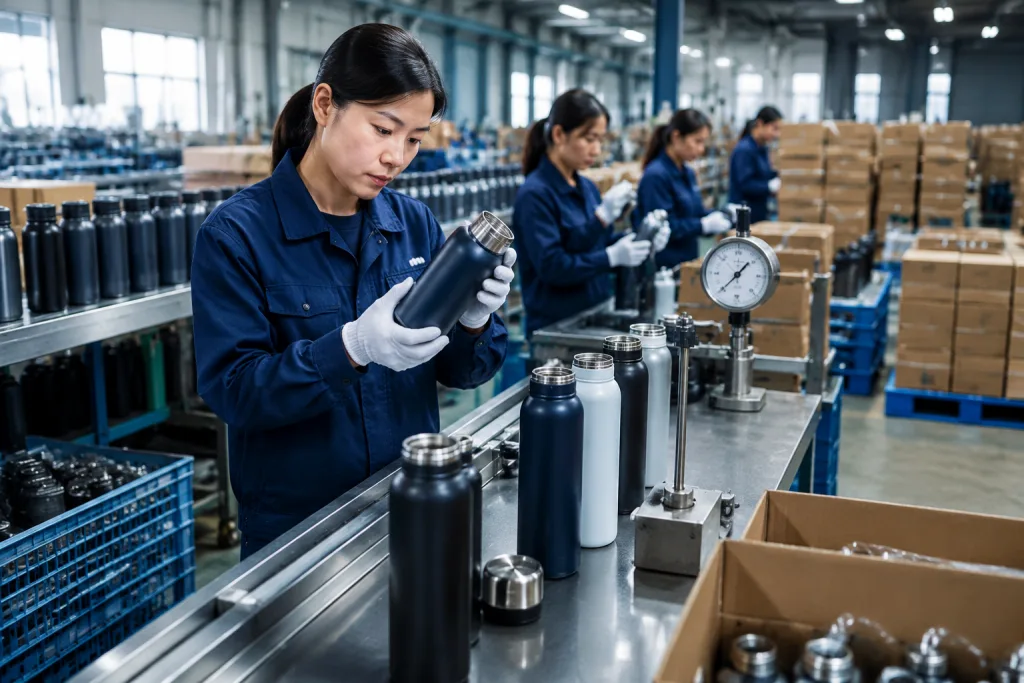
Key Takeaways
- A realistic custom stainless thermos MOQ is 1,000 pcs per color for powder coating and 500 pcs for laser logo on stock bodies
- 304 stainless steel at 0.45-0.60 mm body wall is the normal range for retail-grade thermos bottles
- Plan 35-50 days production after artwork approval, plus 25-38 days ocean freight to Europe or North America
- Use AQL 2.5/4.0 inspection, 24-hour leak testing samples, and carton drop checks before shipment
You are not buying a bottle. You are buying margin, shelf confidence, and fewer complaint emails when a cap leaks in a customer’s backpack. We saw QC pull 32 pcs from a 1,200 pcs pre-shipment lot last month because the silicone gasket sat 0.6 mm proud after assembly. Small part. Big problem. A stainless thermos bottle custom project looks simple on a quote sheet, but the real decisions sit in 304 stainless thickness, vacuum hold, lid tooling, carton drop strength, and how much branding risk your team can carry.
From our Zhejiang factory team, the practical advice is blunt: do not start with logo size. That is the wrong question to ask. Start with the user, sales channel, and test standard before the deposit hits our account. Outdoor retailers usually push us on 12-hour heat retention and dent marks after a 1 m drop test. Promotional buyers push harder on Pantone color, approval speed, and whether the master carton survives 18 kg stacking. China can ship both types, but only when the thermos custom details are locked before the line opens.
Start with the real use case
Buyer question: “Which stainless thermos bottle custom spec should I ask for first?” That is the wrong question to ask. Start with use. A 350 ml conference giveaway sits on a meeting table; a 1,000 ml winter hiking flask gets opened with cold fingers and knocked against a tailgate. On our sample rack, those two bottles go through different lid checks, even when both carry vacuum insulation.
For outdoor retail, we would quote 304 stainless steel inner and outer walls, full vacuum seal, food-contact silicone, and a lid with enough grip for glove use. QC pulled one 750 ml sample last month because the cup thread scraped at 1.5 turns, and the buyer flagged the sound before they checked the logo. Retail customers notice thin lids, rough threads, and dents after one drop from a car boot. For promotional brands, the math usually breaks on decoration consistency across 3,000-10,000 pcs, or cartons that arrive without scannable barcodes.
A useful factory thermos brief gives capacity in ml; target channel with the store type or buyer type; expected retail price; drinking style such as cup lid or direct sip; branding method; packing format; destination market. Example: “750 ml hiking flask, powder coated matte black, laser logo one side, EU retail carton, REACH compliant coating, FOB Ningbo, 3,000 pcs.” We had a PO last quarter with “750” typed as “75O,” letter O, and it stopped artwork approval for 2 days. A clean sentence saves three rounds of loose quoting.
Checklist before asking for price: Print this before the first quote; our merchandiser marks it beside the 0.01 g scale.
- Capacity: 350 ml, 500 ml, 750 ml, 1,000 ml, or 1,200 ml. Match it to shelf height and carton weight, not just what looks good in a catalog.
- User: hikers need glove-friendly lids; commuters care about cup-holder fit; schools need tighter safety checks; corporate gifts and sports clubs usually push hardest on logo position.
- Channel: outdoor retail needs stronger drop and finish checks; online marketplace orders need barcode cartons; distributor thermos catalog programs need stable SKUs; event promotion orders need fixed delivery dates.
- Branding: laser engraving for clean metal marks, silk screen for simple colors, heat transfer for wrap graphics, UV print for short runs, or emboss tooling when the MOQ and tooling cost make sense.
- Compliance: LFGB, FDA, REACH, ASTM, CPSIA for kids’ items, or Prop 65 if needed. Send the market first so the lab test plan is not rebuilt after sampling.
At BottleForge Industrial in Hangzhou, Zhejiang, we currently handle about 420,000 stainless drinkware units per month across thermos, tumbler, and sports bottle lines. Scale helps. It still will not fix a vague brief. On the line, one missing packing note can turn into 58 cartons opened again for relabeling, so the sharper your first email is, the less safety padding a thermos supplier has to add for unknowns.
Steel grade and insulation answers
Buyer question: “Is 304 stainless enough, or do I need 316?” For most custom thermos bottle orders we run, 304 stainless steel is the right spec: food-contact safe, easy to source in Zhejiang, and stable in forming. 316 makes sense for saltwater gift sets, marine retailers, or acidic drink positioning, but it usually adds USD 0.35-0.90 per unit depending on size and market steel price. We had one PO last year with “316 inside only” typed as “316 outside only”; QC pulled the sample with the XRF gun before mass production, and that typo saved the buyer from a messy relabel.
The better question is wall thickness and vacuum quality. A typical manufacturer thermos for retail uses 0.45-0.60 mm stainless sheet for the body. Cheap giveaway items may use thinner material, but outdoor retailers should be careful below 0.40 mm. The math doesn't work. You save a few cents, then pay for dents, returns, and 1-star photos after the first carton drop test from 80 cm. For a 750 ml customized thermos, we usually quote retail-grade construction instead of chasing the lowest factory thermos price.
Vacuum insulation is not a slogan. Ask for actual test conditions. Common internal testing is hot water at 95°C, room temperature at 20°C, measured after 6, 12, and 24 hours. A strong 750 ml bottle may keep liquid above 55-60°C after 12 hours, depending on mouth width and lid design. Wide-mouth bottles lose heat faster than narrow-mouth bottles because the lid area is larger; on the line, a 58 mm mouth often tests weaker than a 42 mm mouth with the same body. We record this in the lab sheet, not just the sales deck.
Checklist for technical confirmation:
- Inner steel: SUS304, not mixed-grade mystery steel; ask the factory to confirm with an XRF reading.
- Outer steel: SUS304 preferred for retail; 201 may be used only for low-cost promotions if declared on the quotation.
- Body wall: request 0.45 mm minimum for outdoor retail programs, and check it with a micrometer on the pre-production sample.
- Vacuum test: define starting temperature, room temperature, and test duration before artwork approval.
- Copper lining: optional; it can improve performance, but it adds cost and needs tight claim control on packaging.
If a thermos vendor only says “keeps hot 24 hours” without a test table, treat it as marketing copy. Ask for the data, then test pre-production samples yourself. A serious thermos manufacturer will not be offended; we ship sample test tables with batch number, lid type, and measured temperature because buyers have flagged loose claims before.
MOQ, pricing, and honest tradeoffs
Buyer question: “What MOQ should I expect for stainless thermos bottle custom orders?” For stock bottle shapes with laser engraving, 500 pcs usually works; we run those on the rotary laser jig with a 0.2 mm logo position tolerance. For powder coating in a custom PMS color, plan on 1,000 pcs per color, because the spray booth, curing oven, and color purge still take half a shift. For a new lid, new body mold, or special handle system, the first order often lands at 3,000-5,000 pcs; otherwise the tooling math doesn’t work.
As a reference, a 500 ml custom thermos with 304 stainless steel, powder coating, laser logo, and individual white box may land around USD 4.20-6.80 FOB Ningbo at 1,000-3,000 pcs. A 1,000 ml outdoor flask with cup lid, stronger coating, and retail color box may sit around USD 6.80-10.50 FOB. These are working ranges, not promises. Last month QC pulled the sample after coating and found 11 pcs with pinholes near the bottom radius, so yield alone moved the quote by USD 0.18; steel price, lid complexity, packaging, and exchange rate still move the number.
The cheapest quote is usually cheap for a visible reason. The factory may switch to 201 stainless outer wall, shave the wall gauge by 0.1 mm, use generic silicone, pack in a lighter 5-layer carton, skip the carton drop test, or leave no allowance for AQL inspection. If you are a promotional thermos buyer for a one-day campaign, that can pass if it is written on the PI. If you are building a retail SKU, this is the wrong place to save money; we’ve seen this go sideways when the buyer flagged dents after a 1.2 m drop test.
Checklist for quote comparison: Print it next to the sample approval sheet, because one PO typo like “matte black” instead of “PMS Black 6C” can cost 12 days on the line.
- FOB port: Ningbo or Shanghai are common from Zhejiang and nearby China factories.
- MOQ: check body MOQ first, then color MOQ and logo MOQ, because each one can block production.
- Included decoration: one-position laser logo uses a different fixture from wraparound print, so compare setup cost and reject rate.
- Packing: confirm white box, kraft box, color box, master carton, FNSKU label, or hangtag with carton size and kg per carton.
- Inspection: confirm whether pre-shipment QC time is included before vessel closing, with AQL 2.5 booking locked at least 3 days ahead.
For distributors thermos programs, ask for tiered pricing at 1,000, 3,000, 5,000, and 10,000 pcs. Thermos bulk pricing does improve, but not by magic. On roughly 7 out of 10 models we ship, the real drop comes after coating and printing setup costs are spread out; after that, steel, labor, and 304 stainless scrap rate set the floor.
Branding methods that actually hold up
Buyer question: “Which logo method is safest for a customizable thermos?” For stainless thermos bottle custom orders, we usually quote laser first. Low drama. It will not peel in a carton rub test, and QC can check it with a 10x loupe right on the line. On powder-coated bottles, the laser burns through to the stainless layer. On raw stainless, it leaves a soft etched mark. Keep the minimum line width around 0.2 mm; last month QC pulled a 500 ml curved-body sample where 5 pt text closed up near the shoulder.
Silk screen printing fits simple one- or two-color promotional thermos jobs on smooth powder coating, and the price still makes sense at 1,000 pcs. Complex gradients are where we see this go sideways. Wraparound art also needs caution because the jig gap can show a 1.5 mm join line. UV printing gives better color range, but we run adhesion on the exact coating panel first, not a “similar black.” Heat transfer can carry full-color graphics; the math does not work for rough outdoor use unless the film, curing time, and edge sealing pass our abrasion check.
Do not approve decoration from a flat PDF only. This is the wrong question to ask at PO stage if nobody has held a sample. Request a digital mockup, then a physical pre-production sample. For orders over 3,000 pcs, we prefer a signed golden sample with logo position, color, gloss level, and packaging all confirmed. One millimeter matters when the logo sits near a tapered shoulder; we had a buyer flag a 2 mm drift on a 750 ml bottle because the mark looked off-center after shrink wrapping.
Checklist for artwork approval:
- Send vector files: AI, EPS, or clean PDF outlines; screenshots slow the plate room down.
- Define logo size in mm, not “medium” or “as sample”; our operator needs a number on the work order.
- Specify position from bottle base or centerline; “front side” is not enough for a tapered cup jig.
- Use Pantone C references for print and powder coating; one PO typo on 186 C vs 168 C can waste a full color drawdown.
- Run 3M tape adhesion and cross-hatch tests for printed logos; QC records the cut grid before packing approval.
For thermos promotional campaigns, we ship the safest setup as a stock body, stock coating, laser mark or one-color print, plus a standard box. It keeps sampling around 7 days instead of 14 to 18 days for custom coating and lid trials. For premium outdoor retail, spend the extra sample time on coating texture and lid feel. Shoppers touch those first, long before they read your hangtag.
Compliance and inspection questions
Buyer question: “What documents should a thermos supplier provide?” We ask for food-contact material declarations, stainless steel grade confirmation, silicone test reports, REACH data for coatings in the EU, and FDA or LFGB test reports based on the sales market. For North America, we also flag Prop 65 on coatings and inks; on one PO, the buyer even typed “P65” and QC caught it before the line printed cartons. If the bottle is for kids, ASTM and CPSIA are the right questions, not afterthoughts.
Factory audits count too. BSCI, Sedex, ISO 9001, and similar systems do not make every bottle pass, but they show whether the thermos factory runs documented work, keeps records, and closes nonconformities. For a distributor thermos buyer placing repeat seasonal orders, that matters as much as unit price. We’ve seen this go sideways when the factory had no audit trail and the customer asked for supplier evidence in week 2.
For physical QC, run an AQL plan. A common setup is AQL 2.5 for major defects and 4.0 for minor defects, with critical defects at 0. Critical defects are leaks, sharp edges, contamination, wrong material, broken lids, and unsafe packaging. Major defects include weak vacuum performance, coating scratches, wrong logo, and lid fit problems. Minor defects cover dust points and carton scuffs within the agreed limit. On the line, QC pulled one sample with a 1.2 mm lid gap; that’s the kind of miss that turns into a claim.
Checklist before shipment:
- Leak test: invert filled samples for 24 hours and shake-test lids.
- Vacuum test: compare production units against approved sample data.
- Coating test: 3M tape, cross-hatch, rub test, and visual color check.
- Drop test: packed carton from 76 cm if retail cartons are used.
- Barcode and label scan: UPC, EAN, FNSKU, and carton marks.
Do not wait until the goods are loaded. A solid China manufacturer thermos partner will accept third-party inspection before final balance payment, and the math does not work if they push back on that. If a supplier refuses normal AQL inspection, that is not a tradeoff; it is a stop sign.
Timeline, freight, and reorder planning
Buyer question: “How long does a customized thermos order really take?” For an existing mold with custom logo and coating, plan 7-10 days for sample preparation, 3-5 days for sample shipping, 3-7 days for revisions or approval, and 35-50 days for mass production after deposit and artwork sign-off. If you need new tooling, add 20-35 days before sampling. On our line, QC pulls the first coated sample under a D65 light box and runs a 3M tape test before we release photos, because one buyer once approved a matte black that looked charcoal on their office screen.
Ocean freight from Ningbo or Shanghai to major European ports often takes 28-38 days on water, plus origin handling and destination clearance. To the US West Coast, 18-28 days can work; to the US East Coast, 30-40 days is more honest. Air freight works for 100-300 urgent samples or launch shortages. Bad math starts when a buyer wants 3,000 stainless bottles flown out: one 40oz thermos carton can hit 16-18 kg gross weight, and the volumetric weight on a 61 × 45 × 32 cm master carton is not kind.
Outdoor retailers should buy by season, not by panic. If your autumn range launches in September, your factory thermos PO should normally be confirmed by late May or June. Promotional brands with event dates need tighter artwork control: one week lost to logo approval can push goods into expensive air freight. We’ve seen this go sideways when the buyer flagged a Pantone change after the silk-screen plate was already made, and the line sat half a day waiting for a new film.
Checklist for smoother logistics:
- Confirm Incoterms: FOB, CIF, DDP, or FCA before comparing prices; one FOB Ningbo quote and one DDP Dallas quote are not the same deal.
- Ask carton dimensions and gross weight before final freight quote; we measure the packed master carton with a tape, not from an old catalog sheet.
- Reserve barcode, FNSKU, warning labels, and carton marks before packing starts; a missing FNSKU can stop 50 cartons at the packing table.
- Book inspection 5-7 days before estimated production finish; QC needs finished goods, sealed cartons, and the final PO on hand.
- Hold 2-3% spare components for repeat customers if lid design is unique; the math works better than remolding 500 lids later.
Reorders are easier when you lock the specification sheet. Keep the exact coating code, logo file version, lid material, gasket color, carton artwork, and AQL notes. Roughly 8 out of 10 thermos suppliers can repeat the body; fewer can repeat the soft details unless the paperwork is tight. We run into trouble when a PO says “blue lid” but the approved sample used gasket color BL-03, so write the code down before the next deposit.
Send your thermos spec for a practical factory quote
Share capacity, logo, MOQ, market, and packing needs. We will reply with options, tradeoffs, and FOB pricing from Zhejiang.
Frequently asked questions
What is the best MOQ for a first stainless thermos bottle custom order?
For a first order, 1,000 pcs per color is usually the best balance between price and risk. At 500 pcs, you can often do laser engraving on stock stainless or stock powder-coated bodies, but custom PMS coating becomes inefficient. At 3,000 pcs, the unit cost improves because printing, coating setup, and QC time spread across more bottles. If you are testing an outdoor retail SKU, start with one capacity and two colors rather than four colors at low volume. For promotional brands, a 1,000-2,000 pcs pilot order is enough to verify logo quality, packing, and customer response before scaling.
Can you make a thermos customized with my own lid design?
Yes, but a new lid is a tooling project, not just a logo change. A simple plastic lid mold may cost USD 2,000-6,000, while a more complex push-button or multi-part cup lid can cost USD 8,000-15,000. Development usually takes 20-35 days for tooling, then 7-14 days for first samples. You also need leak testing, torque checks, dishwasher or handwash guidance, and silicone material confirmation. For a first custom thermos program under 3,000 pcs, it is usually smarter to use an existing proven lid and customize color, logo, and packaging.
How do I compare thermos manufacturers without choosing only by price?
Ask every thermos manufacturer for the same data sheet: steel grade, wall thickness, vacuum test result, coating type, lid material, MOQ, lead time, FOB port, packing details, and inspection terms. Then compare like with like. A quote at USD 4.10 may use 201 outer steel, thin cartons, and no retail packaging, while a USD 5.20 quote may include 304/304 steel, laser logo, color box, and AQL inspection support. Also check whether the factory can provide REACH, LFGB, FDA, or BSCI documents. The better supplier thermos quote is the one you can ship without surprises.
Which branding method is better for outdoor retail, laser or print?
Laser engraving is usually better for outdoor retail because it is permanent and handles abrasion better than most printed logos. It also has fewer color-matching problems. The tradeoff is that laser is normally one visual color: the exposed stainless or underlayer tone. Silk screen or UV print is better when your artwork requires specific brand colors, but adhesion testing matters. For a 750 ml powder-coated bottle, we recommend approving one physical sample and running a 3M tape test before production. For rugged outdoor use, avoid large printed areas near high-contact zones.
What lead time should distributors thermos buyers plan for seasonal programs?
For distributors thermos buyers, plan 60-90 days from approved artwork to warehouse arrival if shipping by sea. Production alone is usually 35-50 days after deposit for standard models, but sample approval, inspection, vessel booking, and customs add time. If your catalog launch is fixed, add a 10-14 day buffer for coating delays or packaging revisions. For repeat orders using the same specification, the timeline can be shorter because no new sampling is needed. Still, do not schedule a retail launch assuming everything moves perfectly; stainless drinkware is heavy, and freight delays are common.