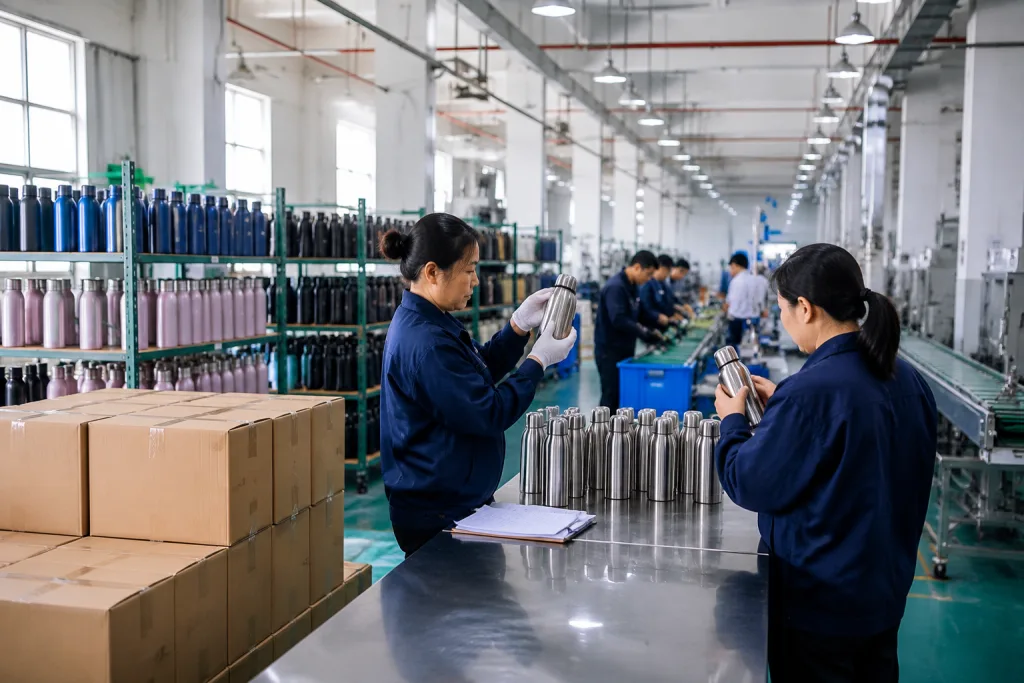
Key Takeaways
- A practical stainless thermos bottle bulk MOQ starts at 1,000 pcs for stock colors and 3,000 pcs for custom powder coating
- Typical FOB Ningbo pricing ranges from USD 3.10 to USD 8.90 depending on capacity, steel grade, lid, and finish
- Normal production lead time is 30-45 days after artwork, deposit, and pre-production sample approval
- Logo setup costs usually run USD 45-120 per design for silk screen, laser, or heat-transfer artwork
` tags, and tighten the sales-engineer voice with concrete buying details and fewer AI-style fillers.
If you buy stainless thermos bottle bulk for an outdoor retail line or a promo run, finding a supplier is the easy part. The real question is whether that USD 3.20 quote turns into USD 5.80 after logo work, color match, carton inserts, inspection, and freight timing get added.
Our Hangzhou, Zhejiang team runs custom thermos programs for North American and European buyers who want landed cost and ship dates they can hold. We ship these orders from the line every week, and the math only works when you lock MOQ tier, steel grade, vacuum retention, decoration method, carton spec, and AQL 2.5 before the PO lands.
Start With The Real Buying Unit
I’ll rewrite this section in a more factory-floor, sales-engineer voice and keep every HTML tag in place.Buyers often ask for thermos bulk pricing before they lock the buying unit. That is the wrong question to ask first. For a factory thermos quotation, the unit is the full sellable set: bottle body, inner plug or lid, cap, silicone gasket, color finish, logo, hang tag, polybag or kraft box, master carton, and sometimes a barcode or FNSKU label.
For outdoor retailers, the bottle needs a retail carton that can take shelf handling and a few drops in transit. For promotional thermos orders, the buyer may only want a white box and a clean logo. Same 500 ml stainless body. Different packing. The gap is usually USD 0.45-1.20 per piece, and that math matters when you are ordering 5,000 pcs.
At BottleForge Industrial in Zhejiang, we run about 450,000 units a month across thermos, sports bottle, and travel tumbler lines. A normal custom thermos job uses 304 stainless steel inner wall, 201 or 304 stainless outer wall, copper-coated vacuum insulation, and wall thickness around 0.45-0.55 mm. QC pulled the sample last week and the 0.6 mm tube held weight better, but it also pushed up cost and shipping mass. Thicker steel sounds safer, but the line shows the real tradeoff.
Before you compare thermos manufacturers, send every supplier the same spec sheet. Capacity, mouth diameter, lid type, color code, logo size, packaging, test standard, Incoterm, and order quantity all need to match. We’ve seen a buyer flag a PO typo on “500 ml” versus “550 ml,” then the quote blew up after tooling had already started. A cheap quote from a thermos vendor often just leaves out parts you will pay for later.
FOB Cost Drivers Buyers Miss
I’ll rewrite the section in place, keeping the HTML structure and tightening the copy so it sounds like a buyer-facing factory note.For stainless thermos bottle bulk orders, FOB cost comes down to material, body construction, surface finish, lid build, packaging, and how tight the QC gate is. A simple 500 ml model with an existing mold and stock color can sit around USD 3.10-4.20 FOB Ningbo. A 750 ml outdoor bottle with powder coating, a folding-handle lid, retail box, and drop-test packing can land at USD 5.80-8.90 FOB. We run this math every week, and the buyer who asks for “the cheapest one” usually misses the packing line.
Steel grade is the first cost lever. Most buyers who know the category choose 304 stainless for the inner wall because it holds up better on food contact. The outer wall can stay 201 stainless for price control, or move to 304 stainless if the brand wants a higher spec. Going from 201 outer to 304 outer adds roughly USD 0.18-0.45 per piece, depending on capacity and steel price in China. On one PO, the buyer flagged a typo on “304/201” and the whole quote had to be redone.
Lids are the second lever. A basic screw cap is cheap and steady. A one-touch button lid, straw lid, compass cap, cup cap, or carry-loop lid can add USD 0.25-1.10. More parts mean more gasket checks and more risk during AQL inspection. QC pulled the sample once and found a loose silicone ring on a button lid after 200 open-close cycles. I still push simple lids for distributor thermos programs; after-sale claims are lower, and the math does not work on fancy lids if the target margin is thin.
Surface finish is the third lever. Standard spray paint usually stays on the lower end. Powder coating brings better hand feel and scratch resistance, but it can add USD 0.25-0.60. Full-wrap heat transfer, gradient color, rubberized paint, and electroplating can look sharp in photos, yet they raise reject risk on the line. If you need thermos promotional pricing for a fixed campaign budget, keep the bottle shape and color simple, then spend on a clean logo and a carton that survives a 1.2 m drop test.
MOQ Tiers And Price Breaks
I’ll rewrite just this section, keep the HTML intact, and make the copy read like a factory-side sales engineer wrote it. Next I’m tightening the MOQ logic, adding a couple of shop-floor specifics, and cutting the AI-style filler.MOQ is not a factory trick; it is how the coating line, pad printer, carton crew, and buying desk keep one order from eating another. On our Zhejiang thermos line, 1,000 pcs is the usual MOQ for a stock mold, stock color, and one logo position. At 3,000 pcs, Pantone color matching starts to make sense. At 5,000-10,000 pcs, we can buy lids, boxes, and body shells with less waste, so the unit price settles down.
A practical MOQ ladder for a customized thermos looks like this: 1,000 pcs for laser logo on stock black, white, or stainless; 3,000 pcs for a custom powder-coated color; 5,000 pcs for retail box printing; 10,000 pcs for lid color changes or a bundled spoon, strap, or brush. New mold development is a different job. A new body mold often needs 10,000-20,000 pcs annual commitment, and tooling usually lands at USD 2,500-8,000. QC pulled a sample last month with a 0.3 mm lid gap, and that kind of issue is why we do not quote new tooling like stock goods.
For outdoor brands, I usually tell buyers to start at 3,000 pcs per color if the style will repeat. That gives room for color matching and carton printing without tying up cash in dead stock. For promo brands, 1,000-2,000 pcs works when the event date matters more than perfect shade control. The buyer flagged a 7-day delivery ask on a 2,000 pc order once, and the math did not work with a new Pantone mix.
Price breaks are real, but they are not magic. Going from 1,000 to 3,000 pcs may cut cost by 3-7%. Moving from 3,000 to 10,000 pcs can cut another 4-9%, depending on the lid, the box, and whether we run one shift or two. If a thermos manufacturer says you will get 25% off just by doubling volume, ask what changed in the spec. Usually something changed.
Customization Costs And Setup Fees
I’ll rewrite the section in place, keep the HTML structure unchanged, and tighten the sales-engineer voice with concrete shop-floor details.A custom thermos order can stay simple, or it can get expensive fast, depending on the decoration method. Laser engraving gives a clean mark on 304 stainless and powder-coated bottles; we usually quote USD 45-80 setup per logo, then USD 0.08-0.25 per unit based on logo size. Silk screen printing fits one- or two-color logos better, and the screen charge is often USD 50-100 with unit cost around USD 0.06-0.18 per position.
Heat transfer and water transfer make sense for full-color promotional artwork, but they run slower and curved bodies cause headaches. Plan on USD 0.35-1.20 per piece, depending on coverage. UV printing can take gradients and short runs, but the buyer flagged it before on a scratch test, so we always run tape testing and a dishwasher cycle on the exact coating before we confirm the quote.
Color matching adds its own bill. A custom Pantone powder coat usually needs 3,000 pcs MOQ per color, and the sample approval cycle takes 5-7 days after the powder supplier mixes the batch. A lab dip can pass under office light and fail in daylight; QC pulled the sample under D65 light, then we keep one signed master bottle on the line for production reference.
Packaging gets missed all the time. A printed kraft box may add USD 0.18-0.45, and a color retail box may add USD 0.35-0.90. Insert cards, manuals, hang tags, and FNSKU labels look small on paper, but artwork control matters. If your distributor thermos program ships to three warehouses, write the label position into the packing instruction; memory on the packing line is the wrong way to run it.
Lead Time By Project Type
I’ll keep the HTML structure exactly as-is and rewrite the prose to sound like a factory-side sales engineer, with concrete timing and line details.Lead time starts after we have approved artwork, deposit received, packing details confirmed, and the pre-production sample signed off. It does not start on the first inquiry. For stainless thermos bottle bulk orders, a practical China timeline is 7-10 days for quotation, artwork check, and sample setup; 5-12 days for sample making; 30-45 days for mass production; and 3-7 days for final inspection and booking handover.
Stock color with laser logo is the fastest route. If the shells and lids are already on hand, 1,000-3,000 pcs can often ship in 20-30 production days. Custom powder coating takes 35-45 days because the line needs coating, curing, adhesion testing, and a small rework buffer. Once the buyer asks for retail cartons, mixed SKUs, or two logo positions, the math jumps to 45-60 days.
Seasonality bites hard. China factories fill up before Chinese New Year and again before late-summer campaign shipments. If you want stock in a European warehouse by October, approving samples in late August is the wrong question to ask. Sea freight to Europe or North America adds 25-45 days port to port, and inland delivery adds more; we’ve seen a 40-day production plan turn into a missed promo because the buyer ignored the vessel schedule.
We run a simple milestone sheet for bulk thermos orders: day 0 deposit and artwork lock; day 7 sample approval target; day 15 raw material and packaging confirmation; day 25 first-line QC; day 35 final assembly and packing; day 40 AQL inspection; day 42 FOB handover. QC pulled the sample with a 1.2 mm lid gap once, and that saved a late PO typo from going into production. It is not glamorous, but it keeps the line from turning into a last-week fire drill.
Quality Checks Before Shipping
I’ll rewrite the four paragraphs in a more natural factory-sales voice, keep every tag intact, and preserve the technical claims and certification names.Cheap stainless thermos orders turn expensive fast when the vacuum drops, lids drip in transit, or cartons split on the pallet. On stainless vacuum runs, a quick look is not enough. We check raw material, weld seams, vacuum insulation, leak points, coating adhesion, logo rub, capacity, and carton drop results. QC pulled one sample at 500 ml last week and found a tiny weld pinhole that would have passed a visual scan.
For export orders, AQL Level II with critical 0, major 2.5, minor 4.0 is a solid starting point. Critical defects are leakage, sharp edges, contamination, and loose parts. Major defects are weak vacuum performance, wrong logo, bad coating, off-color finish, or a lid that does not work. Minor defects are small cosmetic marks inside the agreed limit. The math does not work if the buyer wants premium claims but skips the inspection table.
Insulation needs a clear test line. A common 500 ml stainless thermos gets filled with 95°C water at room temperature, then checked at 6 hours or 12 hours, depending on the claim. If the retail pack says “keeps hot 12 hours,” the PO should state the minimum temperature at 12 hours. We saw one buyer flag a PO typo where the claim said 12 hours but the QC sheet said 8; that kind of gap causes trouble.
Compliance changes by market. EU buyers usually ask for LFGB, REACH, and food-contact migration reports. US buyers often ask for FDA-related food contact documents, CPSIA for children’s items, and ASTM-related checks where relevant. BSCI or ISO 9001 factory audits help, but they do not replace batch inspection. We run the line, we ship the cartons, and we want the inspection rule written before production starts, not after the buyer finds a leak in their warehouse.
Choosing A Factory Partner
I’ll rewrite the section in place, keeping the HTML exactly as-is and tightening the sales tone with more concrete factory detail.A good thermos factory is not the one that says yes to every request. It is the one that tells you when a request will raise cost, add 15 days, or push defect risk past AQL 2.5. If you are buying stainless thermos bottle bulk for retail shelves, you need a partner who can hold the same finish and vacuum result across 5,000 pieces. If you are buying a promo run, you need fast artwork control and a line that can switch colors without slowing packing.
Ask potential thermos manufacturers for three things: a current price table by MOQ, a lead-time chart by customization type, and photos or videos of the production line. Do not settle for catalog renderings. A real thermos team can show the seam welding jig, vacuum test rack, coating booth, assembly table, and carton pack-out. They should also tell you what stays in-house and what gets sent out. We once had a buyer flag a “factory” that could not explain where the 304 inner cups were made. That was the wrong question to dodge.
Payment terms are another reality check. Common terms are 30% deposit and 70% before shipment after inspection. For established distributors thermos programs, some suppliers may discuss 20/80 or partial credit after several clean orders, but a first order should not depend on friendly terms. FOB Ningbo or Shanghai is standard from Zhejiang and nearby China production zones. We’ve seen launch plans fall apart because the PO still had the old port code after the buyer changed routing twice.
My practical advice: send one tight RFQ instead of ten vague ones. Include target FOB price, target delivery date, capacity, color, logo method, packaging, compliance needs, and annual forecast. A serious thermos vendor can then tell you what is possible, what needs a tool change, and where your money is best spent. If your RFQ is clean, the math works. If it is fuzzy, the line wastes a day just guessing.
Send Your Thermos RFQ For Real Factory Costing
Share capacity, logo, color, MOQ, packaging, and delivery date. We will return a practical FOB quote and production timeline.
Frequently asked questions
What is the best MOQ for stainless thermos bottle bulk orders?
For most outdoor retailers and promotional brands, 3,000 pcs is the cleanest MOQ if you want custom color, logo, and printed packaging. At 1,000 pcs, you can usually do stock color with laser engraving or simple silk screen. At 5,000 pcs, retail carton printing and better component purchasing become easier. If you need two colors, plan 3,000 pcs per color rather than 1,500 pcs each. Small mixed-color orders create coating waste and inspection complexity. For a first order, I would rather see you buy 3,000 pcs of one reliable model than 6 weak SKUs at 500 pcs each.
How much does a custom stainless thermos cost FOB China?
A basic 500 ml customized thermos in stock mold normally runs USD 3.10-4.20 FOB Ningbo with one simple logo. A 750 ml outdoor bottle with powder coating, better lid, and printed box usually lands at USD 5.80-8.90. Laser logo may add USD 0.08-0.25 per piece, while full-wrap artwork can add USD 0.35-1.20. Packaging can add USD 0.18-0.90 depending on box style. These are practical factory ranges, not landed costs. Freight, duty, import clearance, warehousing, and domestic trucking must be calculated separately.
How long should I allow from sample to shipment?
For stainless thermos bottle bulk production, allow 45-60 days from first artwork handoff to FOB shipment if the project includes custom color or retail packaging. The sample phase usually takes 5-12 days after artwork confirmation. Mass production takes 30-45 days after deposit and sample approval. Final inspection, carton marking, and booking handover need another 3-7 days. Stock color with laser logo can sometimes move in 25-35 days, but only when raw material, lids, and cartons are already available. Add sea freight time separately: often 25-45 days depending on destination port.
Which logo method is best for promotional thermos orders?
For most promotional thermos orders, laser engraving is the safest option when the logo can be single-color or metal-reveal. It is durable, clean, and usually adds only USD 0.08-0.25 per unit after setup. Silk screen is better for bold one- or two-color artwork, especially on smooth powder coating. Heat transfer or UV printing is better for full-color graphics, but adhesion and scratch testing are more important. If the product will be used outdoors, avoid tiny text under 5 mm height and avoid large solid ink blocks on tapered bottle sections.
What quality standard should I put on the purchase order?
Use AQL Level II with critical 0, major 2.5, minor 4.0 as a practical baseline for bulk thermos inspection. Define leakage as critical, poor vacuum performance as major, wrong logo as major, and small cosmetic marks as minor if within agreed limits. Add a specific insulation test, such as 95°C water filled to rated capacity and measured after 6 or 12 hours at 20-25°C room temperature. Also list coating adhesion, logo rub, capacity tolerance, carton drop, barcode scan, and packaging count requirements. The purchase order should match your retail claim and compliance needs.