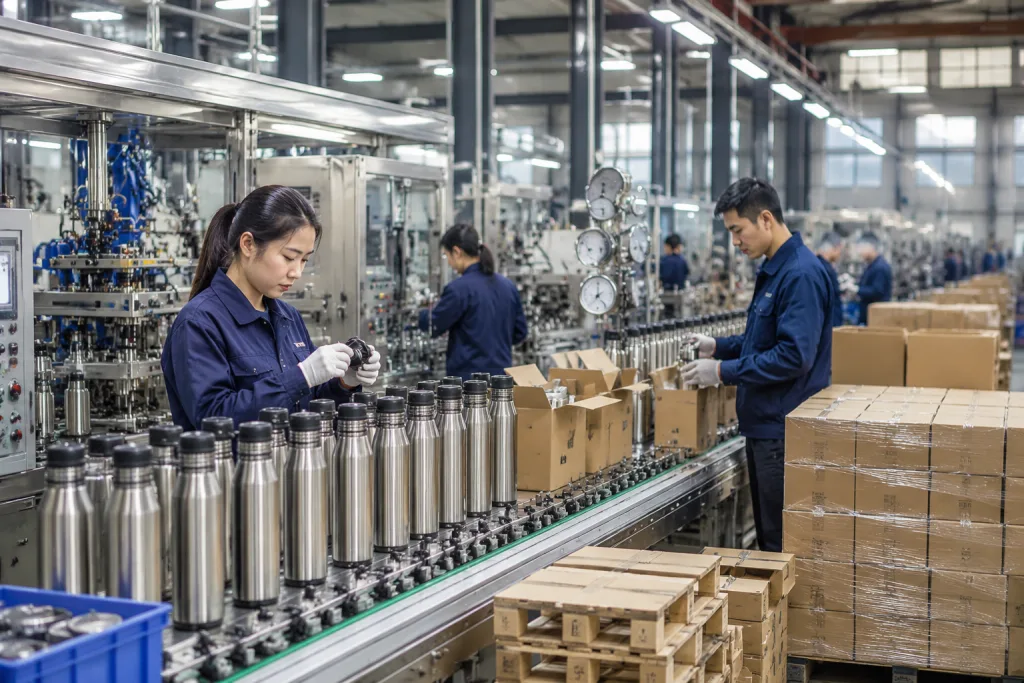
Key Takeaways
- 304 stainless and 18/8 usually mean the same food-contact grade, but wall design and vacuum quality decide the real thermal result
- A 500 ml bottle with 0.4 mm inner and outer walls often lands at USD 2.10 to 4.30 FOB depending on cap, coating, and print
- For most factories in Zhejiang, MOQ starts at 1,000 to 3,000 units per SKU and lead time is 20 to 35 days after sample approval
- Request AQL 2.5 for major defects, REACH or LFGB where needed, and a real thermal test report, not just a catalog claim
If you buy drinkware for retail, Amazon, or a private label program, a stainless thermal bottle looks simple until the sample lands on the bench. One quote says 304 stainless, another says 18/8, another says vacuum insulation, and then the real bottle drops short by 8 to 12 hours on the hot-water test. That is where margin goes. We run this check on the line with a 95°C fill and a stopwatch, and the buyer usually flags the same issue: the spec sheet was clean, but the bottle was built to a cheaper stack of parts. In Zhejiang and across China, the better suppliers are not selling “a bottle”; they are selling the numbers that decide whether you get a low-return SKU or a complaint magnet.
This guide treats stainless thermal bottle wholesale like a spec sheet, not a brochure. You will see what each line item does to cost, durability, and customer satisfaction, and where buyers pay for the wrong thing or cut the wrong corner. If you manage drinkware wholesale programs, canteen wholesale, or stainless SKUs under a private label, this is the level of detail you need before you place a bulk order with a factory in China. QC pulled the sample, checked the lid torque at 1.2 N·m, and the math still had to work on your landed cost.
What the spec sheet really means
I’ll rewrite the prose in place, keep the HTML structure untouched, and make it read like a factory-side sales engineer wrote it.When you compare stainless thermal bottle wholesale quotes, start with the spec sheet, not the unit price. That sheet tells you if the bottle is built for shelf display, commuter use, or rough handling. We run the same shape at USD 1.80 and USD 4.80 because the build changes under the hood: steel grade, wall thickness, vacuum gap, lid structure, finish, and print method. Those lines decide dent resistance, heat retention, and how many cartons come back with leakage complaints.
Use the core lines like this:
- Material: 304 stainless is the default for the inner wall and often the outer shell; 316 adds cost and only makes sense when the buyer needs extra corrosion resistance, usually for salty or acidic use.
- Wall thickness: 0.35 to 0.45 mm is standard; 0.35 mm ships lighter, but QC pulled the sample and the dent mark showed up fast on the press test.
- Vacuum layer: Steady vacuum depth matters more than a shiny coating, and a 1 mm gap swing will show up in the insulation test.
- Capacity: 350 ml, 500 ml, 750 ml, and 1 L cover most programs, and a PO typo on “750 ml” as “70 ml” can waste a full day on the line.
For bulk drinkware programs, the cheap quote usually hides a weak lid or a soft seal ring. A 2 mm silicone gasket can be the gap between a clean unboxing and a refund claim. We’ve seen this go sideways: the buyer pushed for a lower lid cost, then the leak rate failed at AQL 2.5. If you want a best wholesale drink bottle that holds up in channel checks, tie each spec line to a buyer result: fewer returns, cleaner compliance, better shelf margin.
Steel grade and wall build
I’ll rewrite just the prose inside the existing HTML, keep the tags intact, and make it sound like a buyer-facing factory note with concrete specs and shop-floor detail.Buyers ask if 304, 18/8, and food-grade stainless are different metals. They are not. 18/8 is the trade shorthand for 304 stainless, about 18% chromium and 8% nickel, and that is the base material we run for most stainless thermal bottle wholesale orders. It is fine for hot and cold drink contact, easy to source in China, and the mill certs are standard paperwork on our side.
The bigger cost driver is the tube draw and how much metal stays after trimming, not the grade name on the PO. A 0.4 mm inner wall with a 0.4 mm outer wall is a solid commercial spec. We’ve seen buyers push for 0.3 mm to shave a few cents, then the dent rate climbs once cartons hit the warehouse. Go thicker and the bottle feels stronger, but the weight goes up fast. On a 500 ml SKU, many retail programs stay under 320 g. For club or promo canteens, 350 g to 420 g still works if the price holds. QC pulled a sample last week at 0.39 mm by caliper, and that is close enough for production, not for guessing.
Rule of thumb: if the supplier cannot tell you the wall thickness in millimeters, they are not quoting a real production spec.
For canteen bulk orders and canteen wholesale programs, ask for inner wall and outer wall thickness separately, not one vague “stainless body” line. We had a buyer flag a PO typo once because the spec just said 0.4 stainless, and that kind of line leads to trouble. It is the wrong question to ask if you only chase grade; the math does not work unless the wall build is written out.
Vacuum performance and hold time
I’ll keep the HTML structure intact and rewrite the three paragraphs in a more grounded factory-sales voice, with concrete test details and tighter language.Thermal performance closes the sale, but the test sheet decides whether the bottle stays in your program. A normal double-wall vacuum bottle with a sound seal can keep hot water above 60°C for 6 to 12 hours and cold water below 10°C for 12 to 24 hours, depending on room temperature and fill level. If a supplier promises 24 hours hot on a 500 ml flask with a basic screw cap and no copper lining, the math does not work.
The test setup matters. We ask the factory to show start temperature, fill ratio, cap style, ambient temperature, and whether the bottle was preheated. Without that, the claim is just sales talk. QC pulled the sample at 20°C ambient, full-fill, and logged readings at 6, 12, and 24 hours; that is the kind of sheet you want on a stainless thermal bottle wholesale order.
Mouth size changes the numbers too. Wide-mouth bottles are easier to clean, but they usually give up heat faster than narrow-mouth models. If your channel is hiking or gym use, wide mouth is fine. For a commuter line, narrow mouth holds temperature better and drinks cleaner. We’ve seen buyers push for one universal spec, and that is the wrong question to ask—mouth size should match the user, not the catalog.
Cap, seal, and leak control
I’ll keep the HTML structure intact and rewrite the prose to sound like a factory-side sales engineer, with concrete QC details and fewer filler phrases.The cap is where a lot of wholesale drinkware orders go wrong. We have seen a bottle pass visual QC and still leak in transit because the thread pitch was off by 0.2 mm or the gasket was sitting too shallow. For drinkware wholesale, treat the lid as a core part, not an add-on. Ask what resin it uses, how the seal ring is seated, and whether the cap has run through cycle testing on the line.
Typical cap choices are PP, Tritan, stainless, bamboo-look covers, and flip-top assemblies. Each one changes your landed cost and your scrap rate. A basic PP screw cap keeps FOB down, but if the buyer is tossing bottles into gym bags, the math does not work unless the seal is tight. We use a 5,000-cycle open-close test as a practical floor. For leak testing, 100 percent inverted water testing on production samples is the minimum for retail orders; for larger programs, we pair it with carton drop checks from 80 cm.
- Seal ring: Silicone is standard; QC should confirm the food-grade declaration and ring fit.
- Thread: Deep, clean threading cuts cross-thread complaints and bad torque readings.
- Vent design: Helps flow and relieves pressure after hot-fill.
- Cap torque: Too loose leaks; too tight gives the buyer a hand-cramp complaint.
If you are sourcing wholesale drinkware for mass retail, ask for cap drawings before tooling starts. We have seen one PO typo on the cap code turn into a 3-week delay, and the leak risk usually starts right there.
Finish, print, and branding value
I’ll rewrite the prose only, keep the HTML exactly as-is, and make it sound like a factory-side sales engineer wrote it.Surface finish is not decoration only. It changes scratch resistance, the way the bottle reads on a shelf, and whether the logo still looks sharp after carton drops and courier abuse. Powder coating is the safest commercial finish for a stainless thermal bottle wholesale program; it covers minor forming marks and gives better hand feel. Paint costs less, but it chips faster. Electro-polish looks clean, though the math usually fails on mainstream bulk drinkware.
Branding should match the sales channel. For a premium gift set, laser engraving holds up and looks clean. For high-volume private label, silkscreen or UV print works if the artwork stays simple. One-color print usually adds about USD 0.08 to 0.18 per unit in bulk. Laser engraving costs more at the start, but it cuts peeling complaints. If you need custom decoration across multiple SKUs, keep the same bottle body and change the branding. We run that setup a lot; retooling the shape just burns time and MOQ.
In Zhejiang, a lot of factories run 1 to 3 spot colors on the same line with no drama, but the cure oven still decides the result. Ask for tape-test data and rub resistance if the bottles move through ecommerce. QC pulled the sample on one job because the ink smeared after 20 strokes, and the buyer flagged it before shipment. If you sell a beer tumbler bulk line or beer tumbler wholesale bulk program next to thermal bottles, keep the finish family matched so the shelf set looks planned, not patched together.
MOQ, pricing, and freight math
I’ll rewrite the section in-place, keep the HTML exactly as-is, and make the copy sound like a seasoned factory-side sales engineer.MOQ is where sourcing turns real. For stainless thermal bottle wholesale, we usually see Zhejiang factories quote 1,000 units per color or 3,000 units per model when the job needs custom tooling, logo work, or special packaging. Stock molds can go lower. The math changes fast, though, because a 500 ml double-wall bottle at USD 2.10 FOB and the same bottle at USD 4.30 FOB are not playing the same game once cap parts, coating lines, and carton specs get involved.
Do not compare FOB alone. Compare landed cost. A bottle at USD 2.60 FOB can turn into a headache if the carton crush test is weak; we had one buyer flag 5 mm of carton sag after a drop test, and the rework bill wiped out the savings. Add freight, duty, local fulfillment, and FNSKU labeling if you ship to Amazon. For Amazon-ready orders, we ask for 6 or 12 units per inner carton and barcode placement confirmed before the line starts. If you are building a beer growler wholesale program or growler bulk line, freight math matters even more because the cartons get heavy fast.
Keep an eye on order mix. We can usually shave unit cost if you combine bulk canteen, bulk drinkware, and growler wholesale items in one container, but this is the wrong question to ask if the SKU count gets messy. We’ve seen it go sideways when one PO typo sent the wrong carton code to the packing line, and QC had to pull 40 samples before loading. Zhejiang factories handle volume well. The trick is to keep each model clear, each carton code clean, and the MOQ plan tied to one shipping rate, not wishful thinking.
Quality checks you should insist on
Quality control is not optional when you buy China volume; we have seen 12,000 bottle orders go sideways over one loose lid gasket. Ask for an inspection plan that names defect levels, sampling size, and acceptance criteria, not a one-line promise on the PI. AQL 2.5 is a common baseline for major defects in retail drinkware, with tighter limits for leakage, bad print, and finish flaws. QC should be able to open the AQL chart at the packing table, point to the sample size, and explain why 5 failed units in a carton check is a hold, not “almost pass.” If the factory cannot explain the AQL tables, walk carefully.
For stainless thermal bottle wholesale, we run these checks before the cartons leave the line:
- Leak test: 100 percent of sampled units, filled to the thread, inverted for 30 minutes on a dry white test sheet.
- Thermal test: Verified against the agreed hold-time targets, usually with a probe thermometer reading at start, 6 hours, and 12 hours.
- Surface check: Scratches over 3 mm, dents, color drift against the approved swatch, and print alignment measured with a simple caliper.
- Drop test: Carton and sample drops from a defined height, with the buyer’s shipping mark checked after impact because cartons fail before bottles do.
- Compliance: REACH for Europe, LFGB where required, and relevant food-contact declarations matched to the exact inner steel and coating batch.
If your order includes alcohol flask bulk, alcohol flask in bulk, or alcohol flask wholesale bulk items, the same discipline applies. Flasks are smaller, but leakage and coating problems still damage the brand; one buyer flagged 18 leaking caps from a 315-piece sample pull, and the math did not work for retail. For beverage programs sold as wholesale canteen or wholesale growler, request batch traceability by production date, especially when you reorder the same SKU 4 months later and the PO has one digit wrong in the color code. In Zhejiang, the better factories run monthly output in the 200,000 to 500,000 unit range, but scale only helps if QC is locked down.
Buyer questions that change the order
I’ll rewrite the section in place, keep the HTML tags intact, and tighten the sales-engineer tone with more concrete factory detail.Before you sign off tooling or release a PO, ask the questions that change the bottle, not the ones that just check a box. What is the real vacuum retention at 12 hours, 24 hours, and 48 hours? What wall thickness are we running—0.35 mm or 0.45 mm? Which cap parts come off our own injection line, and which ones are bought out? Can the supplier hold 500 replacement lids for after-sales? Those answers hit return rate and replenishment speed fast.
Channel matters too. A retailer selling the best wholesale drink bottle for commuting wants a different build from a distributor ordering beer growler in bulk for hospitality. The commuter unit needs lower weight, a tighter lid, and cleaner print; the growler needs mouth size, handle comfort, and drop resistance. We saw a buyer flag a 2 mm handle change on a PO because the carton still fit, but the hand feel did not. If you sell beverageware across channels, keep the bottle shell stable and change the lid, finish, and decoration. That is how we run margin without opening a new mold every season.
Sample discipline has to be tight. Golden sample, pre-production sample, and mass-production reference sample should be three signed-off bottles, not one vague sample moved around the office. Put each one on approval with written notes, and mark the cap torque at 18-22 kgf·cm if that matters to the closure. QC pulled one sample with a 0.3 mm print shift last month, and that one line item saved a full rework. This is the right question to ask: can the supplier repeat the same result on the line, or only make a good-looking one-off?
Send your spec sheet for a quote
If you want a clean FOB, a real MOQ, and fewer surprises, send your target capacity, lid style, and branding file. We’ll quote it straight.
Frequently asked questions
What is a normal MOQ for stainless thermal bottle wholesale?
For a custom stainless thermal bottle wholesale order, 1,000 to 3,000 units per SKU is common in Zhejiang factories. Stock molds and simple one-color logo jobs may start lower, but once you ask for custom packaging or a special cap, MOQ rises. If you combine related items like wholesale drinkware or bulk canteen products in one shipment, you may improve price, but each model still needs its own approved sample. Expect 20 to 35 days after sample approval for production, plus sea freight time.
How much should I budget per bottle FOB?
For a 500 ml double-wall bottle, a realistic FOB range is USD 2.10 to 4.30 depending on stainless thickness, cap complexity, coating, and print. A basic smooth bottle with a PP cap sits near the lower end. Powder coating, laser engraving, or a more complex lid moves you up. For beer tumbler wholesale bulk or growler wholesale styles, the body size and handle design often push cost higher. Always compare landed cost, not FOB only, because packaging and freight can add another 20 percent to 40 percent.
How do I verify thermal claims?
Ask for a written test report that states ambient temperature, starting water temperature, fill level, and measurement points at 6, 12, and 24 hours. A credible claim for a standard 500 ml thermal bottle is often 6 to 12 hours hot and 12 to 24 hours cold, depending on the cap and mouth design. If a supplier says 24 hours hot without conditions, treat it as marketing. For procurement, that one document is better than a glossy catalog.
What compliance documents should I ask for in Europe or North America?
For Europe, ask for REACH-related declarations and, when the market requires it, LFGB or equivalent food-contact support. For North America, ask for food-contact material declarations and any required state-level compliance if your channel needs it. If you sell on Amazon, keep the paperwork aligned with your FNSKU and carton labels. Serious Chinese suppliers in Zhejiang should also provide material specs, ink or coating declarations, and traceability by batch. Do not ship until those are in the file.
Can I mix canteen, growler, and flask items in one order?
Yes, but only if you keep the product families clear. A wholesale canteen or canteen wholesale program can ship alongside bulk drinkware or bulk growler items in one container, which helps freight efficiency. The risk is QC confusion when too many SKUs share similar cartons and lids. If you add alcohol flask bulk or beer growler wholesale items, separate the carton codes and sample approvals. One clean purchase order is better than three loosely connected ones.