Key Takeaways
- A serious RFQ should include capacity, steel grade, wall thickness, lid type, logo method, carton spec, and target FOB price
- For new molds or canteen customized projects, plan 10-15 days for 3D drawing and prototype confirmation before production
- Our Zhejiang line can produce about 600,000 stainless bottles per month, with typical MOQ from 1,000 pieces per color
- Bulk QC should use AQL 2.5 for major defects and AQL 4.0 for minor defects, with leak and vacuum retention testing included
If you are looking for a stainless thermal bottle supplier, you probably have 8–12 quotes already. The hard part is knowing which price will still hold after sampling, a 1.2 m carton drop test, compliance review, and a delivery date the forwarder can book. Cheap is cheap. It means nothing if QC pulled the sample and found the lid leaking at 30 kPa, the logo peeling after 50 dishwasher cycles, or the mill sheet showing 201 stainless after the approved sample was marked 304 stainless.
We manufacture drinkware in Hangzhou, Zhejiang, so I’ll say it straight: the cheapest quote is the wrong question to ask first. We run custom bottle orders through RFQ drawings, sample sign-off, PO line checks, AQL 2.5 inspection rules, and Incoterms before the deposit lands; one buyer once sent a PO with “matte black” in the item line and “gloss black” in the packing note, and the line stopped for 3 hours while sales confirmed it. For stainless vacuum bottles, that paperwork is not office decoration. It keeps both sides out of trouble.
Start with a hard RFQ
I’ll rewrite the prose in place, keep the HTML exactly intact, and tighten it into a more buyer-side RFQ section with concrete factory detail and fewer generic phrases.Your RFQ is where most sourcing mistakes start. Send only a photo and “best price,” and you get five different reads from five canteen suppliers. One quote may use 201 stainless steel, another 304, another a thinner shell, another a cheaper lid gasket. The sample looks fine on paper, then the buyer flags it at 48 hours.
For a stainless thermal bottle supplier, price comes after the spec. Put capacity in ml and oz, bottle diameter, height limit, mouth opening, insulation target, finish, logo process, packaging, compliance market, and annual forecast in the first line. A solid example is: 750 ml double-wall vacuum bottle, inner 304 stainless steel, outer 201 or 304, 0.45 mm inner wall, 0.50 mm outer wall, powder coating, laser logo 35 x 55 mm, color box, REACH compliant for EU, FOB Ningbo. We run this check on the line before we quote.
If you are a canteen distributor or distributor drinkware buyer, add channel information. Amazon FBA cartons are not the same as retail shelf packs. A canteen promo order for a sports event can take a plain carton, while a gift set often needs a fitted EVA insert and barcode label. A distributor canteen program needs replenishment stability first; the math does not work if you chase the cheapest opening order and miss the reorder cycle.
Your RFQ should also say what you will not accept. No mixed steel without approval. No lid substitution. No logo resizing without written confirmation. No carton mark changes after artwork lock. This is the right place to be strict, because a good canteen manufacturer in China will price faster when the guardrails are clear. QC pulled the sample against the PO, and the typo on the carton mark cost us one extra proof run.
RFQ line items to include:
- Item name, capacity, dimensions, and target weight
- Material: 304, 316, 201 stainless steel, PP, silicone grade
- Finish: powder coat, spray paint, polish, electroplate, or raw steel
- Logo: laser engraving, silk screen, heat transfer, UV print
- MOQ, target FOB price, delivery window, and inspection standard
Read the quotation like an engineer
A quotation is not just a price sheet. It is a technical promise, and we treat it like a mini spec before the line opens. When you compare canteen vendors, break the price into material, decoration, packaging, testing, tooling, and freight assumptions, then ask the awkward question. If one canteen vendor is 8% lower, where did the saving come from? Sometimes it is real production efficiency, such as one mold already running 20,000 pcs this week. Sometimes QC pulls the sample and finds thinner steel, lighter lid construction, or zero budget for a third-party test.
For stainless vacuum bottles, useful quotation data includes steel grade, wall thickness, copper plating choice, vacuum performance, lid structure, gasket material, powder coating thickness, and carton packing. A common 500 ml bottle may use 0.4-0.5 mm stainless steel, while heavier retail models may use 0.55 mm or more. Powder coating usually sits around 60-80 microns, checked with a coating thickness gauge after curing. No spec, no control. If the quote does not mention these details, you do not yet have a controlled offer.
Ask the canteen factory to quote three levels if you are unsure, but make each level tied to a real construction difference, not sales wording. For example, 500 ml powder-coated bottle, laser logo, white box: USD 3.20 FOB for standard structure, USD 3.55 with improved coating and stronger lid, USD 3.90 with 304 inner and outer steel plus upgraded retail packaging. The cheapest option is not automatically wrong. The wrong question is “which price is lowest?” Ask what it gives up, because we have seen this go sideways when a buyer approved a low quote and later flagged carton crush at 13 kg gross weight.
In Zhejiang, around 60 drinkware factories may buy from the same steel sheet, PP lid, silicone ring, and coating powder suppliers. The difference is process control. A real stainless thermal bottle supplier should explain why a quote changes when you move from 1,000 pieces to 3,000 pieces or from one-color printing to full-wrap heat transfer. We run different fixtures for full-wrap work, and the math does not work if the quotation ignores film setup, alignment loss, and 2% extra inspection allowance.
Quotation PO checks:
- Incoterm: FOB Ningbo, FOB Shanghai, EXW, CIF, or DDP. One PO typo we caught changed FOB Ningbo to CIF Hamburg, which erased the margin.
- Currency and validity: usually USD, valid 15-30 days. Steel sheet can move within 12 days, so do not leave a 30-day quote open without written confirmation.
- MOQ by SKU, color, and logo version. We ship mixed colors, but 300 pcs per color is a different setup from 1,000 pcs in one Pantone.
- Sample cost, tooling cost, and refund policy. State whether the USD 80 sample charge includes laser logo setup and courier fee.
- Lead time counted from deposit, artwork approval, or sample approval. A 25-day promise from deposit becomes 32 days if artwork approval sits with the buyer for 7 days.
Lock the sample before deposits
Samples are not souvenirs. They are the physical contract for your custom canteen or customizable drinkware order. Before we ask for a deposit, we decide what the sample must prove. A stock sample checks body shape and vacuum insulation; our QC usually logs the wall thickness with a digital caliper before it leaves the line. A pre-production sample checks logo, color, lid fit, carton printing, barcode scan, and workmanship against the order file. Do not mix them up. We have seen this go sideways when a buyer approved a blank bottle, then argued about a 2 mm logo shift after bulk production.
For a normal customized canteen using an existing mold, a stock sample can leave our Hangzhou, Zhejiang factory in 3-5 days. A logo sample usually takes 7-10 days after vector artwork approval; if the AI file arrives with missing fonts, that clock starts after the corrected file lands. For a customized growler or custom growler with new tooling, allow 20-30 days for mold and first sample. If you require Pantone-matched powder coating, add 3-5 days for color panels and curing checks. We run those panels through the same curing tunnel as bulk goods, not a hand-sprayed shortcut on the sample bench.
Your sample approval should use measurable points. “Looks good” is too weak. Write it like this: powder coating close to Pantone 5535C under D65 light, laser logo centered within ±1.5 mm, lid torque smooth with no thread grinding, no leakage after inverted 30 minutes, hot water retention at 95°C start and minimum 55°C after 12 hours at 20°C room temperature. If you are selling to children or outdoor retail, add the exact ASTM, CPSIA, LFGB, or REACH clause your market needs. QC pulled one sample last month because the buyer wrote “green lid” on the PO, while the artwork sheet said Pantone 5535C body only.
For canteen custom programs, keep two approved samples. One stays with you. One stays sealed at the factory as the golden sample, with the buyer name, date, and revision number written on the hang tag. During bulk inspection, the inspector compares mass production against that sample, not against memory or marketing images. This is the right control point; arguing from a website render after 8,000 pieces are packed does not work.
Sample PO line items:
- Sample type: stock sample for shape check, logo sample for marking, color sample for coating, pre-production sample for full packing, or tooling sample for new mold review
- Artwork file name with version code, Pantone number, and logo placement drawing with mm dimensions from rim or base
- Sample quantity, courier account, declared value, and delivery address copied exactly from your shipping instruction
- Tests required before shipment: leak test inverted 30 minutes, coating adhesion cross-cut check, vacuum retention report with start and finish temperatures
- Approval authority: buyer name, approval date, and revision number matching the final PO
Write the bulk PO clearly
The bulk PO is where negotiation ends and the line starts following instructions. A good PO for customized drinkware is boring, detailed, and hard to misread. If your PO only says “5,000 pcs stainless bottle, black, logo,” the math doesn't work. It should lock the approved sample version and attach the 1:1 artwork, dieline, packing file, inspection rules, and shipment terms. We once had QC pull a black powder-coated sample because the PO said matte black, while the artwork file name said glossy black_v3.ai.
For a typical canteen promotional order, the PO should include SKU, capacity, Pantone or finish code, logo method, unit price, quantity by color, carton quantity, barcode or FNSKU if needed, delivery date, and payment terms. For distributor growler or distributor canteen programs, add reorder rules and spare parts. Extra lids, straws, silicone rings, and retail sleeves cost little when we run them with the bottle batch, but after shipment you are paying courier charges on small cartons. We ship 48 lids per inner carton on some models, and that small packing detail matters when a buyer asks for 300 replacement lids later.
Payment terms vary by order size and relationship. For new buyers, 30% deposit and 70% balance before shipment is common in China. Larger repeat programs may use 30/70 against copy BL, LC at sight, or staged payments. If tooling is involved, tooling fees are normally paid 100% before mold opening. Put tooling ownership on the PO, not in a WeChat thread or email chain. We've seen this go sideways when a lid mold was paid by one importer, then a second buyer asked our tool room to run the same PP lid in a different color.
At BottleForge Industrial, standard MOQ is usually 1,000 pieces per color for stainless bottles and 3,000 pieces for some custom lid colors. Normal bulk lead time is 30-40 days after deposit and sample approval. In peak season before Q4, plan 45-55 days. A canteen manufacturer that promises 15 days for a complex custom order is either guessing or planning to skip steps. On the floor, logo jigs, salt spray checks, and carton drop tests still need calendar time, especially when the order has 2 logo positions or mixed cartons.
Bulk PO line items:
- Product code, approved sample reference, and revision date, matching the signed golden sample tag
- Quantity by SKU and color, logo placement in mm, and carton configuration
- Unit price, mold fee, setup fee, test fee, spare parts, and who pays if the lab asks for a retest
- Inspection standard: AQL level, defect list, test method, and photos for common rejects like pinholes or tilted logos
- Shipping mark, pallet requirement, forwarder contact, ship date, and the exact consignee name from the booking form
Control compliance and inspection
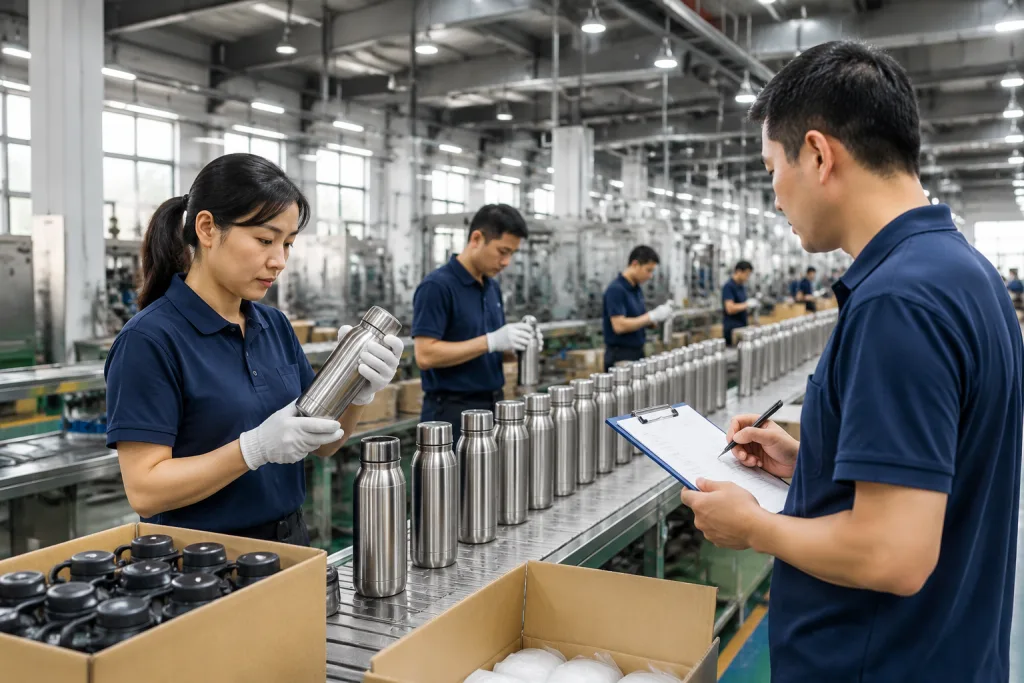
QC should start before cartons are sealed. On a stainless thermal bottle line, the usual misses are leaks, vacuum loss, coating scratches, logo shift, lid odor, rust spots, carton crush, and SKU mix-ups. We run these out with checkpoints from raw tube to packed master carton, and the buyer pushback we hear most is “can’t you inspect at the end?” No, that is the wrong question.
Start with incoming checks on stainless steel, food-contact plastic, silicone rings, and coating powder. For EU buyers, REACH and LFGB are the usual asks. For the US, FDA food-contact rules apply, and children’s items may also need CPSIA plus the right ASTM standard. Canada has its own food-contact and labeling checks. Do not accept a vague “all certificates available”; we match the paper to the exact material lot and keep the batch code on the COA.
Run first-article inspection after the first 50-100 pieces. That is where we catch color drift, logo offset, cap fit, and pack-out mistakes before the line runs thousands. For orders above 10,000 pieces, or a new supplier, a mid-production check saves pain later. Final random inspection should follow AQL, usually level II with AQL 2.5 for major defects and AQL 4.0 for minor defects. Leakage and sharp edges stay at zero tolerance. We have seen one bad carton slit turn into a mixed-SKU claim; the math does not work.
For leak testing, we use water fill, inversion, pressure checks where needed, and lid torque review with a calibrated torque wrench. For insulation, pull a sample with 95°C water, room temperature around 20°C, then record results at 6, 12, and 24 hours. For coating, cross-hatch adhesion and rub tests catch trouble before the market does. QC pulled a sample once with a 0.2 mm paint chip at the shoulder; better to see it on the line than from a buyer photo.
Inspection PO line items:
- AQL standard, sample size, and defect classification
- Required lab tests and who pays if the first test fails
- Inspection booking window and factory access permission
- Golden sample, artwork file, and packing file used for comparison
- Corrective action deadline before balance payment
Plan freight before cartons exist
I’ll rewrite the section in-place, keeping the HTML structure and all existing tags intact while tightening the sales-engineer tone and adding concrete freight details.Logistics is not a side note for custom drinkware. Stainless bottles are bulky, light for their size, and carton design changes landed cost fast. A 500 ml bottle may load 24 pieces per export carton; a 1.2 L customizable growler may load 12 pieces or fewer. If your packaging team switches from a white box to a thick retail gift box after quotation, CBM can jump 15-30%, and the freight bill follows.
Ask your stainless thermal bottle supplier for carton dimensions, gross weight, net weight, HS code, pallet plan, and loading quantity before PO release. We had a buyer flag a PO typo on the carton size once, and that 3 mm mistake changed the whole loading plan. For sea freight, many buyers run FOB Ningbo or FOB Shanghai from Zhejiang factories. FOB gives you control of the forwarder and destination charges. CIF looks simple, but the math on destination fees does not always work. For Amazon or 3PL delivery, label rules need to be locked before cartons go to print. FNSKU, carton labels, suffocation warnings for polybags, and pallet height limits all need sign-off first.
If you are a canteen distributor serving multiple retailers, consider master carton neutrality. One neutral export carton can support several retailer labels with less inventory risk. We ship this way when the buyer wants to keep 2 or 3 retail accounts live on the same SKU. If you are buying canteen promotional goods for a fixed event date, build in a buffer. A 5-day production slip plus a 7-day vessel rollover can kill the launch.
For North America, sea freight often takes 25-40 days port to port, depending on route. Europe is commonly 30-45 days. Air freight works for samples and urgent top-ups, but stainless bottles get expensive fast because dimensional weight bites hard. QC pulled the sample last week on a 750 ml bottle, and the outer carton drove more air cost than the bottle itself.
Shipment PO line items:
- Incoterm, port, forwarder, and cargo ready date
- Carton size, carton weight, pieces per carton, and total CBM
- Label requirements: FNSKU, UPC, carton mark, pallet label
- Documents: commercial invoice, packing list, BL, CO, test reports
- Penalty or remedy if shipment misses the agreed event deadline
Build the reorder system
I’ll rewrite the section in place, keep the HTML intact, and tighten the sales-engineer tone with concrete reorder details.The first order shows whether the bottle can be made. The second order shows whether the supplier can keep your program moving. If you are building a customizable canteen line, a distributor drinkware catalog, or a private-label outdoor range, the reorder file matters more than a first-shipment discount.
After bulk delivery, check defect rate, customer feedback, insulation complaints, lid returns, coating scratches, and carton damage. Send the numbers to your canteen factory with photos and the PO number. A serious factory will change process settings, not argue over every image. We had one buyer flag 1.8% base chips on a 500-piece lot; QC pulled the sample, and the fix was tray spacing plus 8 minutes more curing time, not a new mold. If customers complain about lid smell, the silicone supplier and post-curing step need a reset.
Set reorder rules before stock gets thin. Confirm whether the factory keeps steel, lids, and coating powder in steady supply. For custom colors, ask for the minimum powder order and shelf life in months, not vague promises. If your canteen customizable line has six colors and three capacities, cut part count where you can. Shared lids and shared cartons lower MOQ pressure and make spares easier to run.
Forecasts only work when they match the line. If you tell canteen manufacturers you may buy 200,000 pieces but start with 800 pieces, the math does not work and the price will show it. Give a clean forecast: 3,000 pieces first PO, 6,000 pieces reorder after 60 days if sell-through stays above 70%, annual estimate 30,000 pieces. That lets the canteen supplier plan 304 stainless, lid inventory, and carton slots with less guesswork.
Reorder PO line items:
- Previous PO number, defect report, and approved improvement points
- Repeated SKUs, new colors, and discontinued versions
- Spare lids, gaskets, straws, brushes, and replacement parts
- Updated forecast by quarter and required delivery windows
- Agreement on whether tooling, artwork, and color standards remain unchanged
Send your RFQ before you commit the PO
Share capacity, quantity, logo, market, and target date. We will return a practical quote with MOQ, lead time, and sampling steps.
Frequently asked questions
What MOQ should I expect from a stainless thermal bottle supplier?
For existing molds, a realistic MOQ is usually 1,000 pieces per color for stainless thermal bottles. Some canteen suppliers may accept 500 pieces if you use stock colors, stock lids, and simple laser engraving, but the unit price will be higher. For custom canteen shapes, custom lid colors, or a customized growler with new tooling, MOQ often moves to 3,000-5,000 pieces because material, mold setup, and line changeover costs are higher. If you are testing a distributor canteen program, start with one capacity and two colors instead of six SKUs. That keeps inspection, packaging, and inventory easier to control.
How long does sampling and bulk production normally take?
For an existing bottle mold, stock samples normally take 3-5 days, and logo samples take 7-10 days after artwork approval. Pantone powder coating samples may add 3-5 days. Bulk production is usually 30-40 days after deposit and approved pre-production sample. During September to November, many China factories are handling Q4 and holiday orders, so 45-55 days is safer. New mold projects need more time: 10-15 days for drawings, 20-30 days for tooling and first samples, then normal production time after approval. Always write the lead time trigger on the PO: deposit date, sample approval date, or artwork approval date.
Which logo method is best for customized drinkware?
It depends on the finish, budget, and brand standard. Laser engraving is durable and clean on powder-coated stainless bottles, usually adding USD 0.08-0.20 per piece depending on logo size. Silk screen printing works well for one or two colors and can be cheaper on larger runs, but adhesion needs testing. Heat transfer or full-wrap printing is better for complex graphics, but setup cost and defect risk are higher. For canteen promotional orders with tight budgets, laser or one-color silk screen is usually safest. For retail customized drinkware, request a logo sample and run tape adhesion, rub, and dishwasher-related checks if your market expects it.
How do I compare canteen manufacturers beyond unit price?
Ask each canteen manufacturer for the same technical quote sheet: steel grade, wall thickness, lid material, silicone grade, coating thickness, packing method, test standard, MOQ, lead time, and FOB port. Then compare what is included. A USD 3.10 quote with no REACH test, thin carton, and unknown lid material may cost more than a USD 3.35 quote once you add testing and replace damaged goods. Also check communication speed and engineering detail. A good factory can explain vacuum testing, AQL, carton drop resistance, and why a certain lid design costs USD 0.18 more. Cheap silence is not a sourcing strategy.
Can I use one supplier for bottles, growlers, and canteens?
Yes, if the supplier has the right production scope and stable upstream partners. Many stainless drinkware factories in Zhejiang can handle thermal bottles, custom growler orders, sports bottles, and some canteen customized projects from existing molds. But do not assume every canteen factory is strong in every category. A 350 ml coffee tumbler, a 1.9 L customized growler, and a narrow-mouth hiking canteen have different lid sealing and insulation challenges. Ask for category-specific samples, current monthly capacity, and inspection records. If you are a canteen distributor, using one qualified supplier can reduce artwork control problems and simplify spare parts management.