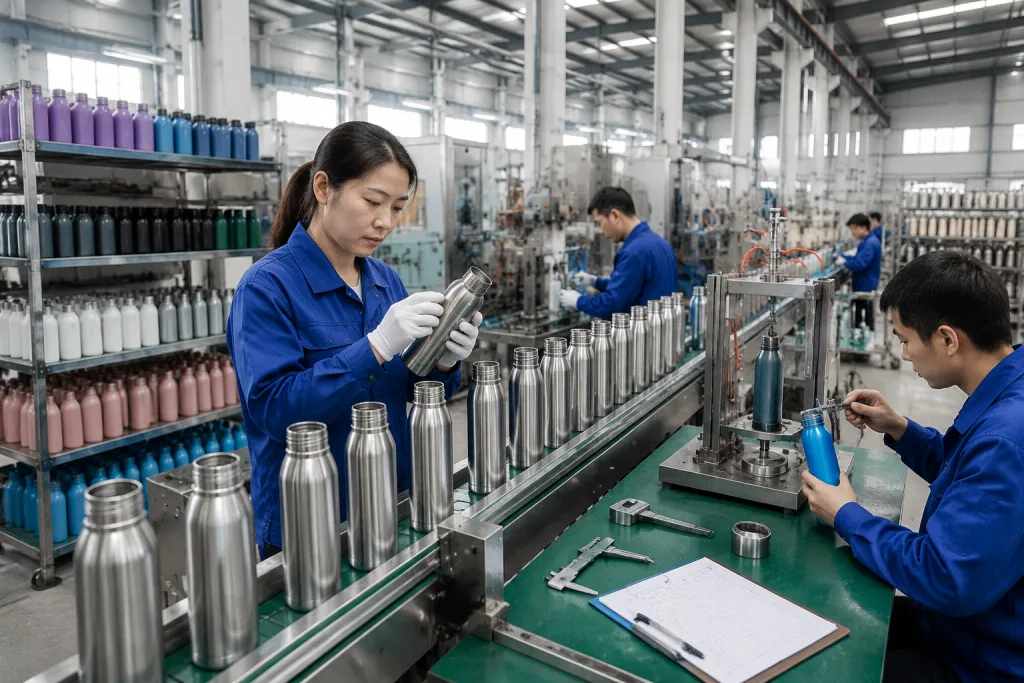
Key Takeaways
- Specify 304 stainless steel at 0.45-0.55 mm body thickness for most retail thermal bottles
- Use AQL Level II with 0/1 critical defects for leakage and vacuum failure
- Plan 35-45 days mass production after approved sample for a 3,000-10,000 unit order
- Confirm logo process, carton strength, and lid torque before paying the 70% balance
A stainless thermal bottle looks simple until a 40HQ lands with loose lids, vacuum loss after 24 hours, chipped powder coat, or master cartons that collapse in a 76 cm drop test. Then nobody is talking about the design mockup. The fight is over rework cost, air freight, 3,000 replacement units, and the retail date the buyer already promised.
We run stainless thermal bottle orders in Hangzhou, Zhejiang, and we see the same avoidable problems on custom drinkware jobs every month. QC pulled a sample last week where the PO said “matte black,” but the approved color chip was PMS Black 6 C; that 1-line mismatch can stop the line. Most failures start with loose specs, rushed samples, promo pricing that leaves no room for proper coating, or a buyer assuming every canteen factory in China uses the same steel grade, laser welding setup, vacuum test time, and inspection standard. That is the wrong bet.
Failure starts with loose specifications
The first production failure usually happens before any steel is cut. A buyer asks for a custom canteen, customizable canteen, or distributor canteen and sends 1 photo, a 500 ml target, and a logo file named “final-logo-new2.ai.” That is not a manufacturing specification. It is a direction. Our drawing engineer still has to ask for body diameter in mm, lid thread type, Pantone code, and carton drop-test target before the line can quote cleanly.
For stainless vacuum bottles, lock the commercial and engineering details together. A canteen supplier may quote USD 3.20 and another canteen vendor may quote USD 4.10 for what looks like the same 500 ml bottle. The gap is not magic. It may be 201 versus 304 stainless steel, 0.38 mm versus 0.50 mm wall thickness, a thin painted lid instead of food-grade PP, or skipping 100% vacuum testing on the vacuum tester. We have seen this go sideways: QC pulled the sample after 8 hours, and the hot-water drop was already 12°C worse than the approved sample.
For B2B buying, your RFQ should state the intended market and then pin down capacity tolerance, steel grade, surface finish, lid and gasket material, logo method, packaging, compliance, and inspection plan with measurable limits. If you sell in Europe, ask for LFGB or EU food-contact test history. If you sell in North America, ask about FDA food-contact expectations and whether CPSIA or ASTM applies for kids products. The buyer often flags price first, but this is the wrong question to ask if the PO still says “silver finish” instead of brushed 304 stainless with Ra target and 2 mm logo position tolerance.
At BottleForge in Zhejiang, our practical MOQ for custom drinkware is usually 1,000 units per color for existing molds, with a monthly output around 300,000 stainless bottles across thermal bottles, travel tumblers, and canteen customized programs. Below that, setup loss, color matching, and inspection cost become too high per unit. The math doesn't work. We run spray-line color matching with a standard light box, and changing from matte black to PMS 5483C can burn 2–3 kg of powder before the first approved bottle reaches the packing table.
Do not ask only, “What is your best price?” Ask, “What exactly changes if we reduce the price by USD 0.30?” That answer tells you whether the canteen manufacturer understands export risk, because someone has to say if the saving comes from thinner steel, cheaper gasket material, fewer leak checks, or 12 days lead time becoming 18 days after rework.
Vacuum loss is not random
The costliest failure for a stainless thermal bottle manufacturer is weak insulation. The bottle can pass a visual check, take a clean logo print, and still fail after the first hot-water fill because the vacuum layer has leaked. We see it from bottom weld pinholes, dust left before sealing, uneven copper plating, or cartons dropped after vacuum pumping. QC pulled one 750 ml sample last month that looked perfect under the lamp, but the bottom weld showed a 0.3 mm burn mark after we cut it open.
A proper double-wall bottle needs vacuum testing on the line, not just a quick look at the shell. For 500-750 ml bottles, 95°C water staying above roughly 60°C after 6 hours is a common buyer target, depending on mouth size, cap design, room temperature, and the exact test method. The test room matters. We run ours at 20-25°C, and a loose cap gasket can change the result by 4-6°C. Wide-mouth bottles, custom growler formats, and customized growler products lose heat faster than narrow-mouth bottles, so copying one insulation claim across every SKU is the wrong move.
If you are comparing canteen manufacturers, ask how they test vacuum performance and where the reject bottles go after testing. A serious canteen factory should tell you whether it runs automated vacuum detection, thermal imaging, hot-water sampling, or two of these steps together. For export lots, we push for 100% vacuum screening during production, then finished-goods sampling during final inspection. In an AQL inspection, vacuum failure belongs in critical defects, not minor cosmetics. We have seen this go sideways when a buyer approved cartons after checking only scratches and logo position.
Buyers sometimes ask for ultra-light bodies to save freight and stainless cost. The math doesn't work past a point. For most retail stainless bottles, a body wall below 0.40 mm increases denting and makes the drawing line less stable, especially near the shoulder radius. Our tooling tech checks wall thickness with a digital micrometer at 6 points before mass production. For a premium customized canteen or distributor growler, 0.50-0.60 mm makes more sense. The unit price rises, but you cut returns and keep the product feeling worth the shelf price.
Leaking lids ruin good bottles
Leakage is where 4 out of 10 custom drinkware complaints start after the consumer opens the carton. The bottle body may pass vacuum and wall-thickness checks, but the cap thread, silicone gasket, straw vent, push button, or carry loop gets the blame. We see this most often when a buyer pairs our existing 500 ml body with a new lid for a canteen customizable program and asks the line to “make it look exclusive.” The math doesn’t work if the lid was never matched on a thread gauge.
Lids need their own specification. Confirm material such as food-grade PP, Tritan, stainless steel insert, or bamboo cover. Confirm gasket Shore hardness, gasket color, and whether the gasket is removable without a pick tool. For a sports lid, check straw fit, air venting, bite valve pull strength, and whether the lid passes a 180° inversion leak test for 30 minutes. For a screw lid, check thread engagement and closing torque, usually 0.6-0.9 N·m on our torque meter. A cap that feels smooth on one sample can bind during mass production if the mold tolerance opens by 0.15 mm.
We run three leakage checks: incoming gasket inspection, in-line water fill with inversion testing, and final random testing after logo and packing. QC pulled the sample last month because 18 of 500 lids had twisted gaskets after assembly. Simple problem. Big mess. For high-risk canteen promotional orders with low price points, ask for a tighter lid check; promotional users are less forgiving than people assume, and we’ve seen this go sideways after a supermarket giveaway.
AQL should separate critical and major defects. Leakage, broken lid structure, and detached carry handles should be critical or major depending on the failure mode. Small flow marks on hidden plastic can be minor if they stay outside the sealing face. During pre-shipment inspection, the buyer flagged a checklist that grouped “lid scratch” and “water leak” under one line item; that checklist was useless. If your inspection agency treats all lid problems the same, rewrite it before production starts.
For canteen distributors and distributor drinkware programs, spare lids are worth discussing. Adding 1-2% spare lids to a bulk shipment can solve after-sales issues faster than negotiating a replacement shipment from China six weeks later. On a 3,000 pcs order, that means 30-60 spare lids, usually packed in a marked inner carton so the warehouse team does not lose them. Cheap insurance.
Coating defects are usually predictable
Powder coating, spray painting, and plating defects usually start before the bottle reaches the spray booth. We see them after weak alkaline degreasing, a curing oven running 165°C instead of the 180°C on the powder TDS, 6 extra hand touches between washing and hanging, or a buyer asking for a soft-touch gradient at a USD 0.18 finish budget. The math doesn't work.
For a stainless thermal bottle manufacturer, matte powder coating is the daily workhorse because it gives grip and holds up better than basic spray paint. Not all powder is the same. Specify coating type, target gloss in GU, Pantone reference or a physical color chip, adhesion expectation, and whether the bottle must pass a cross-hatch test. For retail or premium customized drinkware, we run the 3M tape pull after cross-hatch; QC pulled one 750 ml sample last month where 4 squares lifted at the shoulder radius. For rugged outdoor canteen customized products, ask for the exact abrasion method and dishwasher cycle count, not a loose “dishwasher safe” claim.
Laser engraving is stable on stainless and powder-coated surfaces, but it cuts through the finish and the mark can shift if coating thickness moves from 60 μm to 90 μm. Silkscreen printing is cost-effective for simple logos, usually from around USD 0.05-0.12 per position depending on size and colors. Heat transfer and UV printing give more color detail, but scratch testing and alcohol-rub testing must be written into the sample approval. A cheap logo that fails after 30 rubs with 75% alcohol is not cheap when a canteen distributor rejects 2,000 pcs at inbound QC.
Color matching is another common failure point. Digital Pantone values are not enough. Approve a sprayed metal sample under D65 light if color accuracy matters, and write the acceptable ΔE limit on the PO. We had one buyer flag “Pantone 7499C” in the email while the PO said “7499U”; the line stopped for 2 hours while sales, QC, and the powder supplier checked chips. In Zhejiang humidity, rainy-season drying and handling discipline matter too; a clean coating line in China controls dust, fingerprints, and the curing window, not just the spray booth.
Packaging fails before the product does
A bottle can pass production QC and still reach the buyer with dents because nobody respected the carton spec. We see it on the packing line: the vacuum test is clean, the paint film passes the 3M tape pull, then QC pulls a carton after the vibration table and finds two lids rubbed through the bag. Export packaging is not decoration. It is insurance against compression, vibration, moisture, and rough handling during truck loading, ocean freight, warehouse unloading, and parcel delivery.
For wholesale canteen suppliers, the packaging spec should name the PE bag thickness, individual box board grade, master carton ply, carton dimensions, gross weight limit, and drop-test requirement. A common export master carton is five-ply corrugated, but five-ply from one paper mill is not the same as five-ply from another. We run 48 cm x 36 cm x 32 cm cartons often, and the corner crush changes fast when the buyer pushes us to add 6 more bottles per carton. For Amazon FBA or distributor drinkware shipments, confirm labels, FNSKU placement, suffocation warnings, and carton weight limits before mass packing, not after the first 80 cartons are taped.
For stainless bottles, we prefer keeping master cartons below 15-18 kg gross weight when possible. Heavy cartons get dropped harder. Tall bottles need divider protection or snug individual boxes so they do not hammer each other during transport; QC pulled a 750 ml sample last month with a clean body but a lid ring mark caused by loose packing. Custom growler and customizable growler products need stronger bottom support because the unit weight is higher. Glass-lined or glass bottle projects need a different damage allowance and a stricter drop-test plan.
Buyers often remove individual boxes to cut USD 0.12-0.25 per unit. The math doesn't work if the sales channel rejects scuffed goods. That saving can pass for some bulk promotional orders, but only when the bottle has a protective sleeve or egg-crate divider and the buyer accepts small rub marks in writing on the PO. For retail, gift, and premium canteen vendor programs, under-packing is a false saving; we have seen one typo, "no color box," turn into 3 pallets of repacking work.
Ask your canteen manufacturer for packed carton photos, carton markings, pallet plan, and one finished packed sample before full packing. We normally shoot the sealed carton on the floor scale, show gross weight in kg, then stack 1 pallet plan with carton count and arrow marks visible. Change the carton early. It is easier to fix a carton before 500 cartons are sealed.
Compliance cannot be patched later
Compliance failure is not the same as a scratch or dent. You cannot buff it out with a Scotch-Brite wheel. If your stainless bottle, custom canteen, or customized growler lands in Europe or North America without the right test basis, we have seen shipments sit 12 days instead of 3 at the forwarder while the buyer asks for relabeling, recall wording, or a retailer rejection memo.
For stainless thermal bottles, the compliance check usually covers food-contact safety for 304 stainless steel, silicone seals, PP or Tritan lids, powder coating, and printed inks. Europe may require LFGB or EU 1935/2004-related documentation depending on the buyer and market. REACH comes up for restricted substances in coatings, paints, and accessories; our QC once pulled a matte green lid because the coating code on the BOM did not match the SGS report. North American buyers may ask for FDA food-contact declarations, California Proposition 65 assessment, or CPSIA/ASTM requirements for children’s bottles.
Factory audits matter too. BSCI, Sedex, ISO 9001, and retailer-specific audits do not guarantee a perfect bottle, but they tell you whether the factory keeps labor files, inspection records, and 8D corrective actions in order. On our line, a retailer auditor once spent 42 minutes checking AQL 2.5 records against carton labels and found one PO typo: “mat black” instead of “matte black.” If you are appointing a canteen supplier for repeat distributor canteen programs, audit status affects whether the channel stays open after the first container.
Old test reports are not enough. This is the wrong question to ask. A report for a black 500 ml bottle with one lid does not automatically cover a newly painted 750 ml bottle with a straw lid and four-color logo, because the powder, ink, silicone ring, and drinking path changed. Before production, ask your China supplier to map every food-contact part and decorated surface to available reports; we run this against the BOM, color chip, lid drawing, and 0.2 mm gasket spec before releasing PP samples. If there is a gap, test pre-production samples, not finished goods waiting in a warehouse.
This is where cheap canteen vendors get expensive. They may quote fast FOB Ningbo pricing, then fail when the buyer asks for material traceability, batch records, or corrective action within 48 hours. We have seen this go sideways over a missing silicone batch number on 3,000 lids, and the math does not work once air freight replaces the planned sea shipment.
Late shipments expose weak planning
Delays usually show up early if someone is watching the line board. Stainless bottle production moves through material purchase, body forming on the hydraulic press, seam welding, vacuum processing, polishing, powder coating or spray painting, logo application, assembly, inspection, packing, and booking. If vacuum yield drops 4% on Tuesday, packing will feel it next week.
For an existing mold and approved artwork, we quote 35-45 days after deposit and sample approval for a 3,000-10,000 unit order. New mold work can add 20-35 days depending on lid structure, thread depth, and whether the 2D drawing matches the 3D file. Peak-season capacity in China, especially before major holidays, needs earlier booking. Zhejiang factories move fast, but the math does not bend: one curing line may handle 18,000 coated bodies per day, while a vacuum station tops out at its fixed rack count.
Your purchase order should carry milestone dates for pre-production sample approval, bulk material confirmation, first finished units, mid-production inspection, final inspection, and estimated vessel closing. We once had QC pull the first finished sample on day 19 and find the Pantone code typed as 186C on the PO while the approved artwork said 185C. Small typo. Big argument. If you are a canteen distributor or working with multiple canteen distributors, do not promise launch dates from the supplier’s first cheerful email; we have seen this go sideways.
Payment terms shape control. A common structure is 30% deposit and 70% balance before shipment. Tie the balance to passed final inspection and complete shipping documents, including packing list, invoice, and BL draft checked against carton marks. For FOB terms, confirm port, usually Ningbo or Shanghai for Zhejiang production. For DDP quotes, ask what is inside the number because tax, duty, pallet charge, and delivery appointment rules change by country.
A good stainless thermal bottle manufacturer will tell you the risk before it lands on your desk. If the logo needs two-hit screen printing, the lid mold has flash at the 0.3 mm seal edge, or the requested price cuts out incoming material checks, you should hear it during sampling. Not after AQL 2.5 final inspection fails and the buyer flags 27 scratched lids.
Send your bottle spec before you request pricing
Share capacity, steel grade, logo, packaging, target market, and order volume. We will flag manufacturing risks before quoting.
Frequently asked questions
What MOQ should I expect from a stainless thermal bottle manufacturer?
For existing molds, a practical MOQ is usually 1,000 units per color for custom logo work and 3,000 units per color for custom powder coating. Some canteen suppliers accept 500 units, but the unit price is higher and color control is weaker because coating line setup loss is spread over fewer bottles. For a fully custom canteen or new lid mold, expect 5,000-10,000 units depending on tooling cost and structure. At BottleForge in Zhejiang, we normally recommend starting with an existing mold if you are testing a new distributor drinkware program.
How do I compare quotes from different canteen manufacturers?
Do not compare only FOB unit price. Ask each canteen manufacturer to confirm steel grade, body wall thickness, lid material, coating type, logo method, packaging, inspection level, and compliance documents. A USD 0.40 difference can come from real material changes, not margin. For example, 304 stainless steel at 0.50 mm, powder coating, individual box, and 100% vacuum screening will not cost the same as thinner steel, basic paint, bulk packing, and random checks. Put every supplier into the same RFQ table before choosing.
Which logo method is best for customized drinkware?
For simple permanent branding, laser engraving is the safest choice because it does not peel and works well on stainless or powder-coated bottles. Silkscreen printing is economical for one- or two-color canteen promotional orders, often around USD 0.05-0.12 per print position. UV printing or heat transfer is better for full-color artwork, but you should test scratch resistance and alcohol rub performance. If the product will be sold at retail, approve a decorated sample and include the logo defect standard in the AQL checklist.
Can I make a canteen customizable for several distributors?
Yes, but plan the platform carefully. You can use one bottle body and change color, logo, lid, sleeve, or packaging for different canteen distributors. This keeps tooling cost down and improves production stability. The risk is SKU complexity. If you run 6 colors, 4 logos, and 3 packaging types in one order, packing mistakes become more likely. Use barcode labels, clear carton marks, and a packing matrix. For mixed distributor canteen programs, we suggest a pre-packing audit before final carton sealing.
What inspection standard should I use before shipment?
Use ANSI/ASQ Z1.4 or ISO 2859-1 sampling with General Inspection Level II for most finished-goods inspections. Set critical defects at 0 acceptance for leakage, vacuum failure, unsafe sharp edges, broken lids, and wrong food-contact materials. Major defects can include visible coating chips, wrong logo placement, loose assembly, or damaged retail packaging. Minor defects cover small cosmetic marks within an agreed limit. For a 5,000 unit lot, your inspector may check around 200 units depending on AQL settings, but vacuum and leakage controls should also happen during production.