Key Takeaways
- Typical stainless thermal bottle bulk MOQ starts at 1,000 pieces per model/color for standard molds
- 304 stainless steel with 0.45-0.55 mm inner wall thickness is common for retail-grade vacuum bottles
- A realistic custom logo lead time is 30-45 days after deposit, artwork approval, and pre-production sample sign-off
- For drinkware bulk orders, use AQL 2.5/4.0 inspection and specify REACH, LFGB, FDA, or ASTM needs before quotation
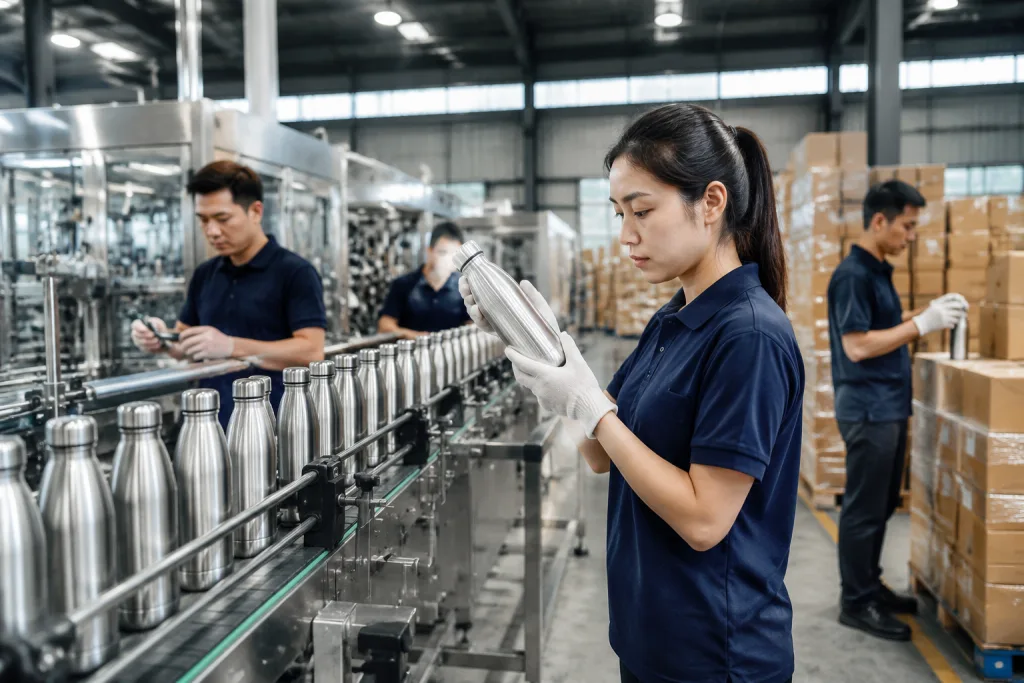
Buying stainless thermal bottle bulk is not like buying one carton of samples. After 1,000 pieces, a 0.1 mm change in steel thickness, a different PP lid insert, powder coating loss, carton CBM, or AQL 2.5 inspection plan can move your margin and your ship date. QC pulled one 1,500-piece sample run last month because the buyer approved the shape but never locked the lid torque target.
We manufacture in Zhejiang, China, and most failed projects we see do not fail because the bottle is complicated. They fail because the buyer writes “premium bottle” on the PO, then leaves 304 stainless grade, vacuum test time, coating thickness, and carton drop test undefined. Bad start. If you are sourcing wholesale drinkware, a bulk canteen, or a beer growler bulk program, get the numbers fixed before artwork; we have seen this go sideways over a 2 mm logo placement change after mass production started.
What are you actually buying?
I’ll rewrite the section in-place, keep the HTML tags untouched, and tighten the copy so it sounds like a factory-side sales engineer wrote it.A stainless thermal bottle bulk order is a build sheet, not just a bottle. Buyers usually start with capacity and color. We start with body shape, steel grade, vacuum pull, lid resin, coating, logo method, packing, and the test plan. Leave one item vague, and the quote moves. QC pulled a sample on the line last week because the lid spec was missing, and the price gap was USD 0.22 a piece.
For standard wholesale drinkware, the usual build is 18/8 304 stainless steel on the inner wall and 304 or 201 stainless steel on the outer wall. A retail-grade bottle often runs 0.45-0.55 mm steel before forming. Go thinner and FOB can drop USD 0.15-0.35 per piece, but the body dents easier; we’ve seen that go sideways in sports and travel accounts. The buyer flagged a PO typo once because the wall thickness was written as 0.5 mm on the sample, then 0.05 mm on the order.
Vacuum insulation is a number, not a slogan. For a 500 ml bottle, a solid target is hot water staying above 55°C after 12 hours, using 95°C water at room temperature. A 1.9 L bulk growler carries more thermal mass, but the cap stack and mouth size matter more than the headline hold time. We run a 12-hour hot test with a probe in the workshop, and the math does not work if the lid leaks air.
When you ask for drinkware wholesale pricing, name the use case first: office bottle, outdoor canteen bulk order, beer tumbler bulk promotion, alcohol flask bulk gift set, or kids retail bottle. Each one has a different weak point. A wholesale canteen needs strap pull strength and leak testing. A wholesale growler needs cap sealing and inner polishing. An alcohol flask wholesale bulk order needs clean welds and a shape that sits well in a pocket. This is the wrong question to ask if you only ask for “best price.”
Questions before you request price
I’ll keep the HTML exactly as-is and rewrite only the prose to sound like a factory-side sales engineer. First I’m checking the repo rules, then I’ll patch the section in place.I’ve got the target section. Next I’m applying a tight rewrite with concrete factory details, fewer fillers, and the same tag structure.The quickest way to get a weak quote is to send a photo and ask for “best price?” We quote faster when the spec is tight, because the line needs real inputs before we can lock cost and lead time. If you want a drink bottle that fits your channel, start with a clean buying sheet.
- Capacity: 350 ml, 500 ml, 750 ml, 1,000 ml, 1.9 L, or custom.
- Material: 304 inner/201 outer, full 304, or 316 inner for higher corrosion resistance.
- Finish: powder coating, spray painting, electro-polish, mirror polish, or raw brushed steel.
- Logo: laser engraving, silk screen, heat transfer, 3D UV print, or embossing.
- Packaging: white box, kraft box, color box, gift box, or e-commerce drop-test carton.
- Compliance: FDA, LFGB, REACH, BPA-free declaration, Prop 65, ASTM where relevant.
- Delivery term: FOB Ningbo, FOB Shanghai, CIF, DDP, or Amazon FBA prep.
At BottleForge in Zhejiang, our MOQ on most stainless models is 1,000 pieces per SKU: one body, one color, one logo file. For a new private mold, tooling usually runs USD 3,000-12,000, and the lid set often decides where that number lands. We ship about 450,000 stainless vacuum drinkware units a month, but that only works when the buyer sends a full spec pack before we slot the order.
Do not approve a quotation until the supplier confirms the same spec sheet you intend to inspect against.
Price ranges that make sense
For stainless thermal bottle bulk sourcing, FOB price follows the spec sheet, not a country slogan. In Zhejiang, we run steel forming, powder coating, plastic injection, silicone sealing, and carton packing within a short trucking radius; last month one lid mold moved from Yuyao to our Hangzhou line in 2 days. That tight chain helps. It does not make every low quote safe.
As a working reference, a standard 500 ml double-wall stainless bottle with powder coating and one-color logo often lands around USD 2.20-3.80 FOB China at 3,000 pieces, depending on lid design and packaging. A 750 ml sports bottle may run USD 3.00-5.20. A 1.9 L beer growler in bulk can sit around USD 7.50-13.50 because the steel area is larger, the handle adds parts, and the master carton gets heavier; our QC scale often shows 16-19 kg per carton on these. A beer tumbler wholesale bulk project at 16 oz may be USD 2.10-4.00.
Small flasks price differently. Alcohol flask in bulk orders can look cheap, sometimes USD 0.90-1.80 FOB for simple 6 oz models, but polishing marks, cap tolerance, and weld leakage need real checking. QC pulled the sample once after 30 seconds in the air-pressure leak tester, and the buyer flagged the cap thread before we did. For alcohol flask wholesale, ask for 100% leak testing, not random checking.
Be careful with “same as sample, lower price” negotiations. This is the wrong question to ask. A factory can cut cost by changing outer steel from 304 to 201, reducing wall thickness by 0.05-0.10 mm, switching to a cheaper powder, simplifying the lid, or packing in thinner cartons; we have also seen POs where “304 inside” became “SS inside” after three email rounds. Some changes work for promotional drinkware bulk. They do not work for premium retail wholesale drinkware. Ask the supplier to show each cost lever, line by line.
How to control custom branding
Branding is where 7 out of 10 procurement delays start. For stainless thermal bottle bulk orders, the logo method has to match the surface finish and the retail life your buyer expects. Laser engraving works cleanly on powder coating and bare steel, and we run it with a 0.08 mm beam setting on most 304 stainless bodies. It stays put. It does not suit full-color artwork. Silk screen is cheaper for one or two spot colors, but curved bodies need a proper jig or the logo will climb 1-2 mm at the edge. Heat transfer and 3D UV can carry more detail, but QC needs to pull samples for adhesion before the line opens.
If you are buying canteen wholesale for outdoor retail, test the printed logo with 3M tape pull, 50-cycle dishwasher simulation if required, and abrasion rubbing. We usually rub 500 cycles with a 500 g load when the buyer asks for retail shelf life, not just a promo giveaway. For beer tumbler in bulk promotions, event-level durability may pass, but retail buyers often reject that standard. For beer growler wholesale bulk, large logo placement on curved shoulders can stretch the artwork; we have seen a round badge turn oval by 3 mm when the file was not adjusted.
Packaging also carries brand risk. A color box with the wrong barcode, missing recycling mark, or incorrect capacity claim can stop goods at the warehouse even when the bottle passes AQL 2.5. We had one PO where “750ml” was typed on the carton, but the approved bottle was 700ml; the buyer flagged it before shipment, luckily before we sealed 186 master cartons. If you ship to the United States, set UPC or FNSKU placement before artwork approval. If you ship to Europe, confirm language, importer details, recycling symbols, and claims such as “BPA free” or “keeps hot 12 hours.” Claims need test data behind them. The math does not work if marketing writes first and the lab tests later.
Our normal custom sample sequence is digital mockup in 1-2 days, physical pre-production sample in 7-12 days, then mass production after written approval. For a simple logo on an existing model, total lead time is usually 30-45 days after deposit, assuming the artwork file is vector and the Pantone code is confirmed. Complex gift sets or new lids can push this to 60 days. Small detail, big delay: if the PO says matte black but the artwork sheet says PMS Black C, QC will stop the sample until sales confirms which black we ship.
Quality checks buyers should require
I’ll rewrite the section in place, keep the HTML intact, and make the language sound like a factory-side sales engineer wrote it.Put inspection inside the purchase order. If it comes up after cartons are packed, the buyer and the line both lose time. For wholesale drinkware, we run AQL 2.5 for major defects and AQL 4.0 for minor defects unless the channel spec is tighter. Leakage, sharp edges, contamination, and unsafe components stay at zero tolerance.
For stainless bottles, the checklist should cover capacity, weight, wall dents, coating thickness, color variation, logo position, cap torque, silicone ring fit, odor, inner cleanliness, and carton drop strength. We usually check vacuum performance with hot water testing or thermal imaging. On one 500 ml run, QC pulled the sample after a 2 mm print shift, and that kind of miss is cheaper to catch before packing. A common factory flow is 100% vacuum testing before packing, then random finished-goods inspection.
For bulk canteen or wholesale canteen projects, check handle pull strength, strap rivets, lid hinge life, and mouth thread smoothness. For growler bulk orders, we lay the bottle horizontal for 4-8 hours and then check the cap seal. For beer growler wholesale, some buyers ask for pressure-related evaluation if the product is tied to carbonated drinks. The math does not work if the bottle was never designed for that use, so do not claim pressure retention without testing.
Compliance has to match the target market. FDA food-contact expectations are standard for the U.S. market. LFGB is common for German and EU buyers. REACH can apply to coatings, paints, and some accessories. For children’s drinkware, ASTM and CPSIA may apply. A BSCI or ISO 9001 factory audit helps your supplier file, but it does not replace product testing; we have seen buyers get burned when they treated the audit report like a lab result.
Ordering plan and shipment checklist
I’ll rewrite just the prose inside the existing HTML, keep every tag and the heading structure unchanged, and tighten the copy so it reads like a factory-side sales engineer.A clean stainless thermal bottle bulk order follows the same shop-floor sequence every time: confirm spec, sign off the quote, pay deposit, approve artwork, sign off the pre-production sample, run mass production, do inspection, pay balance, ship. We have seen it go sideways when a buyer changes the powder coat after the line has already formed the steel, or tweaks the carton print after 3,000 boxes are finished.
For a first order, keep the SKU count tight. Three colors across two capacities already gives 6 SKUs. If the MOQ is 1,000 pieces per SKU, that is 6,000 pieces before you add spare lids or display boxes. For a distributor testing wholesale drinkware, the better move is one hero bottle, one canteen bulk model, and one beer tumbler wholesale item. Spreading budget across 10 weak SKUs is the wrong question to ask.
Carton planning hits landed cost hard. A 500 ml bottle may pack 24 pieces per export carton, while a large bulk growler may pack 6 or 12 pieces. Once the carton weight goes past 18-22 kg, warehouse crews start complaining, and QC will flag crushed corners on the stretch-wrap test. For Amazon or e-commerce, confirm master carton size, FNSKU labeling, polybag rules, and drop test requirements before we run production.
Payment terms for new buyers are usually 30% deposit and 70% before shipment after inspection. FOB Ningbo is standard for factories in Zhejiang, while FOB Shanghai works for some forwarders. If you need DDP, spell out duties, anti-dumping exposure, insurance, and delivery appointment fees. A cheap freight quote often leaves out the charges that show up at the destination warehouse.
The rule is simple: freeze the spec before deposit, freeze the artwork before sampling, and freeze the carton before mass production. That discipline protects margin more than chasing another USD 0.05 discount.
Send your bottle spec and target landed cost
We will review MOQ, tooling, packaging, compliance, and FOB options before you commit budget to a bulk order.
Frequently asked questions
What MOQ should I expect for stainless thermal bottle bulk orders?
For existing molds, expect 1,000 pieces per model/color/logo as a practical starting MOQ. Some simple drinkware bulk projects can run at 500 pieces if you accept stock colors and standard packaging, but the unit price is usually higher by 8-20%. For custom powder colors, factories often need 1,000-3,000 pieces because coating lines lose efficiency on small batches. New molds are different: you may need 3,000-5,000 pieces for the first run plus tooling cost. If your order includes 3 capacities and 4 colors, calculate MOQ by SKU, not by total order quantity.
How long does a custom wholesale drinkware order take?
For an existing stainless bottle with one logo and standard packaging, plan 30-45 days after deposit and sample approval. The pre-production sample normally takes 7-12 days after artwork confirmation. Mass production is often 25-35 days, depending on coating capacity and lid inventory. If you need a custom lid, color box, retail insert, or special compliance testing, allow 45-60 days. Before Chinese New Year, add at least 20-30 days of buffer. Zhejiang factories can move fast, but they cannot recover time lost to late artwork, barcode changes, or unclear inspection standards.
Which steel grade is best for a wholesale canteen or growler?
For most wholesale canteen and growler wholesale orders, 304 stainless steel for the inner wall is the baseline. It offers good corrosion resistance for water, tea, coffee, and normal beverage use. The outer wall can be 201 or 304 depending on budget and positioning. For premium outdoor or food-service programs, full 304 is cleaner to market. For more acidic or demanding beverage contact, some buyers choose 316 inner steel, but it increases cost. For beer growler in bulk orders, also focus on weld quality, inner polishing, and cap sealing. Steel grade alone does not guarantee performance.
Can I mix beer tumbler, alcohol flask, and bottle items in one order?
Yes, but MOQ and production timing are usually calculated separately by product family. A beer tumbler bulk order may run on a different forming line than an alcohol flask wholesale order. Lids, polishing, coating, and packaging may also use different workshops. You can consolidate shipment in one container or LCL booking, but do not assume one combined MOQ applies to all items. For example, 1,000 stainless bottles, 1,000 beer tumblers, and 2,000 alcohol flasks may be treated as three production lots. Consolidation saves freight and documentation time, not necessarily factory setup cost.
What inspection standard should I put on the purchase order?
Use AQL 2.5 for major defects and AQL 4.0 for minor defects as a normal starting point for wholesale drinkware. State zero tolerance for leakage, sharp edges, loose internal contamination, unsafe odor, and wrong food-contact material. Add specific tests: 100% leak test before packing, vacuum performance check, coating adhesion test, logo rub test, carton drop test, and capacity verification. If you sell in the EU, mention LFGB or REACH where applicable. For the U.S., include FDA food-contact expectations and any retailer-specific requirements. The PO should say who pays for reinspection if the first inspection fails.