Key Takeaways
- A workable first order is often 3,000-5,000 units with 30-45 day production from a canteen factory in Zhejiang.
- For retail-grade stainless steel tumbler vendors, ask for 304 steel, 0.5-0.7 mm wall thickness, and lid leak tests at 40-60 kPa.
- A realistic FOB China tumbler price is often USD 2.20-4.80 depending on finish, lid type, and decoration.
- Your QC should include AQL 2.5 for major defects, carton drop testing, and 100% visual checks for logo placement.
You are not buying tumblers. You are buying a repeatable result: the right wall thickness, the right coating, the right lid seal, the right carton count, and a shipment that lands without turning into a claims file. Stainless steel tumbler vendors should be judged like production partners, not catalog sellers. If you buy custom drinkware for retail, e-commerce, or promotions, one weak link can wipe out the margin on the whole order.
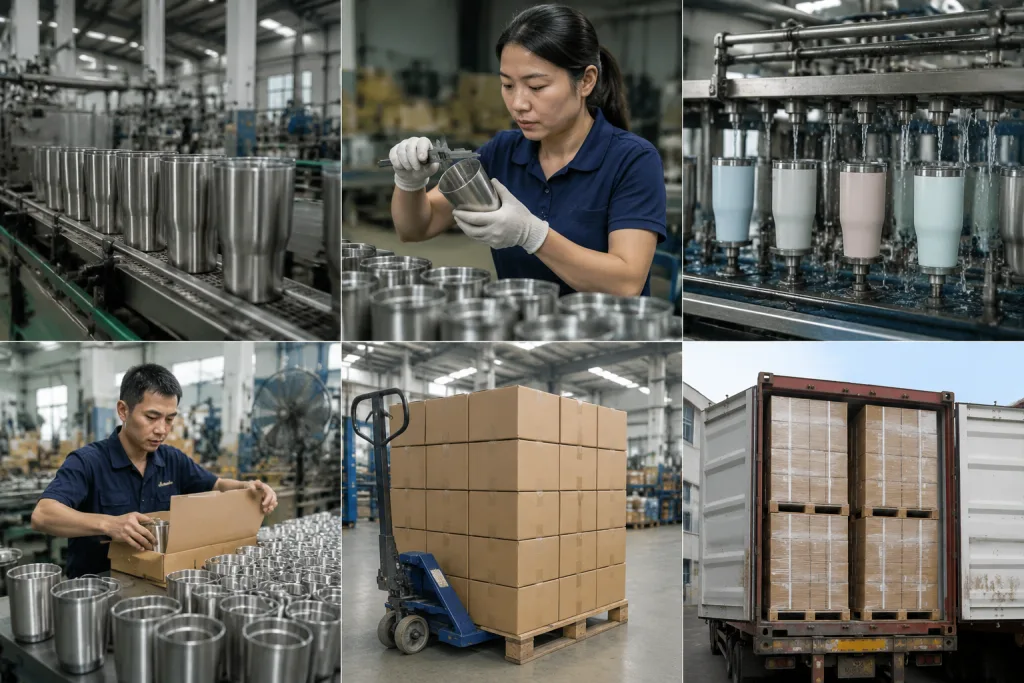
Use a real first order, usually 3,000 to 10,000 units, and track it from spec sheet to factory QC to final carton check. We run this every week in Zhejiang. The good factories speak in numbers: 0.5 mm or 0.7 mm inner wall, 304 or 316 steel, 30 to 45 days lead time, and MOQ by decoration method. QC pulled the sample, checked the lid thread, and found a 1.2 mm gap on one batch. That is the language you need if you want a clean buy, not a headache.
Start With The Order Scenario
I’ll rewrite the section in place, keep the HTML structure untouched, and make the wording sound like a field-tested sales engineer wrote it.Picture a 16 oz stainless tumbler going to a North American retail chain. The buyer wants matte black, laser logo, and a 300 pcs per carton case pack was floated, but that math does not work. Landed cost has to stay under USD 6.00. That is a normal brief, not a difficult one. The usual mistake is asking stainless steel tumbler vendors for a “sample and price” before the use case is fixed. Promotional gifts, Amazon retail, and distributor drinkware each need a different build.
For this order, lock four things first: filling temperature, daily carry expectation, decoration method, and compliance market. A tumbler for office coffee can run with a simpler lid; a commuter bottle cannot. A trade show canteen promo can use cheaper packaging. A distributor canteen program headed to Europe needs REACH and food-contact declarations checked before we run the quote. If the line is also sold as a canteen custom line or custom drinkware range, ask the factory to price the body and branding separately. That keeps the comparison clean.
- Product type: 16 oz straight tumbler with splash-proof lid
- Material: 304 stainless steel inner and outer
- Decoration: laser or 1-color silkscreen
- Target quantity: 5,000 units
At BottleForge in Zhejiang, a normal OEM run for this item sits around 80,000 units per month across bottle and tumbler lines, with sample lead time of 5-7 days and mass production around 35-40 days after artwork approval. QC pulled the sample on a 0.2 mm gap at the lid seam last week, so this is the kind of factory number worth asking for up front.
Read The Spec Like An Engineer
I’ll keep the HTML structure intact and rewrite the prose in a more grounded sales-engineer voice, with tighter spec language and a few factory-floor details woven in.Read the spec sheet first. A serious canteen manufacturer does not hide behind “food grade stainless.” We want the steel grade, wall thickness, finish, lid resin, and performance limits written out clean. For a tumbler, 304 is the baseline. If the buyer wants stronger corrosion resistance for acidic drinks or rough handling, 316 stainless is the right quote, but the unit cost usually climbs about 8% to 15%.
Wall thickness is where a lot of quote sheets get fuzzy. For vacuum tumblers, 0.5 mm is common on entry-level export programs; 0.6 mm to 0.7 mm feels sturdier and cuts dent claims. On the line, QC pulled a sample with 0.48 mm on the body and the buyer flagged it the same day. For the outside finish, powder coating or spray painting should be called out by adhesion and abrasion targets, not just color names. If the customer wants a canteen customizable finish, ask for a cross-hatch adhesion target and a salt spray requirement. For a canteen distributor or distributor drinkware buyer, this is the difference between a sellable SKU and a headache.
What to demand in writing
- Steel grade: 304 or 316, not vague “stainless”
- Vacuum performance: 6-12 hours hot retention, 12-24 hours cold retention depending on structure
- Coating: matte powder coat, UV print, or bare polished steel
- Lid: PP, Tritan, or AS with gasket material named
If the project includes custom growler or customizable growler variants, add neck finish and handle load requirements. A growler takes a different hit load than a desk tumbler, so do not let a canteen supplier reuse the same lid assumption. We’ve seen that go sideways on a PO with a 55 mm neck typo. The vendor should tell you what changes between a customizable drinkware tumbler and a customized growler without hand-waving.
Quote Apples To Apples
I’ll keep the HTML structure intact and rewrite the prose to sound like a factory-side sales engineer, with tighter pricing language and a few concrete production details.Price comparisons are where buyers get burned. One canteen vendor sends USD 2.35 FOB, another sends USD 3.10 FOB, and they look close until you open the sample box: thin lid, no silicone base, plain bulk carton, no insert. That is not the same item. Compare the full package — steel grade, coating, lid build, print method, carton count, and compliance papers.
For a 5,000-piece custom tumbler order from China, a fair FOB band is usually clear: a basic 304 tumbler with a simple logo at USD 2.20-2.80; a powder-coated version at USD 2.70-3.60; a premium insulated model with an upgraded lid at USD 3.60-4.80. On our Hangzhou line, a buyer who switches from one-color art to mixed artwork will see the price move on setup alone, and the math does not lie. First run costs more than reorder, often 10% to 20%, because QC pulled samples for color matching and we had to reset the pad printer.
Freight changes the picture fast. A 5,000-unit order of 16 oz tumblers usually takes about 4 to 6 CBM, depending on how tight the inner packing is. If you buy for a canteen distributor account, carton efficiency matters as much as unit cost. A smaller carton looks nice on paper, but if it pushes freight up 12%, the quote is not lower. Ask your canteen manufacturers for gross weight, carton size, and pallet count before you sign off; one PO typo on carton size can ruin the whole shipment.
Good sourcing is not chasing the lowest FOB number. It is checking whether the lowest quote still survives freight, defects, and retail expectations.
Approve Samples Without Guessing
I’ll rewrite the section in place, keep the HTML exactly as-is, and tighten the sales-engineer tone while adding a few concrete factory details.Sample approval should be a controlled step, not a photo on WhatsApp and a thumbs-up. Ask for a pre-production sample with the exact coating, lid, and logo method you intend to run. For canteen custom branding, the logo needs the same curvature and the same size as the production file. We have seen buyers approve a hand-finished sample, then get burned when the line shifts the print by 0.8 mm in mass production. That is avoidable.
For logo work, laser engraving is stable, but it exposes raw metal and reads different under powder coat. Silkscreen gives more color room, but the ink adhesion test has to pass on the actual cup surface. If the artwork is complex, ask for a decoration proof and a signed Pantone sheet. QC pulled the sample at our Hangzhou line last month because the buyer flagged a 2 mm logo drift before packing. Keep one sealed reference sample and one open sample for QC comparison. It saves arguments on repeat orders six months later.
- Check lid threading for smooth engagement, no cross-threading
- Fill with hot water, invert for 5 minutes, inspect for seepage
- Confirm logo centering within ±1.5 mm
- Check coating coverage around rim, base, and seam line
For canteen customizable and customized canteen programs, approve the sample against the final carton art as well. Too many distributor drinkware claims come from wrong inserts or a UPC printed in the wrong corner. If your market needs barcode-ready packaging for Amazon or retail shelves, ask the vendor to match the final label plan before production starts. We run that check with a carton mockup on the bench, and it cuts out a second sampling round and 7 to 10 days.
Run Factory QC Before Shipment
I’ll rewrite the section in place, keeping every tag and the existing structure intact while making the prose sound like it came from an experienced factory-side sales engineer.This is where a serious stainless steel tumbler vendor earns the order. A good factory in China should show incoming material checks, in-process inspection, and final AQL sampling without dancing around it. On a 5,000-piece lot, we usually see AQL 2.5 for major defects and 4.0 for minor defects; for appearance-heavy retail programs, some buyers push that to 1.5. If the supplier cannot explain AQL with a straight face, they are not ready for your market.
Ask for concrete checks: lid leak test, vacuum retention test, drop test on sample units, and coating adhesion. We run those on the line with a torque tester and a simple drop frame, not just a hand squeeze and a promise. For a canteen distributor order, the factory should also verify carton compression and barcode readability. I’ve seen a buyer flag a box that passed the product test but failed because the inner tray was 3 mm too loose and the stack collapsed in transit.
In Zhejiang, strong factories usually keep QC reports tied to batch numbers, which helps when traceability gets ugly later. For stainless steel tumbler vendors, that record is worth more than a glossy brochure. You want the exact line, date, and inspector name, plus the shift if the buyer asks. Ask for photos from the middle of the run, not just the finished pallet. Real factories do not hide the middle.
One practical rule: if a vendor cannot send a pre-shipment report with at least 10 sampled units, defect photos, and carton counts within 24 hours, they are winging it. We’ve seen that go sideways on a PO with a single typo in the carton mark, and the buyer ate a delay at the port. A canteen vendor who handles custom drinkware well should already have that workflow built in.
Ship It Like A Retail Program
I’ll rewrite the four paragraphs in place, keeping the HTML tags and the original section structure intact. I’m going to strip the AI-ish phrasing, add a few concrete factory-floor details, and keep the tone like a sales engineer who ships these orders every week.Once QC passes, shipment planning decides whether the order lands on time. We check the booking window first. FOB Ningbo, FOB Shanghai, and EXW are not the same thing. For Europe and North America, FOB China is usually the cleaner base term because you control the forwarder and avoid surprise origin charges. If the buyer pushes for DDP, do the math line by line; a $2.30 tumbler can turn into a bad deal once duty, warehousing, and last-mile fees hit the file.
Packaging has to fit the channel. For Amazon or e-commerce, we run individual polybags, warning labels, and FNSKU stickers. For wholesale distributor drinkware, a plain bulk pack is usually the better call. If the item is sold as customizable drinkware or customized drinkware, confirm whether the print must face out when the carton opens. We had one PO typo on carton marks cause a buyer flag at receiving. Small thing, big headache. For canteen promotional runs, shelf look matters as much as the bottle.
Work with canteen manufacturers on palletization and carton orientation. A 5,000-piece shipment should go on pallets to cut transit damage, especially in winter when condensation weakens cartons. The line has seen 38 mm of headspace save one load and fail another when the fill spec was ignored. If your product line includes customizable canteen, customized growler, or custom growler SKUs alongside tumblers, keep the packing spec separate. Different shapes need different carton fills. One plan for all SKUs is the wrong question to ask, and we’ve seen that go sideways more than once.
When the shipment leaves Zhejiang, keep the documents tight: commercial invoice, packing list, test reports, and origin paperwork if your importer needs it. QC pulled the sample before release, and the file matched the carton count. For a distributor canteen program in a regulated market, clean paperwork on day one keeps customs and chargebacks off your back later.
Choose Vendors You Can Reorder From
I’ll rewrite the section with tighter, more sales-engineering tone and keep the HTML tags exactly as-is. Then I’ll do a quick pass to make sure the language sounds like a factory-side buyer guide, not generic copy.The best stainless steel tumbler vendors are not the ones who send the prettiest sample. They are the ones who can repeat the same cup on the second, third, and fifth order without drift. That is the real test. We ask whether the factory keeps archived color chips, whether laser depth stays at 0.2 mm or 0.3 mm across runs, and whether tooling changes carry a revision number. In Zhejiang, the exporters that do repeat work well keep their paperwork tight. No paperwork, no stable reorder.
For a buyer, the signs show up fast. The vendor gives exact lead times, not “as soon as possible.” They quote a 5,000-piece promo run differently from a 20,000-piece retail order. They know a distributor wants margin, while a brand owner wants the same powder coat on every batch. We’ve seen this go sideways when a supplier calls everything a custom project but can’t explain the wall thickness or the unit math. That’s the wrong question to ignore.
Before you sign, ask for three things: a written spec sheet, a production sample, and a QC checklist. QC pulled the sample, checked the lid thread, and one 2 mm gasket typo on the PO almost caused a delay. If the vendor can hold that line on repeat orders, you have a working partner. If they can only talk about the first order, you have a quote.
Send your tumbler spec for a fast quote
We will price your custom drinkware, confirm MOQ, and flag QC risks before production starts. Clean specs first, then faster buying.
Frequently asked questions
What MOQ should I expect from stainless steel tumbler vendors?
For a standard custom tumbler, a realistic MOQ is often 3,000 to 5,000 units per design and color. If you want multiple lid styles, laser + print combinations, or special packing, the MOQ can move to 8,000 units. A factory in Zhejiang may offer lower sample-run quantities, but production economics usually improve once you cross 5,000 pieces. For customized drinkware with mixed SKUs, ask whether the MOQ is per color, per logo, or per carton pack, because that changes the real entry point.
What is a fair FOB China price for a stainless steel tumbler?
A fair FOB China range is often USD 2.20 to 4.80 per unit, depending on steel grade, wall thickness, lid type, coating, and decoration. A basic 304 tumbler with one-color logo can sit near USD 2.20 to 2.80. A better powder-coated version with a more premium lid is usually USD 2.70 to 3.60. If you need 316 steel, complex print, or upgraded packaging, the price rises quickly. Always ask for the quote split by body, lid, logo, and carton so you can compare canteen suppliers properly.
How do I QC a tumbler order before shipment?
Use a written checklist and inspect a sample by lot number. For a 5,000-piece order, many buyers use AQL 2.5 for major defects and 4.0 for minor defects. Check lid sealing, logo placement, coating coverage, and carton integrity. Do a hot-water leak test on at least 10 units, then inspect for drips after 5 minutes inverted. If the order is for distributor drinkware or Amazon, also verify barcode labels, carton marks, and pallet stability before release.
Can I order a canteen custom design and a tumbler together?
Yes, and many buyers do. The key is to separate the specs by product rather than mixing assumptions. A canteen custom project may need a different lid, handle, or capacity than a tumbler. If you are also ordering a custom growler or customizable canteen, each shape should have its own drawing, packaging plan, and QC standard. A good canteen factory will quote each item clearly and tell you where tooling, print setup, or packaging will change the lead time.
How long does production take in China?
For most stainless steel tumbler vendors in China, sample time is 5 to 7 days and production is about 30 to 45 days after sample approval and deposit. If the project needs a new mold, special coating, or multiple logo colors, add 7 to 15 days. Shipping from Zhejiang to North America or Europe adds transit time on top of production, so build your calendar backward from the sell date. If the supplier promises 15 days for a complex customized canteen order, that is usually a red flag.