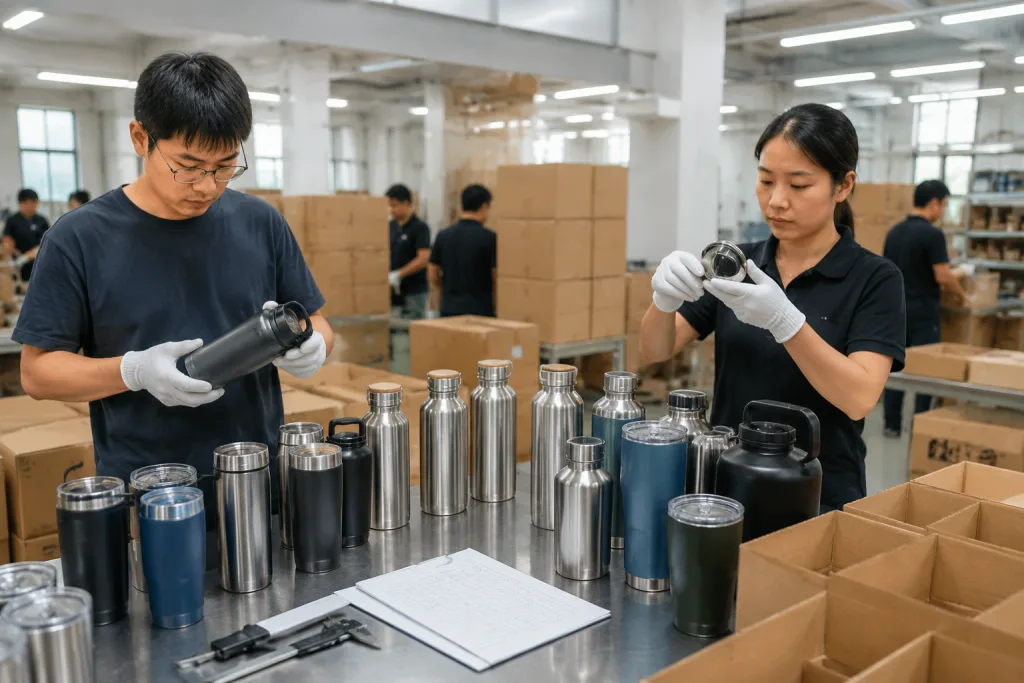
Key Takeaways
- A practical MOQ is usually 1,000 pcs per color for stocked tumbler bodies and 3,000-5,000 pcs for new colors or lids
- 304 inner steel is standard; 316 inner steel adds cost but helps for premium outdoor and coastal-positioned programs
- Laser engraving suits 500-5,000 pcs B2B programs, while full wrap powder coating needs tighter color control and longer setup
- AQL 2.5/4.0 inspection and 24-hour leak testing samples should be agreed before deposit, not after production
A stainless steel tumbler supplier can send a quote in 2 hours. The harder question is whether that SKU fits your retail shelf, promotion pack, FBA carton rule, or distributor catalog. A 20 oz travel tumbler, 32 oz custom canteen, and 64 oz custom growler may all use 304 stainless steel, but the tooling risk, freight cost, lid test, and logo area are not the same. On the line, QC pulled a 32 oz sample last week because the flip lid failed after 3 drop tests from 1.2 m.
From our factory work in Zhejiang, China, we see buyers lose 7 to 10 days when they compare only FOB price. Wrong question. Put wall thickness, vacuum performance, MOQ, packaging cube, logo method, and compliance path on one sheet, then ask for photos from the salt spray tester or the vacuum aging rack. We run this check before mass production because the math does not work if a cheap quote adds 18% carton volume or forces a new logo fixture after the PO is signed.
Compare the product families first
If you are searching for a stainless steel tumbler supplier, do not start with artwork. Start with the job the bottle must do. This is the wrong question to ask at RFQ stage: “Can you print my logo?” Custom drinkware is not one category on the factory floor. We run tumblers for commuting and desk use, where the lid fit and cup-holder diameter get checked with a 75 mm gauge. A canteen customized for outdoor retail needs a stronger cap system, better carry hardware, and a strap that does not fail after 500 pull cycles. A customized growler is judged by mouth diameter, seal pressure, and whether the wall feels solid in hand.
The table below is the kind of head-to-head comparison you should ask your canteen supplier or tumbler factory to complete before sampling. QC pulled one pre-production sample last month because the PO said “matte black,” but the approved lid sample was gloss black.
| Item | Best use | Typical capacity | Common MOQ | Main risk |
|---|---|---|---|---|
| Travel tumbler | Coffee, car cup holders, corporate gifts with stocked slider lids | 12-30 oz | 1,000 pcs/color | Lid leakage, powder coat scratches, and carton rub marks |
| Custom canteen | Outdoor retail, school programs, team hydration | 20-40 oz | 1,000-3,000 pcs/color | Cap thread fit, silicone gasket size, and strap durability |
| Customizable growler | Brewery retail, camping kits, premium gift sets | 32-64 oz | 1,000 pcs/model | Vacuum failure and high freight cube |
For distributor drinkware, the safer first SKU is usually a 20 oz or 30 oz tumbler with a stocked lid and a carton we have already drop-tested at 76 cm. Simple wins. For a canteen distributor serving outdoor accounts, a 32 oz wide-mouth bottle gives stronger shelf value, but it needs tougher drop testing around the shoulder and cap loop. The buyer often flags this after seeing cracked handles in competitor samples. For a distributor growler program, budget for heavier cartons, thicker dividers, and higher landed cost per unit even when the FOB price looks attractive. The math does not work if the freight cube jumps by 18%.
A canteen factory in Zhejiang can run multiple shapes, but each shape has a different bottleneck. Tumblers bottleneck at coating and lid assembly; on a busy line, powder coating can hold 12,000 pcs in WIP before packing catches up. Canteens bottleneck at cap injection, silicone gasket fit, and handle hardware, especially when the gasket tolerance moves by 0.3 mm. Growlers bottleneck at welding consistency and vacuum testing time. Ask where the factory bottleneck is. The answer tells you more than a glossy catalog.
Steel grade and wall construction
For most B2B orders, specify 304 stainless steel on the inner wall, then choose 201 or 304 for the outer wall based on your price band. Food contact starts inside the cup. We run 0.4 mm inner plus 0.5 mm outer on a standard vacuum tumbler; 64 oz growlers often move to 0.5 mm and 0.6 mm because the body dents too easily during carton drop tests. If a canteen vendor writes only “stainless steel” on the quotation, send it back. The grade must be on the PI and PO.
Here is the comparison we use with buyers before tooling or sampling:
- 304 inner / 201 outer: widely used for promotional and mid-market customized drinkware. It keeps cost under control, and QC normally checks the inner wall grade with an XRF gun before mass production.
- 304 inner / 304 outer: stronger corrosion resistance for outdoor programs and premium canteen orders. We suggest this when the buyer flags rust complaints from salty air, dishwasher use, or long warehouse storage.
- 316 inner / 304 outer: niche choice for premium coastal programs, tea brands, or acidic beverage positioning. Expect a noticeable cost increase, often USD 0.40-0.90 per unit depending on size, and confirm MOQ before the sample request.
Test vacuum insulation by data, not sales claims. For a 20 oz tumbler, a normal target is hot retention above 45°C after 6 hours when filled with 95°C water at room temperature. Cold retention is less standardized because ice ratio changes the result, so define the test method in writing: ice weight, water weight, start temperature, and room temperature. For a 64 oz customized growler, pay attention to the base weld and shoulder forming. Large bodies punish weak process control; we have seen QC pull samples for a 1.2 mm shoulder ripple after polishing.
For China export orders to Europe and North America, request LFGB or FDA food-contact documentation where relevant, plus REACH awareness for coatings and silicone parts. Do not ask, “Do you have certificates?” That is the wrong question. Ask which test report matches the lid, paint, gasket, and body material on your exact SKU. A serious canteen supplier will match reports to components, and we usually attach the report number beside the item code so nobody ships a black powder-coated lid against a report for clear PP.
Decoration method changes the order
Decoration is where custom drinkware orders slip. We see it on the line: the body is ready, the cartons are booked, then QC pulls 32 pcs with logo rub-off after a 3M tape test. Buyers sometimes treat the logo as the last step; that is the wrong question to ask. Logo method changes MOQ, scrap rate, lead time, and packing. A canteen customizable with one-color silkscreen is not the same order as a full-body gradient powder coat with laser engraving and a retail gift box.
Use this head-to-head view before you freeze the PO:
| Method | Good for | Typical setup | Watch point |
|---|---|---|---|
| Laser engraving | Corporate buyers, outdoor programs, premium gifts where the logo must survive handling | Low setup, stable for 500-5,000 pcs; we run it after coating and before final packing | Shows base metal; contrast depends on coating, and black powder gives a sharper mark than silver or champagne |
| Silkscreen | Simple logos and canteen promotional orders with one flat print area | Best from 1,000 pcs; screen fee is small, but color matching still needs a signed sample | Curved surfaces distort artwork, especially logos wider than 55 mm on tapered cups |
| Pad printing | Small logos near curves, lids, caps, and narrow plastic parts | Useful on lids and caps; the pad mold must match the curve | Limited print area; fine text under 1.2 mm often fills in |
| Powder coating | Retail color programs and shelf-ready bottle ranges | Usually 1,000-3,000 pcs/color; color changeover takes about 2-3 hours on our coating line | Color delta and scratch resistance; the buyer flagged ΔE 1.8 on a beige order last season |
| Water transfer | Camo, wood, and marble patterns where every piece can look a little different | Higher labor content; operators trim film by hand around the shoulder and base | Pattern repeat and reject rate; seams near the bottom can fail visual inspection |
If you are a brand owner, ask for a signed pre-production sample with Pantone reference and gloss level. Put the gloss on the approval sheet, not just in an email. If you are a canteen distributor, keep the first run simple: one body color, one logo position, one carton layout. Simple ships cleaner. Complexity is not free; we have seen it come back as rework, rejects, and arguments over whether a 2 mm logo shift is acceptable.
At BottleForge Industrial in Hangzhou, Zhejiang, our normal monthly output across tumbler and bottle lines is about 450,000 units, but full-wrap custom coating cuts real capacity. A plain stainless item may ship in 25-30 days after deposit and artwork approval. A canteen custom order with molded lid color, powder coating, and retail box normally needs 35-50 days. One recent PO had the Pantone typed as 186C in the artwork and 185C in the order sheet; we stopped the line for half a day to get the buyer’s written confirmation.
Use-case fit beats catalog guessing
The right stainless steel tumbler supplier should match the item to the sales channel, not just send a catalog PDF. This is the wrong question to ask: “Which model sells best?” A bank promotion, a canteen distributor, and an outdoor retail shelf each need a different build. We saw one PO come through with “matte black” in the email and “gloss black” in the artwork file; QC pulled the pre-production sample before the line ran 3,000 pcs. Good catch. A distributor canteen line takes repeat handling, shelf scuffs, and returns. A one-time event gift cares more about logo area and unit price.
For corporate gifting, a 20 oz or 30 oz tumbler with slider lid, 304 inner wall, powder coat, and laser logo is enough for most orders we ship. We run powder thickness around 70-90 μm on standard matte colors, then check logo burn depth with a sample plate before mass laser work starts. The carton should look clean, not overbuilt. A realistic FOB China price might sit around USD 3.20-5.80, driven by the lid mold, coating finish, and whether each pc needs a color box with insert. For retail hydration, a 32 oz customized canteen with wide mouth, carry handle, and straw lid may range from USD 4.50-8.50. The lid system carries the cost.
For breweries, camping stores, or premium gift sets, a customized growler or customizable growler needs bench testing, not a nice photo. Check fill volume with a graduated cylinder, run the thread seal in the vacuum leak tank, pull the carry handle to 20 kg, and smell-test the cap after hot-water soaking. A 64 oz vacuum growler looks strong on a product page, but it eats container space fast. The math can go sideways here: your landed cost can climb faster than the FOB price suggests, especially when the buyer asks for foam inserts after the first drop-test failure.
For Amazon or marketplace programs, packaging and barcode control matter as much as the bottle. Plan for FNSKU labels, drop-test cartons, suffocation warnings for polybags, and master carton dimensions that stay under your 3PL limits. We once had a buyer flag a 2 mm barcode shift because the scanner at their receiving warehouse missed 6 cartons in one pallet. A canteen vendor who has only shipped bulk promotional cartons may not understand FBA-style routing. Ask directly whether they have packed that way before.
Supplier checks before you pay
A solid canteen factory does not dodge technical questions. The weak ones answer “yes” to everything and chase a low quote. Before you send a deposit, get the commercial terms and the shop-floor details in writing. QC pulled the sample off the leak tester at 0.08 MPa last week, and the lid popped on a line test. That is the sort of thing that saves trouble.
- MOQ: stocked tumbler body, 1,000 pcs/color is common; custom molded lids often need 5,000-10,000 pcs.
- Payment: 30% deposit and 70% before shipment is normal for China export orders. We usually tie that to a PI with the exact carton count, because a typo on the PO can stall the line for a day.
- Trade term: FOB Ningbo or FOB Shanghai is common from Zhejiang; EXW can hide local transport and export handling. Ask who books the truck and who pays the warehouse fee at the gate.
- Audit: BSCI, ISO 9001, or retailer audit history is useful, but confirm scope and expiry date. One expired certificate on the wall means nothing if the file on the office desk is six months old.
- Inspection: use AQL 2.5 for major defects and 4.0 for minor defects unless your retailer requires stricter limits. We run this with a caliper and a flashlight, and the inspector should pull cartons from the bottom stack, not only the top row.
Ask whether the supplier is an actual canteen factory, a hybrid manufacturer-trader, or a pure trading company. Nothing is wrong with a supplier that outsources some items, but you need the split in black and white. If your order includes a tumbler, a kids bottle, and a glass infuser, one shop may not run every item on its own line. The math does not work if they claim full in-house control. We have seen this go sideways when the buyer flagged a 0.3 mm lid wobble and the supplier had no tool room to fix it.
For distributor drinkware, ask about spare lids and gasket support. A lid failure rate of even 1% turns into 200 complaints on a 20,000-unit order, and that is a service headache nobody wants. We usually ship 1-2% spare lids for new retail programs, especially for straw lids and flip lids with moving parts. QC keeps a tray of backup gaskets by the bench, and that little buffer has saved more than one launch.
Quality control that catches real defects
Quality control for stainless drinkware is not just appearance checking. A shiny cup can still leak, lose vacuum, fail coating adhesion, or smell like uncured silicone when QC opens the lid after a 60°C hot-water test. Your QC plan has to match the product family. For a tumbler, we run lid fit, slider movement, coating rub, and cup-holder base checks, usually against a 70 mm to 75 mm lower diameter target. A custom canteen needs cap torque, strap pull, leak inversion, and drop simulation. A custom growler needs vacuum integrity and thread seal consistency. Pretty is not enough.
For pre-shipment inspection, define defect categories before production. Major defects include leakage, sharp edges, wrong material, wrong logo, serious dents, unstable base, and failed vacuum insulation. Minor defects include tiny coating specks, light polishing marks, and small carton print variance within the approved sample. We once had a PO typo where “matte black” became “mate black,” and the buyer flagged it only after cartons were packed. Without a written standard and an AQL 2.5 reference, you will argue over photos at the worst time.
Practical tests we use include 100% visual checks on critical logo areas, random hot-water insulation tests, 24-hour room-temperature leak checks on sample units, 3M tape adhesion tests on printed logos, and carton drop tests for retail packs. For powder coating, cross-hatch adhesion and rub resistance are worth specifying when the item is positioned above basic promotional grade. QC pulled the sample, cuts the 1 mm grid with a cross-hatch cutter, applies 3M tape, then checks whether the coating lifts at the logo edge. If the buyer wants retail-grade finish at promo pricing, the math does not work.
Compliance also needs discipline. For Europe, REACH and food-contact expectations are not optional. For the United States, FDA food-contact material expectations and, where relevant, California Proposition 65 screening should be discussed. For kids items, ASTM and CPSIA can apply, but most adult tumblers and canteens follow a different route. Do not let a canteen manufacturer reuse an old report for a new lid material without checking the match. We have seen this go sideways when a 304 stainless body passed, but the new PP lid gasket had no matching food-contact report.
How to brief the factory
I’ll rewrite this section in-place, keep the HTML exactly as-is, and tune the copy to sound like a factory-side sales engineer.The fastest quotes come from a clean brief. Send us capacity, target FOB price, market, annual volume, logo method, packaging, compliance needs, and ship date. If you only send a photo and ask for “best price,” we have to guess. That guess is usually wrong on cost, lead time, or both.
A workable RFQ for a stainless steel tumbler supplier should read like this: 20 oz double-wall vacuum tumbler, 304 inner wall, 201 or 304 outer wall options, matte black powder coat, laser logo on one side, clear slider lid, individual white box, master carton for export, MOQ 1,000 and 3,000 pcs price breaks, FOB Ningbo, target delivery 40 days after deposit. On the line, that level of detail saves a lot of back-and-forth. For a customizable canteen, add cap type, handle type, straw requirement, mouth diameter, and whether the bottle must fit a bicycle cage or backpack pocket. For a distributor growler, include filled weight expectations and shelf packaging.
Tell us the commercial reality too. If you are testing a new line, say so and ask for stock molds. If you are a canteen distributor building a two-year range, talk about color continuity, spare parts, and reserved capacity. If you are buying canteen promotional items for a fixed event, protect the ship date and skip untested custom tooling. We’ve seen the buyer flag a “simple” lid change and the sample turned into a 12-day delay.
China factories can be flexible, but we are not magic. New tooling, special paint, molded color lids, and retail packaging all eat calendar days. QC pulled the sample, checked the box size at 72 x 72 x 245 mm, and found the insert was wrong by 8 mm. A tight brief lets your canteen suppliers answer like engineers instead of guessing from a photo. That is where the good orders start.
Send your tumbler or canteen RFQ for review
Share capacity, artwork, market, MOQ, and target ship date. We will reply with practical options, risks, and FOB China pricing.
Frequently asked questions
What MOQ should I expect from a stainless steel tumbler supplier?
For a standard tumbler body using an existing mold, expect 1,000 pcs per color as a practical MOQ. Some factories in China may quote 500 pcs, but the unit price, coating setup, and inland handling usually become inefficient. For a customized canteen with a special lid color, 3,000 pcs is more realistic. New molded plastic lids can require 5,000-10,000 pcs because injection setup and color matching need volume. If you are a distributor testing demand, ask for two price breaks, such as 1,000 pcs and 3,000 pcs, rather than forcing the lowest MOQ.
Is 304 stainless steel enough for custom drinkware?
For most custom drinkware sold in Europe and North America, 304 stainless steel for the inner wall is the normal and acceptable choice. It handles water, coffee, tea, and most daily beverages well. A 201 outer wall can be used for cost-sensitive programs, while 304 outer wall is better for premium outdoor or humid coastal markets. 316 inner steel is possible, but it can add roughly USD 0.40-0.90 per unit depending on size and market price. Your canteen manufacturer should confirm material grade with documentation and production traceability, not only a catalog claim.
Which logo method is best for canteen promotional orders?
For canteen promotional orders, laser engraving is the safest if you want durability and a clean B2B look. It works well from 500-5,000 pcs and avoids ink adhesion issues, but the logo color is limited by the coating and metal contrast. Silkscreen is better when you need a specific brand color, usually from 1,000 pcs upward. Full-color heat transfer or water transfer can look retail-ready, but reject rates and lead time are higher. For curved canteens and growlers, always approve a physical pre-production sample because flat artwork can distort on the body.
How long does production take after I approve the sample?
For a stocked stainless tumbler with normal powder coating and laser logo, 25-35 days after deposit and sample approval is common. A customized canteen with special lid components, molded color parts, or retail packaging usually needs 35-50 days. A custom growler may take similar time but can be slowed by vacuum testing and heavier packaging. Add 3-7 days if you need third-party inspection or updated lab testing. From Zhejiang, FOB Ningbo is common, and vessel schedules can add uncertainty, so do not plan a fixed event order with no buffer.
How do I know if I am dealing with a real canteen factory?
Ask for production photos, audit documents, business scope, equipment list, and a video call from the workshop during working hours. A real canteen factory should explain welding, polishing, vacuum testing, coating, assembly, and packing capacity in practical numbers, such as units per day or units per month. Also ask which items are made in-house and which are outsourced. Many China suppliers combine manufacturing and trading, which can be acceptable if managed honestly. The warning sign is a canteen vendor that claims every material, lid, coating, and test is available with no MOQ or lead-time impact.