Key Takeaways
- A 20 oz 304 stainless tumbler usually starts at 3,000 pcs MOQ for custom color and logo
- Vacuum insulation claims should be backed by 100% air pressure testing, not sample testing only
- Laser engraving is stable for 10,000+ pcs, while full-wrap printing needs tighter artwork control
- AQL 2.5/4.0 inspection and carton drop tests catch most promotional order failures before shipment
A stainless steel tumbler promotional order looks simple until the spec sheet starts eating your margin. A 20 oz tumbler can ship as a profitable distributor item, or it can turn into 1,200 complaint emails because the lid weeps at the sip hole, the powder coat loses gloss after a 3M tape test, or the K=K carton crushes at the corner before it reaches the retailer.
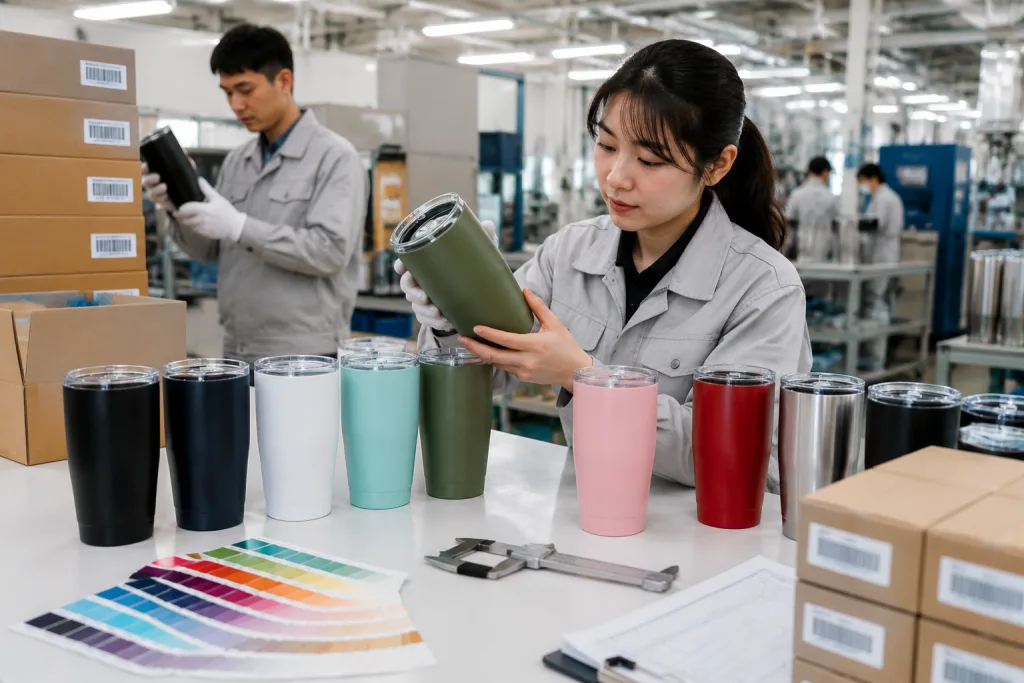
At our Zhejiang, China factory, we quote custom drinkware by the line item: steel grade, wall thickness, vacuum test, coating, logo process, packing, and inspection level. We run calipers on the rim, check vacuum loss in the water tank, and QC pulled one sample last month because the PO said “matte balck” while the artwork called for PMS Black 6C. If you are buying from a canteen supplier, canteen manufacturer, or export vendor for the first time, read the spec like a purchasing document. Not a brochure.
Capacity, shape, and real use
The first spec line is usually capacity: 12 oz, 16 oz, 20 oz, 24 oz, 30 oz, or 40 oz. For a stainless steel tumbler promotional program, 20 oz is still the safer buy for corporate gifts and distributor canteen assortments. We run this size often because it fits most car cup holders, leaves about 70-90 mm of clean print height for a logo, and keeps FOB cost easier to defend. A 40 oz handled tumbler sells well on the retail shelf, but the math changes fast: more steel, a taller master carton, and often USD 0.45-0.90 per unit added in sea freight equivalent depending on packing density. Last month QC pulled a 40 oz sample that looked fine on the bench, then failed the carton drop because the handle pressed into the next cup.
Do not approve shape from a rendering only. Ask for the bottom diameter, top diameter, height, and cup holder compatibility. This is the wrong question to ask: “Is it 20 oz?” A tumbler with a 72 mm bottom is easier for daily use than one with an 82 mm bottom, even if both hold the same liquid volume. We check this with a simple plastic cup-holder gauge on the line, not a pretty 3D file. If you sell through canteen distributors or a distributor growler channel, buyers care less about the stated ounce count and more about grip comfort and shipping cube.
For promotional orders, we normally recommend a straight or slightly tapered body for 360-degree logo placement. Bulged shapes look good in photos, but silk screen distortion shows up near curves; we have seen a 35 mm logo stretch enough that the buyer flagged it during pre-shipment photos. Keep it boring if the logo matters. If you need a family set with custom canteen, custom growler, and tumbler together, keep the shoulder radius close across SKUs, such as 18-22 mm, so the brand line looks planned instead of pulled from random molds.
Steel grade and wall thickness
Serious buyers usually write food-contact 304 stainless steel for the inner wall on the PO. Good. The outer wall is where cost pressure starts: 304 for better programs, 201 when the target price is tight. For Europe and North America, we quote 304 inner and 304 outer for premium promotional runs, especially when the tumbler sits beside customized drinkware or a customized growler in a higher retail tier. 201 outer steel is fine for dry office use, but we have seen it go sideways in humid coastal storage and after repeated dishwasher cycles. QC pulled one returned sample last year with rust spots around the bottom seam after 7 days in a salt-spray check.
Typical wall thickness is 0.4 mm to 0.5 mm per layer before forming. Do not chase the lowest sheet gauge. Going below 0.38 mm saves a few cents, but dent resistance drops fast, and the line will show more oval mouths after expanding. For a 20 oz vacuum tumbler, 0.45 mm inner plus 0.5 mm outer is a practical balance. If your canteen factory quotes much lower than other canteen manufacturers, ask whether wall thickness or steel grade changed. The math doesn't work otherwise. We run calipers on incoming coil; a “0.5 mm” claim that reads 0.42 mm on the Mitutoyo gauge is not a small difference.
For compliance, request material declarations and food-contact test reports before deposit. Common requirements include FDA LFGB-style food contact testing for the US market, LFGB for Germany, and REACH screening for coatings and plastic parts in the EU. China has hundreds of capable factories, but not every canteen vendor keeps current reports for the exact model. Check report date, model coverage, and test lab name. Short step, big risk. A report from 2019 on another bottle body is not evidence for your 2026 tumbler order; we had a buyer flag this after the PO even had the wrong model code typed as “TMB-20OZ” instead of “TMB-20OZ-V.”
Vacuum performance and lid choice
Vacuum insulation is where a promotional tumbler passes or fails. A proper double-wall tumbler should pass 100% vacuum testing after welding. On our Zhejiang line, we run about 600,000 stainless units a month, and QC pulled one sample every 500 pieces with an air-pressure gauge plus a 60°C water hold check before packing. Sampling only 2% misses pinholes. One leak and the buyer flags the whole PO.
A realistic claim for a 20 oz tumbler is 6-8 hours hot and 12-18 hours cold under room-temperature lab conditions. We test at 25°C with a Fluke probe on the bench. Some sellers print higher numbers, but those figures depend on preheating, full volume, a closed lid, and no opening during the test. If you need ASTM-style data or retailer paperwork, say that before quotation. This is the wrong question to ask after samples are approved. Testing after production can push shipment back 7-10 days.
Lid choice changes both user feel and defect rate. A push-on clear AS lid costs USD 0.18-0.30, but spill resistance stays limited. A threaded PP lid with a silicone gasket adds USD 0.35-0.70 and is safer for commuting. Straw lids for 30 oz and 40 oz formats need 8 mm straw diameter, stopper shape, and a clear call on whether the lid is leak-resistant or only splash-resistant. Do not let a canteen supplier write “leakproof” unless the structure can take it. We had a buyer flag a clear lid as leakproof after one café spill test, then the 180° inversion check on the line showed why the math does not work.
Decoration that survives handling
Logo method is not a decoration detail; it decides claim risk and piece cost. For a stainless steel tumbler promotional project, laser engraving is usually the safest call because the beam cuts or marks the surface permanently. We run it on powder coating and electroplated finishes, and it avoids the ink-adhesion trouble QC keeps catching after the 3M tape pull. For 3,000-10,000 pcs, laser setup is usually modest, and unit cost is predictable. The math is clean.
Silk screen printing fits bold one-color logos on flat or gently curved areas. It can be economical at scale, often USD 0.05-0.15 per color per position, but Pantone matching and adhesion testing matter. Full-wrap heat transfer or water transfer can give you shelf-ready artwork, but seam control is where we see this go sideways; last month QC pulled 27 pcs from a 500 pcs pilot because the seam drifted 1.5 mm. If your artwork has small text under 5 pt, gradients, or legal copy, confirm print method before approval.
Powder coating should be checked for coating thickness, adhesion, and color tolerance. A typical coating thickness is 60-90 microns. Ask for a cross-cut tape test and 3M tape pull test on decorated samples. For customizable drinkware and canteen promotional programs, buyers often approve a good-looking pre-production sample but forget carton rub resistance. Wrong question. The buyer should ask how the logo looks after the drop test, the shake table, and 30 days at sea. During ocean transit, one poorly separated tumbler can rub against another for 30 days. Use paper sleeves, egg-crate dividers, or individual polybags based on your sustainability policy and retailer rules.
If you are building a canteen customizable range across tumblers, sports bottles, and growlers, keep one logo standard. A laser mark on a tumbler and a low-grade sticker on a customized canteen will make the whole program feel mismatched. We ship mixed drinkware sets often, and the buyer flagged this exact issue when one PO had “laser logo” on line 1 and “label sticker” typed on line 3.
Packing, barcodes, and retail readiness
I’ll rewrite the prose to sound like a factory-side sales engineer, keep the HTML structure intact, and weave in a few concrete shop-floor details without changing the headings or tags.Promotional buyers often under-spec packing because the item is “just a giveaway.” That line costs money. A tumbler with a scuffed powder coat lands badly with a client, and we have seen a whole PO get flagged over one dented rim. Bulk packing works for an internal handout, but distributor drinkware, retail, and e-commerce orders need tighter packing control.
Common packing choices include white box, kraft box, color box, mailer box, and gift box. A 20 oz tumbler in a white box may pack 24 pcs per export carton. A heavier gift box can drop that to 12 or 18 pcs, and the freight math changes fast. Ask for carton size, gross weight, and CBM before you lock the FOB price. For Amazon-style fulfillment or retailer DC delivery, we run FNSKU labels, suffocation warnings, master carton labels, mixed SKU carton rules, and pallet height limits on the line.
Barcode quality should be checked by scan, not by eye. UPC, EAN, SKU, and FNSKU labels need the right placement and adhesive, or the buyer flags it at inbound. If your vendor applies labels by hand, build a barcode inspection step into final QC; QC pulled the sample and a 2 mm shift was enough to fail the scan on one carton. For North America, carton drop testing is practical: 1 corner, 3 edges, and 6 faces from 60-80 cm depending on carton weight. For Europe, some retailers ask for plastic reduction, FSC paper packaging, or no individual polybag. The wrong question is “can you do it later?” Decide packing rules before sample approval, or you will pay for rework after mass production starts.
MOQ, pricing, and lead time
I’ll rewrite the section in-place, keep the HTML untouched, and tighten the copy so it sounds like a factory-side sales note with concrete numbers and a few shop-floor details.For a custom stainless tumbler, MOQ follows the change list. A stock color with one-position laser logo can start at 500-1,000 pcs if we have inventory on hand. Custom powder color usually starts at 3,000 pcs per color. New mold, special lid, or private shape can mean 10,000-30,000 pcs, because tooling, test runs, and line setup all sit on our side.
From China, a 20 oz 304 stainless vacuum tumbler with powder coating and one laser logo usually lands around USD 3.20-5.80 FOB Ningbo or Shanghai. A 40 oz handled tumbler often runs USD 5.80-9.50 FOB. Steel grade, lid type, finish, pack-out, and order size move the number fast. This is the wrong question to ask if the quote is 25% low. Ask what got cut: 304 outer wall, vacuum test, coating thickness, carton strength, or AQL 2.5 inspection. We have seen that go sideways on the line.
Normal lead time is 25-35 days after deposit and approved pre-production sample for repeat styles. Custom color, new lid, or a harder print setup can push it to 40-55 days. Add 5-7 days for sample making and 2-4 days for courier. We run samples through a 180 mm height check and a lid torque test before release. If the buyer flags a tight event date, keep the first order simple: stock body, stock coating, laser logo, standard box. Then build the customizable growler, canteen customized shape, or full customized drinkware line after the launch order proves demand.
Inspection and supplier paperwork
I’ll keep the HTML exactly as-is and rewrite only the prose, tightening the wording and adding a few concrete factory-floor details without changing the tags.Put the inspection standard on the purchase order. For promotional drinkware, we usually run AQL 2.5 for major defects and 4.0 for minor defects. Zero tolerance for critical defects. Major defects cover leaking, failed vacuum, wrong logo, sharp edges, heavy dents, wrong color, and a dirty inner wall. Minor defects cover small coating specks, light carton marks, or a slight print shift within the signed tolerance. On one 5000-piece order, QC pulled the sample and the buyer flagged a logo 1.5 mm off-center; that kind of miss is a headache you can catch on paper first.
Do the final random inspection only after goods are 100% produced and at least 80% packed. The checklist should cover capacity test, lid fit, vacuum spot check, coating adhesion, logo measurement, barcode scan, carton drop, gross weight, and carton mark check. A 500 ml tumbler that passes a lid test on the line can still fail after packing if the cap thread is off by 0.3 mm. For orders above USD 20,000, third-party inspection is money well spent. The math does not work the other way; sorting 5,000 bad pieces in Germany, Canada, or the US costs more than the inspection fee.
Paperwork matters as much as the sample. Ask for the business license, export records, BSCI or a social audit if your customer asks for it, product test reports, and a proforma invoice with Incoterms spelled out. FOB is cleaner for experienced importers; DDP can look easy, then freight, duty, and tax assumptions start drifting. We’ve seen this go sideways on a PO with “Stainless tumbler 500ML” typed as “5000ML,” and the factory had to stop the line to confirm the typo. Whether you work with canteen suppliers, canteen vendors, or a direct canteen factory in Zhejiang, China, the rule is simple: if it is not on the PI, sample approval form, or QC checklist, the line will not guess it.
Send your tumbler spec for a practical factory quote
Share capacity, logo, color, packing, quantity, and destination. We will return a line-by-line FOB quote with MOQ and lead time.
Frequently asked questions
What is a realistic MOQ for stainless steel tumbler promotional orders?
For a standard 20 oz tumbler with a stock body and one laser logo, 500-1,000 pcs may be possible if raw inventory is available. For custom powder coating, plan on 3,000 pcs per color. If you need a private mold, special handle, custom lid, or exclusive shape, MOQ often rises to 10,000-30,000 pcs. The MOQ is driven by coating line setup, steel purchasing, logo fixtures, packing materials, and rejection allowance. If a canteen supplier offers 200 pcs with custom color at a very low price, confirm whether it is real production or repainting existing stock.
Should I choose laser engraving or printed logo for a promotional tumbler?
Laser engraving is the safer default for B2B promotional tumblers because it is permanent, clean, and consistent over large runs. It works especially well on powder-coated stainless steel and usually has fewer adhesion issues than ink. Silk screen printing is good for simple one-color artwork and can be cheaper at volume, but it needs coating compatibility tests. Full-wrap artwork is possible, but expect more setup time, higher unit cost, and stricter QC. For 3,000-10,000 pcs, many buyers choose laser for corporate orders and reserve full-color printing for retail customized drinkware.
How do I know if the tumbler is really 304 stainless steel?
Ask for a material declaration, current food-contact test report, and, if needed, third-party material verification by XRF or chemical analysis. A magnet test is not reliable because cold-worked 304 stainless can show slight magnetism after forming. Your PO should state 304 stainless steel inner wall, and whether the outer wall is 304 or 201. For higher-end promotional programs, specify 304 inner and 304 outer. Also check that lids, gaskets, and straws have applicable food-contact reports, because the steel body is only one part of compliance.
What lead time should I plan for a holiday or event order?
For a repeat tumbler style with stock color and laser logo, plan 20-30 production days after deposit and artwork approval. For custom powder coating, retail box, or multi-color print, plan 35-45 days. If you need pre-production samples, add 7-10 days including courier time. Sea freight to Europe or North America can add 25-45 days depending on port and season. For fixed event dates, approve the sample at least 90 days before delivery if you are shipping by ocean.
Can one supplier make tumblers, custom canteen, and growlers together?
Yes, but confirm the factory actually produces those categories rather than trading them from different workshops. Tumblers, canteen customized bottles, and a custom growler may use similar stainless steel processes, but lids, handles, welding, and testing can differ. Ask for production photos, capacity, test reports, and samples from the same production site. A unified supplier can help keep powder colors, logo size, packing style, and carton marks consistent across a distributor canteen or distributor growler program. For mixed-SKU orders, clarify MOQ by model and color before quotation.