Key Takeaways
- A practical B2B MOQ is usually 1,000-3,000 pcs per color for custom stainless tumblers
- 304 stainless steel is the normal food-contact choice; 316 is useful for higher-corrosion use cases
- Powder coating adds about USD 0.35-0.90 per unit compared with plain brushed steel
- Plan 35-50 days production after sample approval for most customized drinkware orders
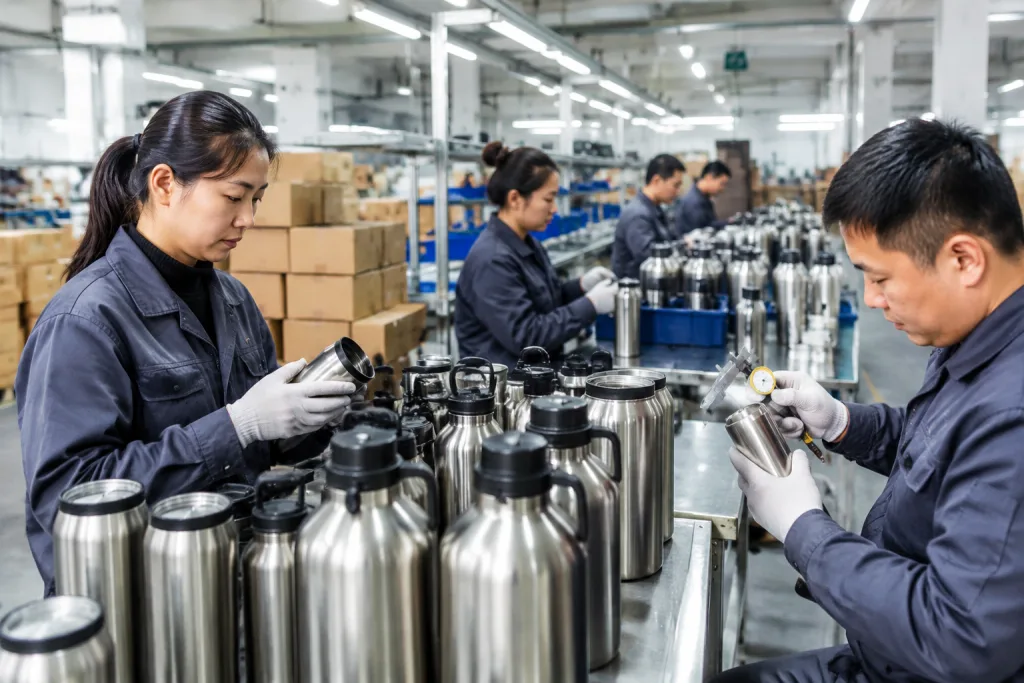
Choosing a stainless steel tumbler manufacturer is not a logo decision. You are buying 304 stainless steel, vacuum insulation, powder-coat adhesion, lid tooling, carton crush strength, compliance files, and batch repeatability. QC pulled one matte black sample last month with a 0.4 mm coating build-up at the rim; small issue, big complaint after 30,000 pcs if nobody catches it.
From our factory network in Zhejiang, China, we see the same mistake 7 times out of 10: buyers ask for the cheapest 20 oz tumbler quote before they confirm the selling channel, target retail price, and drop-test requirement. Wrong question. A supermarket distributor program does not need the same wall thickness, gift box, or lid tolerance as a premium custom growler line. We run the comparison on a spec sheet first, not a catalog screenshot, because the math gets ugly when the buyer flags a cracked lid after the first container lands.
Tumbler, canteen, or growler
Buyers call almost any stainless bottle a “tumbler.” On our quote sheet, we don’t. A tumbler, custom canteen, and custom growler need different body molds, lid gauges, leak tests, and carton inserts. Last month one buyer sent the same 18-word RFQ to 5 canteen manufacturers and got 5 prices with a 22% spread, because 2 factories quoted a screw cap, 2 quoted a straw lid, and 1 quoted a single-wall body. The math doesn’t work unless the spec is locked.
Here is the practical head-to-head view we use with new B2B buyers after QC pulls the sample and checks the lid fit with a 0.02 mm feeler gauge:
| Product type | Typical capacity | Best use case | Main risk |
|---|---|---|---|
| Vacuum tumbler | 12-40 oz | Coffee, retail shelves, corporate gifts | Lid leakage, coating scratches, straw hole fit |
| Custom canteen | 500-1,000 ml | Outdoor, school, sports clubs | Cap seal, dent resistance, strap pull strength |
| Custom growler | 32-64 oz | Beer, kombucha, outdoor refill programs | Thread tolerance, cap compression, pressure handling |
A stainless tumbler is usually the safest first private-label order because the tooling is mature and the line has seen the same cup body thousands of times. Simple is good. A canteen customized with a handle lid, silicone boot, or paracord strap needs extra checks because each added part can fail in packing, drop testing, or daily use. We run strap pull tests at 15 kg on outdoor canteen samples. A customized growler is heavier, costs more to ship per carton, and becomes a headache if the cap thread is off by even 0.3 mm.
If you are a canteen distributor or distributor growler buyer, decide first whether the item is for daily hydration, gifting, outdoor retail, or refill service. This is the wrong question to ask: “What is your cheapest canteen?” A canteen promotional order can use a lighter finish and a simpler lid if the MOQ is tight and the logo area is the selling point. A premium customizable canteen for specialty stores should use thicker body material, stronger powder coating, and a retail carton that survives the 1.2 m drop test. We’ve seen this go sideways when the PO says “mat black” instead of “matte black” and the artwork team follows it exactly.
Spec table before price talk
A serious stainless steel tumbler manufacturer should quote from a spec sheet, not a photo. Photos hide wall thickness, steel grade, vacuum gap, coating system, and lid material. Those five lines move the price more than the product shape does. We check body material with a handheld XRF gun and confirm thickness with a micrometer at the rim before the cup goes to forming.
For standard vacuum tumblers, our common export specification from Zhejiang is 304 stainless steel inner wall, 201 or 304 outer wall depending on price position, 0.4-0.5 mm body thickness before forming, double-wall vacuum insulation, BPA-free PP lid, and silicone seal ring. For higher-end customized drinkware, around 7 out of 10 brand buyers we quote choose 304 inner and 304 outer, 0.5 mm material, copper lining, and powder coating. On the line, QC pulled one 40 oz sample last month because the body sheet measured 0.38 mm instead of the 0.5 mm written on the PO. Small line. Big argument.
| Spec choice | Value option | Premium option | Typical cost impact |
|---|---|---|---|
| Outer steel | 201 stainless | 304 stainless | +USD 0.25-0.70 |
| Finish | Spray paint | Powder coat | +USD 0.35-0.90 |
| Logo | 1-color silkscreen | Laser or 2-side print | +USD 0.10-0.45 |
| Carton | Bulk inner box | Retail color box | +USD 0.20-0.80 |
Do not approve a quote that says only “stainless steel bottle, logo included.” That quote is missing the parts that cause claims. Ask whether the inner wall is 304, whether the lid is PP or Tritan, whether silicone parts meet LFGB or FDA food-contact requirements, and whether the quoted carton is drop-test suitable. If your channel requires REACH, LFGB, or Prop 65 documentation, say it before sampling. We have seen this go sideways when a buyer wrote “FDA needed” in an email thread but left it off the PO; the lab retest added 9 days and the air shipment killed the margin.
For a canteen factory or canteen supplier, ask about cap torque testing and leakage testing. For a customizable growler, ask for thread gauge control and 24-hour leak testing after vacuuming. We run caps on a digital torque tester and put random pieces upside down after the vacuum station; if one lid sweats or seeps, QC stops the batch. These are normal controls, not fancy requirements. The wrong question is “can you make it cheaper?” Ask what has been removed from the spec to get that price.
Use-case fit by sales channel
The same tumbler can be a bargain or a return claim, depending on the shelf it sits on. A petrol station promo cup, an outdoor retailer canteen, and a bank gift order should not run the same spec; the buyer flagged this exact issue last month when the PO said “matte black” but the artwork file showed gloss. Cut the wrong features. Do not thin the steel where it matters.
For promotional drinkware, the job is cost control and a clean logo. A 20 oz tumbler with 304 inner wall, 201 outer wall, slide lid, 1-color silkscreen logo, and individual white box can land at FOB China around USD 3.20-4.80, depending on order volume and finish. We run these on a single-color body when the campaign lasts one season, and QC checks the logo with 3M tape after curing because cheap ink failure is the first complaint we hear.
For retail and distributor drinkware, coating and packaging carry more risk. Budget for powder coating with a 60-80 μm film thickness, barcode labels, retail boxes, and carton marking by SKU. If you sell to marketplaces or retail chains, your canteen vendors must handle FNSKU, EAN, suffocation warnings for polybags, and master carton drop-test requirements. A nice cup in a weak 3-ply carton will arrive with rim dents; we have seen 7 cartons fail a corner drop before the goods even left Hangzhou.
Outdoor and hospitality programs need tougher specs, not prettier renders. A custom canteen for hiking needs a thicker body, a handle lid that passes a 5 kg pull check, and a silicone boot if the buyer expects trail use. A customized growler for breweries should be built around cap seal, mouth diameter, and brush access for cleaning. Too many small parts look good on a mockup, but the math doesn't work after dishwashing, hand assembly, and field use.
Our practical advice: match the drinkware to the abuse level, not the catalog beauty shot.
Decoration methods compared honestly
Logo decoration is where buyers either overspend or leave the spec too loose. We see this on about 7 out of 10 new RFQs. A good canteen manufacturer should push back when the artwork does not suit the cup radius, taper, or coating thickness. Curved stainless bodies punish small mistakes; our pad gauge will catch a 2 mm logo drift that nobody would notice on a flat notebook. Small text, fine gradients, and wraparound graphics should not be treated as the same job.
| Method | Best for | Limit | Typical MOQ |
|---|---|---|---|
| Silkscreen | Clean 1-3 color logos with solid lines | Weak choice on tapered bodies and near shoulder curves | 1,000 pcs |
| Laser engraving | Permanent premium marks on powder coat or bare 304 stainless | No full-color artwork or Pantone matching | 500-1,000 pcs |
| Heat transfer | Full-color designs with photos, gradients, or mascot art | Coating must pass tape test and rub test first | 1,000-3,000 pcs |
| Water transfer | All-over patterns around the body | Higher reject risk at seams and bottom curves | 3,000 pcs |
For most B2B custom drinkware orders, laser engraving is the safest premium option. It does not peel in warehouse handling, and it removes the usual Pantone argument before it starts. The weak point is finish. On bare stainless steel, the mark can look quiet; on powder-coated bodies, the contrast is cleaner. QC pulled one black powder-coated sample last month because the laser depth was set too light at 18W, and the buyer flagged the logo as “grey, not silver.” Fair comment.
Silkscreen still works for canteen customized campaigns when the logo is simple and the budget is tight. Send Pantone codes, vector artwork, and the real print size in mm, not just a JPG pasted into a PO. We run Delta E 1.5-2.5 as the normal tolerance for coated color matching. Exact matching across stainless steel, plastic lids, silicone boots, and paper boxes is the wrong promise to make unless the buyer pays for 2 or 3 pre-production sample rounds. The math doesn’t work on a 1,000 pcs promo order.
If you are comparing canteen suppliers, ask how they inspect decoration before you ask for the lowest FOB price. We normally recommend AQL 2.5 for major defects and AQL 4.0 for minor defects, with critical defects at 0. Write the logo position tolerance into the spec sheet before mass production starts, such as ±2 mm vertical and ±3 mm horizontal. Small line, big trouble. We have seen this go sideways when a PO said “center logo,” but the approved sample measured 6 mm higher than the buyer’s retail mockup.
MOQ, pricing, and lead time
MOQ is not a factory trick. It usually comes from coating line setup, laser logo jigs, printed carton MOQ, and steel purchasing by coil. For a stainless steel tumbler manufacturer in China, a workable MOQ is 1,000 pcs per model for laser logo on existing stock colors, 3,000 pcs per color for custom powder coating, and 5,000-10,000 pcs if you ask for new lid tooling or a private mold. Last month QC pulled a 40 oz sample because the logo sat 2 mm off-center after the fixture was changed. That is why we do not quote “300 pcs custom color” like a trading company.
At BottleForge Industrial in Zhejiang, we run about 600,000 units per month for stainless tumblers and canteen customized programs across partner production lines. Standard lead time is 35-50 days after deposit and sample approval. Back-to-school and Q4 gifting season can add 10-15 days, mainly when the powder coating oven is full or the retail box artwork has to be re-plated. We have seen one PO typo, “matte black” written as “mate black,” stop a 3,000 pcs carton print run for two days. Small mistake. Real delay.
FOB Ningbo or FOB Shanghai is the normal term for export buyers. Ningbo works well for Zhejiang factories because the truck ride is shorter, often 3-4 hours from our Hangzhou area packing warehouse versus a longer haul to Shanghai. For North America, ocean freight on drinkware is driven by carton cube as much as kg weight. A 40 oz tumbler with handle lid eats carton space; a slim 500 ml customizable canteen packs tighter. Ask for master carton dimensions and units per carton before judging unit price. If you only compare FOB, the math does not work.
Typical FOB ranges are broad but still useful: a basic 20 oz tumbler may sit around USD 3.00-5.50; a stronger 30 oz handle tumbler around USD 4.80-8.50; a 32 oz custom growler around USD 6.50-11.00; and a 64 oz customized growler around USD 9.00-16.00. The gap usually comes from steel grade, lid parts, coating spec, carton style, and inspection level. For example, a slider lid with silicone ring and extra straw brush adds more cost than buyers expect, and AQL 2.5 inspection means we need finished goods ready and sorted before the inspector arrives.
If a quote is 18% lower than every other canteen vendor, ask what changed. We have seen this go sideways: 201 outer steel instead of 304 stainless, wall thickness cut by 0.1 mm, weak powder coating that fails a cross-hatch tape test, no individual box, or no budget for third-party inspection. Cheap is not always wrong, but someone removed something from the build.
Factory checks buyers should require
A canteen factory can look clean on a WeChat video and still miss basic control points on the line. Ask for evidence: audit status, inspection records, test reports, and a sealed sample that matches bulk production. BSCI, ISO 9001, Sedex, or a similar audit tells you the factory has a system on paper. It does not define wall thickness, lid torque, coating color, or logo position. We once saw a PO list “black matte” while the approved sample was “black sand texture”; QC pulled the sample at packing, and 3,000 lids had to be reworked.
For stainless tumblers and customizable drinkware, require these checks before mass production: vacuum insulation test; leak test; coating adhesion and cross-hatch test with 3M 600 tape; salt spray test for coastal retail programs; dishwasher guidance; carton drop test. Around 8 of 10 buyers we work with ask for heat retention testing by filling with 95°C water and measuring after 6 or 12 hours. A well-built vacuum tumbler should stay within the agreed range across random bulk samples, not just one golden sample from the sample room.
Food-contact compliance depends on your market. For the EU, buyers usually ask for LFGB, REACH, and specific migration testing. For the US, FDA food-contact compliance and California Prop 65 risk review belong on the checklist. For children’s items, ASTM and CPSIA requirements need to be checked before tooling or print film is released. This is the wrong question to ask: “Is the material safe?” Ask whether the exact lid, straw, silicone gasket, coating, and ink have matching reports. We rejected one kids’ bottle sample because the LFGB report covered the PP lid, but not the soft silicone straw.
Third-party pre-shipment inspection is worth the money for first orders above USD 10,000. Use AQL standards and include function tests, appearance checks, barcode scans, carton measurements, and drop-test photos. If you are a canteen distributor handling multiple SKUs, tell the inspector to verify assortment ratio by color and logo, not just total quantity. We ship mixed-color orders every month, and the buyer flagged one case where the carton mark said 24 pcs blue but the box held 18 blue and 6 green. Wrong color mix is boring to discuss and painful to fix after the container sails from China.
How to brief your supplier
The best RFQ is short, complete, and measurable. You do not need a 40-page file for a first quote, but you do need enough detail for a canteen manufacturer or tumbler factory to price the same bottle you plan to buy. One missing line on steel grade can change the quote by USD 0.18-0.35 per unit. We see it often. Vague RFQs create cheap quotes and expensive corrections once QC pulls the pre-production sample.
Send capacity, product type, steel grade, finish, logo method, packaging, compliance market, target order quantity, delivery term, and required delivery date. If you already have a target FOB price, share it. A practical supplier can then show where the cost sits. For example, changing from a custom molded lid to an existing lid may save USD 0.40-1.20 per unit and remove 25-35 days of tooling time. The math changes fast when the mold room quotes a new PP lid at USD 1,200-2,500 before the first shot.
If you are sourcing a canteen custom line, include lid photos, strap requirements, leak expectations, and whether the bottle must fit a bicycle cage or car cup holder. A 74 mm body and an 82 mm body are not the same product to the line. If you need a customizable growler, specify mouth diameter, cap type, handle style, and whether beer or carbonated drinks are intended. Pressure use needs a straight answer from both sides; not every stainless growler is designed for carbonation, and we have seen samples fail after a buyer added sparkling drinks during a shelf test.
State your business role too. A brand owner usually cares about unique shape and retail packaging. Canteen distributors look harder at stable replenishment, carton efficiency, and mixed-SKU loading, so tell us if one 40HQ must carry 6 colors across 3 sizes. A promotional agency may need fast sampling and artwork proofs. This is where buyers sometimes ask the wrong question: the lowest body price is not always the cheapest order if the carton CBM is poor or the logo file arrives with a typo on the PO.
A good supplier in Zhejiang, China should answer with a clean specification, sample cost, MOQ, lead time, carton data, payment terms, and test options. Ask for wall thickness, carton size, GW/NW, and the inspection level before you pay. If you receive only a unit price and a smiling promise, keep asking before you send the deposit.
Send your tumbler spec and target FOB price
We will compare the right steel, lid, finish, packaging, MOQ, and lead time before you commit to tooling or production.
Frequently asked questions
What MOQ should I expect from a stainless steel tumbler manufacturer?
For existing molds and standard colors, 1,000 pcs per model is common for laser engraving or simple silkscreen. Custom powder coating usually starts at 3,000 pcs per color because the coating line needs setup and cleaning time. New lid tooling or a fully private mold can require 5,000-10,000 pcs, plus tooling cost from USD 1,500 to over USD 8,000 depending on complexity. If a supplier offers 200 pcs with full customization, check whether it is stock decoration rather than true production.
Is 304 stainless steel always better than 201 for custom drinkware?
304 stainless steel is the normal choice for food-contact inner walls because it has better corrosion resistance. Many value tumblers use 304 inner wall and 201 outer wall to control cost. That can be acceptable for promotional or lower-price retail orders if the coating is good and the market does not demand full 304. For premium customized drinkware, outdoor canteens, or products exposed to salt, sweat, or hard cleaning, 304 inner and 304 outer is safer. Expect roughly USD 0.25-0.70 extra per unit depending on size.
How long does sampling and production take for customized tumblers?
A plain laser logo sample usually takes 5-10 days after artwork confirmation. A custom powder-coated sample may take 10-18 days because color matching and coating setup are slower. Mass production is typically 35-50 days after deposit and approved pre-production sample. Add 10-15 days during peak seasons or if you need retail color boxes, multi-color artwork, or third-party testing. Ocean freight to North America or Europe can add 25-45 days depending on port pair and shipping market.
Can one supplier handle tumblers, canteens, and growlers together?
Yes, but confirm whether they manufacture all items directly or coordinate with partner lines. Many stainless drinkware factories specialize by body type, capacity, or lid system. A supplier may be strong in 20 oz tumblers but weaker on 64 oz customized growler thread control. For a mixed distributor drinkware program, ask for separate samples, carton data, and QC checklists by item. Combining SKUs can save communication time, but it should not hide different production risks. Use AQL inspection on each SKU, not only the total order.
What should I check before paying a deposit to a canteen supplier?
Confirm the full specification in writing: capacity, dimensions, steel grade, wall thickness if available, finish, Pantone color, logo method, packaging, carton quantity, compliance documents, MOQ, lead time, FOB port, and payment terms. Ask for recent test reports relevant to your market, such as LFGB, REACH, FDA, or Prop 65 review. For first orders above USD 10,000, budget for third-party inspection using AQL 2.5/4.0. Also confirm whether the production sample is made by the same line that will make mass production.