Key Takeaways
- A workable stainless steel tumbler factory quote often starts at 500-1,000 pcs, with FOB China pricing around USD 3.20-7.80 depending on capacity and decoration.
- Double-wall 18/8 stainless with 0.4-0.5 mm inner and outer shells is the practical standard for most custom drinkware programs.
- Typical production lead time from a Zhejiang factory is 25-35 days after sample approval, plus 5-8 days for packing or carton changes.
- For North America and Europe, ask for REACH, LFGB where needed, and an AQL 2.5 inspection plan before you approve mass production.
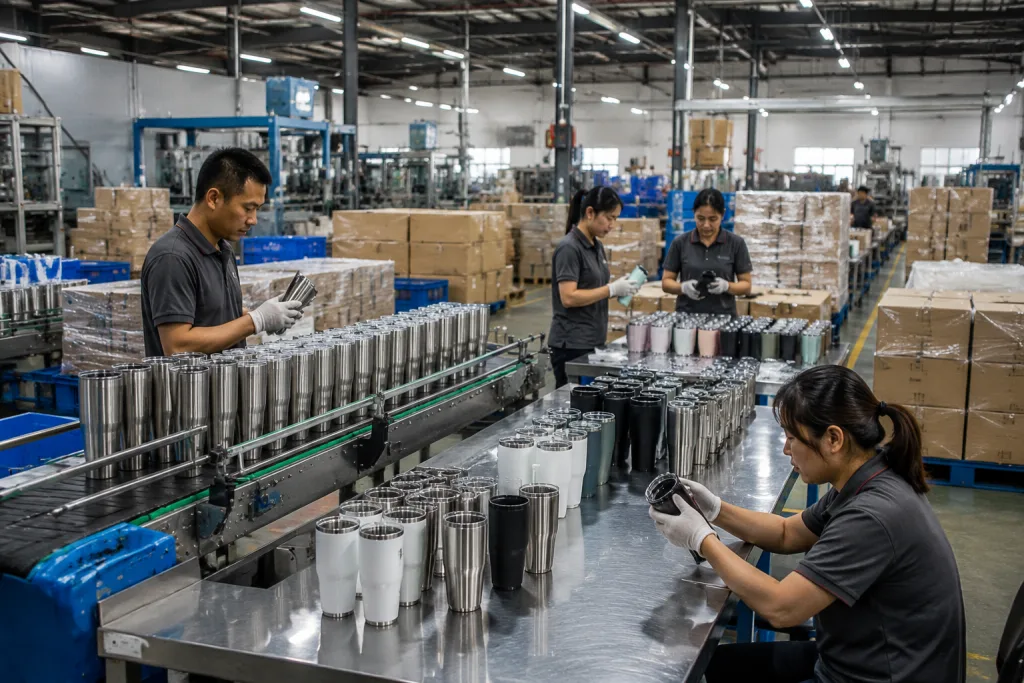
If you are buying from a stainless steel tumbler factory, the real risk is not whether the cup looks good on a sample table. The risk is whether the factory can hold a 0.5 mm wall spec, keep a 500-2,000 unit MOQ under control, and ship a compliant product on time without turning your launch into damage control. We run into this on the line all the time: a cup looks fine in hand, then QC pulls the sample and finds the wall drifts at 0.62 mm. In Zhejiang and across China, plenty of factories can quote fast. Fewer can quote accurately.
The smarter way to buy custom drinkware is to make four decisions early: material and construction, decoration method, compliance level, and commercial terms. That sounds basic, but it is where most problems start. A canteen manufacturer that is fine for a 304 double-wall tumbler may not be the right canteen supplier for a promotional order with laser engraving, REACH paperwork, and Amazon FNSKU labeling. We have seen buyers skip one of those calls and the math does not work later. You need a hard checklist, not a sales pitch.
Start with the use case
I’ll rewrite the section in-place, keeping the HTML structure unchanged and tightening the sales tone around concrete factory cues.Before you ask for quotes, pin down where the tumbler will sit. A 20 oz office cup, a field bottle for a sales crew, and a promo item for distributor programs are three different jobs. A stainless steel tumbler factory should ask about hot-fill hours, lid leak risk, logo print size, and your target retail or wholesale price. If you cannot answer those, unit cost is the wrong place to start.
Start with the non-negotiables:
- Capacity: 350 ml, 500 ml, 600 ml, or 20 oz / 30 oz
- Finish: powder coat, spray paint, brushed steel, or glossy lacquer
- Use profile: commuting, gifting, sports, travel, or promotional canteen campaigns
- Packout: bulk carton, individual box, or e-commerce-ready set
Once the use case is clear, we can tell you if you need a simple customized drinkware line or a heavier customized growler-style body with thicker gauge and a tighter lid seal. We see buyers mix those up all the time. A 0.4 mm wall and a 1.0 mm wall are not the same product, and the buyer who flagged a leaky flip lid on the sample knew it before the line shipped 5,000 pcs. Good factories in Zhejiang will say a design is too heavy for the market or too light for the spec. That pushback saves cash.
Check the build, not the gloss
I’ll rewrite the prose in-place, keep the HTML structure untouched, and tighten it to sound like an export sales engineer wrote it.Sample photos lie. Metal thickness does not. For a real tumbler program, ask for stainless grade, shell thickness, and weld detail. Most export-grade models use 18/8 or 304 stainless steel; on low-cost SKUs, some factories push 201 steel, but that is the wrong trade if you care about corrosion resistance, taste neutrality, or how the brand holds up after 6 months in the field. For drinkware going into Europe or North America, 304 is the safer baseline. We run a caliper on the shell before QC signs off.
A useful spec sheet should show:
- Inner wall: 0.4-0.5 mm
- Outer wall: 0.4-0.5 mm
- Vacuum gap: even across the body, not just printed on paper
- Bottom pad: laser date code or stamped lot traceability
Do not ignore lids. Most buyer complaints come from the cap, not the cup. A stainless steel tumbler factory with export experience will check lid fit for 20-30 open/close cycles and run an inverted leak test for 2-4 hours. We’ve seen a buyer flag a PO because the lid drawing called out 72 mm and the sample came in at 71.6 mm; the math does not work. If you are buying canteen customized products for outdoor use, ask for gasket material details, usually food-grade silicone. A canteen factory that cannot explain gasket hardness or venting is not ready for a serious B2B order.
Price the right way
I’ll rewrite this section in-place, keep the HTML structure intact, and tighten the pricing language so it reads like a factory sales engineer wrote it.Unit price only makes sense after you split it into body cost, lid cost, print cost, and packing cost. A plain 500 ml tumbler in FOB China terms may land around USD 3.20-4.10 at 1,000 pcs. Add powder coating, one-color silkscreen, and a printed box, and that same order can move to USD 4.60-6.20. Laser engraving, custom molds, or a complex straw lid can push it higher. Normal. Not inflation.
What matters is whether the supplier is straight with the breakdown. Ask for:
- FOB pricing by quantity tier: 500, 1,000, 3,000, 5,000 pcs
- Tooling or mold fees, if any
- Pantone match surcharge and setup charge
- Secondary packing cost per unit
Buyers often underprice decoration. A simple logo may add USD 0.15-0.40 per piece; laser engraving may add USD 0.25-0.60; full-wrap printing can add more. We’ve seen a PO typo on carton marks turn into a 2-day reprint job, so this is the wrong place to guess. If your program is for a canteen distributor or a distributor canteen rollout, spread these costs over the expected sell-through, not just the first invoice. A cheap quote that skips packaging or carton markings usually gets expensive later.
Demand compliance upfront
I’ll keep the tags and structure intact, and rewrite the prose with a more field-tested sales tone plus concrete factory details.If you sell into Europe or North America, compliance is part of the product spec. Ask the stainless steel tumbler factory whether it can support REACH declarations, LFGB food-contact testing when required, and migration testing for inks, coatings, and silicone parts. For the U.S. market, buyers often ask for FDA-aligned food-contact paperwork too, even though the exact route depends on the material stack and end use.
For wholesale and Amazon programs, your supplier should also handle:
- AQL inspection: usually AQL 2.5 for major defects, 4.0 for minor defects
- Carton tests: drop, compression, and shipping simulation
- Labeling: UPC, FNSKU, or retailer-specific sticker placement
- Traceability: lot number, production date, and packaging records
This is where a factory beats a middleman. A vendor moves cartons; we run the line, check incoming 304 stainless coils, and keep final packing under the same roof. In Zhejiang, a solid plant will show sample COAs, line photos, and inspection checklists before you ask twice. If they dodge that request, walk away. We’ve seen buyers get burned by one coating defect after customs release, and the math does not work.
Choose decoration by channel
I’ll rewrite the section in-place, keep the HTML exactly as-is, and tighten the copy so it sounds like a factory-side sales engineer.The decoration method should match the sales channel, not the mood board. For bulk B2B orders, silkscreen is usually the lowest-cost path when the logo is simple and uses one or two colors. We run this on the pad printer line all the time. Laser engraving fits premium corporate gifts better, because the mark holds up and does not fade. Heat transfer and UV printing work for full-color branding, but they add setup steps and make SKU reuse harder.
Think about the commercial life of the product. A trade show canteen promo order may only need a one-color logo and a low price. A retail launch canteen often needs matte powder coat, laser logo, and a gift box. A distributor drinkware catalog order may need blank stock plus flexible branding for different clients. Different game.
For buyers comparing canteen customizable, canteen customized, and customized drinkware options, ask the factory to quote the same body with three decoration paths. That is the right question. On our side, QC pulled the sample and checked logo placement at 2 mm tolerance before we released the quote. If one decoration adds 12 days and USD 0.35 while another adds 3 days and USD 0.20, the math is clear. The best stainless steel tumbler factory will show where branding drives margin and where it just burns budget.
Read the factory beyond the sample
The sample room is not the factory. Ask what they can ship in a normal month, how many operators are on the line after lunch break, and whether your season has reserved capacity. A solid Zhejiang factory may run 300,000-500,000 units per month across multiple drinkware lines, but the number means little if your SKU gets squeezed behind a 40,000 pcs promo order. We check the line loading board, welding stations, and carton area before we trust the sample. Ask for current line loading and peak-season lead times, such as 12 days to sample versus 18 days in October.
Useful factory questions are simple. No soft talk. Put these on the table before the PI is signed, the same way QC checks lid torque with a torque meter before sealing the golden sample:
- What is your normal MOQ for this body, lid, and finish?
- How many days from PO to pre-production sample?
- How many days from sample approval to bulk shipment?
- Do you own coating and printing, or is packing handled by an outside workshop?
If the factory also acts as a canteen distributor or canteen suppliers hub, make sure you are buying from the production site, not a trading layer that adds margin and delays. A canteen vendor is fine if they control the answers, but the math does not work when every lid issue travels through 3 people before the line sees it. We have seen this go sideways: the buyer flagged a color shift, QC pulled the sample, and the PO even had the Pantone code typed wrong. For repeat programs, the right partner holds drawings, repeats color, and keeps lid torque consistent across batches. That is what keeps custom drinkware programs alive after the first order.
Get factory quotes that hold up in production
Send your target price, capacity, and market. We’ll map the right tumbler spec, decoration, and compliance path before you place a PO.
Frequently asked questions
What MOQ should I expect from a stainless steel tumbler factory?
For standard models, expect 500-1,000 pcs per color and print combination. If you choose a custom lid, custom box, or special coating, MOQ may rise to 2,000 pcs. A few Zhejiang factories can support 300 pcs for stock bodies, but pricing is usually higher, often by 15-25%. If you need canteen custom SKUs across multiple markets, ask whether the MOQ is per design or per total order. That detail changes your cash flow more than the sticker price does.
How long does production usually take?
For a normal export order, sample lead time is often 5-10 days, then bulk production takes 25-35 days after sample approval. If you need printed cartons, extra testing, or a busy season slot, plan 35-45 days. A reliable canteen factory in Zhejiang should tell you whether coating, print, and packing are done in-house or outsourced, because outsourced steps can add 5-8 days. Shipping time is separate and depends on whether you book FOB China or a delivered term.
Which steel grade should I choose?
For most custom drinkware, 304 or 18/8 stainless steel is the right choice. It resists corrosion better than 201 steel and handles mainstream food-contact use in Europe and North America more safely. If you are buying a canteen manufacturer’s low-cost line for short-term promotion, 201 may look cheaper, but the savings are often too small to justify the risk. Ask for material certificates by lot and confirm wall thickness, usually 0.4-0.5 mm for a workable tumbler body.
Can one factory handle both tumblers and canteens?
Yes, many canteen manufacturers in China and especially Zhejiang produce a wider drinkware range, including tumbler, canteen, custom growler, and insulated bottle lines. That is useful if you want a coordinated product family, but only if the factory has separate tooling and quality control for each body type. A good canteen supplier should show you which molds are shared and which are not. Shared parts can lower cost; poor process control can create fit problems, so verify lid compatibility and insulation performance before you scale.
What documents should I ask for before paying deposit?
Ask for a proforma invoice, product spec sheet, artwork confirmation, packaging spec, and compliance documents that match your market. For Europe, REACH and food-contact support are common asks; for the U.S., buyers often want supplier declaration files, test reports, and clear carton labeling. If you are using Amazon, request FNSKU labeling support and carton dimensions. A practical canteen supplier should also agree on AQL 2.5 for major defects and share final inspection photos before balance payment.