Key Takeaways
- A practical distributor MOQ for one custom tumbler color is usually 1,000-3,000 units, with 5,000 units giving better unit cost
- For 304 stainless steel tumblers, confirm inner/outer grade, wall thickness, vacuum test rate, and lid material before quoting
- Logo choice changes cost and risk: laser engraving is stable, while full-wrap printing needs tighter artwork and scratch testing
- Use AQL inspection, carton drop testing, and pre-shipment samples before paying the 70% balance
You are not buying one tumbler. You are buying a repeatable supply program that has to survive sea freight, retail complaints, logo approvals, and margin pressure. For stainless steel tumbler distributors, the costly mistakes usually happen before production starts: specs missing the 0.5 mm tolerance, artwork sent as a low-res JPG, carton rules no one confirmed, and no AQL 2.5 inspection plan. We have seen this go sideways when QC pulled the sample and the buyer flagged a logo that looked grey instead of Pantone 426C.
Let’s walk through one realistic order from inquiry to shipment: 5,000 double-wall tumblers, customized drinkware for a distributor customer in Europe or North America. BottleForge Industrial is based in Hangzhou, Zhejiang, and works with Zhejiang and China supply-chain partners for forming, coating, lids, packing, and export documentation. On an order like this, we run the line by color, check lid fit with a torque gauge, and pack against the buyer’s carton mark sheet before the forwarder books space.
Start with the selling channel
A good quote starts with where the tumbler will be sold. A stainless steel tumbler distributor selling into retail chains needs cleaner shelf cartons and lower cosmetic risk than a distributor drinkware seller shipping mixed cartons to Amazon FBA or a promotional agency. “Send me your best price” is the wrong question to ask. Start with the channel, target retail price, and complaint tolerance; last quarter a buyer flagged 2 hairline scratches on a black powder-coated sample under a 6500K inspection lamp, while another accepted the same finish for a trade-show giveaway.
For this buyer scenario, assume you need 5,000 units of a 20 oz vacuum tumbler with lid, powder coating, and one-color logo. The goods will ship FOB Ningbo from China, then move to a North American warehouse. Your customer wants a clean retail-ready carton, barcode label, and a spare lid rate of 1%. Good. That is enough information for a canteen manufacturer or tumbler factory to build a serious cost sheet; our packing table still needs the barcode size, usually 38 x 25 mm or 50 x 30 mm, before the carton artwork goes to plate.
Here is what we would ask before quoting: capacity in oz or ml with fill-line tolerance; stainless steel grade and inner wall thickness; lid style with gasket material; coating finish with target color code; logo method with artwork size in mm; carton requirements with drop-test target; compliance market with buyer name on the report; delivery deadline with vessel week. If you are acting as a canteen distributor or distributor canteen supplier for a larger brand, confirm whether they need BSCI, ISO 9001, REACH, LFGB, FDA, or California Prop 65 documentation. QC pulled one sample last month because the PO said FDA, but the retail customer later asked for LFGB migration testing. The math does not work when paid lab testing is discovered after mass production.
For a standard tumbler program in Zhejiang, a realistic production lead time is 30-45 days after deposit and artwork approval. BottleForge’s coordinated monthly capacity for stainless tumblers and bottles is about 600,000 units/month, but capacity is not a magic promise. During March-June and September-November, coating and packing lines fill quickly; in May we run powder-coating oven carts with 18-day queues, compared with about 7 days in January. If you need a fixed launch date, lock the order earlier than your spreadsheet suggests.
Lock the product specification first
The word “tumbler” is too loose for purchasing. We see this go sideways in RFQs. One supplier quotes a 180 g promotional body, another quotes a 260 g retail body, and the photo hides the difference. Your RFQ should pin down the construction before anyone talks price; last month QC pulled a sample with a 0.32 mm inner wall after the PO said “standard 20 oz.”
For a 20 oz stainless steel tumbler, a workable distributor spec could read like this: 304 stainless steel inner wall, 201 or 304 outer wall depending on price target, double-wall vacuum insulation, 0.4 mm inner wall and 0.5 mm outer wall, powder-coated exterior, BPA-free AS or PP lid, silicone gasket, and a stainless straw only if the channel needs it. Spell it out. If you are asking for a custom growler or customized growler later in the same program, do not copy the tumbler spec blindly. Growlers need different welding control and leak-pressure testing; on the line we run them through a pressure check that does not apply to open-mouth tumblers.
Ask the canteen factory to state the insulation target in measurable terms. For example, hot water at 95°C remains above 55°C after 6 hours in a 20-25°C room. Cold performance can be tested with ice water, but the method must be written on the sample sheet, including water volume and room temperature. Otherwise 6 suppliers will all claim “keeps cold 24 hours,” and the buyer has nothing to compare. The math doesn’t work.
Capacity needs discipline. A 20 oz tumbler may hold 590 ml to the brim, but usable fill can drop once the lid and silicone gasket are fitted. If your retail packaging says 20 oz, request a capacity test report during sample approval; we usually check with a digital scale and record grams of water before converting to ml. For Europe, metric markings are often preferred. For North America, oz claims still drive consumer recognition, and buyers flag this fast if the carton artwork says 20 oz but the test shows 560 ml usable fill.
If you sell canteen customized programs across several sizes, keep the lid platform common where the diameter allows it. Shared lids cut mold cost and reduce spare-part mistakes after shipment. A canteen customizable range looks strong in a catalog, but 7 unique lids across 8 SKUs create inventory traps for distributors. We ship replacement lids every month; the wrong lid code on a PO, even one digit off, can hold an order for 3 days.
Quote the real landed program
The FOB unit price is only one line on the cost sheet. A low quote gets ugly after rejected cartons, late artwork approval, loose lids, repacking, or air freight because the ETD moved from May 12 to May 19. We have seen QC pull 8 cartons for crushed corners before loading, and the math didn’t work after the buyer paid for new outer cartons. For stainless steel tumbler distributors, compare total landed cost per sellable unit, not the prettiest FOB number.
For the 5,000-unit order, a typical FOB Ningbo range for a 20 oz powder-coated tumbler with one-position logo might be USD 3.20-4.80 per unit, depending on body weight, lid type, coating quality, packaging, and steel grade. A retail color box may add USD 0.18-0.45. A kraft gift box costs less, but it can look wrong on a premium shelf. A full-color printed box with barcode, warning text, and recycling marks needs confirmed dielines before production; last month the buyer flagged a 2 mm barcode shift on the PDF proof, and we held the line until the file was corrected.
MOQ depends on customization. Plain stock colors may start from 500 units if inventory exists. A new powder color usually needs 1,000-3,000 units per color. Pantone-matched coating is possible, but allow tolerance. Stainless powder coating is not paper printing. If your customer demands a tight brand color, this is the wrong question to ask by email. Approve a sprayed color chip or pre-production sample under D65 lighting; a phone photo from the coating room will lie.
Payment terms in China commonly run 30% deposit and 70% balance before shipment after inspection. For a new relationship, be careful with soft terms like 10% deposit and 90 days after BL copy. We have seen this go sideways when a trading layer could not get the factory to fix 312 leaking lids found at final inspection. As a canteen vendor or custom drinkware supplier, we prefer boring terms with clear gates: deposit, sample approval, bulk production, inspection, balance, vessel booking. No drama.
Ask whether the quote includes export cartons, palletization, FNSKU labeling, suffocation warnings, or Amazon carton limits. If you need FBA cartons under 22.5 kg, that changes the master carton count and sometimes the insert tray. A standard 20 oz tumbler carton may pack 24 units, around 13-16 kg gross weight depending on box style. We run the carton on a floor scale before final packing, because a 23.1 kg carton looks harmless in Hangzhou and becomes a chargeback in the Amazon warehouse.
Decoration is a risk point
Logo work is where distributor orders lose time. Your buyer sends a 900 KB PNG, our design desk opens it in CorelDRAW, and the line ends up guessing the edges. Then the sample comes back with a shifted stroke and the buyer flags it. Avoid that. Ask for vector art in AI, EPS, PDF, or SVG, with Pantone numbers and exact logo size in mm, such as 28 x 14 mm on the side panel.
For stainless tumblers, we run laser engraving, silk screen printing, heat transfer, water transfer, and UV printing. Our 20W fiber laser is the cleanest option on 304 stainless and powder coating. It burns off the coat and exposes metal, so ink adhesion is not the issue. It works for corporate programs, canteen promo runs, and hard-use distributor lines. The limit is color: laser stays one-color, and that is the tradeoff.
Silk screen printing is the cheapest path for one or two colors. It holds up on straight bodies and mild tapers, but curved tumblers need a proper jig; we had a batch wobble 1.5 mm because the holder was loose. Ask for a 3M tape pull and a rub test before mass production. For full-wrap art, heat transfer or water transfer can look sharp, but the scrap rate climbs. If the buyer is chasing the lowest price, this is the wrong place to cut corners. Put 3-5% production loss into the cost sheet from day one.
For canteen custom projects and customizable drinkware lines, make a decoration approval sheet. List the logo file name, color code, size, position from bottom, seam position if there is one, finish, and packing orientation. We've seen this go sideways. On our packing table, the seam mark is 6 o'clock, and that keeps repeat orders consistent across tumblers, bottles, and a customizable growler. Buyers notice when one logo sits 8 mm higher and another sits 15 mm lower.
Approve one golden sample and keep it sealed. The factory keeps one, you keep one, and the inspection company uses that card as the reference. We bag ours with a signed label and a date code. Email approval alone is weak when surface color, logo depth, or gloss level matters.
Build inspection into the order
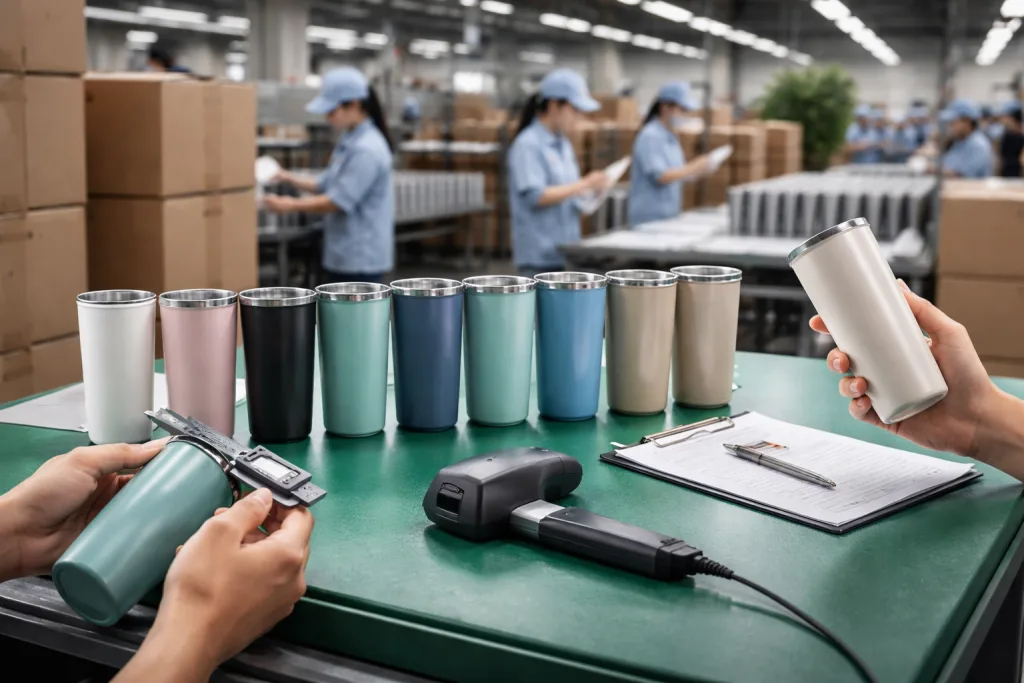
Quality control should not start after the forwarder books the container. For this 5,000-unit order, write the checkpoints into the PI before deposit: 304 stainless incoming material checks with a PMI gun, vacuum testing, coating inspection, lid fit testing, logo inspection, packing audit, and final random inspection under AQL. Do it early. Once the line has packed 5,000 color boxes, fixing a wrong logo position becomes repacking work, not a quick adjustment.
A common inspection setting is AQL 2.5 for major defects and AQL 4.0 for minor defects, with critical defects at 0. For a 5,000-unit lot, a third-party inspector usually pulls about 200 pieces under General Inspection Level II, then checks the defect count against the agreed table. Critical defects include sharp rim edges over the mouth area, oil or dust contamination inside the cup, unsafe materials, broken glass components if any, and leakage that wets the carton. Major defects include poor vacuum performance, wrong logo, coating peeling larger than the approved limit, serious dents, lid mismatch, and incorrect barcode. Minor defects include small coating specks, slight color variation within approved tolerance, and minor box scuffs. QC pulled the sample, not sales.
Vacuum performance deserves its own line item. A proper canteen manufacturer should test 100% of vacuum bodies before packing, usually by hot-water testing or vacuum detection equipment; we run hot water at the vacuum test station before the outer coating goes on. Ask for a retained production record with date, line number, and failed-piece count. For leak testing, tumblers with sip lids are not made to roll around inside a backpack. Do not print “leakproof” on Amazon images or retail sleeves unless the lid construction supports it. We have seen this go sideways. The buyer flagged “100% leakproof” on one artwork file, and we changed it to “spill-resistant” before mass printing. For travel lids, we usually test inverted leakage for 30 minutes and shaking leakage for 10 cycles. State the method.
Coating needs appearance checks and adhesion checks. Powder coating thickness often falls around 60-90 microns; our QC checks it with a coating thickness gauge near the cup wall and bottom curve. Too thin scratches after a few carton rubs. Too thick affects lid fit or leaves orange peel texture near the rim. For a matte finish, fingerprints show more than new buyers expect. For glossy finishes, hairline scratches stand out under warehouse light, especially under 6000K inspection lamps. A canteen supplier should explain these trade-offs before production. After complaints arrive, the math doesn't work.
Carton strength matters because ocean freight is rough. Use 5-ply export cartons for retail boxes, especially when cartons are stacked on pallets. We normally recommend a carton drop test from 76 cm for master cartons under 10 kg, adjusted by weight and customer standard; the line drops on 1 corner, 3 edges, and 6 faces, then QC checks crushed retail boxes and lid damage. If you need ISTA testing, say so early because it changes packaging design and cost. A PO typo like “4-ply” instead of “5-ply” looks small, but after 18 days on the water, weak cartons show every mistake.
Compliance is market-specific
Compliance is not a decoration line on a quotation. It decides whether your distributor growler, tumbler, or custom canteen can legally enter and sell in the target market. For North America, buyers ask us for FDA food-contact compliance, California Prop 65 review, BPA-free confirmation, and ASTM-related safety checks for kids’ items. For Europe, we usually prepare LFGB, REACH, and EU food-contact documents. If the item is for children, the bar moves up fast. Last month QC pulled a kids’ straw lid sample because the silicone straw measured 0.4 mm thinner than the approved drawing.
Ask your canteen vendors to separate three documents: existing factory certificates, material declarations, and third-party lab reports for your exact product. BSCI or ISO 9001 says something about factory management. It does not prove the coating, silicone gasket, or plastic lid passes food-contact limits. A two-year-old report for a PP lid will not satisfy a strict importer if this PO uses Tritan or a painted slider. We see this go sideways when the buyer’s PO says “black lid” but the approved lab report says “clear lid.”
For this order, the lid is the highest compliance risk. Stainless steel bodies are usually straightforward if the grade is correct, but plastics, silicone, inks, and coatings need tighter control. If your customer requires REACH SVHC screening or LFGB sensory testing, include the test cost and 7-10 working days in the project schedule. For California Prop 65, discuss warning-label strategy with your compliance advisor. A factory in Zhejiang can provide documents and cut samples from the line, but it cannot replace your legal responsibility as importer of record. The math doesn't work if testing starts after 30,000 lids are already molded.
Country of origin marking also needs planning. “Made in China” can be printed on the color box, bottom sticker, or laser marked on the base. Some retail customers prefer permanent marking; promotional buyers often prefer box marking only. Confirm before mass production. Changing origin marking after goods are packed is slow and ugly. We once had 86 cartons opened by hand because the buyer flagged the origin mark after final inspection.
If you sell through marketplaces, barcodes and FNSKU labels must scan cleanly. Test label placement on the actual retail box, not a flat PDF proof. A barcode printed over a box fold or glossy coating can fail warehouse scanning and create chargebacks. We run a quick scan test with a Zebra scanner before packing, because a 25 mm label placed 3 mm too close to the edge is enough to cause trouble.
Approve shipment without guessing
Before paying the balance, get the final inspection report with the signed AQL page, packing photos that show carton marks and pallet layout, and a draft set of shipping documents. The report needs the sample size, defect list with photos, key measurements in mm, barcode scan results, carton count, gross weight, and a clear pass or fail against your written AQL standard. Ask for proof. Our QC team usually scans the EAN with a Honeywell scanner and weighs the master carton on a 30 kg bench scale, because “looks okay” is not enough for balance payment.
For the 5,000-unit scenario, expect around 209 units inspected under a general inspection level II sampling plan, based on the exact lot size and standard used. The inspector should open cartons from several pallet positions: front row, rear row, top layer, and middle stack. Not just the clean cartons near the door. If defects cluster in one production date or one color, ask for a targeted recheck; we have seen lid scratches all come from one 20240618 shift tray. Do not let anyone average a serious defect into a pass because the total percentage looks small. That is the wrong question to ask.
Shipping from Zhejiang through Ningbo or Shanghai is routine, but it is not automatic. Confirm carton dimensions early so your forwarder can estimate CBM; a 5,000-unit tumbler order may occupy roughly 18-28 CBM depending on the gift box, straw kit, and inner divider. If you ship LCL, pay for stronger cartons and moisture protection. We run 5-ply export cartons on LCL jobs after seeing corner crush on a mixed warehouse transfer. If you ship FCL with mixed custom drinkware, load planning matters because heavy stainless cartons can crush lighter glass bottle or lid cartons.
Your commercial invoice, packing list, bill of lading instructions, and HS code description should match line by line. Stainless steel vacuum drinkware often falls under different tariff treatment depending on market and product details, so check with your broker before shipment. We once saw a PO typo where the item was called “plastic mug” while the invoice said stainless vacuum tumbler; the buyer flagged it before Ningbo cutoff, which saved a document amendment fee. A canteen suppliers’ casual HS suggestion is not a customs strategy.
A reliable China partner will push back when your plan is risky. It might be MOQ, a coating color, a lead time that gives the line no buffer, or a logo method that will not survive use. We have told buyers not to put fine 0.25 mm text on powder coating because QC pulled the sample after 3M tape testing and the edge broke. That is not negativity. It is how distributor programs stay profitable. If you want a long-term canteen distributor range, choose a canteen manufacturer that documents details and tells you the uncomfortable parts before production starts.
Send your tumbler spec for a factory quote
Share capacity, color, logo, packaging, MOQ target, and market. We will return a practical China production plan with cost and lead time.
Frequently asked questions
What MOQ should stainless steel tumbler distributors expect for custom orders?
For a standard stainless steel tumbler, expect 1,000-3,000 units per color for custom powder coating, with 5,000 units usually giving better FOB pricing. If you use an in-stock body and existing color, some suppliers can start around 500 units, but logo setup and packing cost will be less efficient. For a new mold, special lid, or fully customized canteen shape, MOQ can rise to 10,000 units or more. The practical question is not only MOQ; it is whether your retail price can absorb custom color, packaging, inspection, and freight.
Is 304 stainless steel always required for tumblers and canteens?
For food-contact inner walls, 304 stainless steel is the normal choice and is what we recommend for distributor programs. The outer wall may be 201 or 304 depending on budget and corrosion expectations. A common cost-saving structure is 304 inner and 201 outer, but premium programs often request 304 inner and 304 outer. Ask the factory to state the grade in the proforma invoice and keep material records. For coastal markets or premium retail, spending more on 304 outer steel can reduce rust complaints around rims and bases.
Which logo method is safest for customized drinkware?
Laser engraving is usually the safest and most durable method for stainless steel tumblers with powder coating. It does not rely on ink adhesion and handles normal washing better than many printed methods. Silk screen printing is fine for simple one-color logos, but you should require tape and rub testing. Full-wrap heat transfer or UV printing gives stronger shelf impact but adds risk, especially on tapered shapes. For a 5,000-unit order, approve a physical pre-production sample and define the logo size, position, and Pantone colors before mass production starts.
How long does a custom tumbler order from China usually take?
A normal custom tumbler order from China takes about 30-45 days for production after deposit and artwork approval. Add 5-10 days for sample approval if the decoration or color is new. Lab testing can add 7-10 working days. Ocean freight to North America or Europe may add 25-45 days depending on port, season, and routing. If you need goods for a fixed retail launch, start the project at least 90 days before the warehouse deadline. During peak seasons, coating and packing capacity in Zhejiang can book out quickly.
What should I inspect before releasing final payment?
Inspect product appearance, capacity, vacuum performance, lid fit, leakage method, logo accuracy, coating adhesion, barcode scanning, carton strength, and carton count. Use a written AQL standard, commonly AQL 2.5 for major defects and 4.0 for minor defects, with critical defects at 0. For a 5,000-unit lot, an inspector may check around 209 units under general level II sampling. Also review packing photos and draft documents before paying the 70% balance. If your order uses FNSKU labels or retail barcodes, scan them during inspection, not after arrival.