Key Takeaways
- A 20 oz vacuum tumbler usually lands at USD 3.20-5.80 FOB China depending on steel grade, lid, coating, and logo
- Practical MOQ is 1,000 units per color for repeatable factory pricing; 3,000-5,000 units opens better decoration and packaging options
- Normal production lead time is 30-45 days after sample approval, plus 28-38 days ocean freight to many EU and US ports
- Testing, carton design, inserts, FNSKU labeling, and AQL inspection can add USD 0.08-0.45 per unit but reduce distributor claims
If you source as a stainless steel tumbler distributor, the hard part is not finding a factory. The hard part is proving whether the quoted USD 3.20 tumbler matches the USD 4.60 one in steel grade, wall thickness, lid fit, powder coating, and carton strength before your customer’s retail window closes. We’ve seen this go sideways: QC pulled a sample with a 0.42 mm inner wall against a 0.50 mm spec, and the buyer flagged it after the deposit was already paid.
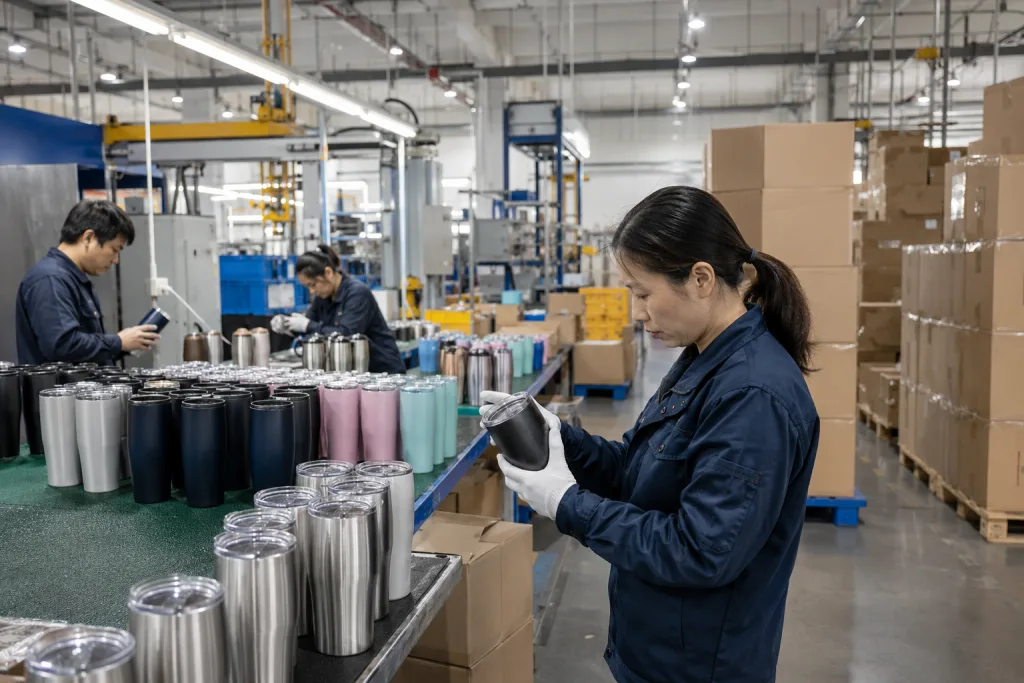
At our Zhejiang facility, we quote custom drinkware every week for Europe and North America: retail brands, promotional agencies, Amazon sellers, and distributor drinkware programs. A normal OEM run starts at 1,000 units per color, while larger projects move through our Hangzhou, China production line at roughly 450,000 stainless units per month. On the line, we run salt-spray checks, lid leak tests, and carton drop tests; one PO last month even had the Pantone code typed wrong by one digit, which would have turned a clean reorder into 3,000 off-color cups.
Start With Landed Cost
Most buyers ask us for the cheapest FOB price first. I get why, but this is the wrong question to ask if you make money as a stainless steel tumbler distributor. Start with the landed, saleable cost per unit after decoration, packaging, inspection, duty, freight, and warehouse handling. Last month a buyer flagged a USD 0.18 cheaper quote; QC pulled the sample and found the carton was 2 mm thinner and the lid gasket failed after 6 leak tests.
For a standard 20 oz double-wall stainless tumbler, our factory quotation from Zhejiang, China normally sits between USD 3.20 and USD 5.80 FOB Ningbo or Shanghai. The low end means 201 or basic 304 stainless, simple push lid, powder coating in an existing color, one-position silk screen logo, and white box packaging. The high end means 304 inner and outer steel, a tighter leak-resistant lid, custom PMS powder coat, laser engraving or full-wrap print, retail gift box, and extra testing. On the line, we check wall thickness with a digital caliper; 0.38 mm and 0.45 mm do not feel the same in hand.
Do not compare two quotes unless the specification sheet is the same. A 0.38 mm body is not the same as 0.45 mm. A slider lid with thin gasket is not the same as a molded lid with replaceable silicone seal. A promotional order can run simpler packaging; a retail distributor canteen or tumbler program cannot. We have seen this go sideways when a PO says “black lid” but the approved sample used a smoke transparent lid, and the buyer only caught it after 12 cartons were opened at inbound inspection.
As a working estimate, add these to FOB: ocean freight and destination charges at USD 0.35-0.90 per unit depending on carton volume and route, import duty based on HS code and destination, inland trucking, and inspection at about USD 180-300 per man-day. If you sell through e-commerce, FNSKU labeling, polybagging, and master carton limits can add another USD 0.08-0.25 per unit. Small charges bite. We ship 24 pcs per master carton on many 20 oz programs, but if Amazon caps carton weight at 15 kg, the packing plan changes and the math changes with it.
What Actually Moves Unit Price
Body construction moves the unit price before the logo even starts. This is the wrong question to ask: “Can you make it look like this photo?” Ask what is hidden inside the sample. Steel grade, wall thickness, vacuum hold time, capacity, finish, lid structure, and decoration all change the quote. Last month QC pulled a tumbler that looked fine on the light box, then the micrometer showed the outer wall was 0.32 mm instead of the quoted 0.38 mm.
For stainless tumblers and a custom canteen range, we typically use SUS304 for the inner wall. Some buyers choose 201 outer steel to reduce cost by around USD 0.15-0.35 per unit, but for humid markets and premium retail, 304 outer steel is safer. Wall thickness commonly runs 0.35-0.50 mm. Thicker steel improves dent resistance but adds material cost and weight. On a 30 oz tumbler, moving from 0.38 mm to 0.45 mm can add roughly USD 0.20-0.40 per unit. We check this on the line with a digital thickness gauge before polishing, because once the powder coat is on, the problem is harder to prove.
Lids catch buyers late. A basic press-fit clear lid may cost under USD 0.35. A better slider lid with silicone seal can be USD 0.55-0.85. A handle lid, straw lid, or leak-resistant travel lid can push above USD 1.00 depending on tooling and material. We have seen this go sideways when a PO says “dishwasher safe” in one cell and the approved sample uses a glued badge. If your customer wants dishwasher claims, we need to discuss coating, adhesive labels, lid material, and test protocol before production; our QC team will ask for the exact wash cycle, not just the marketing sentence.
Decoration has a wide spread. One-color silk screen may add USD 0.08-0.18. Laser engraving is often USD 0.15-0.35. Full-wrap heat transfer or 360-degree UV printing can add USD 0.45-1.20. For canteen promotional orders, simple logo printing is usually enough. For customized drinkware sold at retail, poor decoration is where buyers lose repeat orders. On the factory floor, we run a 3M tape test after curing; if the edge lifts on the first pull, that batch does not ship.
MOQ Tiers That Make Sense
A serious canteen supplier or tumbler factory will quote MOQ by color code, logo process, and packaging SKU, because each one hits a different station on the line. One total MOQ number is sloppy. At BottleForge Industrial, the practical starting point is 1,000 units per model per color for stainless tumblers, canteen customized projects, and simple customizable drinkware. Below that, the unit price climbs because the powder booth still needs setup, the laser jig still needs alignment, cartons still need artwork checking, and a color change can eat 35-50 minutes before the next batch runs clean.
At 1,000-2,000 units, you usually get a stock mold, one existing powder color, one logo position, and neutral or simple branded packaging. This tier fits first-time distributor drinkware testing, regional campaigns, or a canteen vendor checking a new account. Do not expect much price room. We had a buyer ask for 6 colors across 1,200 pcs last month; the math did not work once QC pulled the first coated sample and counted six separate color approvals.
At 3,000-5,000 units, the numbers start behaving. You can split two colors without punishing the line, run custom PMS coating with tighter consistency, order printed gift boxes, and negotiate stronger FOB pricing. This is where 7 out of 10 canteen distributors and promotional importers we deal with start to see stable margin. The buyer still needs clean artwork, though. A 1 mm logo shift on a curved tumbler body gets noticed fast during AQL 2.5 inspection.
At 10,000 units and above, we can talk about custom lid components, dedicated carton packing plans, retail barcode workflow, and sharper material purchasing. For a custom growler or customized growler, the starting MOQ moves higher if the body mold, cap, handle, or silicone parts are not existing tools. New tooling can range from USD 800 for simple accessories to USD 6,000 or more for a complex proprietary lid system. On the factory floor, that means CNC sample checking, trial assembly, drop testing, and sometimes a 0.3 mm gasket adjustment before mass production is safe.
If a canteen factory offers 100 units with full customization and factory-direct pricing, be careful. We have seen this go sideways. It is often stock goods with a logo added later, not your order running under controlled production with pre-production samples, line QC, and carton marks that match the PO.
A Realistic Production Calendar
Lead time starts when the purchase order, deposit, artwork, specification sheet, and packaging files are all in hand. It does not start when you send the first RFQ. A normal stainless steel tumbler distributor order needs 7-12 days for pre-production samples if we use stock components. Custom color matching adds 3-7 days because the powder coat panels need curing, checking under D65 light, and buyer sign-off. We run this every week. If the PO has one typo on the lid code, the line loses a day fast.
After sample approval, mass production is usually 30-45 days for 1,000-10,000 units. In peak months, especially before summer and the Q4 promo rush, 45-60 days is the honest call. Zhejiang factories sit close to Ningbo and Shanghai ports, which helps, but port cut-off times and container space still decide the ship date. The buyer often pushes for “factory near port” as if that solves it. It does not. From China to the US West Coast, ocean transit is often 18-25 days port to port; to the US East Coast, 30-40 days; to major Northern Europe ports, 28-38 days.
A clean timeline looks like this: 2-4 days for quotation and specification lock, 7-12 days for sample, 2-5 days for approval comments, 30-45 days production, 2-3 days final inspection, 3-7 days port delivery and export customs, then ocean freight. We usually book a full shift for QC on lid torque, vacuum check, and carton drop test, not half a day. Air freight is possible for urgent launches, but on stainless drinkware it often adds USD 2.50-6.00 per unit, which kills margin for distributor canteen programs. This is the wrong question to ask if the order is 10,000 pcs.
The easiest way to lose two weeks is late artwork. Send vector files in AI, PDF, or EPS, with Pantone codes, logo size in millimeters, and print position. For Amazon or retail, also send barcode type, FNSKU if needed, carton drop requirements, and any retailer routing guide before sampling. We had a buyer flag a 3 mm logo shift on a 500 ml tumbler after proofing, and we had to remake the screen. Send it clean the first time.
Compliance Is Not Optional
European and North American buyers should put compliance into the unit cost from day one. For stainless steel and plastic contact parts, common requirements include LFGB or EU 1935/2004 for Europe, FDA food-contact expectations for the United States, California Proposition 65 where applicable, and REACH checks for coatings or components. For children’s drinkware, ASTM, CPSIA, small parts, and lead content requirements may apply depending on design and age grading. We’ve had buyers ask for a USD 0.03 cheaper lid, then reject the quote after seeing the test bill. The math doesn’t work.
A reliable canteen manufacturer should provide material declarations, recent test reports for similar items, and production batch traceability. One old report does not cover your new customized canteen. Change the powder coating, PP lid plastic, silicone gasket, straw, ink, or adhesive label, and the compliance status can change with it. QC pulled one sample last year where the gasket supplier changed silicone color without updating the declaration. Small change. Big headache. If your customer requires testing under their own protocol, budget USD 300-1,200 per style depending on market and test scope.
Factory audits also matter. Distributor customers ask about BSCI, Sedex, ISO 9001, or retailer-specific audits; in our quotation files, 7 out of 10 EU retail programs request at least one of these before PO release. Our Zhejiang operation works with documented incoming material checks, vacuum testing, coating adhesion checks, and AQL final inspection. On the line, we run vacuum testers, 3M tape adhesion checks, and carton drop checks before shipment booking. A common inspection plan is AQL 2.5 for major defects and 4.0 for minor defects, but premium retail buyers sometimes require tighter limits.
Typical defects to control include dents, color variation, logo misalignment over 1.5 mm, lid fit problems, poor vacuum insulation, rust spots, odor in silicone parts, and carton compression failure. A cheap canteen vendor may skip these checks to save 1-2 days before ETD. We’ve seen this go sideways: the buyer flagged 18 cartons with crushed corners after a 21 kg stack test failed. The problem arrives later as returns, chargebacks, and damaged distributor relationships.
Packaging Changes The Margin
Packaging is where we see buyers miss the budget by USD 0.20-0.60 per piece. A neutral white box may cost USD 0.12-0.25. A printed color gift box usually costs USD 0.35-0.80 depending on paper weight, finish, and order quantity. A rigid premium box can exceed USD 1.20, which only makes sense for higher retail price points or gift programs. For a canteen promotional order, a simple kraft box is often the better call; put the money into coating thickness or lid fit instead. Last month QC pulled one 600 gsm gift box sample with cracked corners after folding, and the buyer still asked why the quote moved.
For distributor drinkware and customizable canteen programs, carton structure should be fixed before production starts. A 20 oz tumbler may pack 24 pieces per master carton, while larger travel tumblers or a custom growler may pack 12 pieces. Carton size changes container loading, freight cost, warehouse palletization, and parcel damage rate. Small box, big problem. If you sell online, a nice retail box that fails a 76 cm drop test will not stay nice after two courier transfers. We run the drop test with the carton fully loaded, not with one clean showroom sample.
Labeling has a cost too. UPC stickers, FNSKU labels, suffocation-warning polybags, country-of-origin marks, and mixed-SKU carton labels can add USD 0.03-0.18 per unit. If your warehouse needs carton weight under 15 kg, tell the canteen suppliers early, because changing from 24 pieces to 18 pieces per carton affects carton count and LCL handling. If your retailer needs GS1 barcodes, do not let the factory create random codes. We have seen this go sideways when a PO had one digit wrong in the FNSKU, and the buyer flagged it only after the Amazon prep warehouse rejected 86 cartons.
A good canteen factory will ask about sales channel before recommending packaging. Retail shelf and corporate gift packs need cleaner print registration and fewer scuff marks; Amazon FBA needs labels placed within the required panel area, and distributor catalog stock needs cartons the warehouse team can lift all day. Club-store pallet display is a different job again. The product can be identical, but the landed cost and claim risk are not. The wrong question is “what is the cheapest box?” The better question is “where will this tumbler be handled, scanned, dropped, and resold?”
How To Compare Factory Quotes
Send every canteen manufacturer the same RFQ sheet. Include capacity in ml, steel grade such as 304 stainless, measured wall thickness in mm, finish sample code, lid drawing, logo method, packaging spec, test requirements, Incoterm, destination port, target quantity, and approval deadline. We run quote checks against a 0.01 mm digital caliper reading and a packed carton weight, not a loose product photo. No sheet, no real comparison. You are collecting guesses.
Ask each canteen supplier to confirm MOQ per color, sample cost, sample lead time, mass production lead time, payment terms, warranty handling, and whether the quote is FOB Ningbo, FOB Shanghai, EXW, or DDP. For custom colors, 1,000 pcs per color is a normal starting point; 300 pcs sounds nice until the coating line charges a setup fee. DDP looks easy on paper, but we have seen buyers flag it after duty and local delivery were buried in one line. FOB is cleaner for distributors with their own forwarder and a Ningbo or Shanghai sailing schedule.
For a first order, request a pre-production sample, production photos at three stages, and third-party or buyer-appointed final inspection before balance payment. QC pulled the sample before welding last week because the lid thread was 0.35 mm loose, and that is the kind of issue photos alone do not catch. On orders above 5,000 units, add a carton drop check and random vacuum insulation test, at least 32 pcs if your inspector works to AQL 2.5. For a canteen customizable program with multiple logos or colors, request a packing matrix so the warehouse does not receive mixed cartons without clear labels.
The cheapest quote is sometimes real. Often, it means thinner steel, weak lid tooling, no compliance buffer, coating that fails a cross-cut tape test, or a production slot that slips when a 50,000 pcs customer takes the line. This is the wrong question to ask. A good canteen vendor should tell you what cannot be done at your target price, especially before artwork approval and deposit. That honesty beats a USD 0.12 saving that turns into an 18-day delay, missed promo date, and angry distributor.
Send your tumbler specification for a factory quote
Share capacity, quantity, logo method, packaging, and destination port. We will return practical FOB pricing, MOQ, and lead-time options.
Frequently asked questions
What MOQ should a stainless steel tumbler distributor expect?
For factory-level pricing, expect 1,000 units per model per color for a standard stainless tumbler or custom canteen. At 3,000-5,000 units, you get better pricing, more stable custom PMS coating, and more packaging options. Below 1,000 units, many China factories will still quote, but they may use stock inventory, manual decoration, or trading-company channels. For a customized growler or proprietary lid, MOQ can be 2,000-5,000 units because tooling and component sourcing are less flexible.
How much does a custom stainless tumbler cost FOB China?
A typical 20 oz double-wall tumbler costs about USD 3.20-5.80 FOB Ningbo or Shanghai. The lower range usually means basic lid, existing color, simple logo, and standard box. The upper range includes 304 stainless inside and outside, stronger lid, custom powder coating, laser or full-wrap printing, and retail packaging. A 30 oz tumbler may add USD 0.40-1.20. Testing, FNSKU labels, inserts, and AQL inspection should be budgeted separately.
Can I mix tumbler, canteen, and growler styles in one order?
Yes, but MOQ is normally calculated by model, color, and decoration, not only total pieces. For example, 1,000 black tumblers, 1,000 white customizable canteen units, and 1,000 stainless growlers are three production lines or setups. Mixed orders can share export cartons, inspection, and shipment, but they rarely share coating setup costs. If you need distributor growler and distributor canteen items in one container, plan the packing matrix before production starts.
What lead time should I give my retail or promotional customer?
For a normal custom drinkware project, quote your customer 55-75 days from final artwork approval to China port departure, plus ocean transit. Sampling takes 7-12 days, mass production 30-45 days, inspection 2-3 days, and export handling 3-7 days. Add 28-38 days for many Europe routes and 18-40 days for US routes depending on coast. During April-July and September-November, add a 10-15 day buffer.
Which logo method is best for distributor drinkware?
For low-cost promotional programs, one-color silk screen is usually enough and may cost USD 0.08-0.18 per unit. Laser engraving costs around USD 0.15-0.35 and is more durable on powder-coated stainless. Full-wrap print or heat transfer gives the strongest retail look but can add USD 0.45-1.20. If your customer needs dishwasher-resistant claims, confirm coating and decoration testing before approving the sample, not after mass production.