Key Takeaways
- Stainless steel tumbler bulk pricing usually moves by 8-18% when you change lid style, print method, or carton pack.
- A clear RFQ should name steel grade, capacity, wall thickness, finish, and test standard before you ask for FOB pricing.
- For many Zhejiang factories, MOQ starts near 1,000 pcs and sample lead time is 5-10 days, while bulk lead time is 20-30 days.
- Your PO should separate product, decoration, packaging, and inspection terms so you can control canteen wholesale or drinkware wholesale orders.
If you buy stainless steel tumbler bulk for a retail brand, Amazon store, hotel chain, or promo run, the hard part is not finding a factory. The hard part is locking the spec before the first quote turns into a shipment headache. We’ve seen one buyer write 16 oz, another write 18/8, then QC pulled the sample and the lid torque was off, the wall was too thin, or the coating failed abrasion after 200 rubs. That is where margin leaks out.
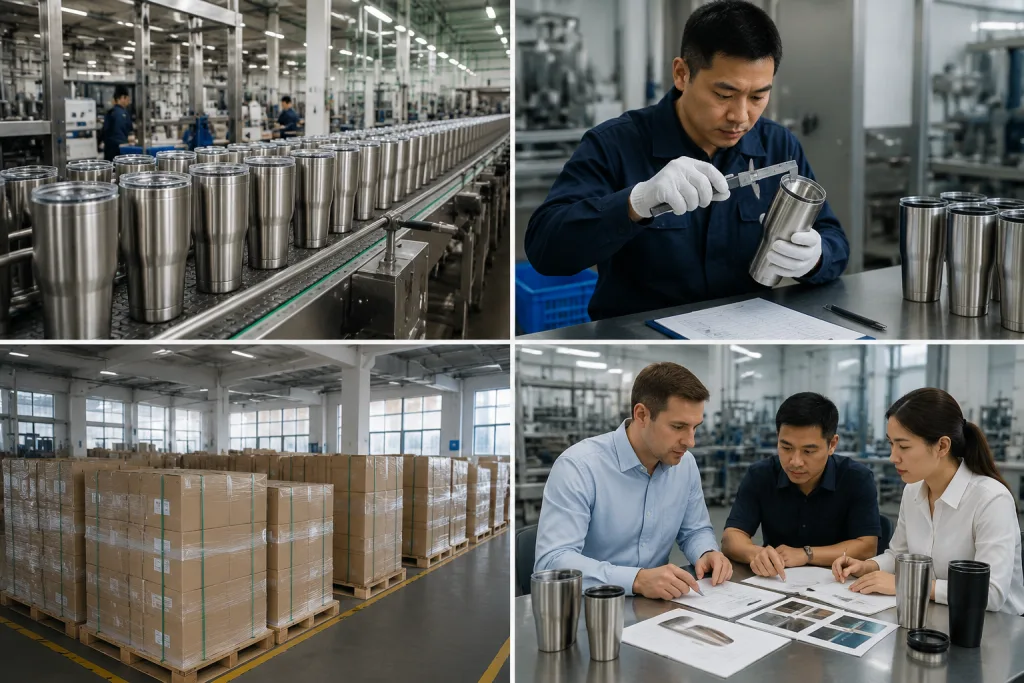
From Zhejiang and across China, the better factories do not wait for you to guess. They want a clean RFQ, a sample plan, and a PO that spells out capacity, steel grade, finish, packaging, and test standards line by line. At BottleForge in Hangzhou, we run about 300,000 units per month, MOQ starts at 1,000 pcs for standard tumblers, and lead time is usually 20-30 days after sample approval. One typo on a PO can slow the line for a day. If you want drinkware wholesale that lands cleanly, you need a process, not luck.
Start with a usable RFQ
I’ll rewrite the section in-place, keep the HTML structure unchanged, and tighten the prose so it sounds like a factory-side sales engineer wrote it.Do not send a vague note that says you need stainless steel tumbler bulk pricing. We can quote that in 10 minutes, but the number will be soft. Start with a usable RFQ: capacity, steel grade, insulation structure, lid type, finish, logo method, and pack format. For a standard 20 oz double-wall tumbler, say if you want 304 inside and 201 outside, or full 304. If you leave it open, a lot of China suppliers will quote the cheapest build that still looks fine on a sheet.
A good RFQ cuts back-and-forth. Put target market, compliance, and forecast volume in the first email. If you need REACH for Europe, FDA food contact for the US, or prop 65 caution language, say it up front. If you are comparing a beer tumbler bulk program with a travel tumbler, spell that out too. We run into this all the time: same diameter on paper, different lid, different mold, different cost. For bulk drinkware, that is the real question, not the first-page unit price.
- Capacity: 12 oz, 16 oz, 20 oz, or 30 oz
- Steel: 304, 316, or 201 outer / 304 inner
- Wall thickness: 0.4 mm, 0.5 mm, or 0.6 mm
- Finish: powder coat, spray paint, brushed, mirror polish
- Logo: silkscreen, laser engraving, UV print
- Pack: bulk pack, gift box, color box, or mailer
When you source in Zhejiang or anywhere else in China, a clean RFQ is the gap between a real FOB quote and a quote padded for unknowns. We have seen the buyer flag a PO because the lid spec was missing by one line. That happens. It is true for wholesale drinkware, canteen bulk, or a best wholesale drink bottle program for a retail rollout.
Read the quote like a buyer
I’ll rewrite this section to sound like a field-tested sales engineer, keep the HTML intact, and preserve the heading structure. Then I’ll check that the pricing logic stays clear and the wording is tighter, with a few concrete factory-floor details.Once the quotes land, do not stare at unit price only. A low number with a loose spec is not a deal; it is a problem waiting on the line. Ask what sits inside the quoted price: inner and outer steel grade, lid style, silicone gasket, coating thickness, printed logo, individual polybag, master carton, and export carton marks. If a supplier says the tumbler is $2.15 FOB Ningbo, confirm whether that is a single-wall screw lid or a vacuum-insulated body with a flip lid and laser logo. Those are not the same cup, and the PO typo usually shows up right there.
For a fair read, normalize every line. A 20 oz tumbler with powder coat and one-color silk screen may land around $2.10-$3.60 FOB depending on order volume, while a more complex beer tumbler wholesale bulk build with a vacuum lid and specialty finish can move to $3.80-$5.20. Add 8-12% for custom packaging and another 3-5% if you need extra drop testing or ship-to-Amazon prep. We run this sort on a 3-column sheet: spec, cost, and risk. If you are buying drinkware wholesale for multiple SKUs, make every supplier quote the same line items. The math does not work any other way.
Never ask for one total number when you actually want five separate things: body, lid, logo, pack, and inspection.
That rule holds for canteen wholesale and wholesale growler orders too. The more the product looks like an insulated bottle with a lid, the easier it is for the quote to hide cost in the cap, gasket, or coating. QC pulled the sample, and the buyer flagged the lid as the weak point more than once. A buyer who reads line items protects gross margin before samples even arrive.
Approve samples with evidence
I’ll rewrite the section in-place, keeping the HTML and structure intact while making the prose sound like a real factory-side sales engineer wrote it.Samples are not a formality. They are the first gate. For stainless steel tumbler bulk, we approve three sample stages: pre-production blank, decorated sample, and full-packout sample. The blank tells us if the cup is formed cleanly, the laser weld is steady, and the vacuum pull is holding. The decorated sample shows whether the logo sits on center, survives rub, and still reads clean. The packout sample shows whether the unit survives real shipping, not just a neat desk shot.
Ask for numbers, not opinions. A solid China factory should send wall thickness, capacity tolerance, and thermal data. On one 20 oz run, QC pulled the sample at 6 hours hot / 12 hours cold, and that was written into the spec before we ran the line. If your buyer wants ASTM-style logic, use it. Check lid fit with a feeler gauge, measure seal compression, and run coating rub resistance. A powder coat that starts failing after 50-100 rub cycles is not ready for retail. The math does not work.
- Check weight against target: a 20 oz tumbler often lands around 260-360 g depending on build
- Verify mouth opening and lid thread engagement
- Test leak resistance upside down for 30-60 minutes
- Confirm logo color against Pantone or sample card
- Run carton drop test from 60-80 cm on edges and corners
If you also buy growler wholesale or alcohol flask wholesale bulk, keep the same standard. A bulk growler or alcohol flask in bulk can look simple, but we have seen the leak issue start at the cap line and the finish drift by the third carton. Sample approval should carry signatures from procurement and the brand owner, not only sales. One PO typo on the lid code can waste a week.
Lock the PO line items
I’ll rewrite the three paragraphs in-place, keeping the HTML tags and the section heading content intact while making it sound like a factory-side sales engineer wrote it.Your purchase order needs to read like a shop-floor instruction sheet, not a cart checkout. For each stainless steel tumbler bulk order, split the PO into line items the line can act on: body spec, lid spec, logo method, packaging, carton count, inspection standard, and shipment term. If those details sit in an email chain, QC pulled the sample late and the production team misses them. Then the buyer flags a 62 mm carton that was never approved.
For a 5,000 pcs order, we would write it like this: 20 oz double-wall vacuum tumbler, 304 inner / 201 outer, powder coated matte black, one-color silk screen logo, individual white box, 24 pcs per master carton, AQL 2.5 major / 4.0 minor, FOB Shanghai, ship within 25 days after sample approval. If Amazon prep is needed, add FNSKU label application, suffocation warning polybag, and carton barcode placement. If you want custom canteen wholesale or drinkware wholesale packaging, state the carton drop test, insert card, and master carton marks. No guessing.
This is where the hidden cost gets locked down. State whether the unit price includes testing, whether tooling belongs to you, and whether decoration plates are new or reused. If you place a second SKU, call it out as a separate line. A bulk canteen order and a bulk growler order can share a shipment, but the PO still needs separate tooling, body size, and print plate lines. Otherwise the math does not work, and we have seen that go sideways on settlement.
Choose QC that matches the risk
I’ll rewrite the three paragraphs in place, keep the HTML intact, and tune the tone to sound like a real sourcing manager talking QC risk and factory checks.Inspection should follow the cost of failure. If you are shipping 1,000 units to a distributor, an in-line check is often enough. If you are shipping 30,000 units into retail, ask for pre-shipment inspection with an AQL table and photo report. For most drinkware wholesale programs, AQL 2.5 for major defects and 4.0 for minor defects works as a base line. If the order is for premium retail or a regulated market, set critical defects to 0 for leaks, sharp edges, and wrong artwork. We had a buyer flag a PO typo on the artwork code once, and QC caught it before cartons left the line.
In a stainless steel tumbler bulk order, the real risks are plain: scratches, dents, off-center logos, weak vacuum seal, and carton crush. None of that is flashy. All of it costs money. Ask for random checks on top rim flatness, lid seal, body roundness, and coating adhesion. We run calipers on the rim at 0.2 mm tolerance and pull 5 samples from every 300 pcs. If the product is a beer tumbler wholesale bulk program, check odor neutrality too. A stainless vessel that carries packaging smell turns into a complaint on the first use.
For factories in Zhejiang and other parts of China, good QC is not about distrust. It is about proving process control. QC pulled the sample, checked the vacuum seam, and the buyer stopped arguing after seeing the leak test pass at 12 hours. If the supplier can show stable line output, you move faster on repeat orders. If not, you slow the order down, not the payment terms. That is how procurement stays in charge.
Scale the repeat order
I’ll keep the HTML untouched and rewrite the copy to sound like a factory-side sales engineer, with tighter phrasing and a few concrete shop-floor details.Once the first shipment lands clean, the repeat order is where the margin shows up. That is when we run a better price on print plates, carton spec, and mixed-SKU loading. A factory moving 300,000 units a month usually closes a repeat stainless steel tumbler bulk order faster than the first run because the body tooling, lid molds, and coating line are already set. On one line, QC pulled the sample and we cut 4 days off lead time, with fewer sample loops.
Use the repeat order to fix the mix. If one SKU is selling faster, move budget out of wholesale canteen or wholesale growler side projects and into the tumbler line that is actually turning. If you are running alcohol flask bulk or alcohol flask wholesale next to tumbler programs, keep the SKU list separate, then combine cartons at ship-out when the CBM math works. Freight from Zhejiang to North America or Europe is not cheap, and this is where buyers get caught paying for empty space.
For a lot of buyers, the better move is a base order plus a swing order. The base order covers committed demand, and the swing order goes live after sales confirms sell-through. That keeps cash flow under control and stops dead stock from sitting in the warehouse. We have seen this go sideways when a PO typo changed a lid code from 316L to 304; the buyer flagged it, and the rework ate a week. Use the repeat order to test one new finish or one new lid, then scale the winner. That is the right question to ask.
Use category logic, not just keywords
I’ll rewrite the prose in place, keep the HTML exactly as-is, and strip the AI-ish phrasing while adding a few concrete factory details and buyer-side reality.Search terms help you find suppliers, but they do not define the product. A buyer typing beer tumbler in bulk, beer tumbler wholesale, canteen wholesale, growler bulk, or alcohol flask wholesale bulk is still buying on 0.5 mm wall thickness, weld finish, coating life, and landed cost. If a factory only talks keyword language and cannot explain 304 stainless, seam quality, or a 24-hour salt-spray result, move on.
Category logic works better when you build a wider sourcing program. One line can cover wholesale drinkware for retail, another can cover bulk canteen for outdoor promotions, and a third can cover beer growler wholesale for hospitality. We have run all three from one line when the molds and powder-coat booth are set up right. Ask the supplier if they can handle canteen bulk, growler wholesale, and drinkware bulk without moving to another factory; if the answer is yes, you save weeks of back-and-forth and QC pulled the sample from the same standard. The buyer flagged it once when the PO said 500 pcs and the carton mark said 5,000, and that kind of typo tells you where the real risk sits.
The point is simple: good sourcing is not about stacking keywords. It is about matching the right product build to the right channel. Do that, and stainless steel tumbler bulk turns into a repeat order, not a guessing game. The math works.
Send your RFQ and get a clean FOB quote
We’ll turn your spec into a practical sample plan, then a bulk order with clear line items, QC, and lead time from Zhejiang.
Frequently asked questions
What QC standard is practical for drinkware wholesale orders?
For most drinkware wholesale orders, AQL 2.5 major and 4.0 minor is a practical baseline. Tighten critical defects to zero for leaks, sharp edges, contamination, and wrong artwork. You should also request random checks on coating thickness, lid seal, and carton integrity. If the order is for premium retail or Amazon, add photo evidence and a packed-carton drop test. A factory in China that can repeat results across 10,000 units is more valuable than one that sends a perfect sample and fails on the line. Consistency is what protects margin.