Key Takeaways
- Stock stainless thermos MOQ usually starts at 1,000 pcs; custom mold projects often need 10,000 pcs or more
- A realistic FOB China range for a 500 ml vacuum thermos is USD 3.20 to 7.80 depending on steel grade, cap, coating, and packaging
- Logo method can add USD 0.08 to 0.65 per unit, with laser engraving slower but more durable than basic printing
- Plan 35 to 55 days for standard bulk thermos production after sample approval, plus sea or air freight time
Asking a stainless steel thermos factory for the lowest unit price is the wrong first question. Outdoor retailers and promo buyers still have to check drop performance, logo rub resistance, carton strength, and the sailing date. Last month QC pulled a 500 ml powder-coated sample after a 1.2 m drop because the lid thread showed a 0.3 mm dent. Cheap quote, bad bottle.
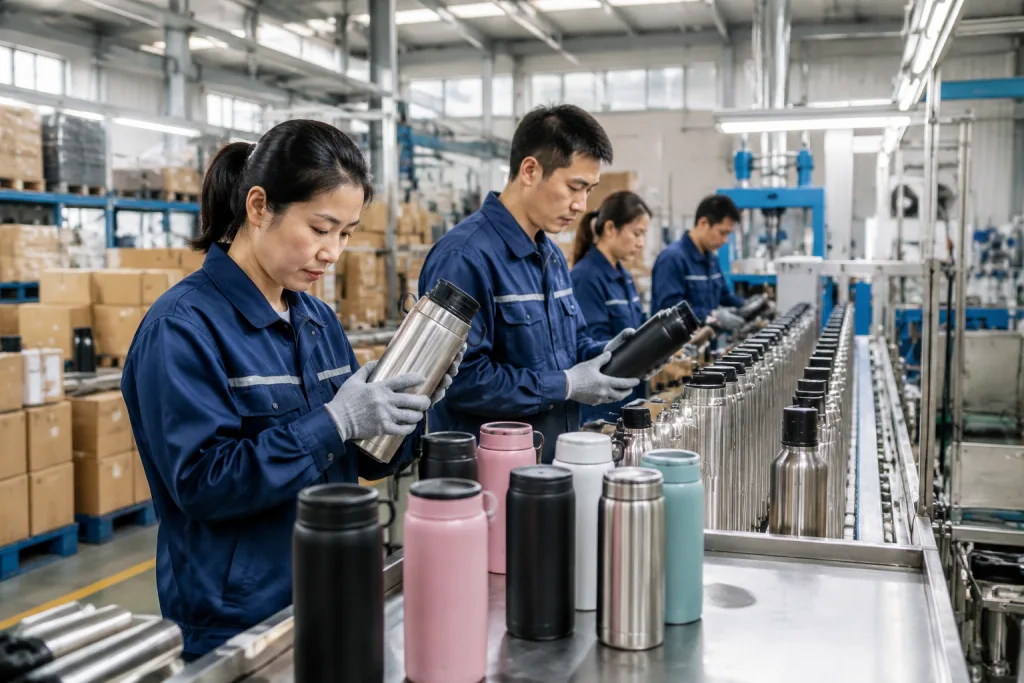
At our Zhejiang facility, a normal custom thermos project runs 35 to 55 days after artwork approval, with MOQs from 1,000 pcs for stock shapes and 5,000 pcs for new colors or special finishes. We run logo plates, color chips, pre-production samples, and carton tests before mass production, because this is where the math often goes sideways. One buyer once approved the price, then flagged the PMS code typo on the PO two days before line setup.
What Actually Sets Your Unit Cost
A stainless steel thermos factory does not price by capacity alone. We have quoted a 500 ml bottle lower than a 350 ml bottle because the 350 ml spec had a flip lid with 4 small parts, powder coating, color box, and individual barcode labeling. Happens often. When you compare supplier thermos quotations, ask for the cost assumptions behind the FOB number; if the PO says “mat black” instead of “matte black,” QC and the printing room will both stop and ask which version the buyer approved.
The cost is mainly set by body construction and stainless grade, then by lid mold, surface finish, logo method, packaging, and the inspection level you ask us to run. For most outdoor and promotional thermos orders, the body is double-wall vacuum insulated, with 304 stainless steel inside and either 201 or 304 outside. Inner wall thickness is commonly 0.35 to 0.45 mm; outer wall thickness is often 0.40 to 0.50 mm. Thinner steel saves money on the sheet, but the math does not work if 2 cartons come back with dent complaints after courier delivery; our line checks this with a digital thickness gauge before polishing.
As a practical FOB China range, a basic 500 ml manufacturer thermos in 304 inner and 201 outer steel may quote around USD 3.20 to 4.30 at 3,000 pcs. A heavier 750 ml factory thermos with 304/304 steel, powder coating, stainless tea filter, and retail box may land around USD 5.80 to 7.80. Add a push-button lid or carry handle and the lid tooling plus assembly time changes the price again; add a silicone boot or gift tube and we are talking about a different packing line, not a small accessory. QC pulled the sample last month because the boot was 1.5 mm too loose after hot-water testing.
For promotional thermos programs, the cheapest quote is often the risky one. We’ve seen this go sideways. A USD 0.20 saving can vanish if the coating scratches in carton transit or the lid leaks during a stadium event with 10,000 giveaways. Before mass production approval, ask for a leakage test, vacuum performance test, coating adhesion test, and carton drop test; on our side, that means upside-down lid checks, a 95°C hot water hold test, 3M tape on the logo area, and a packed-carton drop from 76 cm.
MOQ Tiers Buyers Should Expect
MOQ is where about 7 out of 10 custom thermos talks get tense. The factory is not trying to push small buyers away; the loss sits in setup. Steel cutting uses different tube lengths, polishing wheels need changeover, the vacuum station must reset fixtures, and the spraying booth needs clean-down before a new color. We run the line with a stopwatch. For 300 pcs in one color, the setup time can be longer than the filling, welding, and packing time.
For stock shapes from our Hangzhou, Zhejiang supply base, the normal MOQ is 1,000 pcs per model for simple logo customization. One color with standard packaging is workable at 1,000 pcs. For mixed colors, expect 1,000 pcs per color unless that color is already on the spraying schedule for another order. A customized thermos with new Pantone powder coating usually starts at 3,000 pcs because the powder supplier has its own minimum, and our coating team still checks film thickness with a gauge before QC signs off.
For a fully customizable thermos, such as a new lid shape, new silicone grip, new capacity, or exclusive body profile, the math changes. A private mold may require 10,000 to 30,000 pcs annual volume, with tooling from USD 800 for a small accessory part to USD 6,000 or more for a full body and lid system. If you only need a seasonal promotional run, choosing a mature stock body is usually smarter. Then customize the color, logo, sleeve, and box. We have seen this go sideways when a buyer approved a new lid mold, then cut the PO to 2,400 pcs after the first T1 sample.
- 1,000 pcs: stock thermos custom logo, standard color, standard carton.
- 3,000 pcs: custom color, retail packaging, multiple logo positions.
- 5,000 pcs: special coating, upgraded cap, silicone accessories.
- 10,000 pcs+: private mold or retailer-exclusive construction.
This is why thermos distributors and outdoor retailers should share forecast volume honestly. A factory thermos quote for 2,000 pcs and 20,000 pcs will not use the same costing logic. The buyer may only see a unit price gap; our costing sheet sees mold amortization, carton MOQ, and one extra QC pull under AQL 2.5.
Logo, Finish, and Packaging Costs
Logo decoration looks simple on a PDF. On the line, it changes cost, scrap rate, and ship date. For a custom thermos, we run silk screen printing for flat one-color logos, laser engraving for coated bodies, heat transfer printing for larger graphics, UV printing for sharp multi-color marks, and full-wrap water transfer when the buyer wants artwork around the cup. Before quoting, our prepress team checks the AI file at 1:1 size; a 0.25 mm line can disappear after curing.
Silk screen printing is usually the cheapest choice for one or two colors on a smooth painted body. Expect about USD 0.08 to 0.18 per unit, with a screen fee around USD 30 to 60 per color. It fits promotional thermos orders where the math is tight and the logo area is simple. Laser engraving costs more, typically USD 0.20 to 0.45 per unit, but it lasts and gives a cleaner outdoor-retail look. On powder coating, laser reveals the stainless layer under the paint. Check contrast on an actual pre-production sample; we had one buyer flag a dark gray logo that looked fine on a rendering but went flat on a black bottle.
Powder coating generally adds USD 0.25 to 0.60 compared with plain stainless, depending on color, gloss, and order size. Rubberized or soft-touch coating can add USD 0.40 to 0.90 and needs stricter abrasion testing. For outdoor retail, we recommend powder coating with a 3M tape adhesion test and 100-grid cross-cut check; QC pulled samples last month where two grids lifted after the second tape pull. For one-off corporate gifts, a standard spray finish can pass if the buyer accepts the tradeoff. Asking for “premium feel” at the lowest spray price is the wrong question to ask.
Packaging is where quotes often go sideways. A plain white box may cost USD 0.12 to 0.25. A printed color box is often USD 0.28 to 0.60. A kraft gift tube, molded pulp insert, hang tag, and FNSKU label can push packaging above USD 1.00 per unit. If you sell through marketplaces or distributor thermos channels, barcode accuracy and carton labeling are not optional; one wrong digit on the PO or a 5 mm shifted FNSKU label can trigger warehouse chargebacks before the goods even hit the shelf.
A Realistic Production Calendar
The quickest quote is not the quickest safe delivery. This is the wrong question to ask. A normal stainless steel thermos factory calendar needs time for sample setup, buyer sign-off, steel and carton purchasing, line production, AQL 2.5 inspection, and export booking. If a thermos supplier says 15 days for a fully customized order in peak season, ask which station they are cutting: vacuum test, coating cure, logo check, or final packing. QC pulled one sample last season with a 0.4 mm lid gap after rushing assembly. It failed.
For a stock thermos with a laser logo, we usually run 5 to 7 days for artwork confirmation and pre-production sample, then 25 to 35 days for mass production after deposit lands. For custom color powder coating, add 5 to 10 days for color panel approval and paint matching against the buyer’s Pantone card. A new lid or private mold is a different job: tooling and first-off sample can take 20 to 35 days before the line even starts bulk production. One buyer once typed “matte black” on the PO but sent a glossy black color chip. That mistake cost 6 days.
Our Zhejiang production network can output about 450,000 stainless drinkware units per month across thermos bottles, travel tumblers, and sports bottles, with 304 stainless bodies running through polishing, vacuuming, coating, and packing lines. Capacity helps. It does not remove bottlenecks. Before Christmas, Chinese New Year, and North American promo seasons, the coating ovens and logo workshops get booked fast. We have seen this go sideways: an October distributor thermos order was chasing the same laser machines already reserved by 3 repeat retailer programs booked in August.
A buyer-friendly schedule for a 5,000 pc bulk thermos order looks like this: 2 days for technical review, 5 days for quote and artwork proof, 7 days for sample, 3 days for buyer comments, 30 to 40 days for production, 2 days for AQL inspection, and 3 to 5 days for customs and loading. Sea freight to Europe or North America then adds roughly 25 to 45 days depending on port and season. Air freight fixes some emergencies, but the math often does not work; on a 500 ml bottle, the freight can cost more than the bottle itself. The buyer flagged that once after seeing the DHL estimate. Fair point.
Compliance Is Not Paperwork Theater
I’ll keep the tags unchanged and rewrite the prose with a more field-tested sales tone, adding concrete factory details without touching the structure.For outdoor retailers and promo brands, a compliance miss shows up after the cartons land, and that is where the money burns. We’ve seen a buyer flag a 2 mm ink overspray on the sleeve and hold the whole PO, so this is not paperwork theater. A serious thermos factory knows food-contact rules inside the line, not just certificate names. For Europe, you usually need LFGB or EU 1935/2004 food-contact testing, plus REACH screening for coatings, silicone, and plastic parts. For the United States, buyers often ask for FDA food-contact confirmation, Prop 65 review, and ASTM packaging or child-use checks when the product calls for it.
The metal spec drives the result. 304 stainless steel is the default inner liner for most stainless thermos jobs because it holds up better against corrosion than 201. We run 316 only when the buyer has a real use case, and the math does not work if they want it just for a fancy label. Some marine or premium programs justify it, but the price jump is not small. If the bottle is for coffee, tea, and water, 304 inner steel is the practical call. If the claim is salt-water durability, acidic drinks, or a premium technical story, then 316 is worth a lab check and a sample run.
Factory audits change sourcing risk, plain and simple. BSCI, ISO 9001, Sedex, and retailer audits do not guarantee a clean shipment, but they do tell you the thermos line has some process control. QC pulled the sample on one order because the vacuum reading dropped below spec on a 500 ml unit, and that kind of miss is exactly why we inspect by lot. For mass production, use AQL inspection instead of photos. A common setup is AQL 2.5 for major defects and 4.0 for minor defects, with critical defects at 0. Leakage, sharp burrs, wrong logo color, weak vacuum performance, and dirty interiors need to be written down before inspection day.
Good compliance work happens before deposit payment. After production is finished, testing only tells you how expensive the problem has become.
FOB Terms, Deposits, and Freight
I’ll rewrite the section in place, keep the HTML structure unchanged, and make it read like a factory-side sales engineer wrote it. Then I’ll return only the finished HTML.Most China thermos suppliers quote FOB Ningbo or FOB Shanghai. We are in Zhejiang, so Ningbo usually wins on truck time and port fees; Shanghai still works when the forwarder’s space or vessel schedule is better. FOB means we handle export packing, inland trucking to port, customs declaration, and the loading cost to the vessel side. Ocean freight, insurance, import duty, and destination charges stay with you or your freight forwarder. The buyer flagged this on a 2024 PO once, and the math did not change.
For a first thermos order, the standard payment term is 30% deposit and 70% balance before shipment, usually after QC signs off the lot. On repeat volume, terms can improve, but on the first run we rarely see open credit from China factories. If you work through a buying office, sync the deposit with sample approval and raw material booking; otherwise the line sits for 5 to 7 days while accounting waits for the transfer. We have seen that go sideways more than once.
Carton size and loading qty decide landed cost. A 500 ml stainless thermos may pack 24 pcs per master carton, around 52 x 36 x 28 cm, with gross weight near 10 to 13 kg depending on wall thickness and outer box spec. A 20 ft container may hold roughly 18,000 to 24,000 pcs; a 40 ft HQ may hold 45,000 to 58,000 pcs. These are planning ranges, not promises, because a gift box, handle, or sleeve eats cube fast. QC pulled the sample and measured 1.5 mm wall variation, and that changed the loading plan.
If you are buying thermos bulk for promotion, ask for carton dimensions during quotation, not after production. A bottle that is USD 0.15 cheaper but takes 18% more container space often lands at a higher total cost. For Amazon or distributor warehouses, confirm FNSKU placement, carton marks, polybag warnings, and pallet spec before packing starts. We ship a lot of these jobs, and a typo on the PO label can hold the whole carton at the gate.
How to Brief the Factory Clearly
I’ll keep the HTML structure exactly as-is and rewrite only the prose, tightening it into factory-floor language with concrete specs and fewer AI tells.A clear brief saves more money than hard bargaining. When you contact a stainless steel thermos factory, give the engineer and sales rep enough detail to quote the actual item. Capacity by itself is not enough. State the target volume, market, lid type, steel grade, finish, logo size, packaging, compliance needs, target FOB price, and ship date. A PO typo on volume costs time fast.
If you are an outdoor retailer, spell out the use case. A hiking thermos may need a cup lid, a glove-friendly cap, a thicker powder coat, and stronger heat retention. A promo thermos for a bank or software event is a different job; we run those with lower unit cost, clean logo placement, and delivery split across 3 or 5 addresses. A distributor may want neutral packaging and reorder supply for 12 months. Same bottle shape. Different build.
Do not hide your target price. That is the wrong question to avoid. A practical thermos manufacturer can tell you whether USD 4.50 FOB works by changing the lid, trimming packaging, using 201 outer steel, or moving from 750 ml to 600 ml. On the line, we have seen quotes fail because the buyer kept the price private, then rejected the sample as too expensive after QC pulled it.
For artwork, send vector files in AI, EPS, or PDF format, plus Pantone codes for print and coating. For customized thermos packaging, include dielines, barcode size, warning text, and language rules. For quality, define the checks: heat retention at 6 hours and 12 hours, leakage test angle and duration, drop test height, coating scratch standard, and logo tolerance. A 0.5 mm logo shift matters. The tighter the brief, the fewer paid samples you need.
Send your thermos brief for a factory quote
Share capacity, quantity, logo, packaging, and delivery date. We will return realistic FOB pricing, MOQ, and lead-time options.
Frequently asked questions
What is the normal MOQ for a custom stainless thermos?
For a stock stainless thermos body with one logo, a realistic MOQ is 1,000 pcs per model. If you need custom Pantone powder coating, plan for 3,000 pcs per color because coating setup and powder purchase have minimums. For a customized thermos with a new lid, silicone grip, or exclusive body shape, MOQ usually moves to 10,000 pcs or more. Some China factories may accept 500 pcs, but the unit price often rises by 15% to 30%, and color or packaging options become limited. If you are testing a new retail line, start with a stock mold and invest in better decoration and packaging first.
How much does a 500 ml bulk thermos cost FOB China?
A basic 500 ml bulk thermos with 304 stainless inner wall, 201 outer wall, standard screw lid, one-color print, and white box may cost around USD 3.20 to 4.30 FOB China at 3,000 pcs. A 304/304 version with powder coating, laser logo, better cap, and printed retail box is more likely USD 4.80 to 6.50. If you add a tea infuser, silicone boot, carry handle, or gift tube, the cost can move above USD 7.00. Always compare steel grade, wall thickness, cap construction, and packaging, not only capacity and headline price.
How long does a thermos factory need for production?
For a stock factory thermos with logo customization, sample preparation usually takes 5 to 7 days after artwork confirmation. Mass production normally takes 25 to 35 days after deposit and sample approval. If you need custom powder coating, add 5 to 10 days for color matching and approval. A new mold or special lid can add 20 to 35 days before mass production starts. During peak China export periods, especially before Chinese New Year and Q4 promotional seasons, add a buffer of 10 to 15 days. Sea freight to Europe or North America is additional and can take 25 to 45 days.
Which logo method is best for promotional thermos orders?
For cost-sensitive promotional thermos projects, silk screen printing is usually best if the artwork uses one or two solid colors. It often adds USD 0.08 to 0.18 per unit, plus screen fees. For outdoor retail or premium gifting, laser engraving is more durable and typically adds USD 0.20 to 0.45 per unit. UV printing works for colorful logos but should be tested for scratch resistance on curved surfaces. Heat transfer is useful for large or wraparound artwork, but it needs careful adhesion testing. Ask the thermos supplier for a real pre-production sample, not only a digital mockup.
What quality tests should we require before shipment?
At minimum, require leakage testing, vacuum heat retention testing, visual inspection, logo position check, coating adhesion test, and carton drop test. For AQL inspection, many buyers use AQL 2.5 for major defects, 4.0 for minor defects, and 0 for critical defects. Heat retention should be agreed in numbers, for example water above 60°C after 6 hours for a specified starting temperature and room condition. For food-contact markets, request relevant FDA, LFGB, EU 1935/2004, REACH, or Prop 65 documentation depending on destination. Testing should happen before shipment balance payment, not after goods reach your warehouse.