Key Takeaways
- A practical stainless steel thermos bulk MOQ is usually 1,000-3,000 pcs per color for custom coating and logo work
- Use 304 stainless steel inside, 201 or 304 outside, and ask for vacuum retention data at 6 and 12 hours
- Plan 7-10 days for samples and 30-45 days for mass production after deposit and artwork approval
- Set AQL inspection levels before production, not after cartons are already sealed
You are not just buying bottles. Your customer will fill one with 92°C coffee at 6 a.m., drop it into a truck cup holder, carry it on a wet trail, then blame your brand if the lid seeps. Stainless steel thermos bulk orders look simple on a quote sheet. They are not. A 0.2 mm gap on the silicone gasket, the wrong 304 stainless thickness, a coating that scratches in a 3M tape test, or a weak inner carton can make a retail-ready item feel cheap fast.
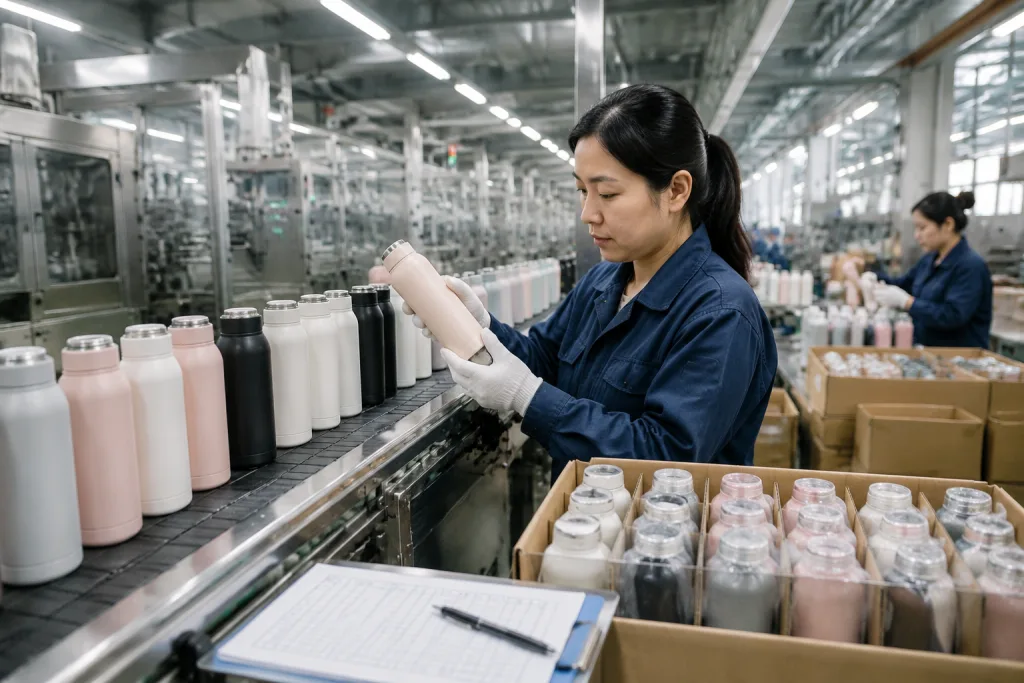
Here is how a typical 3,000-piece custom thermos order should move from idea to shipment. We manufacture in Zhejiang, China, and this is close to how we run a real order on the floor: define the product, approve the sample with calipers and leak test records, lock the artwork file, inspect production under AQL 2.5, then ship with carton marks that match the PO. The buyer flagged it once because “matte black” was typed as “matt black” on the PO. Small error. Big delay.
Start With The Actual Use Case
I’ll rewrite the section in-place, keep the HTML tags untouched, and tighten the copy so it sounds like a factory sales engineer wrote it.Before you ask a thermos supplier for price, lock down who will carry the bottle and where it will be sold. A gift buyer and an outdoor retail buyer may both request a 500 ml vacuum flask, but the build is not the same.
For outdoor retail, we run a harder spec: 304 stainless steel inner wall, durable powder coating, leak-resistant screw lid, retail box, barcode label, and a finish that holds up after 30 touches on the shelf. For promotion work, a simpler lid, standard carton packing, and a one-color silkscreen logo often make more sense when the budget is tight. I’ve seen this go sideways when the buyer tried to use one spec for both channels.
A usable first spec for a bulk thermos order is 500 ml capacity, double-wall vacuum insulation, 304 inner stainless steel, 201 outer stainless steel, copper-plated inner wall, powder-coated body, PP lid with silicone seal, 8.5 cm body diameter, and 260-320 g unit weight depending on wall thickness and lid design. The math changes fast if the wall gauge shifts by 0.2 mm.
Do not start with a photo alone. Photos hide wall gauge, lid thread fit, vacuum performance, and coating adhesion. Send your thermos manufacturer a short written spec and ask what is standard and what needs tooling. QC pulled the sample on one line last month because the PO typo said 580 ml instead of 500 ml, and that kind of mistake burns time. A Zhejiang factory thermos line can often produce 600,000-900,000 units per month across bottles, mugs, and flasks, but the quote is only real after the custom points are confirmed.
Build The Quote From Components
I’ll rewrite the section in-place, keeping the HTML structure and tightening the sales-engineering tone. Then I’ll do a quick pass for the banned filler words and make sure the pricing details stay concrete.When buyers compare stainless steel thermos bulk pricing, they often fixate on the final FOB unit price. That is the wrong place to start. One USD 0.25 swing usually comes from a detail on the spec sheet, not from “factory margin.”
The main cost drivers are steel grade, body weight, lid structure, surface finish, logo process, packaging, and inspection requirements. A plain 500 ml manufacturer thermos often lands around USD 3.20-4.20 FOB Ningbo or Shanghai at 3,000 pcs, with the 0.35 mm body and 304 stainless liner doing most of the work on cost. Add copper lining, premium powder coating, laser logo, gift box, and insert, and the same model can move to USD 4.80-6.50. A 750 ml or 1,000 ml bottle usually adds USD 0.80-2.00 per piece.
Ask your thermos factory to break the quote into bottle body, lid, coating, logo, packaging, inner carton, master carton, test cost, and spare parts if needed. QC pulled the sample on a lid gasket mismatch last month, and that sort of issue is exactly why line-item pricing matters. If you are buying for a distributor thermos program, ask for price breaks at 1,000, 3,000, 5,000, and 10,000 pcs; that is the number that shapes wholesale and replenishment math.
For custom thermos projects, our usual MOQ in Zhejiang is 1,000 pcs for stock colors with logo, 3,000 pcs for custom powder coating, and 5,000 pcs or more for a special lid mold or private shape. A lid mold runs about USD 800-3,500, while a full body shape costs much more. We’ve seen buyers push for 300 pcs with any Pantone color and a complex lid, then the quote falls apart on the line. Check the real build before you chase the cheap number.
Choose Branding That Survives Handling
I’ll keep the tag structure intact and rewrite the prose with a more natural sales-engineer tone, adding concrete factory details and trimming the AI-style phrasing.A custom thermos only works if the logo still looks clean after a few weeks in a bag, on a truck seat, or through a wash test. Outdoor buyers ask about abrasion and dishwasher exposure. Promo buyers ask about Pantone match, logo size, and ship date. We run the line around the order purpose, not the cheapest quote line.
Silkscreen printing is the usual pick for simple one- or two-color logos. It is low cost, quick, and holds up well on straight bottle walls. For a 3,000 pcs thermos custom order, the setup fee stays modest, and the line moves fast. The catch is simple: fine lines can blur on powder coating, and a weak ink system will scratch after QC rubs it with a 3M pad.
Laser engraving burns through the coating and shows the stainless steel underneath. The look is crisp, and it does not rub off easily, so it fits outdoor retail and corporate gifts. It will not give you exact Pantone color. Heat transfer and UV printing handle more color, gradients, and wrap artwork, but we always test them first on a curved body—one bad curve and the buyer flags it on day one.
For a customized thermos with retail expectations, approve a physical pre-production sample, not just a PDF. Check logo height, distance from the base, lid alignment, and whether the logo faces forward when the drinking side is set right. We usually hold logo tolerance at ±2 mm in mass production. That is the right number for cylindrical drinkware, and the math does not work if someone asks for perfect centering on every cup.
If your order is for a distributors thermos catalog, keep one or two standard logo zones across all sizes. It makes repeat artwork easier and cuts mistakes when the same customer comes back for 500 ml, 750 ml, and 1,000 ml versions. We’ve seen a PO typo send the artwork to the wrong panel once; after that, nobody on our side wants to guess at placement.
Sample Approval Is Not Decoration
I’ll rewrite the section in place, keep the HTML tags untouched, and tighten the copy so it sounds like a factory-side sales engineer.The sample stage protects the whole order. A factory thermos sample has to prove the mouth feel, the finish, the carton, and the logo placement. If you treat it like a shelf prop, you miss the stuff that shows up after 100 cartons are on the line.
For a normal supplier thermos order, we usually need 7-10 days for a logo sample if the bottle is already in stock. Add 3-7 days for custom coating color matching. If the buyer wants a new lid, a new body mold, or a retail insert with foam, sampling runs 20-35 days. We ask for written approval with photos, Pantone numbers, packaging dielines, and any test notes; QC once pulled a sample because the PO typo said “silver” while the buyer wanted “silk gray.”
What do we test? Start with heat retention. Fill the sample with hot water at about 95°C, close the lid, and check the temperature after 6 hours and 12 hours. A decent 500 ml vacuum thermos may still hold about 65-75°C after 6 hours in a 20°C room, but mouth width and lid structure change the result fast. A 28 mm drinking cap is not the same as a wide-mouth food jar, so compare the same build.
Then test leakage. Fill the bottle, invert it for 30 minutes, shake it, and leave it on its side. Some lids seal only when fully tightened and should not go near carbonated drinks. Say that on the packaging if needed. We’ve seen this go sideways when a buyer assumed “leakproof” meant any angle, and the math does not work that way.
Last, check coating and logo adhesion. A simple cross-hatch tape test tells us a lot. For retail programs, you can ask for a coating adhesion test or a dishwasher cycle simulation, but dishwasher claims need care. If you sell into the EU, get LFGB, REACH, and food-contact papers on the table early. For North America, ask about FDA food-contact compliance and, for children’s products, ASTM and CPSIA relevance; on one order, the buyer flagged a 1.2 mm logo shift before we packed the first 500 units.
Lock Packing Before Production Starts
I’ll keep the HTML structure intact and rewrite the prose so it sounds like a factory-side packing note, with tighter numbers and a few line-floor details.Packing is not an afterthought on stainless steel thermos bulk orders. Bad packing brings dents, rubbed coating, barcode failures, and warehouse chargebacks. Good packing is dull, measured, and signed off before the line starts running.
For promotional thermos orders, we usually ship one unit in a polybag plus white box, then 24 pcs per export carton. For retail sets, the pack spec may call for a color box, instruction leaflet, care card, FNSKU or EAN label, carton shipping mark, and drop-test packaging. A typical 500 ml thermos master carton holds 24 pcs and lands at 9-13 kg gross, depending on bottle weight and box board. The buyer once flagged a PO typo on carton count, and that cost us a full day on the packing line.
If the order goes to Amazon FBA or a third-party warehouse, label rules decide whether the goods move or sit. Confirm FNSKU size, scan quality, carton weight limits, suffocation warning on polybags, and whether the unit ships as a set. We’ve seen a good bottle get rejected because the label sat on the wrong panel or the carton missed a routing guide limit by 2 mm.
For outdoor retailers, carton strength matters because the goods may pass through three or four distribution points. Ask for five-layer export cartons if the inner box is light. Use dividers or tighter inner packing for powder-coated bottles, since body-to-body rubbing in sea freight will mark the surface. If your thermos bulk order mixes colors, define the carton plan clearly: one color per carton is safer for stock control, while mixed cartons can work for store allocation but raise packing errors. QC pulled the sample last time and found a loose sleeve after a 1.2 m drop test.
We lock the packaging file before mass production and print a carton mockup for approval. That adds 1 day, but it saves us from reprinting thousands of boxes in China after the order is already moving.
QC Needs Numbers, Not Hope
I’ll rewrite the section in place, keep the HTML exactly as-is, and tighten the QC language so it reads like a factory-side sales engineer wrote it.You should lock QC standards before production starts, especially on a first order with a thermos supplier. Put the inspection plan in writing: what gets checked, how many pieces are pulled, and which defects count as critical, major, or minor. On one 5,000 pcs run, a buyer added that detail after the PO misspelled the lid model, and the whole line had to wait for approval.
For most stainless drinkware orders, a final random inspection under ANSI/ASQ Z1.4 or ISO 2859-1 works. We usually see buyers set General Inspection Level II, with AQL 0 for critical defects, 2.5 for major defects, and 4.0 for minor defects. Critical defects are sharp edges, contamination, any glass breakage if a glass part exists, unsafe odor, serious leakage, or the wrong food-contact material. Major defects are failed vacuum insulation, coating peel, clear logo misprint, a lid that does not fit, the wrong color, and a damaged retail box. Minor defects are small dust points, light scratches outside the main logo area, or slightly uneven box corners.
During production, QC needs to check vacuum performance, lid torque, silicone seal placement, welding marks, polishing, coating thickness consistency, and logo position. Mixed lids or seals are a common mess on the line; they look close, but the compression is off by 0.3 mm and the bottle starts weeping later. That is the kind of complaint we hate, because the buyer only sees random leakage and the math does not work.
Ask your thermos supplier for production photos at three points: raw body after welding and polishing, after coating, and after logo and packing. For a 3,000 pcs order, a mid-production check at 20-30% completion gives you room to fix coating shade, logo placement, or packing errors before the full lot is done. We shipped one 3,000 pcs batch where the carton insert was 2 mm short; QC pulled the sample early, and the factory changed the die the same day.
At our Hangzhou, Zhejiang export office, we prefer buyers to approve a signed golden sample. The factory keeps one, you keep one, and the inspector uses the same reference during final QC. Simple setup. It cuts the back-and-forth fast when the buyer flags a detail and someone points to a different shade or print position.
Shipment Planning And Reorders
I’ll rewrite the section in place, keep the HTML structure unchanged, and make the prose sound like a factory-side sales engineer wrote it.Once the order passes inspection, shipment should be routine, not a fire drill. For stainless steel thermos bulk orders from China, most buyers run FOB Ningbo or FOB Shanghai. Ningbo works better for Zhejiang factories, and the truck can hit the port in about 2 hours. Air freight suits urgent promo dates, but a 500 ml steel bottle is still heavy, so the math turns ugly fast. Sea freight is the right call at 3,000 pcs or above.
A normal timeline looks like this: 2-3 days to confirm quote and spec, 7-10 days for logo sample, 3-5 days for buyer approval and deposit, 30-45 days for mass production, 1-3 days for final inspection, then vessel booking. We had a buyer flag a “ship ASAP” PO last summer, and it missed the July retail window by 12 days because the carton spec changed twice. Peak season before summer launches or Q4 gifting needs buffer. Give the thermos manufacturer a delivery date and a warehouse arrival date; “ship ASAP” is not a plan.
If you are a thermos distributor or outdoor retailer, plan the reorder before the first container leaves. Keep the body, lid, coating, logo size, carton size, and barcode fixed if you want the next lot to match. Stainless steel coil batches, powder coating lots, and silicone colors can drift a little over time. QC pulled the sample on one reorder and found the green lid was 1.2 mm tighter than the first run. A six-month-later PO should point back to the original PO, sample number, Pantone, and inspection report.
For distributors thermos programs, we usually push two sizes and three colors first, not six sizes and eight colors. 500 ml and 750 ml in black, white, and green gives you six SKUs. At 1,000 pcs per SKU, you are already holding 6,000 units. That is enough to see which size moves. We’ve seen this go sideways when a buyer tried to launch 14 SKUs at once, and half the line sat idle.
A good suppliers thermos relationship is not about squeezing one low price. It is about repeatable specs, clean QC, honest lead times, and fewer surprises when your customer has already printed the ad.
Send Your Thermos Spec For A Practical Quote
Share capacity, logo method, target price, destination, and order quantity. We will reply with MOQ, lead time, and workable factory options.
Frequently asked questions
What is the normal MOQ for stainless steel thermos bulk orders?
For a standard bottle shape with your logo, a realistic MOQ is usually 1,000 pcs per design. If you need custom powder coating, plan for 3,000 pcs per color because coating lines and powder preparation need volume. For a special lid, private mold, or unusual body shape, MOQ can move to 5,000-10,000 pcs. Some factories in China may accept smaller trial runs, but the unit price, logo setup cost, and color limitations will be higher.
How long does a custom thermos order take from sample to shipment?
For an existing stainless thermos model, allow 7-10 days for a logo sample and 30-45 days for mass production after deposit, artwork approval, and sample approval. Custom coating can add 3-7 days. New mold work can add 20-35 days before production even starts. Sea freight timing depends on destination port, but many Europe and North America routes need another 25-45 days on water plus customs and delivery.
Which stainless steel grade should I specify for a customized thermos?
For the inner wall, specify food-contact 304 stainless steel. It is the common choice for coffee, tea, and acidic drinks. The outer wall can be 201 or 304 stainless steel depending on budget and positioning. A retail outdoor product often benefits from 304 inner and stronger coating rather than spending all budget on 304 outside. Ask your supplier for material declaration, food-contact test reports, and production batch traceability if selling into regulated markets.
Is laser engraving better than printing for promotional thermos orders?
Laser engraving is more durable and gives a clean metal contrast on powder-coated bottles. It is a good choice for outdoor, corporate, and premium promotional orders. Silkscreen printing is better when you need a colored logo, lower cost, or larger decoration area. For 3,000 pcs, both are practical. The right choice depends on surface finish, logo complexity, budget, and whether the bottle will be sold at retail or given away in a campaign.
What QC tests should I require before accepting a thermos bulk shipment?
At minimum, require visual inspection, capacity check, leak test, lid fit check, logo position check, coating appearance check, carton drop condition review, and vacuum insulation testing. Use AQL standards such as critical 0, major 2.5, and minor 4.0 under General Inspection Level II. For insulation, test water temperature after 6 and 12 hours under a controlled room temperature. For EU or North American sales, also confirm food-contact documentation before shipment.