Key Takeaways
- Typical FOB China pricing for a 500 ml stainless steel flask starts around USD 1.60-2.10 at 1,000 pcs
- Custom print, laser logo, or 304 inner upgrade can add USD 0.12-0.80 per unit depending on setup
- Most canteen distributors should expect 25-35 days production plus 5-12 days ocean transit to Europe or North America
- A serious stainless steel flask vendor should quote MOQ, AQL 2.5 inspection, and REACH-compliant material data without hesitation
If you are buying from a stainless steel flask vendor, the first bad habit to kill is asking only for unit price. A $1.60 flask and a $2.35 flask can both look cheap until you add laser engraving, powder coating, gift boxes, test reports, and a 45-day slip on the schedule. We see this all the time in Zhejiang. Buyers compare samples, not landed cost, and the math goes sideways fast.
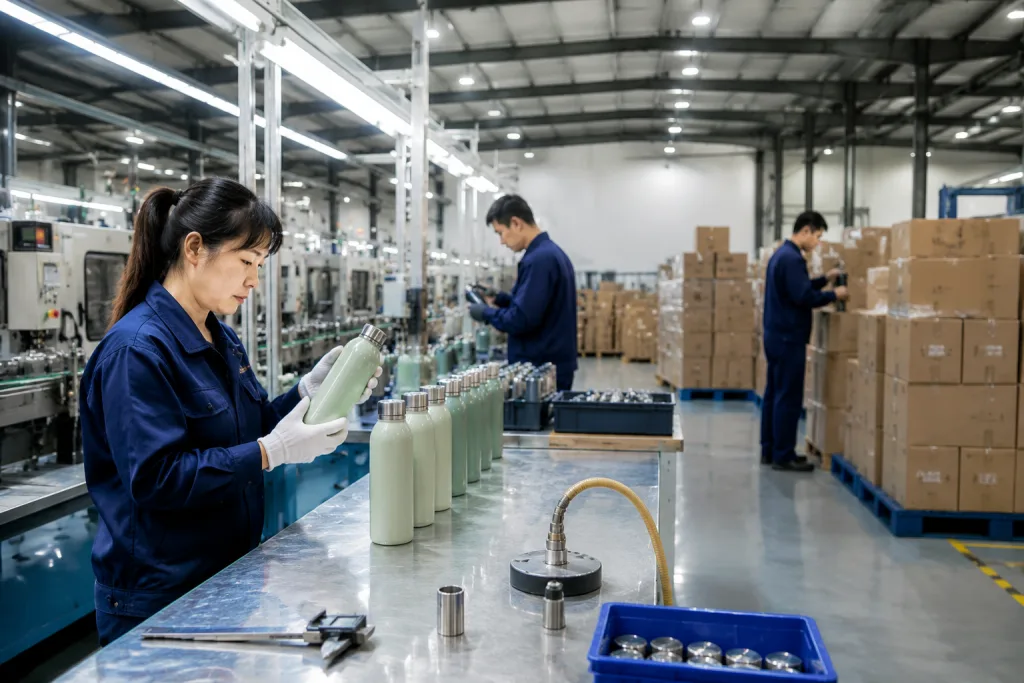
You need a buying frame: what drives cost, where MOQ changes the numbers, and how long a canteen factory actually needs to ship stable quality. At BottleForge in Hangzhou, we run 300,000 units per month, standard MOQ is 1,000 pieces, and typical lead time is 25 to 35 days after sample approval. QC pulled a sample with a 0.8 mm wall and caught a coating issue before packing, which is the kind of check you want from any canteen manufacturer or canteen supplier in China.
What sets the base price
I’ll rewrite the section in-place, keeping the HTML tags and the existing technical numbers intact while making it sound like a factory-side sales engineer wrote it.The base price for custom drinkware is not just stainless steel weight. A stainless steel flask vendor prices by material grade, wall thickness, finish, lid structure, and packing. For a standard 500 ml single-wall or light vacuum bottle, the biggest cost driver is usually the vacuum body plus cap system. We run this every week on the line. If you move from 201 stainless to 304 stainless on the inner wall, expect a real step-up in cost, usually USD 0.18-0.40 per piece depending on thickness and order size.
Wall thickness matters more than most buyers admit. On common vacuum canteen customized builds, the inner wall may sit around 0.35-0.45 mm and the outer wall around 0.30-0.40 mm. Push both up by 0.05 mm and your yield drops, your forming loss rises, and the factory spends more on raw coil. QC pulled the sample twice on one 500 ml run because the buyer flagged a thin spot near the shoulder. That is why one canteen manufacturer can quote USD 1.55 while another lands at USD 2.05 for what looks like the same canteen custom spec.
Decoration also changes the economics. A one-color silk-screen logo may add only USD 0.05-0.12 at 1,000 pcs, while wrap laser etching or color powder coating can add USD 0.20-0.80. If you want a customized canteen with gift box, barcode label, and master carton marking for distributor drinkware channels, add another USD 0.10-0.25. We have seen this go sideways when the PO typo dropped the barcode label line, then the buyer asked why the carton quote changed. Cheap-looking quotes usually omit one of these line items.
MOQ tiers and unit economics
I’ll rewrite the section in place, keep the exact HTML structure, and tighten the sales-engineering tone with concrete factory detail and cleaner MOQ math.The clean way to buy from a stainless steel flask vendor is to split MOQ by decoration and structure. A stocked body can start at 500 pcs, but once you add logo print, custom color, and printed carton, 1,000 pcs is the normal entry point. For molded lids or special Pantone color runs, 3,000 pcs is where the quote stops wobbling. We run that math on the line every week.
Here is the practical range you should expect from a flask factory in China:
- 500 pcs: sample-market pricing, usually USD 2.10-3.20 FOB, limited colors
- 1,000 pcs: normal custom tier, usually USD 1.60-2.40 FOB
- 3,000 pcs: better unit economics, usually USD 1.35-2.05 FOB
- 5,000+ pcs: stable production pricing, often 8-15% lower than the 1,000 pc tier
Buyers often push a 500 pc order into a 3,000 pc price. The math does not work unless the vendor already has the body, cap, and carton ready. QC pulled the sample on a 304 stainless flask last month and found a 0.3 mm wall variance, and that alone changed the unit cost. If you want a distributor program for retail or e-commerce, ask for the price break at 1,000, 3,000, and 5,000 pcs in the same RFQ. Zhejiang factories answer fast when the tooling, coil loss, and packing cost are clear.
Lead time by order complexity
I’ll keep the HTML exactly as-is and tighten the prose so it sounds like a factory-side sales engineer wrote it. I’m rewriting for specific lead-time ranges, cleaner sequencing, and one or two hard-edged buyer warnings.Lead time comes down to order complexity: stock flask, custom drinkware program, or full OEM canteen vendor project. A standard stocked flask with logo only usually ships in 18-25 days. Add custom color, custom box, or a new lid, and the schedule moves to 25-35 days. If the buyer wants a new mold or a new cap shape, 40-55 days is the real number. We run the line by tooling changeover, and that is where the calendar gets longer.
For Europe and North America, we break the schedule into three parts: sample approval, production, and shipping. Sample approval takes 5-10 days if the artwork file is clean; QC pulled the sample last week and a small PO typo on the logo color cost us two extra days. Production in a Zhejiang flask factory runs 20-30 days for regular stainless steel flask vendor orders. Ocean freight adds 5-8 days to West Coast ports and about 25-35 days to Northern Europe, depending on transshipment and customs. If the product needs REACH, LFGB, or FDA-aligned testing, add 3-7 days for document handling. The math does not work if the buyer waits until the PO is signed to start testing.
Do not promise your retail customer a 21-day delivery unless the bottle is stock, the print is simple, and the carton spec is already locked.
What raises cost fast
I’ll rewrite the section in place, keep the HTML exactly as-is, and tighten the sales-engineer tone while adding a few concrete factory details.Some upgrades earn their keep. Others only make a quote look polished on paper. A stainless steel flask vendor will usually add cost for vacuum insulation, copper lining, matte powder coating, soft-touch paint, and a more complex lid stack. On our line, the bead-blast and spray booth steps add handling time, and that is where scrap creeps up.
Watch these cost bumps closely. We run them as separate cost lines, not one bundle.
- 304 inner upgrade: +USD 0.18-0.40
- Vacuum insulation: +USD 0.25-0.55
- Powder coating: +USD 0.12-0.28
- Laser logo: +USD 0.08-0.20
- Color box: +USD 0.10-0.35
- Silicone base or sleeve: +USD 0.06-0.18
If you are buying a custom growler or customizable growler format, the lid and seal matter more than the body. This is the wrong question to ask if the cap leaks. A bad cap triggers claims fast, and one leaked carton can wipe out a week of margin for a distributor. Ask the canteen manufacturer for torque specs, gasket material, and whether the cap passed a 24-hour inverted leak test. QC pulled a sample once where the gasket sat 0.8 mm off-center, and the buyer flagged it the same day. If they cannot answer, move on.
For canteen promotional campaigns, the cheapest quote is often missing compliance or packaging detail. We have seen this go sideways when the PO says “white box” but the buyer really wants a 4-color carton with barcodes. Once you add AQL 2.5 inspection, carton drop testing, and palletization, the quote becomes honest. Honest is good. Honest is profitable.
How to compare vendor quotes
I’ll keep the HTML intact and rewrite the prose to sound like a real sales engineer, with tighter quote-comparison language and a few factory-floor details.When you compare canteen vendors, line up the same basket of items. A clean quote should show product size, stainless grade, wall thickness, decoration method, packaging, carton count, and test standard. If one supplier sends only a per-piece number, you are not comparing vendors. You are comparing guesses.
Ask each canteen supplier to quote these lines separately:
- Body material and thickness
- Lid material and sealing method
- Logo process and setup fee
- Inner box and outer carton
- Testing and compliance documents
- FOB port, usually Ningbo or Shanghai for Zhejiang shipments
For canteen customizable projects, one vendor may bury the tooling charge in the unit price while another puts it on a one-time line. We run into that all the time on the line. That part is fine. What is not fine is a supplier dodging the breakdown. A solid stainless steel flask vendor in China will also state the yield assumption, usually 97-99% on mature items, because a 1,000 pcs order can turn into a 1,020 pcs invoice if the math is loose.
If you are sourcing a custom canteen for a retail chain, start with your sell price and work back. One buyer once flagged a PO typo and the target landed cost changed by 8 cents overnight. If your target landed cost is USD 3.20 and you need a 3.0x markup, your FOB ceiling is usually around USD 1.85-2.05 depending on freight and duty. That is the number that matters.
Specs that protect margin
I’ll rewrite the section in place, keeping the HTML exactly as-is and tightening the prose to sound like a factory-side sales engineer.Margin stays intact when you stop returns, not when you shave three cents off the factory price. A serious canteen factory should show material traceability, 100% leak testing, and carton consistency. For North America, ask for FDA-relevant material declarations and food-contact-safe inks. For Europe, push for REACH paperwork and, when needed, LFGB or migration test support.
A spec pack that works for customized canteen programs usually looks like this:
- 304 stainless inner wall
- 0.35-0.45 mm inner thickness
- 0.30-0.40 mm outer thickness
- Leak test at 100% before packing
- AQL 2.5 major, 4.0 minor
- Retail carton with barcode and master carton mark
That is not a luxury build. It is the floor. QC pulled three samples on our line last week and found a loose cap on one lot; that kind of miss becomes a chargeback in the buyer’s inbox. If you sell custom drinkware into sporting goods, campus retail, or corporate gifting, consistency pays better than clever specs. The math does not work any other way.
One more point. If you plan repeat orders on a canteen customized line, lock the same cap thread, the same carton size, and the same artwork position. We’ve seen a PO typo on carton size turn a clean reorder into a 4-day delay because the buyer flagged it at packing. Keep those three items fixed and you usually save 3-5 days on reorder timing, plus less changeover waste on the line.
Request a factory quote with real cost lines
Send your size, logo, packaging, and target landed cost. We’ll quote MOQ, lead time, and compliance clearly from Zhejiang.
Frequently asked questions
What is the usual MOQ for a stainless steel flask vendor?
For a standard custom order, MOQ is usually 1,000 pieces. Some canteen suppliers will accept 500 pieces if the body is stock and the logo is simple, but the unit price is often 15-30% higher. For special colors, custom lids, or new molds, 3,000 pieces is more realistic. If you need canteen customized packaging plus printing, ask for separate MOQs by component so you can see what actually drives the minimum.
How much does a custom stainless steel flask cost FOB China?
A common 500 ml custom flask from a canteen manufacturer in China usually lands around USD 1.60-2.40 FOB at 1,000 pcs. Simple logo-only orders can be lower, while 304 inner upgrades, powder coating, and premium caps can push it to USD 2.50-3.20. Zhejiang factories often quote more transparently than trading layers because they can break out coil, labor, and decoration costs line by line.
How long does production take for custom drinkware?
For a stock body with logo only, expect 18-25 days. For a customized canteen with color coating or custom packaging, plan on 25-35 days. If you need a new mold, cap redesign, or heavy compliance paperwork, 40-55 days is safer. Then add shipping: 5-8 days to the U.S. West Coast, and roughly 25-35 days to Northern Europe by ocean freight, depending on route and customs.
What documents should a canteen supplier provide?
At minimum, ask for material specification, commercial invoice, packing list, and test-related documents. For Europe, REACH support and sometimes LFGB or migration test references matter. For the U.S., food-contact declarations are common. A solid canteen vendor should also confirm AQL level, carton count, and FOB port. If you are buying for a distributor canteen program, insist on barcode and carton-mark details before production starts.
Is it better to buy from a canteen factory or a canteen distributor?
If you need low MOQ, mixed SKUs, or urgent stock, a canteen distributor can be useful. If you need price control, repeat quality, and custom branding, a canteen factory is usually the better choice. A factory in Zhejiang will usually give sharper tooling feedback and clearer lead times. For long-term canteen promotional or custom growler programs, direct factory sourcing is usually the better margin decision.