Key Takeaways
- A practical MOQ for a custom canteen order is usually 1,000-3,000 pcs per color and shape
- 304 stainless steel is standard for food-contact flask bodies, with 316 used only when the use case justifies the cost
- AQL 2.5 for major defects and AQL 4.0 for minor defects is a normal inspection starting point
- Plan 35-45 days production after sample approval, plus 25-35 days sea freight to Europe or North America
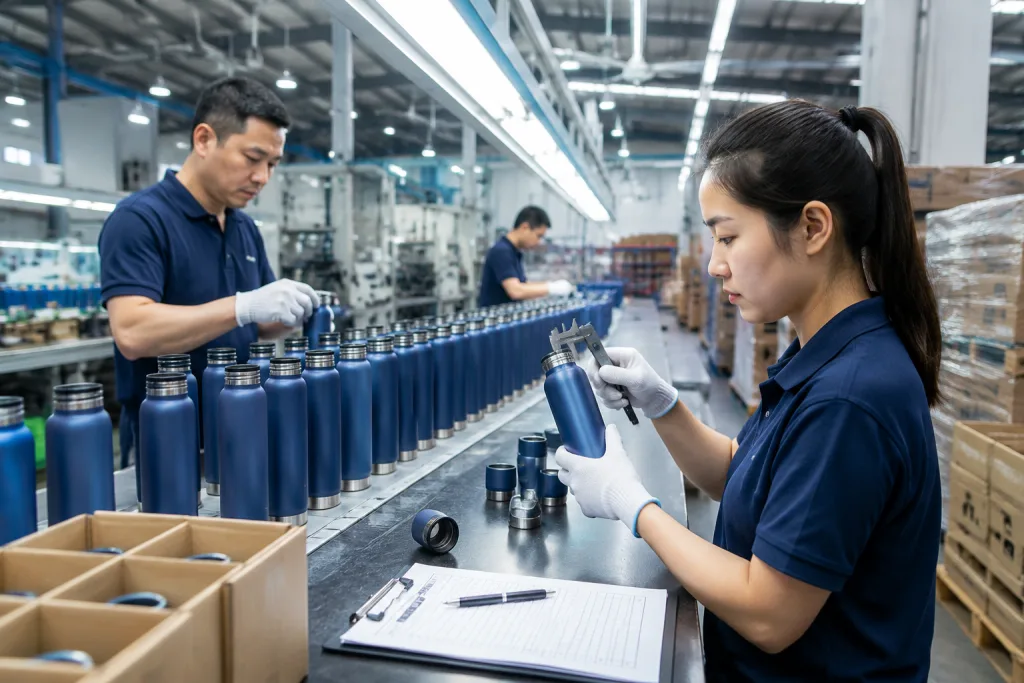
You are not just buying a bottle. You are buying a repeatable SKU: same color, same lid fit, same logo position, same carton mark, shipped before the launch window. We run the first sample against a 0.5 mm caliper check and a 24-hour leak test before carton quantity or logo artwork should even enter the conversation. Ask for price too early and the math gets dirty.
At our Zhejiang factory, hard orders are rarely hard because of 304 stainless steel. They go sideways because the buyer wrote “matte black,” the canteen supplier expected powder coating, the decoration vendor sized the logo from an old AI file, and the forwarder booked the wrong carton CBM. Last month QC pulled a sample where the PO said 500 ml but the artwork proof showed 17 oz. If you are sourcing custom drinkware from China, treat the order like an engineering file, not a catalogue item.
Start With The Buying Situation
I’ll keep the HTML intact and rewrite the prose to sound like a factory-side sales engineer: tighter, more specific, and more natural. Then I’ll return only the finished HTML.Picture a canteen distributor in Germany or a drinkware buyer in the United States. Your customer asks for a 750 ml stainless flask for outdoor retail, one body color, laser logo, kraft gift box, and an opening order of 3,000 pcs. They also want to know if the same shape can later move into a custom growler. Fair brief. Not enough for a factory quote.
A proper stainless steel flask manufacturer will still chase missing specs: single-wall or vacuum insulated, 201 or 304 stainless steel, powder coating or spray painting, leakproof target, cap material, gasket material, drop test level for the box, and the destination compliance file. We’ve seen buyers send only a photo and a logo file, then wonder why the sample misses the mark. The math does not work.
For a standard vacuum flask, we usually push 304 stainless steel for the inner wall, 304 or 201 for the outer wall depending on target cost, 0.4-0.5 mm body wall before forming, food-grade silicone gasket, and a PP or stainless cap. QC pulled the sample last week and checked the seal ring under a 60°C water test. If the flask will hold acidic drinks for hours, 304 inner material is the right call. For a custom growler for beer, mouth diameter, carbonation pressure, and how the buyer will wash it matter more than the logo placement.
In Zhejiang, China, our flask lines run about 420,000 stainless drinkware units per month across bottles, tumblers, and canteens. That number sounds big, but a launch date still needs a slot on the line. If your promo lands in September, tell the canteen manufacturer the retail launch date first. We ship to that date, not the other way around.
Freeze The Product Specification
The first working document is the spec sheet. It does not need nice layout. It needs zero guesswork. For a custom canteen or customizable canteen program, list capacity tolerance, finished height in mm, body diameter in mm, weight target in g, mouth opening ID, lid type with gasket material, Pantone or RAL color reference, decoration method with print area, carton packing with drop-test requirement, and compliance market. On our line, one PO once said “blue” while the artwork file said Pantone 2945C; QC pulled the sample, and the buyer flagged the color before mass production. Good catch. Bad spec sheet.
Capacity starts arguments. A “750 ml” flask can mean brimful capacity, rated usable capacity, or label claim. For export, we define rated capacity at 95-97% of brimful volume. This leaves headspace for the silicone gasket and cuts overfilling complaints. A 750 ml item may measure about 770-790 ml brimful, depending on body shape. We check it with a digital scale and water fill, not by eye. Asking “is it 750 ml?” is the wrong question to ask; ask whether 750 ml is the rated fill line or the brimful number.
Surface finishing needs discipline. Powder coating feels better in hand and beats basic spray paint in scratch testing, but the math changes if pretreatment is weak. For mid-range customized drinkware, powder coating often adds USD 0.18-0.45 per unit versus simple paint, depending on color and order size. Matte black and white are stable. Metallic colors and gradient finishes need extra sampling because batch-to-batch color drift shows fast under a D65 light box. Rubberized coatings need a separate rub test; we have seen them go sideways after 48 hours in a humid carton. The buyer usually notices that before anyone praises the soft touch.
Ask your canteen vendor to state the stainless grade and test method on the proforma invoice or purchase contract. “Food grade stainless steel” is not a grade. 304, 316, and 201 are grades. For Europe, you may also need LFGB or REACH-related documentation depending on the exact materials and claims. For the United States, check FDA food-contact expectations and, for children’s items, CPSIA and ASTM requirements where relevant. We ship samples with a material declaration tied to the SKU, not a loose PDF named “certificate”; one importer sent back paperwork because the PO had 304 stainless in the body spec but the test report only mentioned the lid.
If you are building a family range, define which parts are shared. A distributor growler and sports bottle can share lids or gaskets only if the thread pitch, sealing land, and mouth ID match within the agreed tolerance. We run this check with calipers before quoting spare parts, because one 0.3 mm mismatch can turn a “universal lid” into a leak complaint. Shared components lower tooling risk and make spare-part control easier for canteen distributors. They also cut warehouse confusion when the MOQ is split across 2 capacities and 4 colors.
Price The Order Without Guesswork
I’ll rewrite the section in-place, keeping the HTML tags and all existing numbers/codes intact while stripping the AI-ish phrasing and adding a few factory-floor details.Most buyers ask for the unit price too early. A solid FOB Ningbo or FOB Shanghai quote needs six inputs: material grade, capacity, insulation structure, finish, decoration, and packaging. Leave those out, and the canteen supplier is guessing; cheap guesses usually come back later as change charges. We run this every week on the line.
For a realistic 750 ml double-wall stainless flask order at 3,000 pcs, a broad FOB China factory price may sit around USD 3.20-5.80 per unit. The low end assumes a standard mold, basic color, simple logo, and plain box. The high end may include powder coating, laser engraving, an upgraded cap, custom gift box, and tighter inspection. QC pulled one sample last month with a 1.2 mm lid gap, and the buyer flagged it before packing.
MOQ depends on what you customize. For an existing mold with one color and one logo, 1,000 pcs can work. For a new PMS powder color, 2,000-3,000 pcs is more practical because paint loss and line cleaning are real. For a new mold or fully customized canteen body, the economic MOQ often moves to 5,000-10,000 pcs, plus tooling. Tooling for a new stainless flask body can range from USD 1,500 to over USD 8,000 depending on structure and cap complexity, and that math does not bend.
Decoration pricing is usually separate. Laser engraving is clean and durable, often USD 0.08-0.25 per position. Silkscreen is cheaper for simple one-color logos at volume, but curved surfaces and small text create registration problems; we’ve seen a 2 mm logo shift turn into a reprint. Heat transfer or full-wrap printing gives stronger retail shelf impact, but setup cost is higher and reject risk climbs if the artwork is busy.
Payment terms for new B2B buyers are commonly 30% deposit and 70% balance before shipment after inspection. If a canteen manufacturer offers loose terms on a first order, check whether the price already includes financing cost. The buyer asked for 60/40 once; we said no, because the numbers only work one way.
Build Samples Like Production
I’ll rewrite the section in-place, keeping the HTML tags and structure untouched while tightening the prose for a more field-tested sales-engineer voice.The golden sample is not a souvenir. It is the physical contract between you and the stainless steel flask manufacturer. We treat it as the control sample for 304 stainless, finish, logo position, lid fit, packaging, and carton mark layout. Once approved, any change gets written down and dated.
There are usually three sample stages. First is an existing stock sample to check shape and hand feel. That can ship in 3-5 days if the mold is already on the shelf. Second is a pre-production sample with your color, logo, and packaging. That usually takes 7-12 days for standard decoration or 12-18 days for special coating. Third is the sealed production sample, made from the final materials before the line starts mass production.
Do not approve a sample from photos if color or coating matters. A matte grey powder coat can look right under factory lights and wrong under retail LED lighting. We had a buyer flag this on a 500 ml flask last year, and the math did not work. Ask for a physical sample and give a color reference, such as Pantone, RAL, or your own master sample. For laser logos, confirm both size and contrast. On some coated bottles, QC pulled the sample and the laser showed bright stainless steel; on others, it opened a darker underlayer. The result is not the same across coatings.
Leak testing belongs in sampling, not only final QC. Fill the flask with room-temperature water, close the lid to normal hand torque, invert it for 30 minutes, shake it 20 times, then check the cap area. For vacuum flasks, add a thermal retention check. A 750 ml vacuum flask should keep water above 60°C after 6 hours when filled with 95°C water at 20°C ambient, if the design is built for that spec. We have seen this go sideways when a buyer skipped the cap test.
If you are handling canteen promotional projects, keep one approved sample in your office and one sealed at the China factory. A PO typo on logo placement can cost a full rework, and both sides need the same reference when that happens.
Control Production Before It Runs
I’ll rewrite the section in-place, keep the HTML structure untouched, and make the copy read like a real factory-side sales engineer wrote it.Once the deposit lands, the PO moves from sales talk to the line. At BottleForge in Zhejiang, we run 35-45 days after sample approval for 3,000-10,000 pcs, if the 304 stainless coil is in stock and no new tooling is needed. Before-summer and Q4 rushes usually tack on 7-15 days, and powder coating plus gift box printing are the usual bottlenecks.
A clean production file needs the signed proforma invoice, final spec sheet, approved artwork, approved sample photos, packing method, carton marks, inspection standard, and shipping terms. If you sell through marketplaces or big retailers, add barcode, FNSKU if needed, warning labels, and master carton weight limits. Amazon FBA cartons often need to stay under 22.5 kg, and we check carton size before mass packing; the buyer once sent a PO with the wrong carton length by 30 mm, and that stalled booking for two days.
Ask your canteen suppliers for an inline update when the first 200-500 pcs are done. That is when QC pulled the sample and caught logo skew, coating dust, lid mismatch, and wrong insert cards. Waiting until 3,000 pcs are packed is the wrong question to ask; by then every fix costs more time and scrap.
The main steps are tube cutting, forming, welding, vacuuming for insulated models, polishing, cleaning, coating, logo decoration, assembly, and packing. Each step has its own miss. Welding can leave pinholes. Vacuuming can miss the thermal target. Coating can show orange peel, dust points, or weak adhesion. Assembly can cross-thread caps. A good canteen manufacturer does not promise zero defects. It shows where the line catches them.
For custom drinkware programs with repeat orders, ask for a lot number or production date code on the inner carton or master carton. That makes tracebacks faster when a claim comes in three months later and nobody wants to dig through 18 pallets. It matters most for distributor canteen programs where goods split across several countries or warehouse locations.
Inspect With AQL Discipline
I’ll rewrite the section in place, keep the HTML tags unchanged, and tune the prose to sound like a factory-side sales engineer.Final inspection should land when 100% of the goods are produced and at least 80% are packed. We usually run ANSI/ASQ Z1.4 sampling with AQL 2.5 for major defects and AQL 4.0 for minor defects. Critical defects stay at zero: sharp edges, contamination, or a flask that leaks on the line.
Define the defect list before QC pulls the sample. A major defect can be leakage, wrong material, wrong logo, a heavy color shift, a broken lid, failed vacuum insulation, missing retail packaging, or a barcode the scanner cannot read. A minor defect can be a dust point in the coating, a light carton scuff, or a tiny polish mark outside the agreed viewing area. If you skip this step, every inspection turns into a debate.
For stainless flask inspection, we check capacity, weight, wall thickness, lid torque, thread fit, odor, coating adhesion, logo rub, carton drop, and thermal retention. On powder-coated items, a 3M tape adhesion test after cross-hatch cutting tells us fast whether surface prep was clean. For retail cartons, 76 cm drop on one corner, three edges, and six faces is a common shop-floor check, though a buyer can call for a different protocol. We’ve seen a 12 mm logo shift pass at the factory and get rejected later, so the math does not work.
If you bring in a third-party inspector in China, send the approved sample and spec sheet, not just the purchase order. Inspectors can count defects; they cannot guess your brand tolerance. For canteen vendors under BSCI or ISO 9001, ask for audit files too, but do not let certificates replace batch inspection. QC once flagged a PO typo on carton size, and that one line saved us from a mixed-pack mess.
When an order fails inspection, do not start with a discount fight. Ask for the sorting scope, rework method, post-rework photos, and the second inspection date. A two-day delay is cheaper than shipping bad custom drinkware and eating the claim later. We’ve seen this go sideways more than once.
Ship And Plan The Repeat
I’ll rewrite just the prose inside the existing HTML tags, keep the structure intact, and make it sound like a factory-side sales engineer wrote it.Once the sample is approved, we lock the balance payment, booking, and export papers. On a 3,000 pc 750 ml flask order with gift boxes, the carton plan usually lands around 8-12 cubic meters, depending on whether the inner box is 3-layer or 5-layer. Sea freight from Ningbo or Shanghai to major European ports runs 30-40 days port to port; to the US West Coast, 18-25 days is normal, then you still have customs and inland delivery. Air freight works for urgent promo runs, but the math usually breaks the deal.
Check the commercial invoice, packing list, bill of lading, and certificate set against the buyer name and HS code before we ship. Stainless steel vacuum flasks usually go under HS code 9617, but your broker needs to confirm it against the exact structure and destination market. We’ve seen one typo on a PO name stall customs for 6 days, and that wipes out any “cheap factory” saving fast.
For distributor drinkware and distributor growler programs, the repeat order is where the margin shows up. After the first shipment lands, we want real numbers: leak complaints per 1,000 units, coating scratch rate, carton crush rate, color acceptance, and sell-through. If complaints stay under 0.5% and the SKU moves, keep the mold and the components steady. Change only when the buyer can point to a sales reason.
Before the second PO, ask your stainless steel flask manufacturer to reserve raw material and coating slots. At 5,000 pcs or 10,000 pcs, the unit price usually drops if the spec stays the same. If you need a canteen customizable range with three colors, split the forecast cleanly. We can run 3,000 black, 2,000 white, and 1,000 green; “mixed colors, decide later” is the wrong question to ask.
Good sourcing from China is not about chasing the lowest line on a spreadsheet. It is about getting the same flask approved by QC, packed the same way, and received by your customer carton after carton.
Send Your Flask Spec For Factory Review
Share capacity, quantity, logo, finish, and destination market. We will check feasibility, MOQ, lead time, and FOB pricing before sampling.
Frequently asked questions
What MOQ should I expect from a stainless steel flask manufacturer?
For an existing stainless flask mold with one logo and one standard color, 1,000 pcs is often possible. For a custom PMS powder coating, 2,000-3,000 pcs per color is more realistic because coating setup, line cleaning, and rejection allowance matter. A fully custom canteen body or customized growler shape usually needs 5,000-10,000 pcs to justify tooling and production setup. If a supplier accepts 300 pcs with full customization, check whether they are using stock goods, hand decoration, or a trading warehouse. That can work for samples or local events, but it is rarely the right base for a repeat B2B SKU.
How long does a custom stainless flask order take from China?
A normal timeline is 7-18 days for sampling, 35-45 days for mass production after sample approval, and 25-40 days for sea freight depending on destination. Add 5-10 days for booking, customs, and inland transport. If you need new tooling, add another 20-35 days before production sampling. Zhejiang and other China manufacturing areas can move quickly, but powder coating, printed gift boxes, and peak-season capacity still need planning. For a fixed retail launch, start sourcing at least 90 days before the goods must reach your warehouse.
Is 304 stainless steel always required for custom drinkware?
For the inner wall or liquid-contact surface, 304 stainless steel is the normal recommendation for quality custom drinkware. It has better corrosion resistance than 201 and is more acceptable for export buyers in Europe and North America. The outer wall can sometimes be 201 to reduce cost, especially on vacuum flasks where it does not touch the liquid. 316 stainless steel is used for special corrosion resistance, but it usually increases cost and is not necessary for most water, coffee, or promotional canteen orders. Always state the grade in the purchase contract.
Which logo method is best for a custom canteen?
Laser engraving is the safest choice for durable B2B flasks, especially on powder-coated stainless steel. It normally costs about USD 0.08-0.25 per position and will not peel. Silkscreen can be cheaper for large one-color logos, but curved bodies and fine text need careful testing. Heat transfer, water transfer, or full-wrap printing gives stronger shelf impact, but setup cost and rejection rates are higher. For promotional canteen orders under tight deadlines, choose laser or simple silkscreen. For retail customized drinkware, request a decorated pre-production sample before approving mass production.
Should I work with a canteen manufacturer or a trading company?
A trading company can be useful if you buy many categories in small quantities. A direct canteen manufacturer is usually better when you need stable repeat orders, engineering changes, controlled materials, and factory-level QC. Ask for production photos, audit documents such as BSCI or ISO 9001, monthly capacity, and a video call showing the production line. Also ask who handles failed inspection rework. If the seller cannot answer questions about wall thickness, welding, vacuum testing, or AQL standards, they may not control the factory process directly.