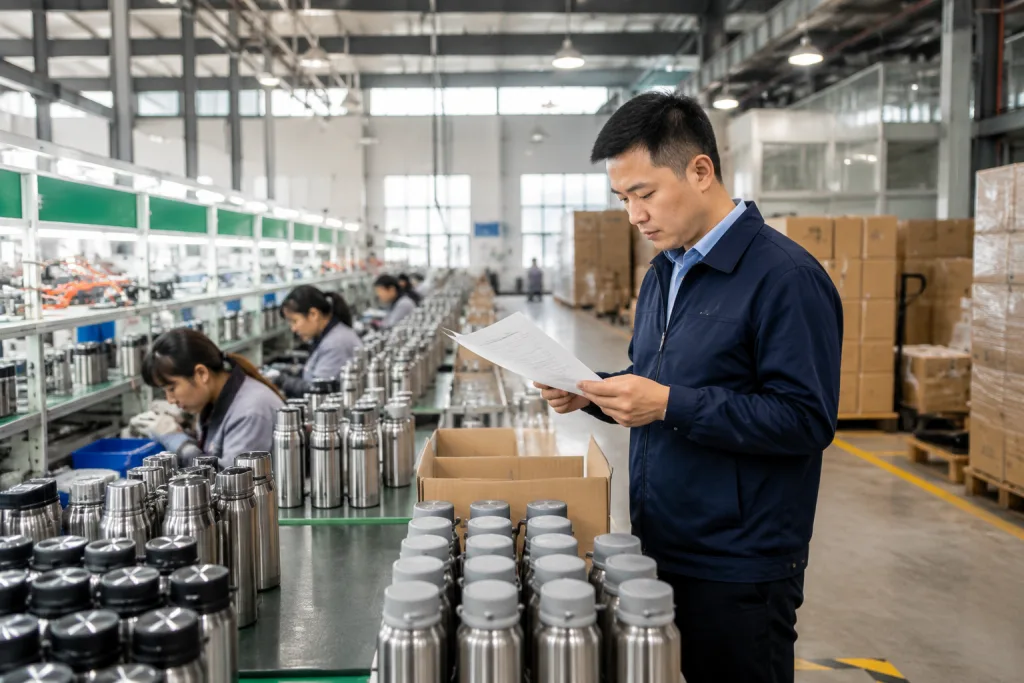
Key Takeaways
- 316 stainless usually costs USD 0.35-0.90 more per unit than 304, but it is worth it for salty or high-acid use.
- Typical MOQ at a Zhejiang stainless steel flask factory starts around 1,000 pcs per SKU; lead time is often 25-35 days after sample approval.
- A 0.5 mm wall can shave weight, but 0.7 mm wall thickness usually gives better dent resistance for distributor drinkware.
- For custom logos, laser engraving is cleaner for 1-2 color branding; silkscreen is cheaper at USD 0.06-0.12 per print.
If you are sourcing from a stainless steel flask factory, the real question is not “what looks good?” It is what survives freight, clears compliance, and still leaves margin after carton damage, duty, and returns. A polished sample can hide a 0.4 mm wall, a weak weld on the seam, or a lid that starts leaking after 200 open-close cycles. That is where first-time buyers in Europe and North America lose weeks and burn cash.
At BottleForge in Zhejiang, we see the same pattern every week: buyers need custom drinkware that can move through retail, promo, Amazon FBA, or distributor programs without noise. The better way to compare a canteen factory, canteen manufacturer, or canteen supplier is by spec, not brochure talk. QC pulled the sample with a caliper and a torque tester last week, and the buyer flagged a lid typo on the PO before tooling started. Use the same check before you place a 1,000-piece trial or a 20,000-piece reorder from China.
Spec table before you compare price
I’ll rewrite the section in place, keep the HTML unchanged, and make the copy sound like a real factory-side sales engineer.Do not lead with unit price. Start with the spec stack. On the line, the same 500 ml flask can land at USD 2.10 or USD 3.40, and both quotes can be valid once you price in steel grade, wall thickness, lid build, and test scope. For retail or promo orders, a thin spec hides extra cost fast: crushed cartons, returns, and a weak shelf story.
Use this as the working table when you compare a canteen factory, canteen manufacturer, or canteen supplier. QC pulled the sample on a 0.7 mm body and the buyer flagged the lid in the first round, so this is the wrong question to ask if you start with price alone:
| Spec | Entry Option | Better Option | Buyer Impact |
|---|---|---|---|
| Steel grade | 304 | 316 | 316 holds up better in harsher use |
| Wall thickness | 0.5 mm | 0.7 mm | 0.7 mm dents less in transit |
| Lid type | PP screw cap | 304 lid + silicone seal | Better leak control and stronger value signal |
| Finish | Powder coat | Powder + laser logo | Sharper brand visibility on shelf |
| MOQ | 1,000 pcs | 3,000 pcs | Better pricing, slower cash cycle |
In Zhejiang and across China, the factories that stay in the game hold tolerances, not just pretty samples. Ask for wall thickness tolerance, leak test method, and drop test height. We’ve seen this go sideways when the PO said “304 lid” and the buyer meant the bottle body; one typo like that can cost you a week. If the supplier cannot give those numbers, you are not dealing with a serious canteen vendor.
304 versus 316 in the real market
I’ll rewrite the HTML in place, keep the tag structure intact, and tune the prose so it reads like a shop-floor sales note from a real factory.304 versus 316 is not an academic split once you sell custom drinkware. For dry beverage use, 304 usually does the job and keeps landed cost down. For sports accounts, coastal retail, or acidic drinks, 316 gives better corrosion resistance and fewer warranty headaches. The price gap is usually USD 0.35-0.90 per unit, depending on capacity and finish. On a USD 14.99 retail bottle, that math is still workable.
Here is the plain answer: if you are building a canteen promo run and the bottle is handed out once, 304 is the sensible spec. If you are ordering a customized canteen for a premium brand or a custom growler that will go through repeated wash cycles, 316 is the safer call. We have seen this go sideways. One buyer pushed for 304 on a 5000-piece order, QC pulled the sample after a 72-hour salt mist check, and the buyer flagged the finish before shipment. Some canteen manufacturers blur the grades and just change the label.
- 304: best for everyday retail and promo volume.
- 316: better for coastal markets, protein shakes, and acidic drinks.
- Test ask: salt-spray or corrosion check where applicable.
When you compare canteen distributors and canteen suppliers in China, ask for the mill cert, not a sales line. A Zhejiang factory should be able to show heat-number traceability and the PO should match the alloy callout exactly. We run into typos on POs all the time, and one wrong grade code can sink the order. That is standard, not a favor.
Lids decide the return rate
I’ll rewrite just this HTML section, keeping the tags and list structure intact while stripping the AI-ish phrasing and adding a few concrete factory-floor details.Most leaks start at the cap, not the bottle body. A stainless steel flask factory that ships export orders talks about lid torque, silicone hardness, gasket shape, and thread count for a reason: those four points decide whether cartons pass QC and whether buyers reorder. On the line, we’ve had a buyer flag a 0.5 mm gasket mismatch and the whole batch came back for rework. That hurts.
For use-case fit, keep it simple. A PP sports cap works for canteen customized promo programs where target cost is tight. A flip-top or loop lid fits retail custom drinkware better. A full stainless cap suits a custom growler or premium insulated flask, but it adds cost and usually puts another 20-60 g on the unit.
We usually run these checks:
- Silicone seal hardness: 50-60 Shore A
- Leak test: 24 hours inverted at room temperature
- Torque check: consistent opening without overtightening
- Drop test: 1 m onto plywood, 3 times
If you are a canteen distributor, ask for lids that can be swapped fast. If you serve schools, gyms, or outdoor brands, cut the small parts count. We’ve seen a 4-piece cap go sideways in spare-parts packing; a 2-piece lid saves time, and the math on returns works better.
Finish and branding change margin
Branding is not decoration. It moves the selling price. We’ve seen a powder-coated body with laser engraving clear at a $1.20 higher FOB, while a plain polished body with single-color print got pushed back by the buyer after QC pulled the sample under a 3M tape test. For customized drinkware, the finish decides whether the logo still reads after carton rubbing, shelf stacking, and one rough wash on the line.
Use this rule of thumb when you compare canteen customizable options:
| Decoration | Typical Cost | Best Use | Risk |
|---|---|---|---|
| Silkscreen | USD 0.06-0.12 | Canteen promotional runs | Can scratch faster |
| Laser engraving | USD 0.10-0.20 | Retail and premium custom canteen | Limited color impact |
| Heat transfer | USD 0.15-0.30 | Full-wrap graphics | More setup sensitivity |
| Emboss/deboss | USD 0.12-0.25 | Customized canteen and gift sets | Tooling required |
For a canteen manufacturer in China, decoration has to match the run size. At 1,000 pcs, silkscreen is the cleanest move. At 3,000 pcs and above, laser engraving or custom molds start making sense, and the math does not work any other way. If you sell distributor drinkware into Europe or North America, the logo needs to survive repacking and shelf handling; cheap print is usually the first thing the buyer flags.
MOQ, lead time, and factory capacity
I’ll rewrite the section in-place, keeping the HTML tags and list structure untouched while making the sales language sound like a factory-side editor wrote it.Buyers ask for the lowest MOQ all the time. Fine, but the math has to work on our side too. A proper stainless steel flask factory in Zhejiang should handle a pilot run and a repeat order without changing the packing spec. For standard bottles, MOQ usually starts at 1,000 pcs per color per SKU. If you change the lid parts or open a new mold, 3,000 pcs is the number we usually quote. Lead time sits at 25-35 days after sample approval and deposit, and an existing tool normally gives a 7-10 day sample cycle.
Capacity is the part people underquote. Your reorder window can close fast. BottleForge’s Zhejiang setup runs at over 300,000 units per month across drinkware lines, and that is the scale you want for seasonal drops or distributor restocks. We’ve had buyers flag a 2,000 pcs top-up after we already booked the line, and the factory that cannot state a monthly output number usually cannot absorb that kind of push.
For FOB planning, keep these numbers in mind:
- Sample cost: often USD 30-80, refundable on order in many cases
- FOB delta for finish upgrades: usually USD 0.20-0.60 per unit
- Rush order risk: 7-15% cost uplift if you compress lead time
- Inspection: AQL 2.5 for major defects is common for export cartons
We also match pack-out to FNSKU or distributor labels when the PO asks for it. That saves warehouse time. It also avoids the ugly mixed-carton mistake we’ve seen on a 5,000 pcs shipment when the buyer sent one typo on the label spec.
Best fit by channel and buyer type
I’ll keep the HTML structure intact and rewrite the copy to sound like a real sales engineer, with tighter channel-specific detail and fewer generic lines.Different channels need different bottles. Buy like a retailer, and you end up paying for promo specs you do not need. Buy like a promo buyer, and you leave margin on the table. A good stainless steel flask factory should match the product to the channel, not push one “universal” SKU across every account.
Retail brand owner: go with a 304 or 316 body, powder coat, laser logo, and tighter cosmetic limits. We check seam marks with a 0.2 mm feeler gauge on the line because the buyer will spot a rough edge in the first 10 seconds of unboxing. Canteen distributor: choose a durable, stackable body with stable color runs and spare-cap stock. Canteen promotional buyer: keep the focus on unit cost, print speed, and carton density. Outdoor or sports channel: put grip, dent resistance, and leak control ahead of fancy packaging.
The same logic applies to custom growler jobs. A customizable growler for craft beer needs a different cap, gasket, and finish than a customized canteen for fitness retail. One mold does not cover both. We’ve seen that go sideways fast: QC pulled a sample with the wrong lid torque, and the buyer flagged it before the first shipment. That kind of mismatch turns into returns and dead stock.
If you are comparing canteen manufacturers, canteen vendors, or a canteen distributor network in Europe and North America, ask one direct question: “What is the use case, and what failure mode are we protecting against?” That is the right question. If the answer talks only about the sample room and not the line, the supplier does not know the channel.
Inspection rules that protect your margin
I’ll rewrite the section in-place, keep the HTML structure untouched, and sharpen the language to sound like a factory-side sales engineer.QC is not a buzzword. It decides whether you ship clean or eat a claim. For custom drinkware, lock the defect standard before the first sample runs. Cosmetic calls change by buyer, so put numbers on the page. A stainless steel flask factory should accept AQL sampling and hand over the check records.
Use these shop-floor rules:
- Body ovality: no visible wobble on a flat surface
- Coating: no bare spots larger than 1 mm
- Logo: no blurred edges at normal viewing distance
- Leak test: no seepage after inversion and shake test
- Carton drop: no bottle contact damage after outer pack test
If you need customized drinkware for Amazon FBA, ask for carton size, barcode position, and individual polybag rules before the line starts packing. We once saw a PO typo on carton count turn into a 12-day delay, so this is the wrong question to leave for later. If you are sourcing canteen customized sets for a distributor program, confirm master carton count and pallet pattern before PO release. Good factories in Zhejiang and across China should handle that without being chased.
Compare specs with a real factory quote
Send your target capacity, finish, and market. We’ll map the right stainless steel flask factory spec and quote it in USD, not guesswork.
Frequently asked questions
What is a normal MOQ from a stainless steel flask factory?
For standard SKUs, a normal MOQ is 1,000 pcs per color per design. If you need a new cap, new mold, or special packaging, expect 3,000 pcs or more. For simple logo work, some Zhejiang factories can sample faster and lower the entry barrier, but price usually improves only once you pass 3,000-5,000 pcs. If you are a canteen distributor or canteen vendor, ask for tiered pricing at 1,000, 3,000, and 5,000 pcs so you can see the real breakpoints.
Should I choose 304 or 316 for custom drinkware?
Choose 304 for general retail, office, promo, and most dry beverage use. Choose 316 when you need extra corrosion resistance, such as coastal retail, acidic drinks, or repeated harsh washing. The usual premium for 316 is about USD 0.35-0.90 per unit, depending on capacity and finish. If your selling price is above USD 14.99, that premium is often easy to justify. For a custom growler or customized canteen, 316 is a safer choice if you want fewer complaints over time.
What lead time should I expect from a canteen factory in China?
For existing tooling, sample lead time is often 7-10 days and production lead time is 25-35 days after sample approval and deposit. If you need new molds or a complex lid, add 10-20 days. A serious canteen manufacturer in Zhejiang should tell you the timeline by process, not just promise “fast production.” Ask for milestone dates: sample, pre-production sample, bulk start, and final inspection. That lets you plan freight and warehouse booking without surprises.
What price range is realistic for a custom canteen?
For a standard insulated stainless model, FOB prices often sit around USD 2.10-3.40 for entry to mid-range specs, then rise with 316 steel, thicker walls, premium lids, or special decoration. Laser engraving usually adds USD 0.10-0.20 per unit. Better packaging can add another USD 0.15-0.40. If a canteen supplier quotes far below that for a heavy-duty bottle, check wall thickness, steel grade, and whether the quote excludes cartons, testing, or logo setup.
How do I check if a supplier is reliable?
Ask for material certificates, leak-test method, AQL standard, carton spec, and monthly capacity. A credible stainless steel flask factory should be able to state output in units per month, not just “many.” For export orders, ask whether they handle REACH, food-contact declarations, and label requirements for your market. If they also support FOB terms and can align with FNSKU or distributor labeling, that is a good sign. A Zhejiang factory with clear process control is usually more predictable than a vague trader.