Key Takeaways
- Plan 3,000 pcs MOQ for most custom canteen orders and 5,000 pcs when tooling or custom color matching is required
- Use 304 stainless steel for food-contact inner walls and confirm REACH, LFGB, or FDA documentation before mass production
- Budget 30-45 days for standard repeat production and 55-70 days for new mold, PMS color, and retail packaging projects
- Set AQL levels, carton drop tests, and logo abrasion checks in the PO instead of arguing after shipment
If you buy for stainless steel flask distributors, the hard part is not finding a factory in China. The hard part is sorting out which canteen supplier will keep the same wall thickness, cap fit, logo sharpness, carton strength, and ship date after the sample looks good. A clean pre-production sample does not cover chargebacks. We’ve seen that go sideways on a 2,000-unit PO.
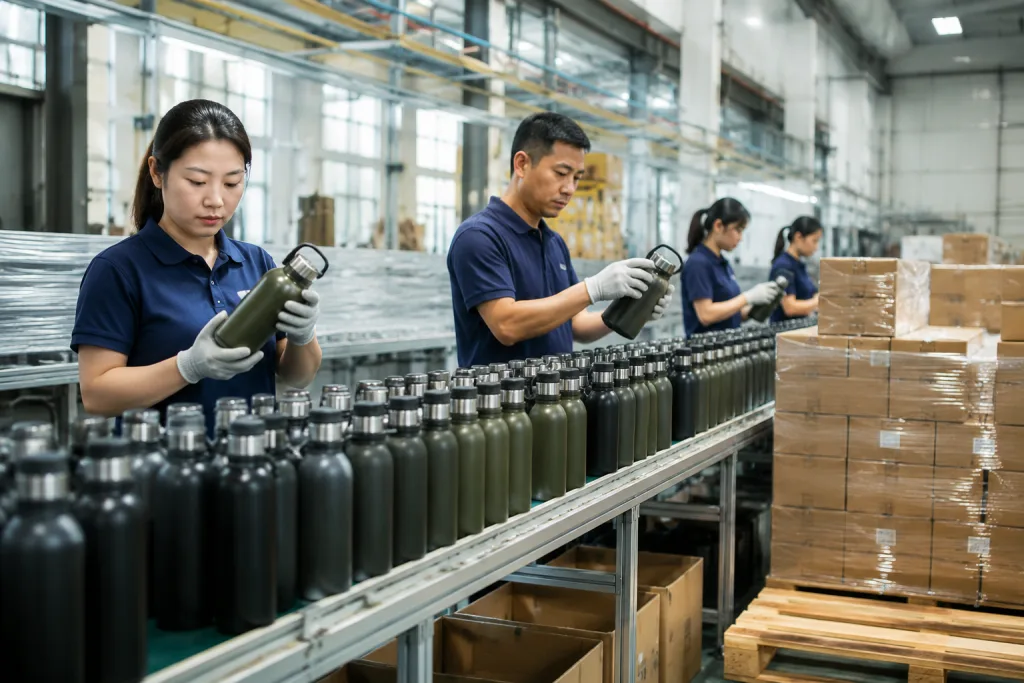
BottleForge Industrial is based in Hangzhou, Zhejiang, and we make custom drinkware for importers, promotional programs, and retail distributors. Our view is simple: start with the channel, then pick the flask. A 750 ml outdoor canteen, a 1.9 L custom growler, and a slim promotional flask need different steel gauges, coating specs, tests, MOQ targets, and packing rules. QC pulled the sample on the line at 0.8 mm, and that number matters more than a glossy mockup.
Start with the sales channel
I’ll rewrite the section in place, keep the HTML structure untouched, and make the sales text sound like a factory-side rep wrote it. Then I’ll give you the cleaned HTML only.Before you ask a canteen factory for a quote, define where the product will be sold. A distributor flask for outdoor retail has different failure risks than a canteen promotional order for a one-time event. Retail buyers watch shelf display, barcode placement, hang tags, warranty claims, and color match across replenishment orders. Promotional buyers care more about logo position, delivery date, and unit price. We had one PO last month that said “750ml” in the email and “750 ml” on the carton file; the buyer flagged it before we cut tooling.
For stainless steel flask distributors, we split projects into four lanes. Standard wholesale is 500 ml, 750 ml, and 1,000 ml single-wall or vacuum-insulated flasks with a stock shape and custom logo. Private label retail needs a custom lid color, retail box, UPC, instruction sheet, and often a matte powder coat. Outdoor and camping orders lean toward a custom canteen or customized growler for higher perceived value. Corporate gifting is different again; the gift box and foam insert matter more than chasing a lab-style spec no one will read.
Ask one direct question inside your team: will the buyer reorder the same item for 12 months, or is this a one-off campaign? For repeat distributor canteen programs, lock down mold ownership, color standards, and spare cap stock from day one. For one-time canteen promotional orders, push hard on production timing and logo approval. This is the wrong question to ask if you skip the carton details; Amazon, warehouse clubs, and regional retailers can reject weak master cartons, and QC pulled the sample straight off the line when the drop test failed at 1.2 m.
In Zhejiang, China, a normal custom drinkware line can produce about 80,000 to 150,000 stainless units per month depending on shape and finishing. That number looks big on paper, but the line fills fast before the April and September shipping windows. If your launch date is fixed, the factory calendar matters as much as the quoted FOB price. We run 304 stainless draws on one line here, and a 7-day slip on cap sourcing can turn into 18 days before vessel booking.
What specification should you send?
I’ll rewrite the section in-place, keep every HTML tag and list structure intact, and make the copy sound like a factory-side sales engineer wrote it.A serious quotation starts with a tight spec sheet. Send only a photo and the line will give you apples-to-oranges numbers. One flask distributor may quote 0.4 mm inner steel, another 0.5 mm; one adds a leak test and color box, another prices a bulk white box. That gap turns into a headache at receiving, not during quoting.
Your RFQ should list capacity, body structure, steel grade, finish, lid type, print method, packing, test items, target market, and delivery term. For vacuum flasks, ask for 304 stainless steel on the inner wall and 201 or 304 on the outer wall. For single-wall canteens, 304 is the safer food-contact call, especially if the buyer will pour in acidic drinks. We run 0.4-0.5 mm for light promo bottles and 0.5-0.7 mm for outdoor drinkware; thinner walls dent fast, and the buyer will flag it on first inspection.
For a custom growler, confirm whether the label is 1.9 L, 2.0 L, or 64 oz. Those are not the same after insulation, thread design, and fill-line tolerance. If you sell into the EU, ask the supplier for REACH and LFGB material declarations. If you sell into the US, FDA food-contact expectations and California Proposition 65 screening may apply. For kids’ bottles, ASTM and CPSIA change the test plan. QC pulled the sample last week and found a 2 mm label shift; that is the kind of small miss that blows up a PO.
- Capacity: 350 ml, 500 ml, 750 ml, 1,000 ml, 1.9 L, or custom mold.
- Decoration: laser engraving, silk screen, heat transfer, water decal, or full powder coating.
- Packing: polybag, white box, color box, kraft box, display tray, or mailer box.
- Inspection: AQL level, vacuum test, leakage test, coating adhesion, logo rub test, carton drop test.
A good canteen vendor will push back on unclear specs. That is not difficult behavior. It is how we keep a quote clean and stop a 5000-piece order from turning into rework.
How MOQ and price really work
I’ll rewrite the section in-place, keep the HTML intact, and tighten the sales-engineer voice while preserving the pricing logic and numbers.MOQ is not a random factory rule. It follows steel purchasing, polishing setup, coating line washout, logo fixture setup, packaging print runs, and carton consolidation. At BottleForge Industrial in Hangzhou, Zhejiang, the line runs 3,000 pcs per model for stock stainless flask shapes with one logo. Custom PMS powder coating usually starts at 5,000 pcs per color. New mold work starts at 10,000 pcs, and tooling depends on the body, lid, and cap parts.
FOB China unit price moves with steel grade, bottle capacity, insulation structure, coating, lid complexity, decoration, and packaging. A basic 500 ml single-wall stainless canteen custom project may sit near USD 1.80-2.60 FOB at distributor volume. A 750 ml double-wall vacuum flask with powder coating and laser logo may land around USD 4.20-6.80 FOB. A 64 oz customized growler with handle lid, retail box, and thicker body can move into USD 8.50-13.50 FOB. These are planning ranges, not promises; steel cost and exchange rate still move the number.
If a quote comes in 18% below every other canteen supplier, don’t celebrate. Ask what changed. We’ve seen this go sideways on thinner steel, 201 stainless in place of 304 inner wall, a cheaper cap gasket, no retail carton, weak coating, or no third-party test budget. Low FOB only works when the spec matches.
For distributor growler and distributor canteen programs, landed cost is the number that matters. A USD 0.25 stronger carton can save USD 2.00 in reshipping after dents and warehouse rejects.
Payment terms are usually 30% deposit and 70% before shipment for new buyers. A distributor with repeat orders can often get more flexible terms after several clean shipments. If a canteen factory offers loose terms before it checks your order history, look at its production control and cash position first. The math doesn’t work any other way.
Decoration choices buyers underestimate
I’ll rewrite the prose tightly, keep the HTML untouched, and make it sound like a buyer-facing factory note with concrete shop-floor details.Custom drinkware sells on the logo, but that is also where the delays start. Laser engraving runs clean on stainless steel and powder-coated shells. We ship it a lot. On the line, it usually fails less than multi-color printing, and it holds up better for distributor orders that stay in market for months. The tradeoff is simple: it cuts into metal or shifts the surface tone, so you do not get a bright printed logo.
Silk screen printing fits one- or two-color logos on smooth flask bodies. It keeps unit cost down for promo runs. The weak spot is curved bodies, where registration drifts, and ink can wear fast if the coating is wrong. We had a buyer flag a PO once because the logo file said 32 mm but the sample came through at 36 mm. For a canteen promotional order, ask for a 3M tape test and a 50-cycle alcohol rub test if the item will be handled hard. Heat transfer or water decal can carry full-color artwork, but the curing needs more control, and QC will usually allow a higher reject rate.
Powder coating is a strong pick for customized drinkware because it feels premium and hides fingerprints. For outdoor custom canteen work, 60-90 microns is the range we run most often. Too thin scratches fast. Too thick can mess with thread clearance or lid fit near the mouth. If you want a PMS color, do not expect stainless steel, plastic lids, silicone straps, and printed cartons to match 100% under every light source. This is the wrong question to ask. Use a physical swatch and set the color tolerance from that, not from a PDF on a buyer laptop.
For a canteen customizable program with several SKUs, keep the artwork rules tight. Same logo size, same placement, same finish, same carton structure. A small mismatch adds setup time and gives QC more points to check. We saw this go sideways on a 12-SKU run where one lid print moved 4 mm and the buyer wanted a full rework. If you need both a custom canteen and a customizable growler in the same program, lock the decoration method early so the retail set looks like one family. A good canteen vendor should send an artwork proof with exact dimensions, not a logo floating on a product photo.
Quality checks before shipment
I’ll rewrite the section in-place, keep the HTML tags intact, and tighten the prose so it reads like a factory-side QC note rather than AI copy.A stainless flask can pass a fast visual check and still fail in the market. Leaks, vacuum loss, rust complaints, coating peel, lid cracking, and carton collapse cost the most. Put inspection standards in the purchase order before the deposit goes out. “Good quality” is not a QC standard.
For stainless steel flask distributors, we run pre-production sample approval, inline inspection after 20-30% of output, and final random inspection before shipment. AQL 2.5 works for major defects and AQL 4.0 for minor defects as a normal commercial baseline. Critical defects, such as sharp edges, wrong food-contact material, leakage, or mold contamination, get zero acceptance. For vacuum products, the factory should run a vacuum performance check and a hot water retention test. We usually test with 95°C water and check the temperature drop after 6, 12, or 24 hours, based on the claim on the box.
Leak testing should use inverted positioning and shaking, not just a quick water fill for 5 seconds. Caps need gasket compression checks; a 0.2 mm tolerance miss can turn into a slow leak after shipping vibration. Coating adhesion gets cross-hatch tape testing. Logo wear gets rub testing. Carton strength needs a drop test, especially for e-commerce or distributor warehouses where the box gets handled more than once—QC pulled one sample from 1.2 m and the corner split on the first drop.
Ask your canteen suppliers for material certificates, but do not lean on certificates alone. Certificates show what was tested, not always what shipped. If the order is big enough, book third-party testing from SGS, Intertek, TÜV, or Bureau Veritas. On a 10,000 pc customized canteen order, USD 250-600 for targeted testing is cheap insurance. We’ve seen this go sideways when the buyer skipped the PO details and typed “inspection by standard” on the first draft; the factory asked which standard, and the line kept moving. Clear QC terms get more attention than price haggling.
Packing, logistics, and reorder discipline
I’ll rewrite the section in place, keep the HTML tags intact, and tune the prose to sound like a sales engineer who ships this stuff every week.Most new buyers treat packing like a footnote. That is the wrong call. Packing drives damage rate, warehouse pick speed, barcode accuracy, and whether a retail buyer accepts the carton without kicking it back. A standard stainless flask often ships 24 pcs per master carton, while a larger custom growler is usually 6 or 12 pcs per carton. We try to keep carton gross weight under 15-18 kg, because once a carton gets heavier than that, it gets tossed harder on the line and some retailers will reject it at inbound.
If you sell through marketplaces, the file set has to be locked before we run the pack-out. That means FNSKU labels, suffocation warning on polybags where required, carton labels, and master carton dimensions all need to sit in the production sheet. If the buyer flags a warehouse rule after sealing starts, the math does not work. For distributor warehouses, ask early about pallet height limits, mixed-SKU carton rules, and ASN data. We can apply labels in China, but once the carton is taped and strapped, changes turn into rework and dead time.
Lead time should be written by stage, not as one soft promise. For a repeat order out of our Zhejiang facility network, we normally plan 7-10 days for sample and artwork approval, 30-45 days for mass production, and extra days for sea freight. New color, new lid, custom retail box, or testing can push production to 55-70 days. If Chinese New Year sits inside the schedule, add 3-4 weeks of buffer. The line does not wake up at full speed on day one after the holiday.
Reorder discipline is where good stainless steel flask distributors protect margin. Keep one golden sample, the approved artwork file, PMS reference, carton dieline, test report, and the last inspection report for each SKU. When you reorder, send the same pack and ask the factory to confirm that the material, gasket, coating, and carton supplier are unchanged. QC pulled the sample on one repeat order and found a 1 mm cap change that the buyer never asked for; that kind of slip turns into customer complaints six months later.
Send your flask spec before the quote stage
BottleForge will review capacity, steel grade, logo method, MOQ, packing, and test needs before you commit to production.
Frequently asked questions
What MOQ should stainless steel flask distributors expect for custom orders?
For stock flask shapes with one logo, a realistic MOQ is usually 3,000 pcs per model. If you need a custom PMS powder coating, plan for 5,000 pcs per color because the coating line has cleaning loss and minimum powder purchase. For a new body mold, custom cap, or fully customized growler, 10,000 pcs is a more practical starting point. Smaller trial orders are sometimes possible using existing colors and laser engraving, but the FOB price will be higher. If a supplier accepts 500 pcs with custom coating, ask whether it is hand-sprayed, mixed with another order, or missing normal QC steps.
Is 304 stainless steel always required for a custom canteen?
For food-contact inner walls, 304 stainless steel is the safer standard for most export drinkware. It has better corrosion resistance than 201 stainless steel, especially when users put juice, sports drinks, or acidic beverages inside. Some factories quote 201 outer walls to control cost on vacuum bottles, which can be acceptable if the inner wall is 304 and your market allows it. For EU buyers, request REACH and LFGB-related documents. For US buyers, ask for FDA food-contact declarations and consider Proposition 65 screening. Do not accept a verbal “food grade” claim; put steel grade and test requirements in the purchase order.
Which logo method is best for distributor drinkware?
For long-term distributor drinkware, laser engraving is usually the lowest-risk decoration because it does not peel and has clean detail on stainless or powder-coated surfaces. Silk screen printing is cheaper for simple one-color canteen promotional programs, but it needs ink adhesion testing on the selected coating. Heat transfer and water decal are better for full-color artwork, yet they require more curing control and a higher defect allowance. If your order is 3,000-5,000 pcs and the item will be reordered, approve a physical decorated sample, not only a digital mockup. Also define logo size in millimeters and position from the bottle base or centerline.
How long does production take from China to North America or Europe?
For a repeat stainless flask order using an existing mold and approved artwork, production normally takes 30-45 days after deposit and sample approval. A new customized canteen with PMS color, printed retail box, and third-party testing is better planned at 55-70 days. Sea freight to North America or Europe commonly adds 25-45 days depending on port, routing, and customs process. Air freight is possible for urgent promotional orders, but it can add USD 1.50-4.00 per unit on bulky drinkware. Around Chinese New Year, add 3-4 weeks of buffer because labor, subcontractors, and trucking all slow down.
What quality standard should a canteen distributor put in the PO?
Use written inspection terms, not general wording. A normal commercial setup is AQL 2.5 for major defects and AQL 4.0 for minor defects, with zero tolerance for critical defects such as leakage, sharp edges, unsafe material, mold, or wrong logo. Define tests for vacuum retention, leakage, coating adhesion, logo rub resistance, and carton drop performance. For example, require 100% leak testing at the factory and random final inspection before shipment. If the order is over 10,000 pcs or entering a major retail channel, add third-party material or migration testing. The PO should also list approved sample number, packing method, carton markings, and barcode rules.