Key Takeaways
- A 0.4 mm wall and 304 stainless are common entry specs; 316 costs 12-25% more but improves corrosion margin.
- Leak and cap-failure claims usually trace back to gasket tolerance, not the bottle body.
- For logo durability, expect UV print or laser engraving to outperform simple pad print by 2-3x in abrasion tests.
- A realistic first order for a canteen distributor is 1,000-3,000 units with 35-45 days lead time after sample approval.
Most bad stainless steel flask customized orders do not fail at the sales sample stage. They fail later, when the cap starts leaking after 1,000 openings, the print scuffs in carton transit, or the weld seam misses salt-spray spec. For Europe and North America, that is the real problem: a clean mockup does not protect you from line drift.
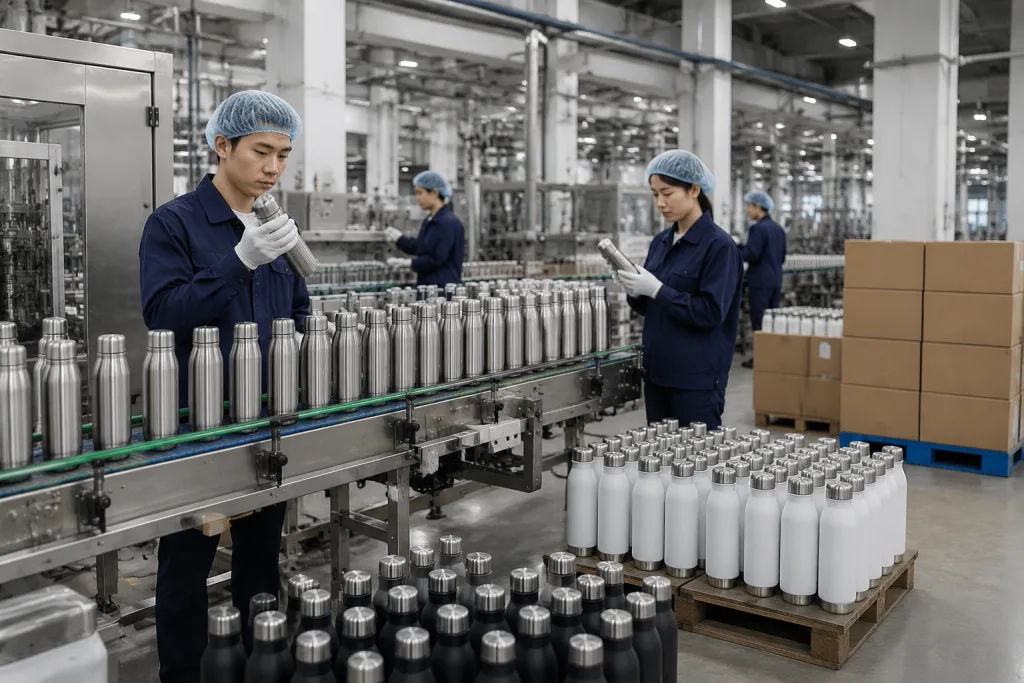
Spec the failure points first, artwork second. That is the right order. In Zhejiang, a serious canteen factory may run 80,000 to 120,000 units per month, and the gap between a clean launch and a chargeback usually comes down to wall thickness, sealing structure, coating adhesion, and AQL discipline. We’ve seen buyers push for one more logo color and skip the cap torque test; the math does not work. A canteen manufacturer in China can ship good product at scale, but only if the PO locks the weak spots before the line starts.
Where flask orders actually break
I’ll rewrite the section in-place, keeping the HTML tags and structure unchanged while making the prose sound like a factory-side sales engineer wrote it.If you want a stainless steel flask customized for retail, promotion, or distribution, ask where the order breaks first, not how the artwork looks. The usual misses are easy to name: carton crush dents, cap threads that do not match, weak vacuum hold, logo drift by 2-3 mm, and coatings that start chipping after a few hundred handlings. We’ve seen all five. None of them are random; they come from spec gaps.
A canteen supplier should show the control points on paper and on the line: body gauge, lid torque, gasket material, surface prep, and the final leak test. For a 500 ml bottle, 0.35-0.45 mm stainless is common; once it drops below that, dent resistance falls off fast. QC pulled one sample at 0.32 mm last month, and the buyer flagged it before packing. A canteen vendor can quote a low FOB price, but if the wall is thin and the cap tooling is loose, the math does not work—you pay later in returns.
Use that same lens for custom drinkware. A custom canteen, customizable canteen, or customized canteen all live or die on process control. Design is the easy part. We run the line every day, and the margin gets protected by gauge checks, torque checks, and a leak test that actually catches bad lids before shipment.
Leakage starts at the cap
I’ll rewrite the prose only, keep the HTML exactly as-is, and tighten the wording so it sounds like a factory-side sales engineer wrote it.Most buyers point at the bottle body first. That is the wrong place to look. On a stainless steel flask customized for hot or cold fill, leaks usually start at the cap: the silicone or EPDM gasket, the thread bite, and the torque used on closure. We’ve seen a 1.5 mm gasket and a 1.8 mm gasket pass the same visual check but seal differently once the flask heats up and the lid grows a touch. Thread pitch does the same thing. The cap feels normal in hand, then fails after a few heat cycles.
Ask your canteen manufacturer to put the sealing spec in writing. We run 100% leak testing on first production, then AQL 0.65 on premium mass runs. On the line, QC pulled the sample cap every shift, not just at order start, because tool wear shows up fast in the threads. If you buy canteen promotional product for events, this is where complaints come from: people over-tighten the lid, open it again, and the seal starts to creep.
The same goes for a custom growler or customizable growler. Larger mouths and heavier closures wear the seal faster. If your canteen distributors are mixing SKUs, keep the lid system the same where you can. One cap platform across several custom drinkware bodies cuts spare-part stock, and the buyer flagged fewer after-sales issues when we did that on a 12,000-piece run.
Print and finish defects cost the most
I’ll keep the HTML exactly as-is and rewrite only the prose, cutting the AI filler and adding factory-floor specifics. Then I’ll sanity-check that the tone reads like a sales engineer, not a generic article.Logo failure is the silent margin killer. We’ve seen a canteen custom order clear dimensional checks and still get rejected because the logo rubbed off in transit or the powder coat flashed fisheyes after cure. Screen print works for a 2-week campaign, but if the flask goes through distribution centers, gyms, or trade show kits, it needs a finish that takes abrasion. Laser engraving is the cleanest call for stainless steel flask customized work because it skips coating failure entirely and keeps its mark after repeat handling.
For printed finishes, ask for cross-hatch adhesion testing, 100 tape pull, and cure records from the oven chart. A normal powder coat sits around 60-80 microns; go thinner and the first scratch shows, go thicker and fine lines start to bridge. On one job, QC pulled the sample at 72 microns and the buyer still flagged the Pantone shift by half a shade, so we held the lot. If you need a canteen customizable line with multiple colorways, lock the Pantone code and get a signed master sample before mass production starts. Zhejiang factories can hold tight color control, but only when the approval file is clean before the line runs.
Practical rule: if the product is sold as distributor canteen stock, choose a finish that survives warehouse handling, not just a tabletop photo.
Thermal claims need proof
I’ll rewrite the section in-place, keep the HTML structure unchanged, and make the prose sound like a factory-side sales engineer wrote it.If you sell a vacuum flask as insulated, the claim has to match the run on the line. We see orders fail here because the factory quotes the best-case lab number and leaves out the test setup. Ask for the method sheet: ambient temperature, fill temperature, and the exact measurement interval. A real vacuum bottle should hold hot liquid above 60°C for 6-8 hours under normal use, depending on capacity and wall structure. Cold retention needs the same check.
Don’t take “12 hours hot” at face value. Ask whether QC pulled the sample from a still lab, whether the flask was pre-heated, and whether the lid stayed closed the whole time. Those details change the result. For a canteen factory in China, a stainless steel shell with true double-wall vacuum construction should pass vacuum decay and weld integrity checks. We’ve seen a 0.2 mm pinhole pass visual inspection and still drag performance down over the next few months.
What buyers regret most is buying by printed claims instead of by test method. If the spec sheet is weak, the product promise is weak.
If you need customized drinkware for retail or corporate use, ask for written test reports tied to the PO lot number. That is how you protect a distributor canteen program from one bad batch wiping out the season.
Packaging failures look small, then snowball
I’ll rewrite the three paragraphs in place, keep the HTML intact, and tighten the language so it sounds like a real factory-side sales note.Packaging is not an afterthought. It is the last line between a clean flask and a return. A stainless steel flask customized for export needs inner protection that stops cap scuffing, carton crush, and logo rub. If the unit ships in a thin white box with a loose insert, we see micro-dents, lid marks, and dust by the time the pallet reaches the warehouse.
For e-commerce or distributor drinkware programs, ask the canteen supplier for drop-test and carton compression data. A 5-ply outer carton beats the cheapest 3-ply board, and the difference shows on a 12-day sea lane versus an 18-day one. FBA buyers should lock down FNSKU placement, carton labels, and master carton size before the line starts. We had one buyer flag a PO typo on the case count, and that cost two days of reprint work.
When you order a custom growler or customized growler, the weight is higher and the cap area is more exposed, so insert design matters more. QC pulled a sample once with the liner shifted 4 mm, and the lid still dented the box corner in transit. The product may arrive usable, but the shelf look is gone, and that is the wrong question to ignore.
How to write a better spec
A strong spec sheet should read dull. That is the point. It makes the canteen manufacturer answer the failure questions before tooling starts. State the material grade, wall thickness, coating thickness, lid structure, gasket material, print method, packaging structure, and inspection standard. For a custom canteen, call out wide-mouth or standard-mouth in mm; we have seen a 52 mm neck written as 54 mm on a PO, and the buyer flagged leaking caps at sample review.
For stainless steel flask customized programs, include these controls:
- Material: 304 or 316 stainless, with mill cert if the order is premium; QC should match the coil tag to the incoming material report before the line starts
- Body gauge: target range such as 0.4 mm ± 0.05 mm; we check it with a digital thickness gauge after stretching, not just before forming
- Finish: powder coat 60-80 microns or laser engraving; if the logo has 0.3 mm thin strokes, ask for a real print panel before approving artwork
- Inspection: AQL 1.0 for major defects, AQL 2.5 for minor defects, or tighter for premium retail; on matte black coating, QC pulled the sample under 6500K light because pinholes hide too easily
If you are comparing canteen manufacturers or canteen suppliers, ask each one to quote the same spec and the same test method. Otherwise you are not comparing factories. You are comparing guesses. The math does not work. A Zhejiang factory with a clean spec can lock material, order cartons, and keep lead time close to 35-45 days after sample approval; with loose specs, we burn 5-7 days just on cap drawings and color comments.
Send your spec, get the weak points checked
We can review your stainless steel flask customized requirements, flag the failure risks, and quote a production-ready plan from Zhejiang.
Frequently asked questions
What MOQ should I expect for stainless steel flask customized orders?
For a typical export order, MOQ is often 1,000 units per color or logo version. If you need multiple lid types, the MOQ can rise to 3,000 units total because tooling and setup are split across SKUs. A Zhejiang canteen factory may be flexible on simple laser engraving, but powder-coated or multi-color programs usually need higher volume to hold a workable FOB price. If you are a canteen distributor testing the market, ask for one master sample run and one pilot batch before committing to full container quantities.
How do I avoid leaks in a custom canteen program?
Specify the gasket material, closure torque, and leak test method. A good baseline is 100% leak testing for the first batch, then AQL 0.65 or tighter on ongoing production. Ask for silicone gasket thickness, usually around 1.5-2.0 mm, and require thread gauges for cap fit. Most leaks come from cap inconsistency, not the body. If the canteen manufacturer cannot show a repeatable cap test, move on.
Is laser engraving better than printed logos?
For stainless steel flask customized products, yes, if you want durability. Laser engraving usually survives abrasion far better than pad print or basic silk screen because the mark is cut into the surface or coating. Printed logos can still work for canteen promotional items with short use cycles, but if the customer will wash, carry, and reuse the bottle daily, engraving is the safer choice. It also reduces color-matching risk for canteen suppliers handling many SKUs.
What lead time is normal from sample to shipment?
After sample approval, normal lead time is 35-45 days for standard production, assuming no new tooling delay. If you need a customized growler, special lid, or complex package insert, add 7-12 days. If the order is busy season in China, expect some stretch. A canteen factory in Zhejiang with 80,000+ units monthly capacity may still need extra time if you request multiple colors or strict carton labelling. Lock artwork early to avoid rework.
What documents should I ask a canteen supplier for?
Ask for material declaration, test reports for leak or thermal performance, carton spec, and QC checklist. For Europe, REACH-related material control matters; for North America, confirm food-contact suitability and clear labeling. If the order is for Amazon or retail, ask for FNSKU support and carton dimension confirmation. A serious canteen vendor should also share in-process inspection points and final AQL targets before mass production starts.