Key Takeaways
- For most stainless steel flask customizable projects, plan MOQ from 1,000-3,000 pcs per color and 35-50 days bulk lead time
- 304 stainless steel is the standard for inner contact surfaces; 201 steel is a price choice, not a food-contact upgrade
- Laser engraving usually adds USD 0.15-0.35 per pc, while full-color printing can add USD 0.25-0.80 depending on area
- AQL 2.5/4.0 inspection, REACH or LFGB review, and 24-hour leak testing should be agreed before deposit
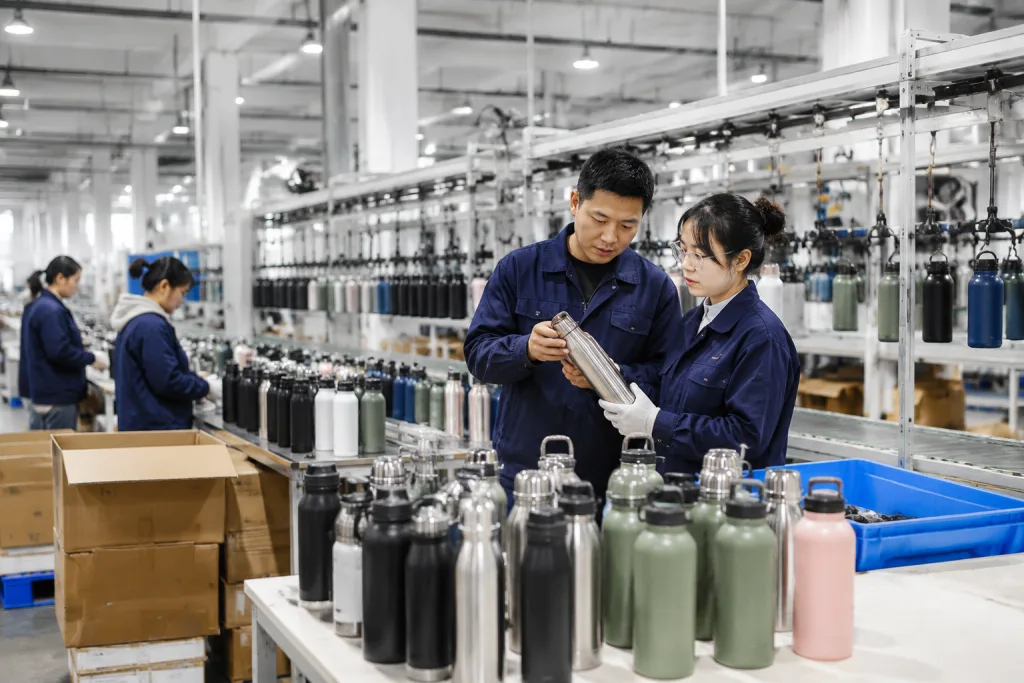
A stainless steel flask customizable for retail, corporate gifting, outdoor promotions, or distributor programs looks simple until you price it. Capacity, steel grade, lid design, coating, logo method, carton packing, and test requirements all move the unit cost. A USD 2.80 flask and a USD 5.20 flask may look close in a photo, but they are different builds on the line.
If you source custom drinkware from China, the cheapest quote is usually the wrong one to chase. We run this check with buyers before sampling: what is the steel grade, what is the MOQ, and where does the logo sit? QC pulled the sample last week and found a 1.2 mm wall on one version and 0.8 mm on another; the buyer flagged the weight difference right away. From our Hangzhou, Zhejiang team, we map the trade-offs before we open a mold, print a logo, or confirm FOB Ningbo.
Start With Product Positioning
Before you ask a canteen supplier for a price, decide where the flask sits in your range. A trade-show giveaway, a retail outdoor flask, and a specialty-store growler need different drawings, caps, packing, and QC points. We see this go sideways when a buyer sends one RFQ and asks 6 factories for “same item.” The quotes look cheap, then QC pulls the sample and finds a thin gasket, weak coating adhesion, or a carton that fails a 76 cm drop test.
For low-cost promotional use, buyers usually choose single-wall stainless steel flasks or basic vacuum flasks with one-color silkscreen. We run these at 1,000 pcs per logo as a normal MOQ, often with 2 or 3 stock colors to keep the line moving. Good enough. The user carries it for light office or gym use, and the logo exposure matters more than a premium hand feel. On the factory floor, the key check is simple: logo position within 1.5 mm and no pinholes after the silkscreen oven.
For retail and distributor drinkware programs, the spec needs more discipline: 304 stainless steel inner wall, powder coating with stable adhesion, leak-resistant cap, individual kraft box, barcode label, and carton drop-test control with a recorded result. A canteen distributor in Europe or North America will ask for replenishment they can trust, not only a first order at a sharp price. We ship these with spare gaskets counted in the packing area, because one missing silicone ring can turn into 200 customer-service emails.
For outdoor or premium gift channels, small parts matter. A wider mouth, thicker cap gasket, carry loop, matte coating, or optional handle adds USD 0.40-1.20 per pc, but the math works if it cuts returns. If you sell a customized growler or customizable canteen as reusable outdoor gear, customers expect it to survive backpacks, car trunks, and repeated washing. The buyer flagged this once after a 24-hour leak test: the cap passed upright, failed when laid on its side, and delayed approval by 12 days.
Do not brief a factory with only “500 ml stainless bottle, logo, best price.” Give the sales engineer the channel, target retail price, annual volume, compliance market, and expected use case.
Choose Steel, Wall, And Capacity
The material call is simple, but buyers still get caught here. For drink-contact surfaces, 304 stainless steel is the normal choice. Some canteen vendors quote 201 stainless steel to cut cost by a few cents per body, but the corrosion resistance is weaker, and it is a poor default for long-term drink contact, especially with lemon tea, sports drinks, or coffee. For higher-end briefs, 316 stainless steel works, but most B2B buyers will not earn back the extra cost unless the packaging and sales page explain it clearly. We’ve seen this go sideways: QC pulled one sample after a 24-hour salt-spray check, and the 201 inner wall already had rust spots near the weld line.
Common capacities for a stainless steel flask customizable project are 350 ml, 500 ml, 600 ml, 750 ml, and 1,000 ml. For custom growler and customizable growler orders, 1.2 L, 1.5 L, and 1.9 L are common. Capacity affects carton size and freight math, not just shelf appeal. A 750 ml flask looks stronger than 500 ml in a retail photo, but it can push the master carton into the next volumetric weight bracket. The math doesn’t always work. On one 750 ml order, the buyer flagged the freight jump after we packed 24 pcs per carton and the carton height passed 46 cm.
Wall thickness drives price fast. Many vacuum flasks use around 0.4-0.5 mm stainless steel wall thickness before forming, depending on the shape. Too thin saves cents, then dents show up at the shoulder after drop testing. Too thick raises material cost and can slow the line during forming. For distributor canteen programs, we run the real net weight sample by sample on a 0.1 g bench scale instead of trusting drawings only, because one PO typo on “0.45 mm” became “0.35 mm” and changed the whole hand feel.
Vacuum insulation matters as much as steel grade. A qualified double-wall flask should hold hot water at a useful temperature after 6-12 hours, depending on capacity and lid design. Define the test condition in writing: starting water temperature, room temperature, fill level, measurement time. Short list. No guessing. Without a written test method, “keeps hot for 12 hours” is a marketing sentence, not a factory standard. In our lab, we usually fill to 95%, start at 95°C water, record room temperature at 20-25°C, and check with a probe thermometer at the agreed hour.
Pick A Customization Method
Logo application is where about 3 out of 10 customized drinkware projects get messy. The right method depends on your artwork, order quantity, coating, and daily use. We’ve seen this go sideways: QC pulled the sample after a 3M tape test, and the logo edge lifted before the buyer even checked the carton marks.
Laser engraving is clean and durable, a good fit for corporate logos, outdoor brands, and premium stainless finishes. It usually costs USD 0.15-0.35 per pc for normal logo sizes. On powder-coated bottles, laser exposes the stainless base underneath. It is the wrong pick for complex gradients or large full-wrap designs; our line checks engraving depth with a 0.02 mm caliper setting before mass production.
Silkscreen printing works well for simple one- to three-color logos. It is efficient for 1,000 pcs and above, with setup charges often around USD 30-80 per color, depending on the artwork. Use it for canteen promotional orders when the logo area is controlled. Last month the buyer flagged a 1.5 mm logo shift on a curved flask, so we added a positioning jig before running the next 5,000 pcs.
UV printing and heat transfer suit multi-color artwork, lifestyle graphics, and full-wrap designs. They add cost, usually USD 0.25-0.80 per pc, and need tighter artwork approval. Check the PDF carefully. For North American retail, you may also need UPC or FNSKU label application if the product moves through ecommerce or marketplace warehousing; one PO came in with “FNSKU” typed as “FNSK,” and the warehouse rejected the label file.
Color customization also needs discipline. Powder coating gives a better hand feel than basic spray paint and fits reusable custom canteen products better. A custom Pantone color usually needs MOQ of 1,000-3,000 pcs per color. If you need 12 colors with 300 pcs each, the math doesn’t work: expect a higher unit price or choose stock colors from the coating rack, where we usually keep 18-24 regular shades ready for sampling.
Control Compliance Before Sampling
I’ll rewrite the section in place, keep the HTML exactly as-is, and tighten the language so it sounds like a factory-side sales engineer wrote it.Put compliance in the RFQ, not after the line is running. If you sell into the EU, ask the canteen manufacturer for LFGB, REACH, food-contact declarations, and pack rules. If you sell into the United States, check FDA food-contact expectations, California Proposition 65 risk if it applies, CPSIA only when the item is clearly for children, and ASTM checks for certain kids’ products.
A real canteen factory in Zhejiang or anywhere in China should hand over material declarations, past test reports from the same product family, and audit files like BSCI or ISO 9001 if they have them. We see buyers rely on old reports, then the new order gets a different powder coat or lid and the test scope changes. That is the wrong shortcut. QC pulled a sample once with a dyed silicone ring, and the odor result moved right away.
For normal stainless steel flask customizable orders, we tell buyers to lock these points in writing: 304 stainless steel inner wall, BPA-free plastic parts where used, food-grade silicone gasket, no sharp burrs, no visible welding defects, leak test requirement, coating adhesion standard, and carton drop-test condition. If the flask is for children, add age grading and small-parts review. On the line, a 0.3 mm burr looks minor until a buyer flags it at packing.
AQL inspection should also go in the purchase order. Most B2B buyers run AQL 2.5 for major defects and 4.0 for minor defects. Critical defects, like leakage, sharp edges, strong odor, wrong material, or a dirty interior, need zero tolerance. We have seen this go sideways on a 20,000 pcs order because the PO typo changed the defect clause by one digit.
Compare Quotes Like An Engineer
When three canteen suppliers send quotes, do not line up the FOB numbers and call it a comparison. Ask what sits inside the price. A USD 3.10 quote may leave out the individual box, insert card, Pantone spray, logo setup, vacuum leak test, or the stronger export carton. A USD 3.45 quote may already cover those items. On the packing table, a 5-ply carton adds about USD 0.18 to 0.25 a set. We see buyers get burned when the proforma invoice lands. The cheap line is often the expensive one.
For a 500 ml vacuum flask from China, the spread is real. Basic stock color with one-color logo may sit around USD 2.60-3.40 FOB; once you move to better coating, a retail box, and laser logo, the range shifts to USD 3.50-4.80; premium cap structures or custom molds go higher. On our line, a 0.4 mm liner and a gift box are not the same job, and the cost gap shows up fast. The math does not work if you compare different caps or cartons and pretend it is one product. These are working ranges, not promises, because steel price, exchange rate, and order volume move.
Payment terms change your risk. Many factories request 30% deposit and 70% balance before shipment. For repeat distributor drinkware programs, some suppliers will tighten or relax terms after 2 or 3 clean orders. If you are a new buyer, spend your negotiation energy on clear specifications, inspection rights, and shipment timing before chasing another USD 0.03 discount. That is the wrong fight. QC pulled the sample at AQL 2.5 on one job and found the cap color was 1 shade off, so the buyer flagged the PO and the ship date slipped a week.
At BottleForge Industrial in Hangzhou, Zhejiang, our normal stainless steel drinkware line capacity is about 450,000 units per month across flasks, tumblers, and bottles, with standard bulk lead time of 35-50 days after sample approval. For new custom molds or complex retail packaging, add 15-25 days. We run two shifts, and a mold swap can eat half a shift. A reliable canteen vendor tells you this early, not after your launch date is already at risk.
Plan Sampling And Approval Gates
I’ll rewrite the section in-place, keep the HTML exactly as-is, and tighten the sales-engineer tone while preserving the existing structure and technical specifics.A sample is not a display piece. It is the approval gate. For stainless steel flask customizable orders, split the flow into reference sample, artwork proof, pre-production sample, and mass production sign-off. Skip one gate, and you save 2 days now only to spend 20 days arguing later.
The reference sample checks shape, capacity, cap function, weight, and hand feel. We usually run it with stock color and no logo. The artwork proof checks logo size, placement, color, and print method. A digital mockup helps the buyer move fast, but it does not replace a physical logo pull when the order is 5,000 pcs or the finish is premium.
The pre-production sample needs to match the final spec: real coating, real logo, final lid material, final packaging, barcode or FNSKU if needed, and carton marks. For a canteen customizable for retail, this is the sample your buyer, sales team, and QC should all sign off. We keep one sealed sample at the factory and one in the sales office. Simple. Works.
Approval needs to be written. Use photos, measurements, color codes, and tolerances. For example: logo width 45 mm ±1 mm; color close to Pantone 3435C under D65 light; capacity 500 ml ±5%; no leakage after 24 hours inverted; coating cross-cut adhesion at agreed level. QC pulled a sample once and found the logo 2.3 mm off-center; the PO typo said “mat black” instead of “matte black.” That kind of slip is where the money goes.
If you buy from multiple canteen manufacturers, use the same sample approval form on every order. It makes quote comparison cleaner and cuts out the usual “our matte black is different” argument from the canteen supplier. We’ve seen that go sideways on a 3,000-piece flask run.
Decide Who Owns Reorders
I’ll keep the HTML structure intact and rewrite each paragraph in a more grounded factory-sales voice, with concrete reorder details and fewer AI-style phrases.The first PO gets the spotlight. Reorders decide profit. If you are a distributor buying for a canteen program, ask who holds the color master, spare lids, logo film, packaging plates, and the retained sample. A second order placed 6 months later should match the first lot, not look like it came off a different line.
For canteen distributors, the real issue is stock rhythm. If your sales plan calls for 5,000 pcs every quarter, we can reserve raw material and block production time. If you rush in with a 300 pcs replacement order after sellout, the math does not work; you pay more and still wait. On stainless steel drinkware, the line is busy with forming, welding, polishing, vacuum sealing, coating, printing, assembly, and inspection.
Ask who keeps the custom tooling, printing screens, Pantone card, and packaging files. For a custom growler or a special cap mold, the ownership line has to be on the invoice or contract. We have seen buyers pay a mold fee and assume that means ownership. Sometimes it does not. Put it in writing before the payment clears.
Reorder quality needs a gold sample and batch records. When we run customized canteen programs from China, QC pulled the sample and checked it against the approved unit, not somebody’s memory from 6 months ago. That matters for retail chain accounts; one shade shift on shelf, even 2 mm off in cap fit, and the buyer flagged it fast.
Send your flask brief for a practical factory quote
Share capacity, logo, target market, MOQ, and launch date. We will reply with options, trade-offs, and realistic FOB China pricing.
Frequently asked questions
What MOQ should I expect for a stainless steel flask customizable order?
For most custom canteen and stainless flask orders, a realistic MOQ is 1,000 pcs per logo and color when using existing molds. If you need a custom Pantone powder coating, many factories prefer 1,000-3,000 pcs per color because coating lines have setup loss. For a new mold or special lid, MOQ can rise to 3,000-5,000 pcs. Small trial orders are sometimes possible using stock colors and laser engraving, but the unit price may be 15-35% higher. If your annual volume is clear, share it during RFQ; a canteen supplier can often support a lower first order when repeat demand is credible.
How long does production take after I approve the sample?
For an existing stainless steel flask body with normal logo decoration, plan 35-50 days for mass production after pre-production sample approval and deposit. Add about 7-12 days for logo sampling and 3-7 days for courier delivery, depending on location. Custom color coating, full-wrap printing, complex retail packaging, or new tooling can add 15-25 days. Sea freight to North America or Europe may add another 25-45 days port to port. If you have a fixed retail launch, work backward from the delivery date and include inspection, customs, and warehouse receiving time.
Which logo method is best for a canteen promotional order?
For canteen promotional orders, one-color silkscreen is usually the most cost-effective if the artwork is simple and the order is at least 1,000 pcs. Laser engraving is better when you want a more durable, premium look and the logo does not need multiple colors. UV printing or heat transfer is better for full-color artwork, but it adds cost and requires stricter artwork approval. As a rough guide, laser may add USD 0.15-0.35 per pc, while larger full-color decoration can add USD 0.25-0.80 per pc. Always test adhesion on the final coating, not only on a blank sample.
Can one factory supply flasks, canteens, and growlers together?
Yes, but check whether the canteen manufacturer actually produces the related items or only trades them. Many stainless steel drinkware factories can handle flasks, sports bottles, travel tumblers, and some custom growler models using shared processes such as forming, welding, vacuuming, polishing, coating, and printing. However, large growlers may need different tooling and stronger caps. Ask for production photos, monthly capacity, sample weights, and inspection records. If you are building a distributor growler and flask range, using one qualified supplier can simplify color matching, packaging consistency, and shipment consolidation.
What quality checks should I require before shipment?
At minimum, require AQL inspection with 2.5 for major defects and 4.0 for minor defects, plus zero tolerance for leakage, sharp edges, wrong material, contamination, or unsafe odor. The inspection should check capacity, appearance, logo position, coating scratches, lid fit, barcode, carton marks, and packaging. For vacuum flasks, include insulation testing by batch sample and leakage testing, such as inverted standing for 24 hours or pressure-based testing at the factory. For EU sales, confirm REACH or LFGB-related documents where applicable. For US sales, review FDA food-contact expectations and any state-specific labeling risks before shipment.