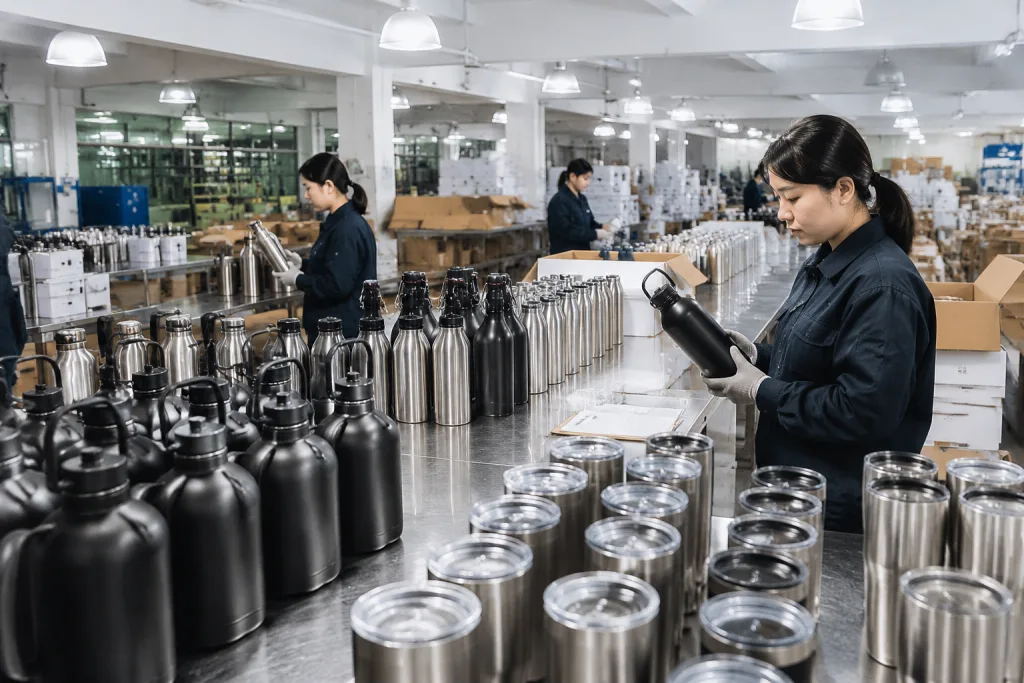
Key Takeaways
- Standard MOQ for custom stainless steel flask bulk projects is usually 1,000-3,000 units per SKU
- 304 stainless steel is the baseline for food-contact flasks, while 316 is reserved for premium corrosion resistance
- Laser engraving suits 500-1,000 unit logo runs; powder coating normally needs 2,000+ units for stable color cost
- AQL 2.5/4.0 inspection and 72-hour leak testing sampling should be written into the PO
Buying stainless steel flask bulk looks simple until the RFQs land with five steel grades, three lid builds, loose capacity claims, and FOB quotes that are not even for the same part. A 500 ml alcohol flask, a 1 L bulk canteen, and a 64 oz beer growler bulk order all sit under drinkware bulk, but they do not run on the same tooling, weld control, pressure test, or carton spec. We’ve seen a buyer flag a PO because “350 ml” turned up as “355 ml” on the drawing. That typo cost a week.
From our Zhejiang line, the same mistake shows up every month: buyers ask for the best wholesale drink bottle without nailing the use case. That is the wrong question to ask. QC pulled a sample last week and the lid torque failed at 1.8 N·m, so the cheap sample became an expensive rework. Compare the formats first, then lock the drawing, finish, MOQ, inspection level, and master carton before deposit.
Start With The Actual Use Case
I’ll rewrite just this section, keep the HTML structure intact, and make the prose sound like a factory-side sales engineer wrote it.The term stainless steel flask bulk covers too many products to quote cleanly. If you send one RFQ saying you need wholesale drinkware, a factory may quote the cheapest single-wall bottle because it looks close enough. We’ve seen a buyer send “camp bottle” on the PO, then tell us later it was for spirits gifting. Too late. The quote is already off.
Use case decides the body shape, insulation, lid seal, steel thickness, finishing process, and carton drop-test requirement. A slim alcohol flask bulk order for a spirits promo is usually single-wall, pocket-sized, and logo-led. A bulk canteen for outdoor retail needs dent resistance, a stronger cap tether, and often a 52 mm mouth for easier cleaning. A bulk growler or beer growler wholesale job needs tighter gasket control because beer buyers notice carbonation loss fast. Beer tumbler bulk is a different animal: rim polish, inner wall smoothness, and lid fit decide the drinking feel.
For a procurement manager, the first filter is not price. It is failure mode. What breaks in the field? Leaking in a backpack, metallic odor, scratched coating, weak weld, underfilled capacity, lid cracking, or a barcode carton that misses the spec all cost more than a USD 0.20 saving. QC pulled a sample with a 0.8 mm lid gap last week, and that is the kind of miss that turns into a claim.
Ask suppliers to quote by use case first, not by catalogue photo. A catalogue image does not show wall thickness, vacuum retention, or gasket material.
At BottleForge Industrial in Hangzhou, Zhejiang, we run custom stainless jobs in 48 hours when the buyer gives target capacity, lid type, finish, logo process, packaging method, test requirement, and destination port. Without those details, you get a number, not a sourcing decision. The math doesn’t work any other way.
Head-To-Head Spec Comparison
I’ll rewrite the section in place, keep the HTML exactly as-is, and tighten the sales-engineer voice with concrete factory details and cleaner price logic.Here is the comparison table we use on the line when brand owners ask us to choose between canteen bulk, growler wholesale, beer tumbler wholesale, and alcohol flask wholesale bulk. The figures are typical China FOB ranges for 2025 production, not a quote for every drawing. Steel price swings, coating pass rate, and lid structure can move cost by 5-12%.
| Format | Typical capacity | Construction | FOB China range | Best fit |
|---|---|---|---|---|
| Alcohol flask in bulk | 6-8 oz | Single-wall 304, 0.4-0.5 mm | USD 1.20-2.40 | Gifting, spirits brands, events |
| Wholesale canteen | 750 ml-1.2 L | Single or double-wall 304, 0.5-0.7 mm | USD 2.80-6.50 | Outdoor retail, military-style merch |
| Beer growler in bulk | 32-64 oz | Vacuum insulated 304, pressure-capable lid | USD 7.50-15.80 | Breweries, taprooms, outdoor beverage |
| Beer tumbler in bulk | 12-20 oz | Double-wall vacuum 304, press lid | USD 3.20-7.20 | Promotions, retail shelves, drink service |
Alcohol flask wholesale is the lowest-cost line. Less steel. No vacuum layer. Simpler carton pack. By contrast, beer growler wholesale is the one QC watches hardest, because the lid has to hold seal after repeated opening and closing. We had a buyer flag a 2% leak rate on a 64 oz growler lot; the factory had cleared visual inspection, but that number still kills a distributor program.
Do not throw all these formats into one price target. That math does not work. A USD 4.00 target is fine for a powder-coated 20 oz tumbler, and wrong for a compliant 64 oz vacuum growler. We run a separate spec sheet for each SKU before we talk money, and that usually saves a full round of back-and-forth. One PO typo on a 0.5 mm wall spec can change the whole quote.
Materials And Wall Thickness Matter
I’ll keep the HTML structure intact and rewrite each paragraph to sound like a factory-side sales engineer, with concrete numbers and fewer AI-style fillers.For stainless steel flask bulk, 304 stainless steel is the standard food-contact grade for Europe and North America. We run 304 on the line because it gives solid corrosion resistance, clean welds, and easy sourcing in China. 201 stainless steel will show up with a lower quote. That is the wrong question to ask if you are building branded drinkware bulk. 201 has less nickel and weaker corrosion resistance, and the buyer flags trouble fast when the end user pours in acidic drinks or cleans it badly.
Wall thickness needs a drawing callout, not a guess. A small alcohol flask wholesale order often starts at 0.4-0.5 mm sheet. A canteen wholesale item usually sits around 0.5-0.7 mm, depending on body diameter and whether it is single-wall or vacuum insulated. A 64 oz bulk growler may run 0.6 mm outer and 0.5 mm inner walls, but the base ring and shoulder forming matter just as much as gauge. We’ve seen 0.4 mm steel pass sample approval and still dent after 12 kg carton compression in transit.
For vacuum insulation, ask for the numbers in writing. Fill to rated capacity with 95°C water, test after 6 hours at 20°C room temperature, and record the result. A decent vacuum bottle may stay above 60°C after 6 hours, depending on volume and lid design. A beer tumbler wholesale bulk item does not need thermos-grade retention, but it should hold cold drinks steady and keep the outer wall dry. QC pulled the sample on one run because the condensation line showed up at the shoulder after 4 hours.
Compliance belongs in the material discussion, not the last email. For EU programs, ask for LFGB or the right food-contact migration test, plus REACH for coatings where it applies. For US orders, check whether the material and coating can support FDA food-contact documentation, and if kids may use it, whether ASTM or CPSIA applies. A factory in Zhejiang can arrange third-party testing, but plan 7-10 working days and USD 180-600 per test set, depending on scope. We’ve seen a PO typo on the coating name blow up the lab sample booking by 2 days, so spell it out before the line starts.
Logo, Finish, And Shelf Appeal
I’ll rewrite the section in-place, keep the HTML untouched, and tighten the sales-engineer voice with more concrete sourcing details.Decoration is where a lot of wholesale drinkware margin disappears. The logo method has to fit order size, retail target, and the actual surface. Laser engraving is clean, durable, and fast on stainless steel, especially at 500-3,000 units. We run it often for alcohol flask bulk, wholesale canteen programs, and premium beer tumbler bulk where the buyer wants a mark that does not rub off. The tradeoff is simple: no full-color logo, only tone-on-metal or tone-on-coating.
Silkscreen printing works for one- or two-color logos on smooth powder coating, but the cure has to hold. We’ve had buyers flag a 0.8 mm artwork shift on a curved body when the print panel was too wide. Heat transfer and water transfer can carry larger graphics, yet the reject pile grows fast on deep curves. UV printing gives bright color and lower setup cost for small runs, but you still need abrasion testing on the line, not just a pretty proof.
Finish choice changes both unit price and defect rate. Brushed stainless hides handling marks better; mirror polish shows fingerprints and scratch lines fast. Powder coating lifts shelf appeal, but pretreatment, oven temperature, and color tolerance all need control. Pantone on powder is not the same as Pantone on paper, and the math does not work if the buyer expects zero Delta E drift. We usually approve one golden sample and set a practical production window instead of promising perfect color under every light.
Packaging sells the item before the customer twists the cap. A plain white box is fine for distributor canteen bulk orders. Retail beer growler wholesale usually needs a color box, instruction insert, barcode, and an anti-scratch polybag; we’ve seen a PO typo on the barcode number hold a shipment for 12 days. Amazon-style fulfillment adds FNSKU labeling, carton weight limits, and drop-test rules. These items can add USD 0.20-0.90 per unit, so price them before you compare FOB offers.
MOQ, Pricing, And Lead Time
I’ll rewrite the section in-place, keep the HTML tags intact, and make the copy sound like a factory sales engineer wrote it.Our usual MOQ for stainless steel flask bulk is 1,000 units on existing molds with a simple laser logo, 2,000 units for custom powder coating, and 3,000-5,000 units for new lid colors, special packaging, or private tooling. We can sometimes mix cartons across SKUs in a drinkware wholesale program, but each SKU still needs enough volume to keep the line moving. A PO with five tiny variants does not make the cost drop. The math does not work.
A realistic Zhejiang, China schedule looks like this: 3-7 days for a stock sample or 10-15 days for a custom sample, 25-40 days for mass production after deposit and sample approval, 3-5 days for final inspection and booking, then ocean freight based on destination. We had one buyer flag a launch date after the sample was already signed off, and that extra 12 days vs 18 days turned into a rush fee. Peak season before Q4 can add 10-20 days. If your retail date is fixed, send the RFQ at least 90 days before the warehouse need date.
BottleForge Industrial coordinates about 450,000 stainless drinkware units per month across bottle, tumbler, canteen, and growler lines. That does not mean every order ships tomorrow. Vacuum growlers need more leak and insulation checks than simple alcohol flask wholesale bulk, and a powder-coated beer tumbler order needs curing time plus scratch control on the packing table. QC pulled the sample on a 1.5 mm lid gap before it left the line, so we do not guess on those details. Custom cartons also need print proofing and, sometimes, retailer sign-off.
Price talks should split real cost drivers from noise. Steel grade, wall thickness, lid design, coating, logo process, packaging, testing, and Incoterm all move the number. Payment terms, exchange rate, and raw material timing matter too. For most first orders, FOB Ningbo or FOB Shanghai is cleaner than EXW because export handling stays visible. If you need DDP, ask for a separate logistics quote; do not hide freight inside unit price. We have seen that go sideways on a 40HQ more than once.
Quality Controls Before Shipment
I’ll rewrite the four paragraphs in-place, keep the HTML tags untouched, and tighten the language so it sounds like a real factory-side QC handoff.Quality control for stainless steel flask bulk belongs in the purchase order, not in a chat after the first defect shows up. We run the line against a simple gate: material verification with a thickness gauge, capacity check, visual inspection, coating adhesion, logo placement, lid fit, leak test, carton drop check, and barcode scan when the buyer asks for retail labels. For normal wholesale drinkware, AQL 2.5 for major defects and AQL 4.0 for minor defects is common. Critical defects get zero tolerance, no debate.
Leak testing changes by product. Alcohol flasks get filled and inverted for a set time, often 30-60 minutes in sampling; we had one PO where the buyer missed the word “minutes” and wrote “hours,” and QC flagged it before the first run. Canteens get shaken and inverted. Beer growler bulk needs a harder lid check because carbonation and truck vibration expose weak gaskets fast. For vacuum insulated growlers and tumblers, test finished goods, not only pre-production samples. That’s the wrong place to save time.
Ask for photos and videos, but do not treat them as final inspection. A third-party inspection in China usually costs USD 200-350 per man-day, and it pays for first orders, new suppliers, or retail launches; we’ve seen buyers skip it and then eat a 12-day delay because the carton print was off by 3 mm. If you are buying beer growler wholesale bulk for a brewery chain, inspect harder than you would for a one-day event giveaway. The math does not work the same. Field failure hurts in different ways.
Documentation matters too. Your shipment file should include commercial invoice, packing list, bill of lading, certificate of origin if needed, test reports, inspection report, and carton marks. For EU importers, keep food-contact declarations in one folder. For North American distributors, keep item numbers, UPCs, and FNSKUs matched from the production file to the carton label; we once saw a PO typo swap one digit on an FNSKU, and the buyer held the whole carton at the warehouse gate. Small admin errors stop a shipment just as fast as a bad lid.
Choosing The Right Format
I’ll keep the HTML untouched and rewrite only the prose, tightening the sales tone and adding a few concrete factory-floor details per paragraph.If your program is a spirits gift set, go with alcohol flask wholesale or alcohol flask in bulk: clean logo, a screw cap that does not wobble, and a gift box that holds shape in carton drop tests. We had a buyer flag a 0.3 mm lid gap last month, and that tiny miss killed the premium feel. Skip vacuum insulation here. If your customer is an outdoor retailer, choose wholesale canteen or canteen bulk with thicker wall stock, a wide mouth, and a cap that survives a 1.2 m drop. If the buyer serves breweries, use beer growler wholesale with a gasket we have already run through real fill-and-shake checks, not just a nice powder coat. For events, corporate gifting, or retail beverage accessories, beer tumbler wholesale usually gives better value on shelf. This is the wrong question to ask if you start from “what is cheapest” instead of “what format sells.”
The best wholesale drink bottle is the one that fits the channel. Distributors watch carton efficiency and repeat orders. Brand owners care about shelf appeal and logo placement within 2 mm. Procurement managers watch landed cost, risk, and whether we can repeat the same spec six months later. On the line, those goals do not blend neatly. A PO typo on lid color can turn into a full rework if nobody catches it early.
For a first order from China, keep the SKU count tight. One body, one lid, two colors, one logo process. That is easier to run than six colors and three packaging styles. After sell-through proves the range, move into growler bulk, beer tumbler bulk, or premium canteen wholesale. A disciplined first PO gives you real defect data, real freight cost, and real customer feedback before you pay for new tooling or promise a retailer 20,000 units. QC pulled the sample, measured the neck at 28 mm, and the math works better when the spec is simple.
A good supplier should push back when your target spec and target price do not match. That is not attitude; it protects the launch. We have seen this go sideways when a buyer wants a brushed flask, laser logo, and gift box at a rock-bottom price. The cheapest quote only matters if the product passes inspection, clears import, and survives the first month in the customer’s bag.
Send us your flask spec and target landed cost
We will check the drawing, MOQ, finish, testing plan, and FOB China price before you commit to production.
Frequently asked questions
What is the normal MOQ for stainless steel flask bulk orders?
For existing molds, the practical MOQ is usually 1,000 units per SKU with laser engraving or one-color printing. Powder coating normally starts at 2,000 units because color changeover, pretreatment, and curing waste are real costs. Custom lids, private molds, or special retail packaging often require 3,000-5,000 units. If you want 300 units, you may need stock goods with limited logo options, and the unit price can be 20-40% higher. For mixed wholesale drinkware orders, ask whether the supplier can consolidate shipment, but do not assume different SKUs can share the same MOQ.
Which is better for bulk drinkware, 304 or 316 stainless steel?
For most stainless steel flask bulk and drinkware wholesale projects, 304 stainless steel is the right baseline. It is food-contact safe when properly sourced, widely available in China, and cost-effective. 316 stainless steel has better corrosion resistance because of molybdenum content, but it usually adds 15-30% to stainless material cost and is rarely needed for standard water, beer, or spirits use. Consider 316 only for a premium line, marine-positioned canteen, or product exposed to salty environments. Avoid switching to 201 just to cut cost unless your compliance team accepts the corrosion and brand risk.
How long does production take for beer growler wholesale bulk?
A beer growler wholesale bulk order usually needs 35-50 days after deposit and approved sample, assuming existing tooling. The body forming, vacuum process, powder coating, lid assembly, leak testing, and packaging all take time. Custom color boxes can add 7-12 days if artwork approval is slow. If you need third-party food-contact testing, add another 7-10 working days. Ocean freight to Europe or North America is separate and can add 25-45 days port to port. For a seasonal brewery launch, start sourcing at least 90 days before your required warehouse date.
Can I order alcohol flask wholesale with custom packaging?
Yes, alcohol flask wholesale orders often use custom packaging because the product is popular for gifting, spirits promotions, and event merchandise. Common options include white box, kraft box, color retail box, EVA insert, window box, or multi-piece gift set with funnel. A simple color box may add USD 0.18-0.45 per unit, while rigid gift packaging can add more than USD 1.00 depending on material and print. For alcohol flask wholesale bulk, confirm barcode placement, carton quantity, and warning text before mass production. Packaging artwork should be approved with a printed proof, not only a PDF.
What inspection standard should I use for wholesale drinkware?
For wholesale drinkware, AQL 2.5 for major defects and AQL 4.0 for minor defects is a common starting point. Critical defects, such as sharp edges, unsafe contamination, wrong material, or serious leakage, should be zero acceptance. Your checklist should include capacity, weight, wall finish, coating adhesion, logo position, lid fit, leak performance, insulation sampling, carton marks, and barcode scan. For first production in China, use a third-party pre-shipment inspection even if the factory sends good photos. The cost is usually USD 200-350 per man-day, which is small compared with rejecting goods after arrival.