Key Takeaways
- Ask for MOQ by decoration method: laser can start at 500 pcs, powder coating often needs 1,000-3,000 pcs
- A serious supplier should state steel grade, wall thickness, AQL level, and lead time before sampling
- FOB Ningbo or Shanghai pricing must separate product, packaging, decoration, mold, and inland freight costs
- For retail and FBA, confirm carton drop test, FNSKU placement, and barcode scanability before mass packing
Choosing a stainless steel drinkware supplier is not hard because China lacks canteen factories. The hard part is finding the one that still holds the agreed diameter, powder coat gloss, vacuum result, carton mark, and ship date after you approve the sample. We have seen the math go sideways on a USD 0.18 cheaper quote when QC pulled 32 pcs from the line and found leaking lids, weak coating at the cup lip, and EAN barcodes printed 6 mm too far from the carton corner.
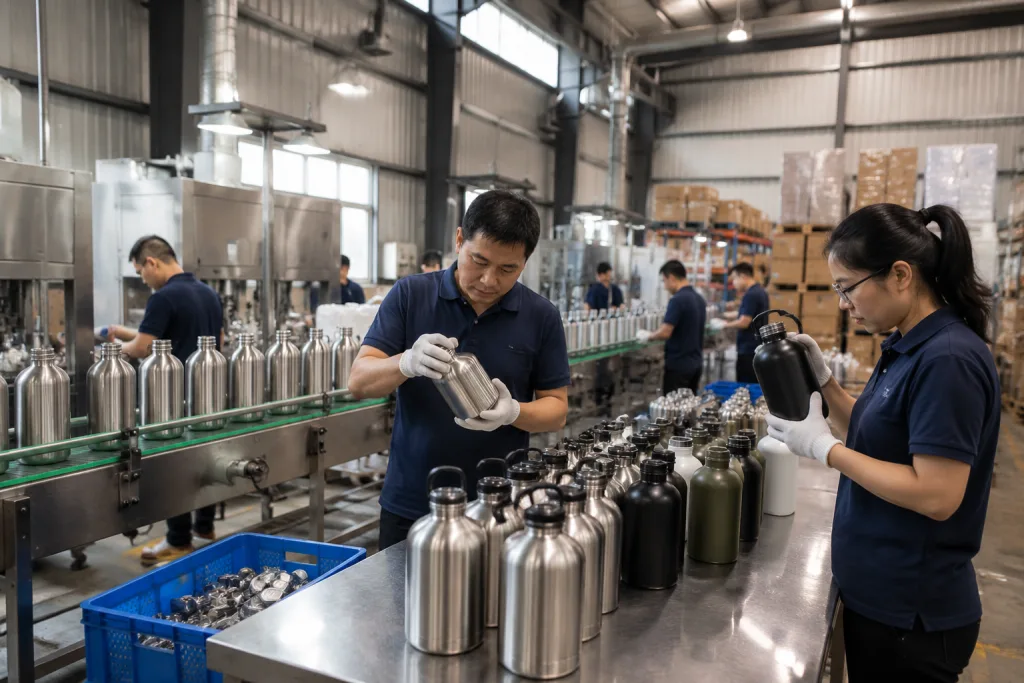
We manufacture in Zhejiang, near Hangzhou, and we ship custom canteen, travel tumbler, bottle, and growler programs for B2B retail, promotion, and distributor orders. This checklist is the same one we use with buyers comparing canteen manufacturers and canteen suppliers before they burn 30 days on loose quotations. MOQ, logo method, lid fit, packing test, and delivery window need to be checked early; last month one PO even had “matte balck” written on it, and the buyer flagged the color only after the pre-production sample was already sprayed.
Start with the supplier type
Procurement managers ask us this all the time: “Should I buy from a trading company, a canteen vendor, or the actual canteen manufacturer?” All three can work. The risk is not the same. For a basic promo canteen, one-color logo, and a 2,000 pcs run, a capable exporter can usually push the order through. If the project has a new lid, private mold, retail box, REACH documents, and repeat shipments every 60 days, buying through a middle layer is the wrong question to ask. We have seen this go sideways when a buyer approved a lid drawing at 58 mm, but the PO typo said 56 mm and nobody on the trading side caught it before tooling.
A real factory should answer technical questions without waiting two days for “engineer feedback.” Ask about 304 versus 316 stainless steel, vacuum welding method, copper lining, lid gasket material, powder coating thickness, and carton compression. Push for numbers: coating at 60-80 μm, gasket hardness, carton drop-test height, inner wall thickness. If the sales contact only says “high quality, best price,” you are not talking to the right person for customized drinkware. QC pulled the sample, not the brochure. On our line, a weak vacuum weld shows up fast in the hot-water test tank.
At BottleForge Industrial in Zhejiang, China, our normal production capacity is about 450,000 stainless steel units per month across bottles for retail shelves, tumblers for coffee chains, canteens for outdoor programs, and growlers for beer brands. Standard MOQ is 1,000 pcs per SKU for powder-coated custom drinkware, 500 pcs for laser logo on existing colors, and 3,000 pcs when you need a new PMS coating. Those numbers matter because real factories plan line time, spray booth slots, and packing labor, not just quotations. If a buyer asks for 300 pcs in six colors with custom cartons, the math doesn’t work.
What should the quotation include?
I’ll keep the tags intact and rewrite the prose to sound like a real factory salesperson, with concrete quote items and a few floor-level details.A quotation for a custom canteen or custom growler should never be just one FOB number with no breakdown. Ask for product cost, logo cost, packaging cost, mold or tooling cost, sample fee, inland freight, and export carton details. We had a buyer flag a PO once because the invoice said “FOB China” with no port, and the math did not work. If you are buying FOB Ningbo from Zhejiang or FOB Shanghai from another China factory, the port name should be printed on the proforma invoice.
A usable quote should show the stainless steel grade, capacity, dimensions, net weight, gross weight, carton size, pieces per carton, and estimated CBM. For example, a 750 ml single-wall canteen may use 0.5 mm 304 stainless steel and pack 24 pcs per export carton, while a 1.0 L vacuum canteen may use 0.4 mm inner wall and 0.5 mm outer wall with 12 pcs per carton. QC pulled the sample on our caliper and checked the wall thickness to 0.02 mm; that kind of detail changes both durability and ocean freight.
For canteen customizable programs, decoration changes the quote fast. Laser engraving is clean and stable, but it is not full color. Silkscreen works for simple logos, usually 1-3 colors. Heat transfer and UV printing give stronger visual impact, but the surface prep is stricter and the reject rate goes up if the art file is sloppy. Powder coating adds cost, usually USD 0.35-0.90 per unit depending on size and finish. A serious canteen supplier should spell out those trade-offs before you pay for samples.
Checklist before approving samples
I’ll rewrite the section in-place, keep the HTML exactly as-is, and make the prose sound like a factory-side sales engineer wrote it.The golden sample is where buyers get too polite. Do not approve it because the logo looks fine under office light. Treat it like a mini line check. We run capacity, weight, color, lid fit, thread feel, gasket smell, weld marks, coating adhesion, and carton crush on the bench. One bad sample becomes a 5,000-piece headache for your canteen route, not for us on the floor in Hangzhou.
- Measure capacity: fill to the practical use line, not brim volume.
- Check weight: compare against the quotation, with ±5% tolerance if agreed.
- Test leakage: fill with water, invert for 30 minutes, then shake 20 times.
- Review coating: request cross-hatch adhesion testing, commonly based on ASTM D3359 method.
- Confirm logo position: record height from the base and alignment to the handle or seam.
- Confirm packaging: check retail box board gsm, insert type, polybag, warning label, and barcode.
For a customized canteen, do not approve a lid by appearance alone. Open and close it 50 times. QC pulled the sample apart once and found a silicone gasket that smelled off after the third cycle. Check whether the gasket is food-contact grade and whether replacement gaskets are in stock. For a customized growler, test handle strength and lid sealing with warm liquid pressure. For customizable drinkware sold in Europe, ask for LFGB or EU food-contact test options. For North America, FDA food-contact compliance and CA Prop 65 screening may still matter, depending on the channel. The buyer flagged a 2 mm logo shift once; the math did not work, and we remade the whole lot.
How to judge quality control
I’ll rewrite this section in place, keep the tags and structure intact, and tighten the language so it reads like a factory-side sales engineer wrote it.Quality control is not a certificate folder. BSCI, ISO 9001, and audit reports matter, but they do not replace line checks during mass production. When buyers compare canteen manufacturers, we tell them to ask how the factory checks incoming stainless steel, welding, polishing, vacuum performance, coating, assembly, and packing. Last month QC pulled one 18/8 sheet coil with a 0.12 mm thickness drift, and that kind of miss shows up later if nobody catches it at the door. You want a supplier that gives the same checkpoint list every time.
For vacuum stainless drinkware, insulation testing is non-negotiable. Our standard bench test uses 95°C water, a sealed lid, and a temperature check after 6 or 12 hours. The pass mark depends on body size and lid structure, so the supplier should lock that down before production starts. For single-wall canteen custom orders, the real checks are weld integrity, mouth smoothness, body dents, and coating adhesion. The buyer flagged a PO typo once—“double wall” on a single-wall item—and the line had to stop while we rechecked the spec sheet.
For pre-shipment inspection, many B2B buyers use AQL General Inspection Level II. A common setting is AQL 2.5 for major defects and 4.0 for minor defects, with critical defects at 0. Critical defects include leakage, sharp edges, wrong material, unsafe odor, or missing legally required labels. Major defects include poor logo registration, obvious dents, lid mismatch, or barcode failure. Minor defects include small cosmetic marks within an agreed viewing distance. We ship thousands of units this way, and the math does not work if the factory tries to call a leakage issue “acceptable.”
Do not let a canteen factory define quality only after defects appear. Put the defect list, AQL level, and inspection timing into the purchase order.
MOQ, lead time, and payment reality
I’ll rewrite the three paragraphs in a more dealer-side voice, keep the HTML exactly as-is, and make the MOQ/lead-time/payment details sound like factory reality.Buyers always ask why one canteen vendor says 300 pcs and another says 3,000 pcs. It is usually the process. If we run stock cups and you accept the existing color, laser engraving at 300-500 pcs is workable. If the buyer flagged a custom PMS powder coat, the coating line needs a full color change, and we usually land at 1,000-3,000 pcs to cover scrap. New body shape or lid mold? Then 5,000-10,000 pcs is the number that makes tooling pay back.
For standard custom drinkware, the timing is straightforward: 5-7 days for artwork proof, 7-12 days for the pre-production sample, and 25-40 days for mass production after deposit and sample approval. QC pulled the sample last week with a 0.3 mm print shift, so do not treat the proof as a formality. Peak season before Q4 retail can add 10-15 days. Ocean freight to Europe or North America adds its own delay, so approving samples in late September and expecting a relaxed November launch is the wrong math.
Normal payment terms from a China canteen supplier are 30% deposit and 70% balance before shipment. On repeat distributor programs, the terms can improve after 3 clean orders. We ship enough POs to know this: if a supplier promises very low MOQ, no deposit, free mold, 15-day production, and the lowest market price in the same email, something is off. One of those points may hold. All of them together usually means the order was not priced honestly.
Retail, promotion, and distributor needs
I’ll rewrite the prose in place, keep the HTML tags intact, and tune the copy to sound like a factory-side sales engineer with concrete buyer details.A canteen promo order and a retail growler order run on different control points. Promo buyers ask about ship date, logo placement, and landed cost down to the cent. Retail buyers check shelf look, barcode scan rate, pack damage, warranty claims, and color match from batch to batch. For Amazon and marketplace sellers, we also handle FNSKU labels, carton labels, suffocation warnings where needed, and carton weight that stays under warehouse limits.
If you are building a distributor drinkware line, keep the body shapes tight and the finish control tight too. A 500 ml bottle, 750 ml canteen, 1.2 L sports bottle, and 1.9 L growler can share lid colors, coating colors, and box style. On one run, QC pulled the sample because the cap color drifted by 2 Pantone steps; the buyer flagged it before we shipped. Fewer SKUs means fewer artwork mistakes and faster reorders for canteen distributors without rebuilding the supply chain every season.
Customizable growler and customizable canteen projects need spare parts on day one. Lids, straws, gaskets, handles, and gift boxes protect margin. Ask if spare lids can be split at 2-3% of total order quantity; that question saves headaches later. For corporate gift channels, we keep a standard white box or kraft box ready. For retail, a 350 gsm color box with clear material claims and scannable EAN or UPC works better. The wrong question is “Can you make the bottle?” The real question is whether the stainless steel drinkware supplier can keep small failures off your P&L.
Send your canteen brief for a factory quotation
Share capacity, logo method, target MOQ, packaging, and delivery market. We will return a practical FOB quote with sample timing.
Frequently asked questions
What MOQ should I expect from a stainless steel drinkware supplier?
For existing molds and existing colors, 500 pcs per SKU is sometimes workable for laser engraving. For powder-coated custom drinkware, 1,000 pcs is a more realistic starting point. If you need a new PMS color, many factories require 3,000 pcs because the coating line has setup loss and color change cost. New lid or body tooling often needs 5,000-10,000 pcs to make economic sense. If a supplier offers 100 pcs with full custom color, retail box, and low FOB price, ask whether the goods are actually stock, whether the color is approximate, and whether the sample will match mass production.
How do I know if a canteen manufacturer is a real factory?
Ask for factory address, business license name, audit reports, production photos, and a live video walkthrough showing welding, polishing, coating, assembly, and packing areas. A real canteen manufacturer should answer process questions quickly: steel grade, wall thickness, vacuum test method, coating adhesion test, and AQL standard. You can also ask for an invoice or packing list from a previous export order with customer details removed. In Zhejiang and other China drinkware regions, many exporters cooperate with factories, which is not automatically bad. The problem is when they pretend to control production but cannot explain defects, lead time, or material choices.
Which logo method is best for customized canteen orders?
Laser engraving is the safest for long-term use because it does not peel and works well on stainless steel and powder coating. It is best for one-color, premium-looking logos. Silkscreen is cheaper for simple artwork, usually 1-3 colors, but it can scratch if the coating and curing are weak. UV printing and heat transfer are better for full-color designs, gradients, or large decoration areas. For a 1,000 pcs customized canteen order, logo cost may range from about USD 0.10 for simple laser to USD 0.60 or more for larger full-color decoration. Always approve a physical pre-production sample, not only a digital mockup.
What certificates do European and North American buyers usually need?
For Europe, buyers commonly ask for LFGB or EU food-contact testing, REACH screening for coatings and components, and sometimes BSCI audit status for social compliance. For North America, FDA food-contact compliance, CA Prop 65 assessment, and ASTM-related physical tests may be requested depending on sales channel. Certificates should match the material and finish you are buying, not a different bottle from two years ago. If your order uses a new coating, new lid, new straw, or new gasket, ask whether testing needs to be updated. Budget roughly 7-12 working days for common lab tests, longer if multiple colors and components are included.
Should I buy FOB, EXW, or DDP for distributor drinkware?
FOB is usually the cleanest term for experienced B2B buyers because the supplier handles export clearance to the China port, and your freight forwarder controls the ocean or air shipment. EXW can look cheaper but pushes more local China handling and export risk to you. DDP is convenient for small orders, but you need to confirm duty, tax, insurance, and delivery responsibility in writing. For distributor drinkware with 3,000-20,000 pcs, FOB Ningbo or FOB Shanghai is often the best balance. Ask for carton dimensions, gross weight, and CBM before booking, because freight can change your landed cost by 8-20%.