Key Takeaways
- A serious stainless steel drinkware factory should quote MOQ, mold fee, sample lead time, mass lead time, and AQL level in writing
- For most custom drinkware orders, 1,000-3,000 pcs per SKU is a realistic starting MOQ
- 304 stainless steel is standard for inner walls; 316 is useful for acidic drinks or premium retail positioning
- Ask for leak testing, vacuum testing, coating adhesion testing, and carton drop testing before shipment
If you are comparing a stainless steel drinkware factory in China, the hard part is not finding a supplier. The hard part is telling which canteen maker can keep the finish steady, match the carton spec, pass inspection, and still load before your retail launch. A low unit price means little if the lid leaks on 2% of the lot, the logo rubs after one carton test, or the factory swaps steel grade without saying so. We have seen that go sideways on a 12-day schedule, then the buyer flags it after QC pulls the sample.
From our Hangzhou, Zhejiang office, we hear the same buyer questions every week: What MOQ is realistic? Is laser cleaner than silkscreen? Can a canteen supplier handle FBA labeling? How do you judge a custom growler sample? The answer is not marketing talk. You need drawings, tolerances, test reports, and a factory that gives straight numbers. On the line, we run 0.2 mm checks with calipers and a buyer typo on the PO can cost a full reprint.
What factory capability should you verify?
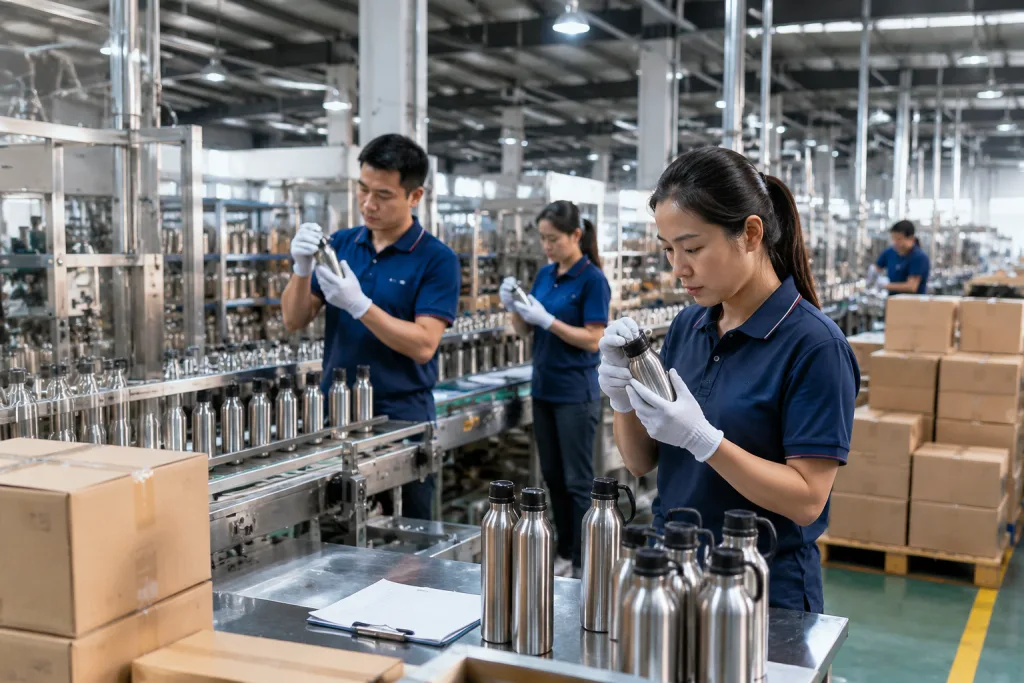
I’ll rewrite the section in place, keep the HTML exactly as-is, and tighten the prose so it sounds like a factory-side sales engineer.Start with capacity and process ownership. A stainless steel drinkware factory is not a trading office with polished renderings. Ask which steps stay in-house and which get pushed out: tube cutting, water expansion, welding, vacuum brazing, polishing, powder coating, lid injection, printing, packing, and final inspection. Outsourcing happens in China. Hidden outsourcing is where QC slips.
For a B2B buyer, the useful factory profile starts with monthly output, main sizes, audit status, and export markets. BottleForge Industrial works from Hangzhou, Zhejiang with partner lines that can support about 300,000-500,000 stainless units per month, depending on season and decoration mix. That matters because a 5,000 pcs canteen promo order and a 60,000 pcs distributor program pull different parts of the line. The math does not work the same.
Ask for photos or video from the current production floor, not just a catalog. Check whether the canteen factory has vacuum testing stations and whether each bottle gets tested or only sampled. We run 100% vacuum performance screening for insulated bottles when the spec calls for it. If a factory says it tests “randomly,” ask for the sampling plan and the reject rule. The buyer flagged it for a reason.
Your checklist should include: business license, export experience, product liability insurance options, BSCI or similar social audit if required, REACH/LFGB/FDA food-contact documentation, ISO-style quality procedures, and an AQL inspection record from a previous order. A reliable canteen vendor will not act like these are strange questions. QC pulled the sample, and a good factory can show the paper trail in 10 minutes, not 10 days.
Which materials are worth paying for?
I’ll rewrite the section in place, keep the HTML structure intact, and tighten the language so it reads like a buyer-facing factory note.Most custom drinkware problems start with material assumptions. Buyers say “stainless steel,” but we see different grades, wall thickness, coating systems, and lid plastics on the same PO. For vacuum drinkware, 304 stainless steel is the standard for the inner wall; the outer shell is often 201 or 304 depending on target price and market. If you ship into Europe or North America, don’t gamble on ultra-cheap 201 on the outside. We’ve seen corrosion complaints after dishwasher runs, coastal storage, and even salty fingerprints left on the shelf.
For a custom canteen, wall thickness usually lands around 0.4-0.6 mm before forming, though size and shoulder shape change the number. Thin stock saves a few cents, then QC starts seeing dent marks at the drop-test table. For a custom growler, especially 1.9 L or 64 oz, body strength matters more because the large sidewall dents fast. A heavier gauge and a stronger base make sense if your channel is outdoor, camping, or brewery retail. The math doesn’t work the other way.
Lids need the same scrutiny. Ask whether the plastic is PP, Tritan, or another resin, whether the gasket is food-grade silicone, and whether spare gaskets are available in the packing list. For canteen customizable programs, one lid mismatch can hold the whole SKU; we’ve had a buyer flag a 2 mm thread mismatch before shipment, and the line had to stop. If you need ASTM or CPSIA compliance for kids’ items, state that before sampling, not after the purchase order.
Do not accept vague material claims. Ask for a material declaration, a food-contact test report, and, on larger orders, the right to run third-party testing on production goods. A serious canteen supplier will build that into the quote and the lead time, not treat it like a surprise. We ship that way when the buyer is clear from day one.
How should customization be specified?
I’ll rewrite the section in-place, keep the HTML tags intact, and make the prose sound like a factory-side sales engineer wrote it.Custom drinkware looks simple until the logo file lands on a curved powder-coated body. That is where PO delays start. Send AI or PDF vector artwork, Pantone codes, logo size in millimeters, placement drawings, and pack-out needs before we quote. “Put the logo on the front” is not a spec; QC will flag that on the first check.
We run laser engraving, silkscreen printing, heat transfer, water transfer, UV printing, and full-body powder coating on the line. Laser engraving is clean and durable, and it works well for corporate custom drinkware, but it shows the base metal or underlayer color instead of a Pantone ink. Silkscreen is cost-friendly for one or two colors on flatter panels, though registration gets messy on a tapered body. Heat transfer fits larger graphics, but if the buyer wants easy cleaning, test abrasion and dishwasher wear first. The math does not work if you skip that test.
For canteen customized projects, lock down the decoration tolerance. We usually quote plus or minus 1-2 mm on logo position, but the fixture and body shape decide the real number. If the retail buyer will reject a 2-degree rotation, say it up front. For a customized growler with wraparound art, ask for a printed paper proof and a pre-production sample on the real coating; a digital mockup only has burned us before.
Packaging belongs in customization, not as an afterthought. A distributor canteen order may need UPC labels, multilingual manuals, master carton marks, and a pallet height cap. Amazon-style orders may call for FNSKU labels and carton drop testing. Put every item on the quotation sheet. A canteen manufacturer cannot price it right if the buyer adds packaging work after mass production starts.
What MOQ and pricing are realistic?
I’ll rewrite the HTML in place, keep the tag structure intact, and tune the copy to sound like a factory-side sales engineer. Then I’ll return only the rewritten HTML.MOQ shifts with body size, color, lid type, decoration, and packaging. On our line, a standard stainless bottle usually lands at 1,000 pcs per color or SKU. A special powder coat, private lid, or new mold pushes that to 3,000-5,000 pcs, sometimes more. We saw a buyer try to squeeze a new canteen shape into 800 pcs; the math did not work, and the tooling quote still came in at USD 800 to USD 5,000+, depending on cavity count and whether the lid was new too.
FOB China pricing moves with steel, exchange rate, and labor. A 500 ml single-wall promotional canteen often sits around USD 1.80-3.20 FOB for basic print or laser mark. A 20 oz vacuum bottle or travel tumbler usually runs USD 4.00-7.50 FOB, depending on coating, lid, and carton. A 64 oz custom growler can go from USD 8.00 to over USD 14.00 FOB once the gauge, handle, cap, and finish step up. QC pulled the sample wall at 0.4 mm last month, and that one detail changed the quote by a full dollar. These numbers are guardrails, not promises.
Price checks only mean something when the spec matches line by line. Ask every canteen supplier to quote the same sheet: steel grade, capacity, dimensions, unit weight, coating, logo method, packaging, test standard, MOQ, payment terms, sample cost, and lead time. If one canteen vendor is 18% cheaper, the buyer flagged it for a reason—check wall thickness, outer steel grade, coating layer, lid material, and carton strength before you call it a deal.
For payment, 30% deposit and 70% before shipment is common in China. We ship a lot on that term. For established distributor drinkware programs, staged payments or credit insurance can be discussed after 3 to 5 clean orders, once the paperwork and QC record are stable.
How do you control quality before shipping?
I’ll rewrite the HTML in place, keep the tags and structure unchanged, and tighten the language so it reads like a factory-side sales engineer wrote it.Quality control does not start with a warehouse photo. It starts with a signed sample and a control sheet. For custom drinkware, we approve a golden sample that matches the body, coating, logo, lid, gasket, packaging, and carton marks. Keep one at your office and one on our side. When the buyer flagged a logo shift on a PO, that reference sample saved the discussion in 5 minutes.
Use AQL inspection before shipment release. For drinkware, AQL 2.5 is common for major defects and 4.0 for minor defects, while retail programs may ask for tighter limits. Major defects are leakage, poor vacuum insulation, sharp edges, broken lids, wrong logo, heavy dents, and contamination. Minor defects are small coating specks, slight color shift, or light polish marks within the approved tolerance. QC pulled the sample at the line and checked a 1.5 mm logo offset before the cartons moved.
Tests need to match the claim. For vacuum items, check heat retention after 6 hours or 12 hours based on the spec sheet. For leakproof canteens, invert filled units for a set time, such as 30 minutes, and add shake testing if the lid is sold for sports or travel use. For coating, run cross-hatch adhesion testing, alcohol rub testing, and abrasion checks. For cartons, use a drop test such as ISTA-style handling or the buyer’s own requirement. We’ve seen this go sideways when a lid passes in still water but fails after one hard shake.
Inspection timing matters. If you wait until 100% of goods are packed, rework takes longer and costs more. For orders above 10,000 pcs, we run inline inspection at 20-30% production, then final random inspection at 100% packed and at least 80% cartons sealed. That is the right question to ask, because a late catch on a 0.3 mm coating defect turns into scrap, not savings. A disciplined canteen manufacturer accepts this because it protects both sides.
What should you ask before ordering?
I’ll rewrite the prose to sound like a factory-side sales engineer, keep the HTML structure intact, and tighten the buyer checklist with more concrete, buyer-facing detail.Ask questions that force a clean answer. “Can you make this?” is too soft. Ask for the confirmed capacity in ml and oz, the unit weight on the scale, the inner and outer steel grade, the MOQ per SKU, and the sample and mass production lead time after deposit and artwork sign-off. We run these checks on the line before we quote.
For a standard canteen promo order, sample lead time is usually 7-10 days when we use existing molds and a normal logo method like screen print or laser mark. Mass production is commonly 30-45 days after deposit, artwork approval, and packaging confirmation. Before Q4, powder coating and retail cartons can add 10-20 days. The math does not work if you promise a North American warehouse date without counting vessel cut-off, customs clearance, and inland trucking.
Your buyer checklist should include:
- Confirmed spec sheet with dimensions, capacity, steel grade, and unit weight in grams
- Signed sample or pre-production sample approval; QC pulled the sample against the PO
- FOB port, carton size, gross weight, and loading quantity per 20GP or 40HQ
- Compliance documents for your market, such as REACH, LFGB, FDA, or CPSIA where applicable
- AQL inspection standard and defect classification, usually AQL 2.5 unless you say otherwise
- Spare parts plan for lids, straws, gaskets, or handles
- Packaging files, barcode rules, FNSKU labels, and pallet requirements
The better stainless steel suppliers in Zhejiang and the rest of China are not the ones with the slickest catalog. They are the ones who answer straight, catch a bad assumption early, and put every detail into the proforma invoice before you send payment. We’ve seen this go sideways when a buyer skipped the carton spec and the freight bill jumped.
Send your drinkware spec before you request pricing
Share capacity, logo files, target MOQ, market, and packaging needs. We will return a practical FOB quote and production timeline.
Frequently asked questions
What MOQ should I expect from a stainless steel drinkware factory?
For existing molds, expect 1,000 pcs per SKU as a practical starting point for many stainless bottles, tumblers, and canteens. If you need a special powder color, custom lid, retail box, or canteen customized finish, 3,000 pcs is more realistic. New tooling can push MOQ to 5,000 pcs or higher because the factory must recover mold setup, fixture work, and production trial loss. Very low MOQs such as 100-300 pcs are possible for stock blanks with simple laser engraving, but the FOB unit price will be higher and packaging options will be limited. For distributor canteen programs, plan annual volume by SKU, not just the first purchase order.
How long does a custom drinkware order take from sample to shipment?
For an existing bottle shape with a standard logo, sample production usually takes 7-10 days after artwork approval. A pre-production sample with custom coating, print, or packaging may take 12-18 days. Mass production is commonly 30-45 days after deposit and sample approval. Add 5-7 days if third-party lab testing is required, and longer if the test fails and parts must be changed. Ocean freight to Europe or North America may add 25-45 days depending on port and season. If your launch date is fixed, do not treat a 45-day factory lead time as a 45-day delivered schedule.
Is laser engraving or printing better for a custom canteen?
Laser engraving is usually better for durability because it removes or marks the surface rather than adding ink. It works well for corporate gifts, outdoor drinkware, and distributor growler programs where long service life matters. The limitation is color: the result is normally stainless, dark gray, or an underlayer tone, not a Pantone match. Silkscreen or heat transfer is better when you need exact brand colors or larger artwork. For powder-coated canteens, ask for adhesion and rub testing before approval. A good approach is to laser engrave simple logos and use printing for retail graphics, but confirm the final method on a real sample.
What compliance documents should canteen distributors request?
For Europe, ask for REACH and LFGB food-contact testing where relevant. For the United States, FDA food-contact compliance is commonly requested, and CPSIA may apply for children’s drinkware. If you sell through larger retailers, they may also require social audit documents such as BSCI, quality procedures, and product liability insurance. Do not rely on a generic test report from a different bottle. Check model description, material, date, lab name, and whether the tested components match your order, including lid, gasket, straw, and coating. For orders above 5,000 pcs, budgeting for fresh third-party testing is usually cheaper than dealing with a rejected shipment.
Can one factory handle bottles, tumblers, canteens, and growlers?
Often yes, but not always with equal strength. Many canteen manufacturers can also produce travel tumblers, sports bottles, and custom growler items because the stainless forming and vacuum processes overlap. The risk is lids, handles, and large-capacity bodies. A 64 oz growler needs different tooling control than a 20 oz tumbler, and a straw tumbler lid has different leakage risks than a screw cap canteen. Ask for recent production photos, unit weights, test records, and samples in the exact category you plan to buy. A broad catalog is useful, but proven production history in your item type matters more.