Key Takeaways
- Typical MOQ for stainless steel drinkware custom is 500-1,000 pcs per SKU, with 35-45 days lead time after sample approval
- 18/8 stainless steel, 0.4-0.6 mm wall thickness, and vacuum insulation are the standard specs for export-grade drinkware
- A good supplier should quote FOB China, pass REACH or FDA-aligned requirements, and support AQL 2.5/4.0 inspections
- Printing adds about USD 0.10-0.60 per piece; laser engraving often costs more upfront but lasts longer than ink
If you are sourcing stainless steel drinkware custom for retail, corporate gifts, or distributor channels, the first mistake is usually the same: buyers ask for a logo before they define the product. That is backward. Define the grade, wall construction, lid system, decoration method, and carton spec before you talk price. On our line in Zhejiang, we can make an 18/8 canteen, a double-wall vacuum growler, or a one-color promo canteen, but the quote changes fast because the build changes. QC pulled the sample, and the buyer flagged a 1.2 mm wall spec on the PO that did not match the drawing.
The smart way to buy is practical. Start with your sales channel, your target retail price, and the compliance needed in Europe or North America. Then compare canteen factory options on MOQ, lead time, and QC consistency. A serious canteen manufacturer in Zhejiang should state material thickness, AQL inspection levels, and packaging in plain words. If they dodge those points, the math does not work. We’ve seen that go sideways on a 5,000-piece order when the carton spec was never locked.
What you should buy first
I’ll rewrite the section in place, keep the HTML exactly as-is, and tighten the wording so it sounds like an export sales engineer, not generic AI copy.Before you compare canteen suppliers, lock the use case first. A distributor order for retail shelves is not the same as a promotional run for trade shows, and neither one matches a customized growler for premium beer channels. Skip this step and you end up approving the wrong lid, the wrong finish, or a carton your warehouse rejects on day one.
Ask four things: who will use it, how often, what price point, and which market. For Europe, the paperwork usually gets tighter on materials and food-contact files. For North America, buyers push harder on lid fit, leak resistance, and private-label presentation. We run this every week on the line, and a good stainless steel drinkware custom brief starts with specs, not a logo file.
- Retail gift SKU: focus on shelf appeal and margin
- Corporate order: focus on branding area and lead time
- Distributor program: focus on stable reorders and carton efficiency
- Amazon-style listing: focus on FNSKU label space and drop-test packaging
Materials and construction
I’ll rewrite just the prose, keep the HTML structure intact, and make it sound like a real factory-side buyer note.Material choice is where a buyer stops paying for mistakes later. For most stainless steel drinkware custom jobs, 18/8 stainless steel is the default for both inner and outer walls. It holds up against corrosion and matches what most export buyers expect. If a canteen manufacturer pushes 201 stainless just to hit a lower price, ask for the reason in writing. We’ve seen that go sideways on finish and denting after 3 months in transit.
Wall thickness changes the feel on the line. A common spec is 0.4 mm to 0.6 mm for the body, with heavier gauge on larger custom canteen and custom growler formats. Double-wall vacuum construction adds cost, but it also raises the ticket value and keeps condensation off the outside. For a canteen customizable program, we ask for the steel grade, wall thickness, vacuum seam method, and whether the base is welded or press-fit. QC pulled a sample once with a 0.38 mm wall when the PO said 0.5 mm, and the buyer flagged it right away. That is basic due diligence.
“If the factory cannot state steel grade and thickness without hesitation, you should not approve the sample.”
In Zhejiang, the better factories answer fast because they run these specs every day. That is what you want from canteen manufacturers and canteen suppliers: a straight reply, not a sales pitch. If they need time to check the answer, the math does not work.
Branding methods that hold up
I’ll rewrite the section in-place, keep the HTML structure unchanged, and tighten the wording so it sounds like a factory-side sales engineer.Branding is where a lot of buyers either overpay or cut corners. Screen print is usually the lowest-cost choice for canteen promotional orders, often around USD 0.10-0.30 per color per piece depending on quantity and setup. Laser engraving gives a cleaner mark and holds up better, but it can add USD 0.20-0.60 per piece and usually slows sample approval by a day or two. UV print and heat transfer can look sharp on day one, yet they are not the best bet for outdoor drinkware that needs to stay legible after rough use.
If you need stainless steel drinkware custom for a premium distributor canteen program, test for abrasion first. We’ve seen logos fade after 40 dishwasher cycles, and the buyer flagged it on the next PO. That is the wrong place to save money. For a canteen customizable or customizable drinkware line, the decoration has to fit the channel. A custom canteen for corporate gifting usually works with one-location engraving on a 45 mm logo area. A customized canteen for retail may need two print zones, a PMS color match, and a neck print that stays centered on the line. Ask for an artwork proof with exact placement, not a flat mockup that hides bad spacing.
- Screen print: low cost, works well for simple logos
- Laser engraving: durable mark, clean premium finish
- Pad print: useful on curved caps and small print areas
- UV print: strong color detail, check abrasion resistance first
MOQ, price, and timing
I’ll keep the tags intact and rewrite the copy in a more grounded factory-sales voice, with tighter numbers and one shop-floor detail per paragraph.Buyers often ask price before they know the production setup. That is the wrong question to start with. A standard custom drinkware order with one logo and stock packaging often starts at 500 pcs per SKU. A custom growler with a special lid and colored powder coating can need 1,000 pcs or more. If you want mixed colors, custom cartons, and three SKUs in one order, the MOQ climbs fast. That is normal in China, because the line has to stop, clean up, and reset the spray rack.
For FOB China pricing, most stainless steel drinkware custom programs sit around USD 2.30 to USD 7.80 per piece, depending on size, wall structure, finish, and decoration. A single-wall canteen custom item usually prices below a vacuum-insulated tumbler or growler. Lead time is often 35-45 days after sample approval and deposit, but a new mold or a Chinese holiday can stretch that to 55 days. We ran one job with a 0.3 mm coating spec, and QC pulled three samples when the buyer flagged a color shift on the first carton.
If a canteen distributor needs fast replenishment, ask for the factory calendar, not just the quote. We ship by slot, not by wish. Real delivery control is a manufacturing question, and the math does not work if the line is already booked for 12 days.
Quality checks that matter
I’ll keep the HTML structure intact and rewrite the prose to sound like an export sales engineer, with concrete QC details and fewer AI-style fillers.A cheap quote with weak QC gets expensive fast. For export orders, ask the factory to lock the inspection points before production starts. We run incoming 304 stainless checks, in-process visual checks, vacuum leak testing, and final AQL inspection. AQL 2.5 is standard for major defects, and AQL 4.0 can apply to minor issues if that is what both sides signed off on. If the supplier cannot talk through that in plain terms, they are not ready for a real B2B order.
For stainless steel drinkware custom, the checks that matter are lid seal integrity, vacuum performance, coating adhesion, logo placement, and carton drop resistance. On one 750ml tumbler order, QC pulled the sample and found a 1.2 mm lid gap that would have turned into a leak complaint later. If you are buying a distributor growler or a custom canteen for outdoor use, test thermal retention in the field, not just on a lab sheet. We’ve seen that go sideways when the buyer trusted a nice test report and skipped a 12-hour heat hold. You also want the paperwork sorted early: REACH for Europe, FDA-aligned food-contact declarations for North America, and any state packaging or labeling rule. A supplier shipping to both markets should know this without guessing.
- Confirm material certificates before mass production
- Request leak tests on every batch
- Use AQL sampling for final QC
- Check master cartons for crush resistance and label accuracy
How to vet the factory
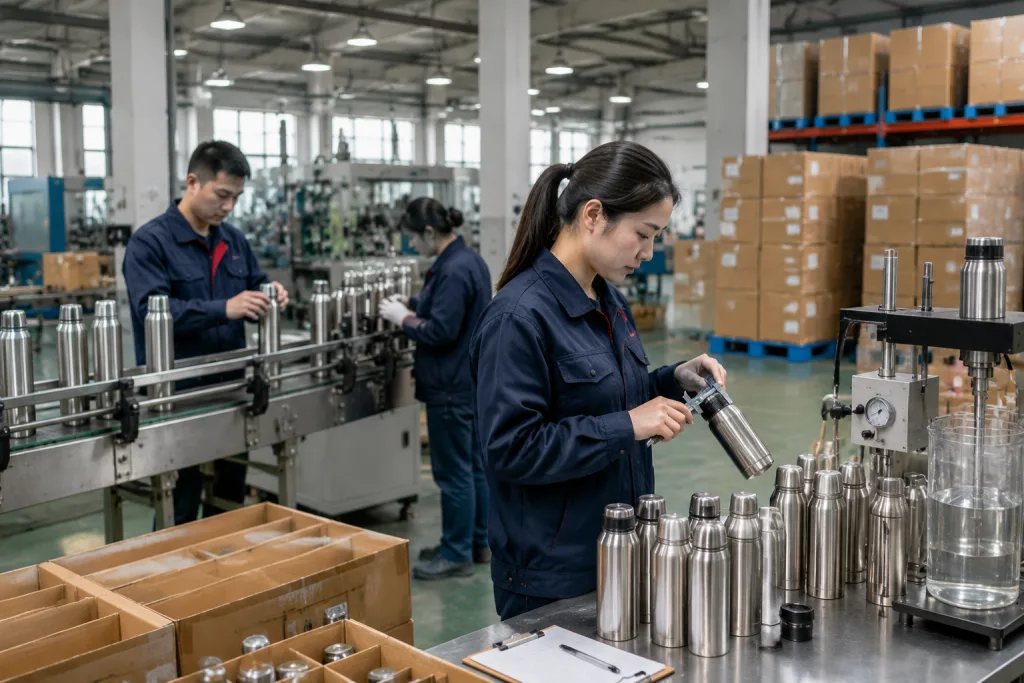
I’ll keep the tags intact and rewrite the prose to sound like an export sales engineer, with concrete factory details and fewer AI-style fillers.Not every canteen manufacturer is ready for export. Some handle domestic orders fine and then fall apart on documents, carton control, or repeat orders. When you vet canteen manufacturers and canteen vendors, ask for factory photos, the line layout, and their last 3 export markets. We want to see real tooling, powder coating lines, assembly stations, and a packing team. A real canteen factory in China should show more than a showroom and a sample shelf.
Look for discipline: sample lead time under 10 days, production lead time under 45 days, and a clean revision process. Ask if they support private label, barcode labels, and carton marks without the buyer chasing every detail. If you are building a canteen promotional line or a canteen customized retail range, reorder stability matters more than first-order price. We’ve seen the math go wrong fast when a supplier saves $0.08 and misses the second shipment color, especially after QC pulled a 500 ml sample and the Pantone match was off by 2 mm on the lid print.
Zhejiang has one of China’s strongest manufacturing clusters, so the sourcing behavior should look organized. If a factory in Zhejiang says it is export-ready, they should talk about BSCI, REACH, and buyer audit items straight away. A factory that hesitates on a 20-page audit pack or cannot show a recent AQL 2.5 report is not the one to trust with your order.
Procurement checklist before PO
I’ll rewrite the prose in place, keep the HTML structure intact, and make it sound like a buyer-side sales engineer wrote it.Use a checklist, not memory. That is how you avoid surprises after the PO is signed. For stainless steel drinkware custom, we put the key points into one approval file: product drawing, steel grade, capacity, finish, logo method, carton spec, test standard, and target ship date. I’ve seen a PO typo on “300 ml” versus “350 ml” turn into a 12-day delay. If you buy as a canteen distributor or distributor drinkware buyer, add assortment planning too, because one bad color split can throw off the whole program.
Here is the short version of what belongs in your approval pack:
- Material: 18/8 stainless steel, wall thickness, and finish code
- Capacity: exact ml or oz, with tolerance
- Decoration: print, engraving, or a mixed method
- Packaging: unit box, master carton, and drop-test requirement
- Compliance: REACH, FDA-aligned declaration, and any retailer-specific rule
- Commercials: MOQ, FOB price, deposit, and lead time
For a custom canteen or customizable canteen line, the better buyers ask for one spare sample from the first production lot. QC pulled the sample on one run and caught a logo shift of 1.5 mm before we shipped, which saved a messy claim later. That makes reorders easier after six months or more. This is not about finding a perfect factory. The math doesn’t work that way. It is about giving the line enough detail to repeat the same result.
Get a quote that matches your spec
Send your capacity, material, logo method, and target market. We’ll quote stainless steel drinkware custom from Zhejiang with clear MOQ, lead time, and QC terms.
Frequently asked questions
What is a realistic MOQ for stainless steel drinkware custom?
For most export programs, 500-1,000 pieces per SKU is realistic. A simple custom canteen with stock color and one-color print may start at 500 pcs, while a custom growler with special coating or special lid often needs 1,000 pcs or more. If you want multiple colors or custom packaging, the MOQ can rise again. A Zhejiang canteen factory will usually quote lower MOQ on standard molds and higher MOQ on customized tooling. Always ask whether the MOQ applies per color, per design, or per total order.
How much should I budget per piece?
For FOB China, many stainless steel drinkware custom items fall between USD 2.30 and USD 7.80 each, depending on size, construction, decoration, and packaging. Single-wall promotional items sit near the low end. Vacuum-insulated tumbler or premium customized growler models sit higher, especially with powder coating or laser engraving. If a quote looks far below that range, check whether it excludes print setup, test fees, inner boxes, or export cartons. Cheap quotes from a canteen supplier often become expensive after revisions.
How long does production take in China?
After sample approval and deposit, standard production usually takes 35-45 days. If the project needs new tooling, a special finish, or a busy season slot, add more time. Sample development may take 7-10 days for standard requests and longer for complex canteen customizable builds. A serious canteen manufacturer in Zhejiang should give you a production calendar, not just an optimistic promise. If your delivery date is fixed, build in at least 10 extra days for freight and customs buffers.
What compliance documents do I need for Europe or North America?
For Europe, ask for REACH-related material declarations and food-contact support documents. For North America, many buyers request FDA-aligned food-contact declarations, test reports, and carton labeling that matches retail or Amazon rules. If you are shipping customized drinkware into a chain store or distributor channel, you may also need barcode placement, carton marks, and batch identification. A canteen factory that already exports should know these basics. If they ask you to draft the documents, you are probably working with the wrong supplier.
Which branding method lasts the longest?
Laser engraving usually lasts longest because it is physically etched into the surface. It is a strong choice for a premium custom canteen, canteen customized corporate gift, or distributor drinkware program. Screen print is cheaper and works well for promotional projects, but it can wear faster if the product is washed aggressively. UV print can look excellent but should be tested for abrasion. For most buyers, the right answer is channel-based: premium resale gets engraving, volume canteen promotional orders get print, and mixed programs may use both.