Key Takeaways
- Start with capacity, steel grade, and insulation target before asking for a USD 0.10 cheaper quote
- Typical MOQ is 1,000-3,000 pcs per color for custom thermos production, depending on finish and cap tooling
- For retail and promotional thermos orders, confirm LFGB, REACH, FDA, and AQL 2.5/4.0 inspection terms before deposit
- A reliable factory thermos lead time is usually 30-45 days after artwork approval and deposit
If you buy for an outdoor retail chain or a promo brand, a custom thermos is not a logo-on-bottle job. You are locking down wall thickness, vacuum performance, cap design, surface finish, packaging, test standards, and freight terms before the first sample leaves the line.
A solid stainless steel bottle supplier should put those trade-offs on the table. At BottleForge Industrial in Hangzhou, Zhejiang, we’ve seen buyers lose more margin from fuzzy specs than from a $0.30 unit-price jump. QC pulled the sample at 18 hours, not because the bottle failed, but because the PO called out “matte black” with no gloss target. China makes strong stainless thermos products, but the order has to read like a production file, not a mood board.
Decide the thermos job first
I’ll rewrite this section to sound like a factory-side sales engineer, keep the HTML intact, and preserve the heading and structure.The first call is not about picking a supplier. It is about what the bottle must do on the line and in the field. An outdoor retailer usually wants a tough body, steady insulation, a scratch-resistant finish, and retail packaging that survives pallet moves and shelf drops. A promo buyer usually cares about a 7-day ship date, clean logo placement, and a price that still works at 1,000 to 10,000 pieces.
For a bulk thermos project, lock four numbers before you ask any thermos supplier for a quote: capacity, insulation target, drop-risk level, and target landed cost. A 500 ml stainless thermos for a gift set is not the same job as a 1,000 ml trail bottle with a carry handle. We run both on the same factory thermos line, but the 38 mm cap mold, carton size, and freight math change fast.
For most custom stainless thermos orders, 304 stainless steel is the normal inner liner choice. Some buyers ask for 316 stainless steel when the drink is acidic or the bottle is going near the sea. That is a fair request, but the material cost usually jumps by about 8-15%, and the buyer usually pushes back once the quote lands. Wall construction is normally double-wall vacuum insulation, with outer wall thickness around 0.5 mm and inner wall around 0.4 mm; go thinner and QC will see dent marks after a 1.2 m drop test.
You also need to decide if this thermos custom program is for replenishment or a one-time campaign. Long-term retail programs justify private molds, color matching, barcode labels, and carton drop testing. A one-off promo order should stay with existing shapes, standard lids, and proven print zones. We’ve seen this go sideways when a PO says “same as sample” but the art file changes the logo by 3 mm.
Choose the supplier model carefully
I’ll rewrite the section in-place, keep the HTML exactly as-is, and tighten the sales-engineer tone while adding the factory-floor specifics you asked for.Not every stainless steel bottle supplier runs the same shop. Some are trading companies, some are integrated thermos factories, some just do decoration, and some are sourcing offices that stitch together several thermos plants. Same product category. Different risk.
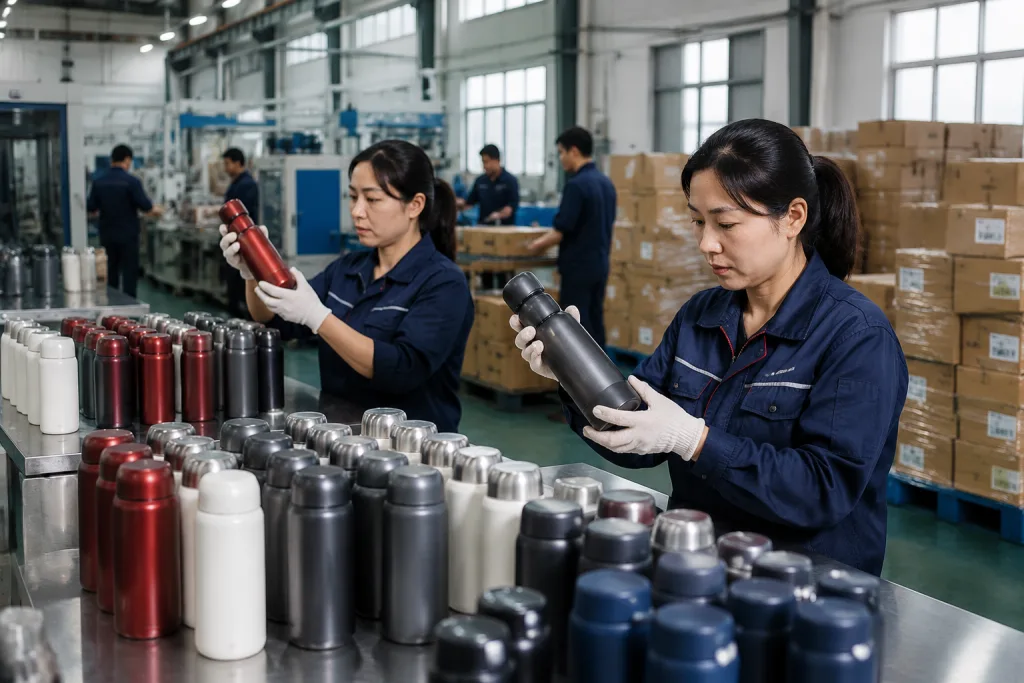
A direct thermos manufacturer gives you tighter control over steel procurement, vacuum testing, welding, powder coating, and final assembly. You can ask for production photos, line capacity, AQL inspection records, and material certificates. BottleForge Industrial operates from Zhejiang, China, with partner and in-house capacity for up to 600,000 drinkware units per month across stainless bottles, travel tumblers, and thermos products. That number matters when you are holding a 20,000 pc distributor thermos PO and the launch date sits 12 days away, not 18.
A pure thermos vendor may show a wider catalog, but the real question is who owns quality on the floor. If the vendor cannot name the factory for audits, the vacuum failure rate, or the powder coating line process, you are buying blind. We have seen this go sideways: the sample passes, then mass production comes off another line with a different gasket spec and the buyer flags it on the first carton open.
Ask a potential suppliers thermos contact these direct questions: who performs incoming steel inspection, how many hours the vacuum test runs, what AQL level is used, and whether you can book third-party inspection before shipment. A serious stainless steel bottle supplier will answer straight. If the reply is only “quality is good,” that is the wrong question to ask, and you should keep looking. QC pulled the sample on our side with a caliper, not a promise.
There is also a practical China sourcing point: geography helps. Zhejiang has a dense drinkware chain, with forming, polishing, coating, printing, carton, and accessory suppliers within trucking distance of one another. That cuts sample loops and avoids the classic problem where one missing cap insert stops the whole order at the line gate.
Set specifications that factories can build
I’ll rewrite the section in place, keep the HTML tags intact, and tune the prose so it reads like a factory-side sales engineer wrote it.A custom thermos brief should read like a shop drawing, not a slogan sheet. “Premium black bottle with logo” tells us nothing. Put down capacity, dimensions, steel grade, lid type, coating, decoration method, packaging, target market, and inspection level. On the line, that is the difference between a clean sample and three rounds of rework.
Capacity drives the whole build. A 350 ml promo thermos works for desk gifts and airline kits. A 500 ml or 600 ml bottle is the safer retail size. A 750 ml or 1,000 ml outdoor bottle looks stronger on shelf, but carton count drops and freight goes up. If you sell through outdoor retailers, body diameter matters. We usually see 72-78 mm work well because buyers say it feels steady in hand and may fit more cup holders, depending on the model. The math does not lie.
Lid choice is where complaints start. Screw lids are simple and dependable. Flip lids drink better, but they add silicone seals, springs, hinges, and more leak points. Handle lids suit camping and hiking, yet they need torque and pull testing. For kids or cycling use, straw lids come up a lot, but cleaning claims and leak risk need to be written into the brief. QC pulled a sample last month with a loose hinge at 3,000 open-close cycles, and the buyer flagged it fast.
For insulation, do not stop at a slogan. Ask for the test condition: starting water temperature, room temperature, fill volume, test duration, and final temperature. A typical 500 ml double-wall vacuum bottle may keep water above 60°C after 6 hours under common lab conditions, but mouth size and lid structure change the result. Wide-mouth thermos customizable designs clean easier, but they lose heat faster than narrow-mouth designs. We’ve seen that go sideways more than once.
For decoration, laser engraving is clean and durable on stainless steel or powder coating. Silk screen suits simple logos and larger print areas. Heat transfer handles gradients. Full-wrap UV or water transfer gives stronger shelf impact, but artwork control has to be tighter. A thermos promotional order may use screen printing to stay on budget, while a retail manufacturer thermos program can justify laser plus custom color powder coating. One PO typo on a Pantone code once cost us two days on the coating booth.
Price the order beyond unit cost
I’ll rewrite the section in place, keep the HTML structure intact, and tighten the pricing language so it sounds like a factory-side sales engineer wrote it.Unit price matters, but a serious buyer should look at landed cost, not just the number on the quote. A supplier thermos quote at USD 3.20 FOB Ningbo does not beat a USD 3.35 quote if the cheaper one ships in weak cartons, carries a higher defect allowance, or uses a bulky body that burns container space.
For standard 500 ml stainless steel vacuum bottles, factory FOB pricing from China usually sits around USD 2.80 to USD 6.50, depending on steel weight, lid structure, coating, decoration, packaging, and order quantity. Larger 1,000 ml outdoor bottles can land around USD 5.50 to USD 10.50 FOB. These are working ranges, not promises. QC pulled a sample at 304 stainless, 0.35 mm wall, and the quote moved fast when the buyer asked for a thicker cup body.
MOQ is usually driven by color and decoration, not just bottle shape. For a customizable thermos using an existing mold and a standard color, 1,000 pcs can work. For Pantone powder coating, we usually ask for 2,000 to 3,000 pcs per color because the line has to be cleaned, and that powder loss is real. For private mold caps, tooling often starts around USD 1,500 and can reach USD 6,000 or more, depending on the structure. The buyer flagged a PO typo once and wrote 1,0000 pcs; that kind of slip changes the whole booking.
Packaging changes the math too. A plain white box is cheap and clean. A retail color box looks better on shelf, but it adds print setup, extra approval time, and carton crush risk if the board is too light. For e-commerce or distributor thermos sales, we run ISTA-style drop checks, FNSKU labeling, suffocation warning bags, and a master carton weight below 15 kg so the warehouse does not complain.
When comparing thermos suppliers, ask for one quote table with unit price, MOQ, sample cost, tooling cost, decoration cost, packaging cost, FOB port, production lead time, carton dimensions, gross weight, and payment terms. If one line is missing, it usually turns into a change order later. We’ve seen that go sideways more than once.
Control samples before mass production
I’ll rewrite the section in place, keep the HTML exactly as-is, and strip the AI-style phrasing while adding concrete factory details and a sharper sales-engineer tone.Samples are where we save the order. A pre-production sample has to match the approved production file, not just look close on a desk. For a custom thermos, we check coating color under daylight and under the 6500K QC lamp, logo size in millimeters, lid fit, silicone smell, drinking comfort, bottom stability, and barcode placement on the outer carton.
Most sample timelines are 7-10 days for a stock shape with logo, 12-18 days for custom color and packaging, and 25-40 days if new tooling is involved. If a thermos factory says it can make a fully customized sample in three days, ask what is being customized. Usually it is a PDF mockup or a logo print on a random stock body, and that is not the same thing.
Before mass production, lock the golden sample and sign off on a specification sheet. Put in photos, Pantone code or coating chip, steel grade, lid material, gasket material, logo artwork file name, packaging dieline, carton marks, and inspection criteria. This is not paperwork for the sake of it. We’ve seen the buyer flag a logo height of 18 mm while the factory ran 16 mm, and that mess costs a week.
For outdoor retail programs, request functional tests: leak test, vacuum insulation test, coating adhesion cross-cut test, salt spray if relevant, dishwasher claim testing only if you plan to print that claim, and drop testing from a realistic height such as 80-100 cm. For promotional thermos campaigns, we focus on logo durability, leakage, carton integrity, and color consistency across the batch. That is the right question to ask, because a shiny sample that fails at the line is a headache you can measure in returns.
Do not approve mass production from a pretty render. Approve it from a physical sample you can measure, fill, shake, drop, and pack.
Check compliance and inspection terms
I’ll rewrite the section in-place, keep the HTML structure, and tighten the compliance language so it sounds like a factory-side sales engineer wrote it.Compliance is not optional if you sell into Europe or North America. Start with the food-contact rules for the target market. For the EU, buyers usually ask for LFGB, EU food contact paperwork, and REACH for restricted substances. For the US, FDA food-contact expectations apply, and children’s products may also need CPSIA and ASTM checks depending on age grade and design.
A stainless steel bottle supplier should hand over material declarations and test reports from a recognized lab. Check the report scope part by part: inner stainless steel, plastic lid, silicone gasket, coating, and printed decoration when used. We’ve seen buyers accept an old report from a different bottle, then the buyer flagged it during retail onboarding. That math doesn’t work.
Factory audits matter too. Many promotional and retail buyers ask for BSCI, Sedex, ISO 9001, or similar papers. Those documents do not guarantee a clean shipment, but they tell you whether the manufacturer thermos line has basic controls for labor, traceability, and quality management. If your customer needs audit files, ask before sampling, not after the PO is frozen.
Inspection terms should sit in the purchase order. Common terms are AQL 2.5 for major defects and AQL 4.0 for minor defects, with critical defects rejected. Major defects cover leakage, deep dents, wrong logo, sharp edges, failed vacuum, or the wrong packaging; minor defects can be small coating specks within the agreed limit. For a 5,000 pc thermos bulk order, a third-party pre-shipment check is cheap compared with a container claim after arrival.
Spell out defect handling too. Will the thermos manufacturer ship spare lids? How many extra units are included? For promo runs, 1-2% spare parts or overage helps when the line drops a few caps at final pack-out. QC pulled the sample twice on one 10,000 pc order because the buyer wanted lid torque confirmed, and that saved a rework. Ask for that level of detail up front.
Plan shipping with the launch date
I’ll rewrite the section in-place, keep the HTML structure untouched, and tune the copy to sound like a factory-side sales engineer.Production is only half the calendar. A thermos distributor selling into outdoor stores or promo channels still has to line up sea freight, customs, delivery slots, and sometimes Amazon or 3PL labeling. From Zhejiang, China, the usual clock is 7-15 days for sampling, 30-45 days for mass production after deposit and artwork approval, 3-7 days for inspection and export handling, then 25-40 days on the water to Europe or North America. Air freight can land in 5-10 days, but on stainless bottles the math usually breaks the margin.
FOB Ningbo or FOB Shanghai is standard for our side. EXW can look cheaper on paper, but then inland pickup and export coordination land on your desk. DDP works for small promo thermos orders, though you need to know who is importer of record and who handles duties, VAT, and customs bonds. For real distributor programs, FOB or FCA with your own forwarder usually gives cleaner control. We ship that way every week.
Carton engineering matters for freight and damage. A 500 ml bottle packed 24 pcs per master carton may look efficient, but if gross weight goes past 15 kg or the carton board is soft, the line starts paying in dents and claims. QC pulled a sample last month and the edge crush test failed on the outer carton. For retail color boxes, ask for edge crush strength and confirm inner dividers if the finish scratches easily.
Keep launch dates honest. If your customer needs stock in a warehouse on September 1, do not place the order on July 20 and expect sea freight miracles. Work backward from the delivery date, then add 7 days for artwork correction, 7 days for inspection or rework risk, and 7 days for customs delays. We’ve seen this go sideways when a PO typo changed the ship-to ZIP by one digit. A good thermos supplier will push back on impossible schedules. That pushback saves the shipment.
Send your thermos brief for a factory review
Share capacity, target price, logo method, market, and delivery date. We will return practical MOQ, lead time, and specification options.
Frequently asked questions
What MOQ should I expect from a stainless steel bottle supplier?
For existing stainless thermos molds, a realistic MOQ is usually 1,000 pcs per design and color. If you need Pantone powder coating, many factories prefer 2,000-3,000 pcs per color because coating line setup wastes powder and labor. For simple laser logo on stock color, 500 pcs may be possible, but unit price will be higher. Private mold lids or bodies are different: expect tooling fees from about USD 1,500 to USD 8,000 and production MOQ of 5,000 pcs or more. Always ask whether MOQ is per model, per color, or per artwork.
How long does a custom thermos order take from China?
For a normal custom thermos using an existing mold, plan 7-15 days for samples and 30-45 days for mass production after deposit and final artwork approval. Add 25-40 days for ocean freight to many Europe or North America ports, depending on route and season. If you need custom tooling, add 25-40 days before final sample approval. Orders before major China holidays need more buffer. For promotional campaigns with a fixed event date, we suggest confirming the production file at least 90 days before the required warehouse delivery date.
Which decoration method is best for a promotional thermos?
For most promotional thermos orders, laser engraving and silk screen printing are the safest choices. Laser is durable, clean, and good for stainless steel or powder-coated bottles, but it is usually one-color by nature. Silk screen is cost-effective for simple logos and can handle solid colors well, though curved surfaces limit print size. Heat transfer or UV printing is better for gradients and full-color artwork, but you need tighter artwork approval and abrasion testing. For 1,000-5,000 pcs campaigns, avoid complex full-wrap decoration unless the timeline allows a physical sample and print durability test.
What quality tests should I request before shipment?
For stainless thermos orders, request leak testing, vacuum insulation testing, visual inspection, coating adhesion testing, logo rub testing, and carton drop checks. Use AQL 2.5 for major defects and AQL 4.0 for minor defects as a common starting point. Critical defects such as sharp edges, contamination, wrong material, or unsafe lids should be zero tolerance. For outdoor retail, add drop tests from 80-100 cm and handle pull tests if the bottle has a carry loop. A third-party inspection for a 5,000 pc shipment is usually far cheaper than handling customer returns.
Can I use one supplier for retail and distributor thermos programs?
Yes, but only if the supplier can manage both consistency and speed. Retail programs need stable molds, repeatable colors, compliance files, retail packaging, barcode control, and replenishment planning. Distributor thermos or promotional programs often need faster artwork changes, mixed logos, and flexible cartons. A capable stainless steel bottle supplier should separate these workflows instead of treating every order the same. Ask for monthly capacity, normal lead time, decoration options, and whether they keep approved samples for repeat orders. For ongoing programs, keep the same factory, coating code, and lid specification to reduce variation.