Key Takeaways
- Standard stainless thermos MOQ starts at 1,000 pcs per color; new mold projects usually start from 5,000 pcs
- Typical FOB China pricing for 500 ml double-wall thermos is USD 2.85-5.40 depending on steel, lid, coating, and packing
- Normal custom thermos lead time is 35-55 days after deposit and artwork approval
- AQL 2.5/4.0 inspection, REACH/LFGB review, and carton tests should be priced before PO, not after production
If you buy for an outdoor retail chain or a promo brand, finding a stainless steel bottle factory is the easy part. The real question is whether the quoted USD 3.20 thermos still holds after the lid swap, powder coat, carton drop test, barcode labels, and a tighter ship date. The wrong question is “can you match the price?” We had a buyer flag a PO last month because the cap drawing showed 32 mm, then the sample lid came in at 34 mm and the tray insert no longer fit.
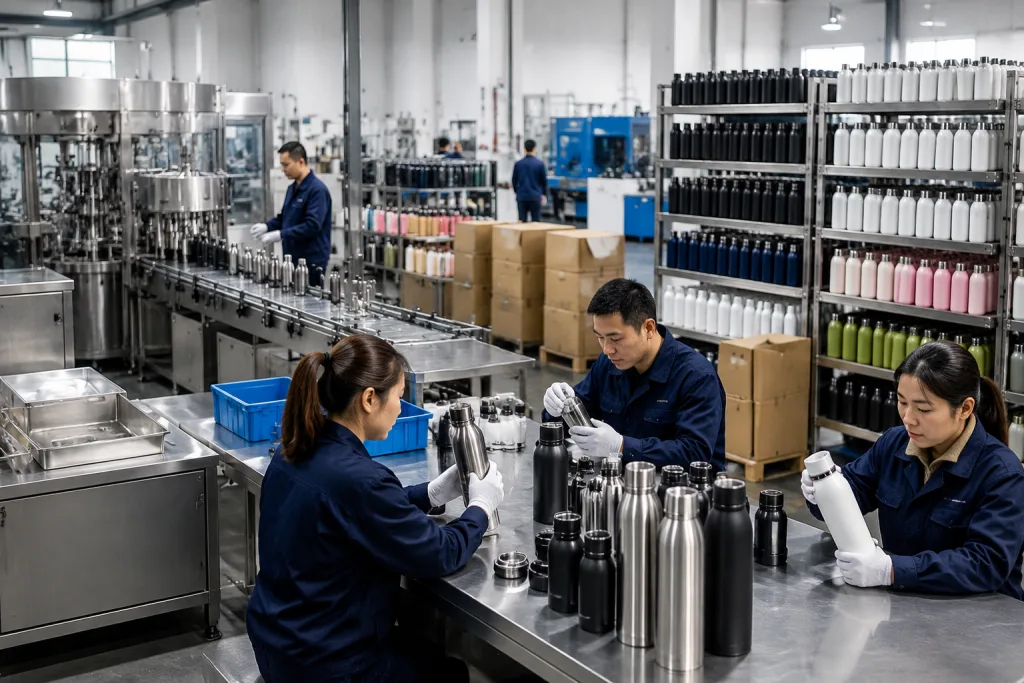
BottleForge Industrial is in Hangzhou, Zhejiang, China, and our line runs about 650,000 stainless vacuum bottles a month. We ship faster when the spec is locked before the PO lands. A custom thermos order can move in 12 days instead of 18 days, but only if the buyer clears the lid style, coating thickness, and carton test upfront. QC pulled a sample at AQL 2.5 this morning, and that is where the real cost leaks show up.
Where the unit price moves
A factory thermos price is never one flat number. It is built from steel grade and body weight, forming and welding time, logo work, carton spec, compliance paperwork, and FOB export charges. For a standard 500 ml double-wall stainless thermos, a realistic FOB Ningbo or Shanghai range from a Zhejiang stainless steel bottle factory is usually USD 2.85-5.40 per piece at 3,000-10,000 pcs. If you see USD 1.90 on the same drawing, ask what was cut. We have seen quotes hide a thinner outer wall, no copper coating, and a cheaper lid gasket; QC only caught it after weighing the body on a 0.1 g scale.
The first cost driver is steel. Most outdoor and promotional thermos projects use 304 stainless steel for the inner wall and 201 or 304 for the outer wall. A full 304/304 construction usually adds USD 0.18-0.45 per unit compared with 304 inner and 201 outer, depending on body weight. Wall thickness matters too. A common outer wall is 0.45-0.55 mm; going thinner saves a few cents but raises dent risk during transport and retail handling. We run spot checks with a micrometer on the line, and once the outer wall drops near 0.38 mm, the math doesn't work for supermarket shelves.
The second driver is the lid. A simple screw lid with PP and silicone seal may cost USD 0.25-0.45. A carry-handle lid, push-button stopper, tea infuser, or leakproof flip lid can add USD 0.35-1.20. For outdoor retailers, we usually suggest spending money on lid reliability before paying for fancy printing. Most complaints in thermos custom orders come from leaking, difficult cleaning, or broken hinge parts, not from the bottle body. Last quarter the buyer flagged 37 pcs in a pre-shipment check because the flip lid hinge pin was loose after a 1.2 m drop test. Logo looked perfect. Nobody cared.
The third driver is vacuum performance. Copper coating inside the vacuum layer, cleaner base welding, and stricter vacuum testing add cost but improve heat retention. A practical standard for a 500 ml customized thermos is 6 hours above 55-65°C after filling with 95°C water, tested at room temperature. If your packaging claims 12 or 24 hours, you need test data and a product design that supports the claim. QC pulled the sample from the aging rack, logged water temperature with a probe thermometer, and rejected one batch at 52°C after 6 hours; that carton artwork had already printed “keeps hot 12 hours,” which is how projects go sideways.
MOQ tiers that actually work
I’ll rewrite the section in-place, keep the HTML exactly as-is, and tune the copy to sound like a factory-side sales engineer.MOQ is where a lot of promo thermos jobs and retail launches go off the rails. Sample approval is easy; production MOQ is tied to coating line setup, logo jig setup, carton printing, and component buying. At BottleForge in Zhejiang, our normal MOQ for an existing stainless thermos model is 1,000 pcs per color for laser engraving or one-color silk screen. For powder coating, 1,000 pcs works, but 2,000-3,000 pcs gives cleaner color matching and less scrap. QC pulled a white sample at 18.2 mm off spec on a lid print once, and the buyer flagged it before we ran the line.
For a custom thermos using an existing body but a private lid color, the MOQ is often 3,000 pcs because the lid injection shop needs resin changeover and a minimum running block. If you need a new lid mold, plan on 5,000-10,000 pcs for the first order and tooling around USD 1,500-6,000 depending on cavity count and venting detail. A new bottle body mold is a bigger ask: it can run USD 4,000-12,000 and needs engineering sign-off. We’ve seen buyers push for a new body on 1,500 pcs; the math doesn’t work.
For distributor thermos programs, we recommend splitting the plan instead of forcing one oversized SKU. For example, 6,000 pcs can be split into 3 colors at 2,000 pcs each, using the same body, same lid, and different logos or sleeves. That setup lets thermos distributors test demand without paying for three full production changeovers. One PO typo on a 2,000 pcs sleeve run cost us a day on the packing table because the buyer swapped Pantone numbers, and the line had to stop.
Thermos bulk orders above 20,000 pcs change the job. At that level, we lock raw material buying earlier, set dedicated inspection time, and adjust carton packing for container loading. A 40HQ container can hold roughly 45,000-70,000 pcs depending on bottle size and gift box volume. If you miss the event date and ship by air, the freight bill can wipe out every MOQ saving. We've seen that go sideways more than once.
Decoration and packaging cost lines
Decoration is where buyers like to spend time, and it is also where the quote starts to move. Laser engraving looks sharp, holds up in daily use, and suits outdoor retail. On a 500 ml thermos, a standard logo engraving usually adds USD 0.08-0.18 per unit after a small fixture charge. We run this on a rotary jig; if the logo sits too close to the weld seam, QC pulls the sample and we stop it there. Silk screen printing costs less for a simple one-color mark, usually USD 0.05-0.15, but adhesion on powder coat has to pass the tape test or the buyer will flag it on first inspection.
Powder coating usually adds USD 0.25-0.60 over plain stainless, depending on color, finish, and order volume. Matte black, white, navy, and army green stay stable on the line. Metallic, gradient, rubberized, and special Pantone colors cost more and usually need 7-10 extra days for color confirmation. On a promotional thermos order, cheap spray paint is the wrong question to ask if the bottle will live in backpacks, car cup holders, or rough outdoor use. We have seen a coating fail the cross-hatch tape test before the carton seal was even broken.
Packaging carries the same kind of hidden cost. A white box may be USD 0.08-0.18. A printed retail box with E-flute support can land at USD 0.25-0.55. A rigid gift box can add USD 0.80-1.80 and push freight volume up 15-35%. For outdoor retail, a color box with barcode, country of origin, care instructions, and a recycled paper insert is the practical setup. We checked one shipment at 58 x 38 x 32 cm master cartons, and the buyer cut the box spec after seeing the cubic charge.
If you sell through online fulfillment, tell your thermos vendor early. FNSKU labels, suffocation warnings for polybags, master carton labels, and drop-test packaging need to be in the quotation from day one. For promotional brands, individual polybagging and carton assortment rules also change the labor line. A PO typo on label placement can cost a reprint. These are small lines, but on 10,000 pcs they become real money.
Lead time from artwork to vessel
I’ll rewrite the section in place, keeping every tag and the existing numbers intact, while making the wording sound like a factory-side sales engineer wrote it.A normal custom thermos lead time is 35-55 days after deposit and final artwork approval. That is not 35 days from your first email. The clock starts after the spec sheet, logo file, Pantone reference, packaging dieline, deposit, and sample approval are all locked. We push on those details for a reason. Loose orders slip.
For an existing model with laser logo and a standard box, sampling usually takes 5-7 days. Add 3-5 days if you need a custom powder coat swatch. QC pulled a swatch last week at 18 microns, and the buyer flagged it because the finish looked different under showroom light. We see this all the time: one approver is fine, six people commenting from different offices is not.
Bulk production for 3,000-10,000 pcs typically needs 25-35 days. That covers tube cutting, forming, welding, vacuuming, polishing, coating, decoration, assembly, and packing. On the line, a 5000 pcs order usually runs cleaner than a mixed 8-color run, and the math changes fast when the buyer adds last-minute artwork revisions. Larger thermos bulk orders from 20,000-50,000 pcs usually need 40-60 days, especially in peak season before summer outdoor campaigns and Q4 gifting.
Ocean freight is separate. Ningbo to Los Angeles is often 18-28 days port to port; Ningbo to Hamburg is often 32-42 days. Customs, inland trucking, and warehouse receiving add more days. If your promo event is fixed, work backward with a 10-14 day buffer. We’ve seen a PO typo on the ship-to city turn a clean plan into a week of calls. China production runs well, but it cannot save a late artwork sign-off, a moving Pantone target, and a hard delivery date at the same time.
Compliance and inspection budget
I’ll rewrite the section in-place, keep the HTML tags unchanged, and tune the copy to sound like a factory sales engineer rather than generic marketing.For stainless drinkware, compliance is not paper decoration. It protects your brand when a mug hits a hot fill line, a retailer asks for files before listing, or a kid’s bottle goes into the market. For Europe, buyers usually ask for LFGB food-contact testing, REACH screening on coating or silicone parts, and sometimes German or French file formats. For North America, FDA food-contact expectations and California Proposition 65 review may apply. If the product is for children, ASTM and CPSIA rules move to the front fast.
Testing cost comes down to scope. A basic food-contact set often lands at USD 250-600 per material group. A fuller package covering stainless steel, plastic lid, silicone seal, coating, and migration can run USD 800-1,800. We had one buyer flag a PO typo on the lid material code, and that small error would have broken the report match. If you change the coating, lid material, or silicone supplier after testing, the old report no longer backs the shipped unit.
Inspection needs its own budget line. Outdoor chains and thermos distributors often use AQL inspection before shipment. A common setup is AQL 2.5 for major defects and 4.0 for minor defects, with critical defects not accepted. QC should check vacuum performance, leakage, coating adhesion, lid torque, capacity, smell, barcode readability, carton dimensions, and drop-test condition. The math does not work if you skip these and hope the line holds.
At BottleForge, we run 100% leak testing and vacuum testing on insulated stainless bottles, then random finished goods checks before packing. We use a vacuum gauge and a torque tester on the line, not guesswork. Third-party inspection is welcome. SGS, Intertek, Bureau Veritas, or your own inspector can walk the factory, and we have seen that go sideways only when the quotation was built on a no-inspection assumption. If a supplier’s thermos quote only works without inspection, it is not a real quote.
How to brief the factory
I’ll rewrite the section in place, keep the HTML exactly as-is, and tighten the sales-engineer tone with concrete factory detail and cleaner RFQ language.The fastest way to get an accurate supplier thermos quote is to brief like a buyer, not like a catalog shopper. Send capacity, target FOB price, quantity by color, required delivery date, logo method, packaging style, destination country, and compliance needs in the first message. If you already sell a similar product, send the current weight, dimensions, and pain points. We run quotes off a real sample table, not a mood board, and a stainless steel bottle factory can price much closer from a 315 g benchmark than from a pretty picture.
Your RFQ should separate fixed requirements from preferences. For example, “500 ml, leakproof, fits standard car cup holder, matte black, 304 inner wall, retail box, EU market, 5,000 pcs” is useful. “Premium bottle, best price, urgent” is not. If your target is a distributors thermos program, tell the factory whether you need neutral stock, private label cartons, mixed-color pallets, or seasonal replenishment. The buyer flagged this on one job because the PO said “assorted colors” and the line had already booked 3,000 black lids.
Be honest about budget. If your landed cost target is USD 6.00 and freight plus duty uses USD 1.40, the FOB product must sit near USD 4.60. That tells the thermos supplier which lid, coating, and packaging choices are realistic. Without that number, engineers may overbuild a product you cannot sell, or sales staff may underquote a version you will reject later. The math does not work any other way, and we’ve seen a 0.8 mm lid spec turn into a margin problem fast.
For a customizable thermos project, we normally return a quotation within 24-48 hours when the specification is clear. Samples for existing models ship in about one week. New molds need drawings, 3D review, prototype confirmation, and tooling time. The more you lock before deposit, the fewer surprises you pay for after production starts. QC pulled the sample, checked the 100% leak test, and caught a typo on a carton mark before we ran the full order.
Send your thermos spec for a factory quote
Share capacity, quantity, logo, packaging, market, and delivery date. We will return practical FOB pricing and lead-time options.
Frequently asked questions
What is the normal MOQ for a custom stainless thermos order?
For an existing factory thermos model, a practical MOQ is 1,000 pcs per color for laser engraving or simple silk screen printing. Powder coating is better at 2,000-3,000 pcs per color because color changeover and scrap are easier to control. If you need a custom lid color, expect around 3,000 pcs. If you need a new lid mold, the first order usually needs 5,000-10,000 pcs plus tooling. For a fully customized thermos body, MOQ and tooling both rise because forming and welding fixtures must be validated.
How much should we budget for a 500 ml bulk thermos?
A realistic FOB China price for a 500 ml double-wall stainless thermos is usually USD 2.85-5.40 at 3,000-10,000 pcs. The low end normally means a standard body, simple lid, one logo, and plain box. The higher end may include 304/304 steel, copper vacuum layer, better lid, powder coating, retail packaging, and stricter QC. Gift boxes, spare parts, hangtags, FNSKU labels, and third-party inspection are usually quoted as separate lines.
Can you make a promotional thermos for an event in 30 days?
Sometimes, but only with an existing model, available color, simple logo, fast artwork approval, and air freight. Production alone often needs 25-35 days after deposit and sample approval. Sampling takes 5-7 days for standard models. If the order is 1,000-2,000 pcs with laser engraving and no custom packaging, a 30-day factory schedule may be possible. Ocean freight will not fit that timing, so you must calculate air cost before promising the event date.
What files does a thermos manufacturer need for logo work?
Send vector artwork in AI, EPS, PDF, or SVG format. For laser engraving and silk screen, the factory needs exact logo size, position, and color reference if printed. For wraparound artwork, provide a dieline and confirm the visible seam area. Pantone codes help, but powder coating on metal will not look identical to ink on paper. For retail packaging, provide barcode size, country-of-origin text, warning language, and any retailer carton label rules before sampling.
How do outdoor retailers avoid thermos quality claims?
Start with a stable lid design, not the cheapest lid. Require leak testing, vacuum testing, coating adhesion checks, and AQL inspection before shipment. For 500 ml insulated bottles, define a heat-retention method such as filling with 95°C water and checking temperature after 6 hours. Use 304 stainless for the inner wall, food-grade silicone seals, and tested coating. Also confirm carton strength. A good bottle can still arrive damaged if the master carton fails during a 30-40 day ocean shipment.