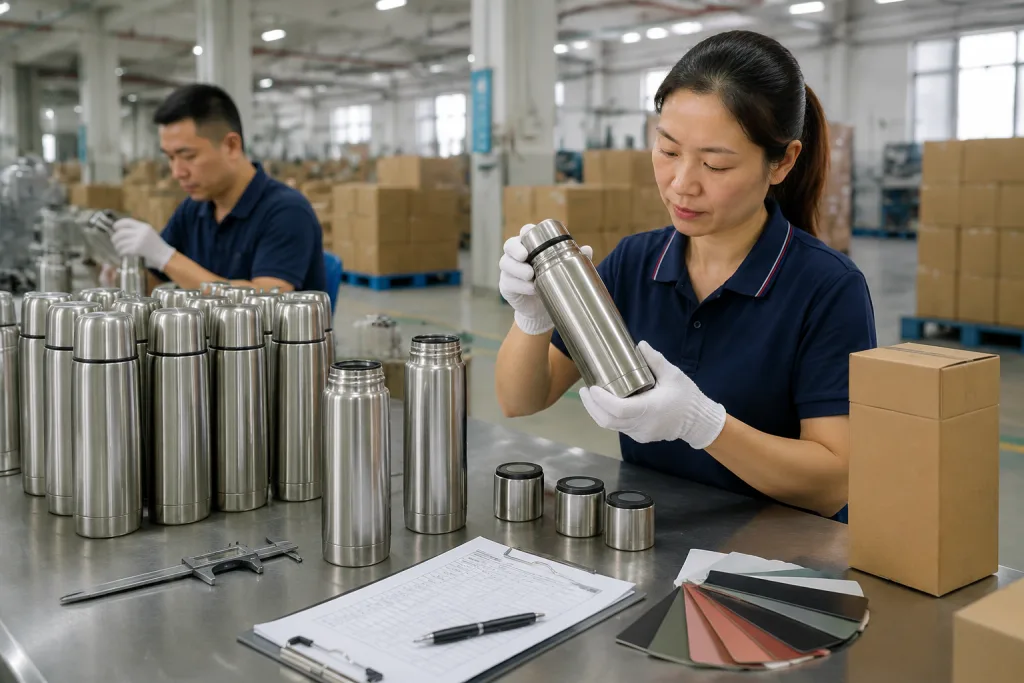
Key Takeaways
- Start RFQs with capacity, steel grade, lid type, decoration area, MOQ target, and Incoterm; 1,000 pcs is a realistic custom starting point
- Vacuum thermos samples usually need 7-12 days for existing molds and 25-35 days for new mold development
- For bulk thermos orders, define AQL levels, carton drop test, barcode placement, and spare part ratios before deposit
- FOB Ningbo or Shanghai pricing is cleaner than mixed EXW quotes when comparing China thermos suppliers
A stainless steel bottle customizable project looks simple until it lands on a purchase order. Outdoor retailers want insulation numbers they can trust, retail cartons that fit the shelf, barcodes that scan first time, and colors that stay consistent across a 5,000-piece run. Promotional buyers ask one thing first: will the logo still hold after 30 days of handling, shipping, and a few desk drops? If the quote leaves out tooling, carton size, or inspection standard, the math does not work.
From our Hangzhou, Zhejiang factory, we see the same mistake every week: the buyer asks for a custom thermos price before the bottle structure is fixed. QC pulled a sample with a 42 mm cap thread last month, then the PO came back with a 44 mm cap note, and the whole schedule slipped. That is how MOQ gets misread, decoration ends up on the wrong surface, and a sample cannot scale to bulk. We run it better: tight RFQ first, then confirmed sample, then AQL inspection, then shipment terms locked down.
Start with a usable RFQ
I’ll rewrite the HTML prose only, keep the tags untouched, and make it sound like a factory-side sales engineer wrote it.If you need a stainless steel bottle customizable quote that means anything, the RFQ has to read like a production brief, not a mood board. We run quotes on the line by wall thickness, cap structure, coating, logo process, and pack spec. A 500 ml bottle can land at USD 3.20 or USD 6.80 FOB. That gap is spec risk, not sales talk.
For outdoor retail, start with capacity, target use, and the test point you care about. A 750 ml hiking bottle usually needs 18/8 stainless steel, double-wall vacuum insulation, a leakproof lid, and powder coating that survives backpack abrasion. For a promo run, the buyer flagged logo size, Pantone match, gift box style, and whether you want individual polybags, master cartons, or shelf-ready packing.
Your first RFQ should carry these PO-style line items: product model or reference photo, capacity in ml or oz, material grade such as SUS304 inner and outer, lid material, coating finish, logo method, packaging, quantity per color, delivery port, required certificates, and inspection requirement. If you need REACH, LFGB, FDA, or California Proposition 65 paperwork, put it in before pricing. QC pulled the sample and found the wrong cap code once; the PO typo cost two days.
At BottleForge Industrial in Zhejiang, China, our normal MOQ for an existing manufacturer thermos model is 1,000 pcs per design, with 500 pcs per color when colors share the same coating line. For a private mold customized thermos, MOQ is usually 3,000-5,000 pcs because tooling and setup waste are real. A clean RFQ lets a thermos supplier give you a quote you can compare without chasing revisions.
Lock the bottle construction
I’ll rewrite the section in-place, keep the HTML structure unchanged, and tighten the prose so it sounds like a factory sales engineer wrote it.The build is where a custom thermos either lands as a shelf-ready product or ends up as a cheap giveaway. We don’t approve a quote until the buyer has locked the stainless steel, vacuum gap, lid, gasket, and base. Thin steel looks fine in a rendering, but we’ve seen the line dent bottles in transit and the buyer flag it after the first retail return.
For most outdoor and distributor programs, we ship SUS304 food-contact stainless steel on both inner and outer walls. The common wall spec is 0.4 mm to 0.5 mm per side for mid-market bottles, and a heavier outdoor version usually goes to 0.5 mm to 0.6 mm on the outer wall. Some low-cost suppliers push 201 stainless on the outside. The math does not work in coastal markets or winter road-salt conditions, and QC pulled the sample with early rust spots in salt-spray testing.
Vacuum performance needs a number, not a promise. For a 500 ml stainless thermos, a normal target is 6 hours above 60°C after filling with 95°C water at room temperature. A larger bottle can hold heat for 12 hours instead of 8, but the lid still decides a lot. A screw cap with a silicone gasket usually seals better than a flip lid, while a straw lid is easier for cold drink use and a poor choice for hot liquid.
Put these points on the sample sheet: inner steel grade, outer steel grade, wall thickness, capacity tolerance, mouth diameter, lid torque feel, gasket material, and leak test method. For an outdoor retailer, we ask for a 24-hour static leak test plus an inverted shake test. If you are buying promotional thermos bulk for an event, one drip may sound minor, but we’ve seen a typo on the PO for gasket size turn into a full rework and a lot of angry emails.
Choose decoration before sampling
I’ll rewrite the prose only, keep the HTML structure intact, and strip the AI-ish phrasing while adding concrete shop-floor detail and buyer-side specifics.A custom thermos is not just a bottle with a logo. The decoration choice locks in the coating system, sample lead time, unit cost, and scrap rate. We’ve seen buyers send the logo after QC already pulled the sample, and then the line has to restart. For a stainless steel bottle customizable job, the logo method needs to be fixed before the pre-production sample.
Laser engraving is clean, hard-wearing, and fits outdoor brands that want a mark that stays put. It works best on powder coated bottles or bare stainless, and our shop usually quotes USD 0.10-0.35 per position based on size and order qty. Silk screen printing is cheaper for a simple one-color logo, usually USD 0.05-0.18 per position, but the surface has to be prepped right and the oven cure has to hold. Heat transfer and water transfer handle complex graphics, yet the reject rate climbs and MOQ often starts at 2,000 pcs per artwork.
For promo brands, color matching is where orders get messy. Pantone matching on powder coating works in practice, but it is never perfect. A Delta E under 2.0 is tight and usually pushes rejects up; for most bulk thermos orders, under 3.0 is the number that holds. Metallic, matte, and gradient finishes need lab dips before we sign off on the sample. The buyer flagged one job because the gray looked fine under white light and failed under daylight.
Your PO line items should state the artwork file format, logo size in mm, print position, Pantone code, finish type, approval standard, and whether small shade variation is allowed. A thermos custom order with six colors and three logo placements is a different job from one black bottle with one laser logo. The math does not work if those are priced the same, and a serious thermos vendor will split them out instead of hiding the cost in one vague unit price.
Sample like you plan to buy
I’ll rewrite the section in-place, keep the HTML tags unchanged, and tune the tone to sound like a factory-side sales engineer.Samples are not souvenirs. They are the cheapest way to catch a bad lid, a loose vacuum seam, or a logo shift before 3,000 pcs land in cartons. For an existing model, a plain sample usually ships in 3-5 days. A logo sample normally takes 7-12 days. A new mold customized thermos takes 25-35 days for tooling, first shots, trimming, and surface finishing. If a thermos factory says a new lid mold is ready in one week, the math does not work.
Use a sample approval sheet. List measured capacity, net weight, height, diameter, mouth opening, coating color, logo size, logo position, packaging dimensions, and insulation result. QC pulled the sample on a caliper at 0.1 mm, then we shot four-angle photos and signed the approved version. That sheet becomes the reference for the pre-production sample and bulk inspection. Without it, the buyer flagged it later and everybody wastes time.
Outdoor retailers should test the sample close to real use. Fill it with boiling water, close it for 6 hours, and record the temperature. Put it in a backpack with metal objects for abrasion checking. Drop a filled bottle from 80 cm onto plywood or rubber flooring and inspect the base, lid, and vacuum failure. For children’s or family retail ranges, check ASTM or the applicable safety requirements for small parts and accessible edges. We’ve seen this go sideways on a 5 mm lid gap.
Promotional brands should test the decoration harder than the bottle. Rub the logo with a wet cloth, alcohol wipe, and fingernail. Check whether the print cracks near curved surfaces. If your campaign needs FNSKU, UPC, or customer-specific labeling, ask for one packed sample exactly as it will arrive. We ship enough cartons to know this: a supplier can make a good bottle and still miss the warehouse if barcode placement is off by 10 mm.
Price the bulk PO clearly
I’ll rewrite this section in-place, keep the HTML tags untouched, and tighten the language so it reads like a factory-side sales engineer wrote it.Once the sample is approved, the bulk purchase order should leave no room for guesswork. A clean PO protects both sides. For a manufacturer thermos order, write the model number, capacity, color split, decoration method, packaging, spare parts, inspection standard, payment terms, Incoterm, shipment window, and document requirements. If the PO only says “customizable thermos, 2,000 pcs,” we have seen it go sideways fast.
FOB Ningbo or FOB Shanghai is usually the cleanest term for European and North American buyers sourcing from Zhejiang or nearby provinces in China. EXW may look cheaper, but it pushes domestic trucking, export handling, and customs coordination onto you. CIF can work, but freight changes week by week. Ask every thermos manufacturer to quote the same Incoterm and the same carton data, or the math does not work.
Typical payment terms for first orders are 30% deposit and 70% balance before shipment after inspection. For repeat distributor thermos programs, terms can move to 30/70 against copy BL, but not before stable history. Our Hangzhou line runs about 280,000 stainless drinkware units per month across thermos, travel tumbler, and sports bottle lines, and QC pulled the sample before we released the bulk run.
For PO line items, add carton quantity, gross weight, carton dimensions, pallet requirement, silica gel use, spare gasket percentage, and instruction sheet language. For thermos promotional orders, add the event deadline and latest acceptable ship date. For retail, add master carton marks, country of origin marking, and compliance documents. The price only means something when it matches the exact bottle you will ship.
Control quality before shipment
I’ll keep the HTML exactly as-is and rewrite only the prose, with tighter sales-engineer wording and a few factory-floor specifics.Quality control starts before the container is booked. For thermos bulk production, we run three checks: material check, inline inspection, and final random inspection. A good thermos factory won’t fight AQL; it keeps the buyer and the line on the same page. For most retail orders, AQL 2.5 for major defects and 4.0 for minor defects is standard. Critical defects, such as leakage or sharp edges, stay at zero tolerance.
Define defects before production starts. Major defects include leakage, serious dents, wrong logo, wrong color, poor vacuum insulation, broken lid, missing gasket, and the wrong barcode. Minor defects include small dust spots, printing offset under 1 mm, or tiny coating specks outside the main viewing area. If you skip this step, QC pulled the sample, the buyer flagged it, and everyone starts arguing from a different rulebook.
Inspection tests should cover capacity measurement, leakage test, visual check under normal light, logo adhesion test, carton drop test, and insulation spot test. For a 5,000 pcs thermos customized order, an inspector may sample 200 pcs or more, depending on the inspection level. On one 5,000 pcs PO, the carton label had a one-digit typo, and that alone held up the release. If the order is for a major outdoor retailer, keep a retained sample for at least 12 months.
Packaging needs inspection too. A strong bottle in a weak carton still arrives damaged. Use five-layer export cartons for heavier stainless thermos shipments, with dividers or individual boxes where needed. Check carton edge crush strength if your distributor thermos order will be palletized and stacked. Ask your thermos suppliers for final carton photos, packing list, and test reports before you pay the balance. We’ve seen this go sideways when the outer box passed, but the 3 mm insert was too loose.
Plan replenishment from day one
I’ll rewrite the section in place, keeping the HTML intact and tightening the sales-engineer tone. No layout changes, just cleaner, more concrete prose.The first order tells you if the bottle can move. The second order tells you if the supply chain is real. If you sell outdoor drinkware, hold the bottle body, coating, lid, and carton spec steady for one season. For promo buyers, keep the approved artwork, Pantone code, and carton marks on file so the next PO does not start from scratch.
Build replenishment into the first PO. Ask the thermos manufacturers thermos team who owns the mold, who pays for mold care, what the repeat lead time is, and whether the cap, gasket, or base is shared with another model. A repeat order with the same materials usually ships in 25-35 days after deposit. Change the color, the gift box, or the lid, and you can add 7-15 days. Before summer and again in Q4, the line gets tight fast.
Distributors need SKU control. Too many capacities, colors, and lids leave dead stock on the shelf. We usually push a launch plan with three capacities, four colors, and one lid family. For promo brands, keep one or two proven models ready for fast campaigns, then open a custom project only when the order value clears the tooling and packing cost. A buyer once asked for eight finishes in one launch; the math did not work, and QC pulled the sample list back to two.
A reliable suppliers thermos relationship runs on forecast, not fire drills after the deadline slips. Send a 90-day rolling forecast if you have it. We would rather quote 40 days from China and ship on time than promise 25 days and miss. That keeps retail launches, event dates, and customer trust intact. One typo on a PO, like a wrong carton count, can throw the whole booking off by a week.
Send your thermos RFQ for a production-ready quote
Share capacity, quantity, logo file, packaging needs, and target market. We will return clear FOB pricing, MOQ, sample timing, and compliance notes.
Frequently asked questions
What MOQ should I expect for a stainless steel bottle customizable order?
For existing stainless thermos models, 1,000 pcs per design is a realistic MOQ from our Zhejiang factory, with 500 pcs per color if the coating colors are standard. For custom molds, unusual lids, or full-surface artwork, expect 3,000-5,000 pcs. Some thermos suppliers quote 300 pcs, but the unit price is usually high and decoration options are limited. If you are testing a new retail SKU, start with one capacity and two colors instead of spreading 1,000 pcs across six weak variants.
How long does a custom thermos sample and bulk order take?
A plain sample from an existing mold usually takes 3-5 days before courier shipment. A logo sample takes about 7-12 days after artwork approval. New mold work can take 25-35 days depending on lid complexity and surface finishing. For bulk production, plan 30-45 days after deposit and approved pre-production sample. During China peak production periods before summer and Q4, add 7-10 days. Ocean freight to Europe or North America is separate and should be planned early.
Which logo method is best for promotional thermos orders?
For promotional thermos orders with simple artwork, silk screen printing is cost-effective and works well on flat or gently curved areas. Laser engraving costs more but is more durable, especially on powder coated bottles used outdoors. Heat transfer is better for complex, multi-color graphics, but it often needs MOQ of 2,000 pcs or more and tighter QC. If the bottle will be sold at retail, we usually recommend laser or high-quality screen printing with an adhesion test before bulk production.
What should be written on the purchase order for thermos bulk production?
Your PO should include model number, capacity, stainless steel grade, color split, logo method, artwork version, packaging type, carton quantity, Incoterm, inspection standard, compliance requirements, and shipment deadline. Add barcode or FNSKU placement if you sell through retail or online channels. For quality, write AQL 2.5 major and 4.0 minor, with zero tolerance for leakage and sharp edges. A vague PO such as “500 ml customized thermos, black, logo” is not enough for controlled production.
Can one thermos supplier handle both retail and promotional packaging?
Yes, but you must specify the packaging workflow early. Retail packaging may need color boxes, instruction sheets, UPC labels, country of origin marks, and stronger display-ready cartons. Promotional packaging may only need individual white boxes or bulk inner cartons. At BottleForge Industrial in Hangzhou, Zhejiang, we quote packaging as a separate line when needed because a color box can add USD 0.20-0.60 per unit depending on size and paper grade. Clear packaging specs prevent surprise costs before shipment.