Key Takeaways
- A 500 ml stainless steel bottle custom order often lands at FOB China $3.20-$5.80 at 1,000 pcs, before freight.
- Most custom thermos orders need 7-12 days for samples and 25-35 days for mass production after approval.
- MOQ usually starts at 500 pcs for stock shapes, 1,000 pcs for color and logo, and 3,000 pcs for deeper customization.
- REACH, LFGB, FDA, and AQL 2.5 inspections matter more than a low quote when you sell in Europe and North America.
If you are buying a stainless steel bottle custom run for outdoor retail or a promo program, do not start with the logo. Start with landed cost. A thermos that looks cheap on paper can pick up $0.35 for 316 steel, $0.18 for powder coating, $0.12 for a laser logo, and another $0.20 to $0.80 for packaging before it leaves China. We have seen buyers miss that by a mile.
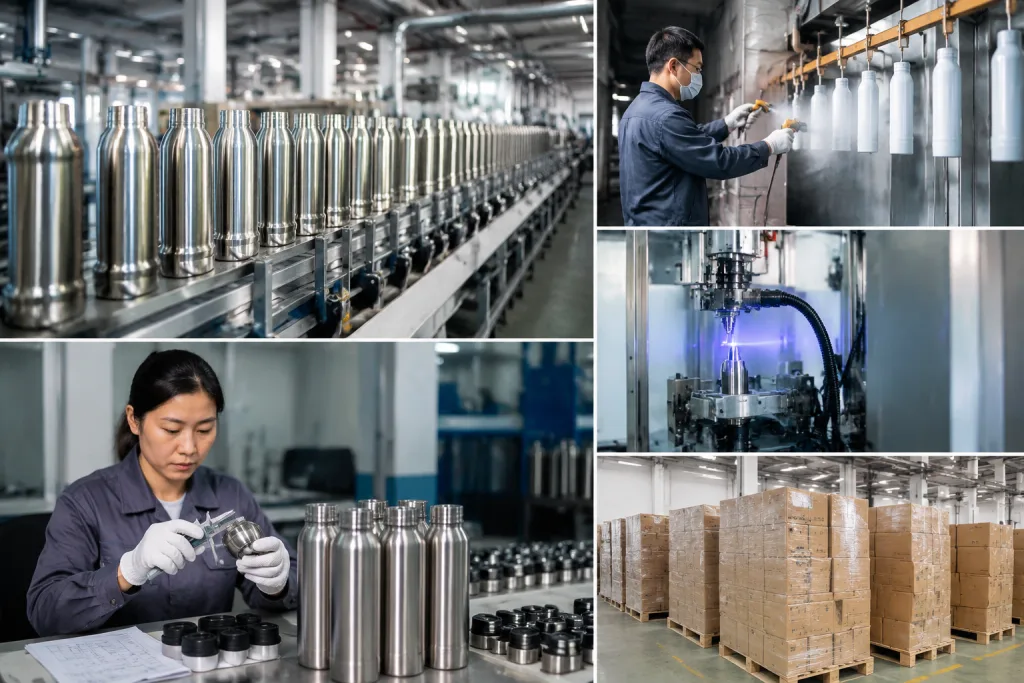
The better move is to price the whole job: unit cost, MOQ, sample time, production lead time, and test paperwork. Our Zhejiang line in Hangzhou runs 300,000 units a month, but the schedule still changes if you need a stock lid, a new mold, or REACH and LFGB reports. QC pulled one sample with a 1.2 mm wall and the buyer flagged the carton mark typo, so yes, the details matter. That is where the margin sits.
What really sets the unit cost
I’ll rewrite just this section, keeping the HTML structure intact and tightening the sales-engineer tone with more concrete cost drivers.A thermos custom quote is never one number; it is a stack of small calls. Steel grade comes first. Standard 304 or 18/8 stainless is the normal pick for a factory thermos, and it covers outdoor retail and most promo runs. If the buyer wants better corrosion resistance for coastal markets or a premium shelf story, 316 steel can add $0.35-$0.80 per unit, depending on size and wall structure.
Then the build changes the math. A common 500 ml bottle uses double-wall vacuum construction with about 0.4-0.5 mm wall thickness. We run that gauge on the line every week. Thicker walls feel heavier in hand, and buyers like that, but they also raise material and forming cost. The lid moves the quote faster than the body. A basic PP screw lid is cheap; a one-hand push lid, tea infuser lid, or bamboo accent lid can add $0.25-$1.20. On a bulk thermos order, packaging is another cost leak: brown box, color box, gift tube, or mailer-ready pack all change the landed number. One PO typo on a gift box spec can cost a day.
- 304 stainless: standard price point
- 316 stainless: higher corrosion resistance, higher cost
- Laser logo: low setup cost, durable finish
- Powder coat: better grip, usually +$0.15-$0.35
If a supplier in China gives you only a photo and a vague price, push back. That is the wrong question to ask. A serious thermos supplier should break out body, lid, finish, print, and carton cost line by line; QC pulled a sample with a 0.3 mm lid gap once, and the buyer flagged it before shipment.
MOQ tiers change the price curve
I’ll rewrite the section in-place, keeping the HTML tags and structure intact while making the sales copy sound like a real factory-side quote discussion.For stainless steel bottle custom jobs, MOQ is where a lot of buyers bleed margin by trying to start too small. At 500 pcs, we usually pull an existing mold, laser one logo, and pack it in stock cartons. That works for a test run or a seasonal promo. The FOB price is higher, often $4.80-$7.20 for a 500 ml custom thermos, depending on lid style and surface finish.
At 1,000 pcs, the quote starts making sense. This is the level we see for distributor thermos programs and outdoor retail trials. You can add color, a custom printed box, and a better closure without asking the tooling room for a new mold. In Zhejiang, we usually see 1,000 pcs land around $3.60-$5.40 FOB for a normal vacuum bottle with one-color decoration. At 3,000 pcs, the line runs cleaner and the price can move into the $2.90-$4.30 range if the spec stays reasonable.
Under 500 pcs, the thermos supplier is charging for setup pain, not just steel. We’ve seen a buyer flag a PO typo on “300 pcs” when the sample approval file said 3,000, and that kind of mismatch stops the line fast. Above 5,000 pcs, you can push on carton spec, alternate finishes, and split shipments. That is where thermos bulk buying starts working for a distributor thermos program, because one order can cover three sales channels.
Rule of thumb: if your design needs a new lid, a special finish, and a custom box, 1,000 pcs is a sane first buy. If you want a true thermos customized line with shape changes, plan for 3,000 pcs or more.
Lead time is several steps
I’ll rewrite the prose in place, keep the HTML exactly as-is, and tune the wording to sound like a factory sales note with concrete timings and one or two field details per paragraph.Do not take one lead time number on faith unless it covers samples, production, inspection, and packing. For a stock thermos, QC can turn a plain sample in 3-7 days. Add printing, laser engraving, or a special lid and you are usually at 7-12 days. If the buyer wants a new mold or a custom cap, 12-18 days is the normal stretch before final sample approval.
Mass production for a custom thermos usually runs 25-35 days after deposit and sample sign-off. In peak season, especially before Q3 retail launches or holiday promo runs, 35-45 days is the safer number. We run the line with 18 assembly stations, and that is only the factory side. Ocean freight from China to North America often adds 18-30 days, and Europe is commonly 22-35 days depending on port and routing. Air freight moves in 5-8 days, but the math does not work on a low-value bottle.
If you sell on Amazon or through a distributor thermos warehouse, count the extra steps: carton marks, FNSKU labels, polybags, drop-test safe outer cartons, and a final AQL inspection. A buyer once flagged a PO typo on the carton count, and we caught it before shipment. I tell buyers to hold 7 extra days for export packing and document checks. That buffer is cheap. Rework is not.
Specs that move margin fast
I’ll rewrite the prose in place, keep the HTML structure untouched, and tighten the sales-engineer tone with a few concrete factory details.The fastest way to burn margin is mixing up features and value. For outdoor retail, 500 ml or 750 ml usually moves faster than a 1 L bottle unless the buyer is selling hard into hiking or camping. For daily-use stainless steel bottle custom orders, we run the line for leakproofing, grip, and insulation stability first, not for a flashy shape. A solid double-wall bottle should hold heat 6-12 hours and cold 18-24 hours, but the real number shifts with fill temperature, lid seal, and whether the user preheats or prechills the flask.
For a custom thermos sold as premium gear, powder coating and laser logo pay back because they take abrasion better than soft print. For a promotional thermos, keep the spec plain. One-color silk screen, standard lid, and a clean carton protect budget better than a fancy accessory set. QC pulled one sample last week and the buyer flagged a 2 mm logo shift, so yes, the small stuff matters. If you need a straw lid, tea filter, silicone base, or carry handle, add about $0.35-$0.90 and plan on 8-12 more days for tooling or assembly work.
- 500 ml: best all-round promo size
- 750 ml: better for outdoor retail
- 1 L: higher freight cost, slower turns
- Laser engraving: durable, premium, low wear
That is the trade-off. Every extra part helps sell the bottle, and every extra part adds time and cost.
Decoration and compliance that buyers ignore
I’ll rewrite the section in place, keeping the HTML tags and the heading context intact while stripping the AI-ish phrasing and adding a few factory-floor specifics.Decoration is where a lot of thermos factories overpromise. Silk screen is still the low-cost path for a 1-color logo on a big run, usually around $0.06-$0.15 per unit depending on quantity and how many colors you stack. Laser engraving costs a bit more, but the mark is cleaner and it survives wear better. Full-wrap printing, gradient paint, and metallic effects look sharp on a sample board, then the line starts seeing more touch-up work, more rejects, and slower packing. If the buyer wants distributor stock, we usually push a restrained finish that survives carton drop tests and shelf handling.
Compliance is not a side issue if you sell into Europe or North America. Ask for REACH and LFGB for EU orders, FDA food-contact declarations for the US, plus steel traceability back to the coil lot. If your brand needs social compliance, BSCI or ISO 9001 helps at the factory level, but a certificate does not prove the bottle passes. We still run vacuum retention checks, leak tests, and visual inspection under AQL 2.5 for major defects; QC pulled one sample last month with a seal gap at 0.6 mm, and that would have turned into a return. A thermos supplier that cannot show test data is asking you to carry the risk.
For promotional brands, ask the manufacturer what goes first: print rub, coating scratch, lid seal, or carton crush. That is the right question. On one PO, the buyer flagged a typo on the carton mark, and we caught the same batch because the outer box print was already misaligned by 3 mm. A glossy sales deck does not tell you that.
How to buy from Zhejiang without waste
I’ll rewrite the section in-place, keep the HTML exactly as-is, and strip the AI-ish phrasing while adding a few factory-floor details and tighter sales language.Buying from a Zhejiang factory should feel tight, not emotional. Ask for a spec sheet first: steel grade, capacity, vacuum layer, lid type, coating method, and carton size in mm. Then ask the MOQ by decoration method. A real thermos factory will say whether 500 pcs works only on stock shapes, or whether a thermos distributors program needs 3,000 pcs to hold the target price. Ask for the production calendar in calendar days, not business days, so weekends and the National Day break are visible.
At our China plant, the number that matters is 300,000 units per month only if the line is booked, QC keeps pace, and your art file is signed off. We run tape tests on the line and the buyer usually flags the logo size before we even pack the first carton. For a manufacturer thermos order, the best buyers send Pantone references, logo vector files, carton artwork, and their target FOB range in the first email. That cuts the back-and-forth fast. If you want a custom thermos line that can scale, work with a supplier that can quote a pilot run and a 10,000-piece reorder on the same spec.
Do not pay for a feature just because it sounds premium. Pay for the feature your channel will actually sell. This is the wrong question to ask: “What looks best?” The math does not work. We’ve seen a 316 cap, laser logo, and gift box push the landed cost up by 18% while the buyer still sold the same shelf price. Outdoor retailers keep turns healthy by choosing the finish that survives 12 days in transit and two warehouse drops, while promotional brands protect margin by stripping out anything the end customer will not notice.
Get a factory quote with real landed cost
Send your target MOQ, capacity, logo file, and market. We will quote the thermos, packing, and lead time without hiding the expensive parts.
Frequently asked questions
What is a realistic MOQ for stainless steel bottle custom orders?
For a standard stainless steel bottle custom run, 500 pcs is realistic if you choose an existing mold, one logo, and standard packaging. At 1,000 pcs, you usually unlock better pricing and more options like color coating or a printed box. If you want a special lid, custom shape, or fully thermos customized program for a distributor, 3,000 pcs is the safer number. Below 500 pcs, the unit price often jumps because the factory still has to set up screens, artwork, packing, and QC. In Zhejiang, many factories can support small test orders, but the margin is usually cleaner at 1,000 pcs and above.
How much does a custom thermos cost FOB China?
A 500 ml custom thermos with 304 stainless steel, one-color logo, and standard box often lands around $3.20-$5.80 FOB China at 1,000 pcs. If you upgrade to 316 steel, premium powder coating, a better lid, or gift packaging, the price can move to $5.50-$7.50. At 3,000 pcs, the same spec may fall by 15%-25% depending on decoration and carton choice. Freight is separate. To North America, sea shipping can add $0.45-$1.20 per piece depending on carton size and season, so you should always compare FOB plus logistics, not just factory price.
How long does a custom thermos order take from sample to shipment?
A normal timeline is 3-7 days for a plain sample, 7-12 days for decorated samples, and 25-35 days for mass production after sample approval and deposit. If you need a new cap, custom color match, or a special box, add another 5-10 days. In peak season, 35-45 days is safer. Then add shipping time: 18-30 days by sea to the US and 22-35 days to many EU ports. If your buyer needs FNSKU labels, carton marks, or Amazon prep, reserve 7 more days. A realistic door-to-door plan often sits in the 45-70 day range.
Which logo method is better for a promotional thermos?
If you want the lowest cost, silk screen is usually the best choice for a promotional thermos, especially at 1,000 pcs or more. It can run around $0.06-$0.15 per unit for a simple one-color logo. If you want a cleaner premium look that resists abrasion, laser engraving is stronger and usually adds only a small amount to the quote. For outdoor retail, laser is often smarter because it survives handling, dishwashing risk, and warehouse abrasion better than print. If your artwork has multiple colors or gradients, you will pay more and accept more reject risk. Keep the decoration aligned with the channel.
What certifications should a thermos supplier provide for Europe and North America?
For Europe, ask for REACH and LFGB-related documentation, plus material traceability for stainless steel and plastics. For North America, ask for FDA food-contact declarations and test reports tied to the exact material batch. If you need factory-level assurance, BSCI and ISO 9001 are useful, but they do not replace product testing. You should also request leak tests, insulation retention data, and an AQL inspection plan, usually AQL 2.5 for major defects and 4.0 for minor ones. A reliable thermos supplier in China should be able to show these documents before you place a repeat order.