Key Takeaways
- Standard 500 ml stainless sport bottle pricing often starts around USD 1.20-1.80 FOB at 3,000 units
- MOQ for custom logo work is commonly 1,000-3,000 pieces, while full customization may need 5,000+
- Typical sampling takes 7-12 days and mass production takes 25-40 days after approval
- AQL 2.5 for major defects and 4.0 for minor defects is common for export inspections
If you buy custom drinkware for retail, promotions, or distribution, the quotation is only half the bill. The real cost sits in tooling, decoration, packaging, freight, and the days the line needs to turn cartons ready for export. A stainless sport bottle manufacturer in Zhejiang can quote USD 1.80 on a plain 500 ml bottle, then jump to USD 3.20 once the buyer asks for double-wall insulation, powder coating, and a laser logo. We have seen buyers miss that gap by 18% on the first round.
That is why we push total landed cost, not just FOB. The math does not work any other way. If you are sourcing from China, check MOQ, sampling pace, and whether the factory can hold a 30-day or 45-day slot; a PO typo on bottle capacity, like 500 ml written as 550 ml, can stall the run fast. A shop with 120,000 units per month and a 24-head laser line usually gives cleaner numbers than a trading setup, and QC pulled the sample to prove it.
What actually drives unit cost
I’ll rewrite the section in place, keep the HTML exactly as-is, and tighten the sales-engineer tone with concrete factory details and cleaner pricing logic.When you ask a stainless sport bottle manufacturer for a quote, the number comes from five inputs: body material, lid tooling, decoration method, packaging, and order volume. For a plain 304 stainless steel sport bottle, the shell cost stays steady. Once you move to a vacuum insulated bottle, the bill goes up fast because the line has to form the inner and outer walls, weld them, run leak tests, and sort the rejects. A 0.5 mm wall thickness on a single-wall bottle is one thing; a 0.4 mm inner wall plus 0.5 mm outer wall on an insulated model is another. QC pulled one batch at 18 days because the seam gap drifted 0.2 mm, and that kind of scrap shows up in the quote.
Decoration changes the math fast. Screen printing on a canteen customized order may add USD 0.08-0.20 per color, while laser engraving often adds USD 0.12-0.35 depending on area and setup. Powder coating adds color choices but usually adds USD 0.20-0.45. If your logo is small and you want a clean premium look, laser is cheaper over time because there is no ink matching or curing loss. If you want a canteen promotional order for events, simple printing keeps the price sharp. We had a buyer flag a PO typo on Pantone 186 C versus 186 U, and the rework burned a full shift.
Packaging is a real line item, not a side note. A kraft box with one-color print may add USD 0.18-0.40, while a retail color box with insert can add USD 0.35-0.80. If you ship to Amazon or a distributor canteen program, carton strength, drop resistance, and barcode labeling can move the total more than the logo does. In China, factories often quote ex-works on the bottle itself; ask for packaging, master carton count, and palletization separately if you want a fair comparison. We run a 5 kg carton drop test here, and a box that passes on paper can still crush at 60 cm if the insert is too loose.
MOQ tiers and price bands
I’ll keep the tags and structure intact, rewrite the prose to sound like a factory sales engineer, and preserve the original numbers and product logic. Then I’ll return just the HTML.MOQ is where a lot of buyers burn time. We see it on the line all the time. A stainless sport bottle manufacturer in Zhejiang may say “flexible,” but the real floor changes with tooling, color, and decoration. For a stock mold, 500 pieces is normal for a plain pilot run. Once you add custom printing, the working MOQ is usually 1,000-3,000 pieces. New mold? Custom cap? A shaped custom growler? Plan on 5,000 pieces or more if you want a unit cost that makes sense.
- 500-1,000 pcs: sample-market or small distributor drinkware orders, higher unit price, fewer logo choices
- 1,000-3,000 pcs: common for canteen custom logo orders, distributor launches, and retail test programs
- 5,000+ pcs: better for full canteen customized programs, private label retail, and customized drinkware with special packaging
At 1,000 pieces, a plain 500 ml single-wall stainless bottle may land around USD 1.45-2.10 FOB. At 3,000 pieces, the same item may drop to USD 1.20-1.75 FOB. For an insulated 750 ml model with powder coating and one-color print, expect roughly USD 2.40-4.10 FOB at 3,000 pieces. QC pulled the sample and checked the coating thickness at 60-80 μm; that’s the kind of detail that moves the quote. If you are comparing canteen manufacturers in China, do not compare a bare bottle quote with a retail-ready quote; the math does not work.
Buyers asking for canteen customizable caps, flip lids, or carry loops should expect extra tooling or assembly time. We’ve seen this go sideways when the PO says “same as sample” but the cap drawing changes by 2 mm. A canteen vendor that takes small orders may still charge a tooling recovery fee. That is normal. The real question is whether the extra USD 300-800 in setup beats paying a 20-30% unit premium on every order.
Lead times by order type
I’ll rewrite the section in place, keeping the HTML tags and the existing structure intact while tightening the sales-engineer tone and adding concrete factory details.Lead time is easier to pin down than price, but only if you split it by stage. A standard stock-mold order from a canteen factory in Zhejiang can move on this cadence: 3-5 days for artwork confirmation, 7-12 days for samples, and 25-35 days for mass production after sample approval. If the bottle needs a new lid, a special coating, or a packed set for distributor canteen programs, add another 7-15 days. We run this every week, and the line tells you fast where the delay sits.
Here is the timeline buyers usually end up with:
- Existing mold, simple print: 20-30 days total after deposit and art approval
- Existing mold, new decoration and box: 30-40 days total
- New mold or special cap: 45-60 days total, sometimes longer in peak season
Seasonality changes the math. In Zhejiang, schedules tighten before the spring export rush and again before Q4 retail deadlines. If you need 20,000 units for a distributor growler campaign, move early or you will end up paying for air freight or rush slots. QC pulled a sample with a lid torque issue on one order, and that one small miss pushed packing back by 4 days. A real canteen manufacturer will tell you whether the hold-up is cap assembly, coating, or carton procurement. That answer is worth more than a polished promise.
If you are building a customizable canteen line for retail, ask for a split schedule: sample in week 2, pre-production confirmation in week 3, bulk run in week 4 or 5. The buyer flagged a PO typo on carton count once, and we lost a day correcting it before the line could start. Small thing. It keeps the launch calendar honest.
Cost of customization details
I’ll keep the HTML exactly as-is and rewrite only the prose, tightening the sales-engineer voice with concrete factory details and cleaner pricing language.Customization is where margins are made and where buyers get burned. A custom canteen program can be as light as a logo on a stock bottle, or it can mean a new lid, matched color, and retail-ready carton. Once you move toward a custom drinkware product, price it as setup cost plus unit cost. That is the math.
We see adders like this on the line: one-color silk screen, USD 0.08-0.20; multi-color print, USD 0.18-0.45; laser logo, USD 0.12-0.35; emboss/deboss, USD 0.15-0.40 if the mold supports it; custom color powder coat, USD 0.20-0.45. A custom canteen with a special carry handle or cap can need new tooling from USD 250 to USD 1,500, depending on the part. For a custom growler with a wider mouth and thicker wall, the lid seal and bottle neck size matter more than the print. QC pulled the sample, and the buyer flagged a 0.3 mm neck mismatch before we ran the next 5,000 pcs.
If your order is under 2,000 pieces, put money into the decoration and packaging the customer sees first. Hidden features rarely move sell-through.
This is where a canteen supplier shows real factory control and a canteen vendor does not. We can hold wall thickness, neck finish, and cap torque spec without turning the order into a 3-week email loop. If you are checking a distributor drinkware line, ask for closure torque and leak data, not just a nice sample. We’ve seen this go sideways when the PO says “matte blue” and the buyer really means Pantone 296 C; then the spray booth has to stop and the line loses a day. China has plenty of good factories. The question is whether the one you pick can repeat the same result 10,000 times.
Quality checks that protect margin
I’ll rewrite the section in-place, keep the HTML intact, and tighten the language so it sounds like a factory-side sales engineer wrote it.Low unit price means nothing if 3% of the shipment leaks or the coating rubs off in transit. We run AQL-based inspection on export drinkware: AQL 2.5 for major defects and 4.0 for minor ones, plus leak checks, drop testing, and finish checks under a 6000K light box. If the bottle is insulated, ask for vacuum retention data and thermal results. For stainless steel, 304 or 316 should match the market position; don’t accept “food grade” on paper without a mill certificate or test report.
For Europe and North America, compliance is not a side issue. Ask the stainless sport bottle manufacturer for REACH-related declarations, food-contact documents, and lab reports from a recognized lab. If the order goes to retail, barcode labels, carton marks, and warning text have to match the destination market before the line starts, not after. We’ve seen a buyer flag 12,000 units because the carton height on the PO was 2 cm off, and that math does not work.
A clean inspection plan for a 5,000-piece order is simple: pre-production sample approval, in-line check on the coating or print, final random inspection at AQL, then photo confirmation of packing. On one job, QC pulled the sample and found a 1.2 mm print shift that would have become a claim later. If you are working with canteen manufacturers in Zhejiang, ask for one named QC contact and one production contact. That keeps lot numbers, carton counts, and ship dates from drifting.
Choosing the right factory partner
I’ll rewrite the section in-place, keep the HTML untouched, and tighten the sales-engineer tone with concrete factory details and cleaner wording.Not every stainless sport bottle manufacturer fits every buyer. Brand owners usually want design input, packaging control, and steady color matching across repeat orders. A canteen distributor cares more about ship date, carton consistency, and margin. For procurement teams handling promotions, the real issue is calendar certainty and a fast approval loop. We’ve seen that go sideways when the buyer asks for “one more revision” after the PO is already fixed.
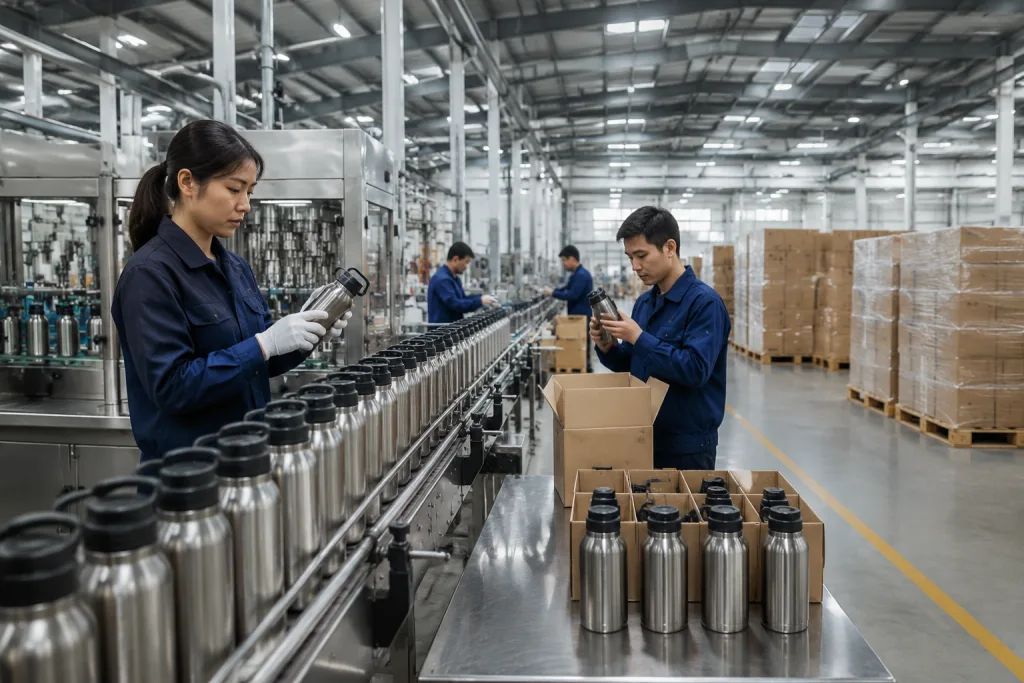
A good factory in Zhejiang should answer three numbers without checking with sales: monthly output, normal MOQ, and exact lead time. A line running 120,000 units a month can cover a retail program; a smaller line suits flexible canteen batches better. Ask how many bottle lines are active, how many QC inspectors are on shift, and whether the plant can run retail packing and promotional cartons in the same week. QC pulled a sample at 9:20 a.m. on our 18-head filling line last month, and that kind of floor discipline tells you more than a glossy deck.
For buyers comparing a canteen supplier, canteen factory, or canteen vendor, keep the talk on numbers: 304 or 316 steel, 0.4-0.5 mm wall thickness, 1,000-3,000 MOQ, 25-40 day lead time, AQL 2.5 inspection. If the quote skips those points, you do not have a sourcing offer yet. You have a brochure with a price on it. The wrong question is “Can you do it cheaper?” The math does not work if the spec sheet is still fuzzy.
Request a factory quote with real numbers
Send your target MOQ, logo file, lid type, and delivery port. We’ll quote unit cost, setup cost, and lead time without padding.
Frequently asked questions
What is the usual MOQ for a stainless sport bottle manufacturer?
For a standard stock mold with simple logo work, MOQ is often 1,000-3,000 pieces. If you want a custom cap, special finish, or full retail packaging, plan on 5,000 pieces or more. Some factories in China will quote 500 pieces for samples, but the unit price is usually much higher. A Zhejiang canteen factory with 100,000+ units per month can often keep MOQ lower on repeat molds, but setup still has to be paid somehow.
How much does a custom 500 ml bottle usually cost FOB?
A plain 500 ml single-wall stainless bottle may land around USD 1.20-1.80 FOB at 3,000 units. Add powder coating, one-color print, and retail packaging, and the number can move to USD 1.80-2.60. If you switch to an insulated model, expect roughly USD 2.40-4.10 depending on wall structure and decoration. The exact figure depends on material grade, lid type, and carton spec.
How long should I budget for samples and mass production?
Samples usually take 7-12 days after artwork and spec confirmation. Mass production typically takes 25-40 days after sample approval and deposit. If the order needs new tooling, special lids, or peak-season scheduling, add 10-20 days. A canteen manufacturer in Zhejiang will usually give you a shorter timeline if the mold already exists and the packaging is standard.
What tests should I ask for before shipment?
Ask for leak testing, visual inspection, carton drop checks, and an AQL final inspection report. For export, also request food-contact compliance documents and material declarations. For insulated bottles, ask for vacuum retention or thermal performance data. If the order is retail-bound, barcode and packaging checks should happen before final packing, not after the containers are sealed.
Is it better to choose laser engraving or screen printing?
Choose screen printing when you want low cost and strong color visibility on a promotional run. Choose laser engraving when you want a cleaner premium look and fewer decoration variables. For a small logo, laser may add only USD 0.12-0.35 per piece, while screen printing can be even cheaper on high-volume simple art. For canteen customized retail products, many buyers use laser on stainless steel and print on secondary packaging.