Key Takeaways
- A practical stainless polypropylene bottle factory quote should list material grades, not just “stainless steel + PP,” with MOQ starting around 3,000 units.
- For canteen custom projects, 304 inner steel, PP outer parts, and 0.4-0.6 mm wall ranges change both price and durability.
- Lead time in Zhejiang is often 25-35 days after sample approval; rush programs usually cost 8%-12% more.
- AQL 2.5 for major defects and REACH-compliant components matter more than pretty renderings when you ship to Europe or North America.
When you source from a stainless polypropylene bottle factory, the question is not “stainless or plastic.” It is how the bottle is built, what the inner wall contacts, and whether the lid, seal, and print hold up in shipping. We have seen buyers find out the hard way on the first carton: a 0.4 mm cap wall splits, a soft-touch finish rubs off in transit, or a logo drops after 20 dishwasher cycles.
If you buy for retail, corporate gifts, or distributor programs, you need a straight spec discussion. Zhejiang factories run millions of units a month, but not every canteen manufacturer quotes the same construction or test standard. The right custom drinkware partner should give you the exact material grades, tolerance ranges, compliance papers, and the MOQ that fits your market. That is where the real cost gets set. QC pulled the sample, not the brochure.
Read the spec line by line
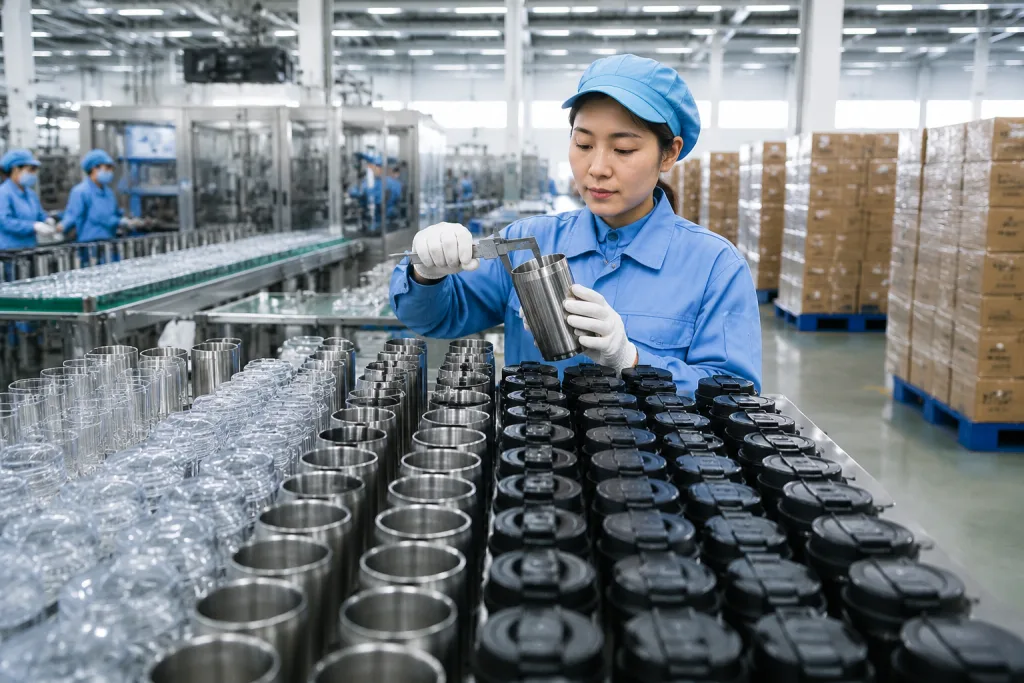
Start with the build. That is where the real bottle is defined. A serious stainless polypropylene bottle factory should split the spec into inner liner, outer shell, lid, gasket, and finish. If a quote only says “stainless steel bottle,” push back. Ask whether it is a single-wall canteen, a double-wall insulated custom canteen, or a hybrid body with PP outside parts. Those choices change unit cost, net weight, drop performance, and whether your customized drinkware claim holds up when the buyer checks the carton. On our line, QC will reject a drawing if the wall stack is missing by even 0.2 mm.
For most B2B programs, the line items are clear: 304 stainless inner wall, PP outer shell or lid parts, silicone gasket, and 0.4-0.6 mm steel thickness depending on volume and price target. At that spec, you get a solid balance between dent resistance and landed cost. Go thinner and the bottle starts looking weak after transit. Go thicker and freight weight climbs fast. This is the wrong question to ask if you only chase the lowest quote. A canteen supplier that works with export buyers will also tell you whether the steel is food-contact compliant and whether the PP is BPA-free, because those points show up in retail checks and procurement audits. We have seen a buyer flag a PO because the lid text said “BPA freee” with a typo.
- Inner liner: 304 stainless for mainstream canteen factory work
- Optional upgrade: 316 stainless for harsher use or premium custom growler lines
- Outer parts: PP for lighter weight and lower mold cost
- Seal: silicone, usually 50-70 Shore A depending on closure type
If the factory cannot explain the spec in one pass, you are probably dealing with a canteen vendor that outsources too much of the build. We run into this with sample sheets that bounce between 12 parts and 18 parts after the first preproduction check. The math does not work.
Capacity changes everything
I’ll rewrite the section in-place, keep the HTML structure unchanged, and make the copy sound like a factory-side sales engineer wrote it.Capacity looks simple, but it changes the whole commercial equation. A 350 ml bottle is a different product from a 750 ml or 1,000 ml canteen set for sports or hiking channels. We run this every week on the line. Smaller sizes are easier for gift programs and canteen promo orders because freight stays low and shelf space is tighter; larger sizes sell better in outdoor and workwear channels when the buyer needs a clear value story.
For example, a 500 ml stainless polypropylene bottle factory quote may land around USD 2.20-3.40 FOB China at 3,000 units, while a 750 ml version with a better lid and print treatment can move into USD 2.70-4.20 FOB. The math does not lie. More capacity means more steel, a larger mold, higher pack volume, and usually a pricier closure. QC pulled the sample and checked the wall thickness at 0.6 mm before release. If you are a canteen distributor, pick the capacity for the buyer’s use case, not the catalog photo.
Buyer impact: capacity changes price, carton efficiency, warehouse space, and retail price points. A 24-piece master carton filled with 500 ml units may fit 15%-20% better than a bulky 1,000 ml SKU. We’ve seen buyers flag this after the PO was already typed with the wrong carton count. That matters when you ship to Amazon FBA, club stores, or regional distributor warehouses in Europe and North America.
Wall thickness and weight
I’ll keep the HTML structure exactly as-is and rewrite the prose to sound like a factory-side sales engineer, with tighter, more concrete wording.Wall thickness is where a lot of margin disappears quietly. A 0.35 mm inner wall can pass a quick sample check, then start denting after packing, line handling, and a few drops in transit. For mainstream custom drinkware, 0.4-0.5 mm is the working range. On premium insulated models or a tougher custom growler, 0.5-0.6 mm gives better stiffness and a firmer hand feel.
Weight is not just a quality signal. A bottle that is 20% heavier can push carton weight into a higher freight class or cut units per pallet, and the math stops working fast. We ask every canteen manufacturer in Zhejiang to quote net weight and gross packed weight. If they leave one out, the buyer should flag it. At our line, QC pulls the sample on a 0.1 g scale before the carton spec gets approved, because export routes through Hangzhou and Ningbo punish sloppy weight control.
Rule of thumb: if the sample feels “too light to be safe,” it usually is. If it feels “premium” but the freight quote jumps, you added metal where you did not need it.
For most canteen suppliers, the sweet spot is 180-280 g, depending on size and insulation. We run into pushback when buyers want the wall thicker “just in case,” but that is the wrong question to ask. At that point the bottle turns into deadweight, and nobody wants to pay air freight on extra grams.
Lid, seal, and leak test
I’ll rewrite the section in-place, keeping the HTML tags and structure unchanged while tightening the sales-engineer tone and adding a few concrete factory details.The lid is where warranty claims start. The body can pass and still fail if the cap thread walks or the gasket sits loose. When you check a bottle factory, ask for the lid structure first: screw cap, flip top, push-button, one-hand open, or carry-handle lid. Each one breaks in a different way. A custom canteen for office use often runs fine with a plain screw cap; a promotional outdoor run usually needs a stronger loop and deeper thread engagement. We’ve had buyers flag a 0.3 mm thread mismatch on the first pre-production sample, and that tiny gap was enough to cause trouble later.
Leak testing needs a hard number. The factory should state whether they test inverted at room temperature for 24 hours, whether they use vacuum or pressure testing on insulated designs, and what defect limit they accept. For export runs, we normally ship against zero leakage in a 1 meter drop test plus a 24-hour inversion check on random samples. On the line, QC pulled one sample that dripped only after the second cap turn; that is the kind of issue the buyer should catch before carton loading. For AQL, many buyers specify 2.5 for major defects and 4.0 for minor defects on finished goods. That is the right question to ask; “looks fine” does not hold up in a claim.
For a customized canteen order, silicone gasket hardness and thread depth matter more than artwork. If your distributor order will be repacked or handled again and again, insist on a lid that survives at least 3,000 open-close cycles in internal testing. We run that test with a torque meter and a simple clamp jig, and the math does not work if the lid starts backing off after a few hundred cycles. Good drinkware factories in China can show this data if they already ship into export channels.
Print methods and logo durability
I’ll rewrite the section in-place, keep the HTML tags unchanged, and sharpen the copy with factory-floor detail, concrete numbers, and a more human sales-engineer tone.Logo choice changes the commercial result fast. Screen print is the low-cost option for flat branding, laser engraving leaves a permanent mark on stainless, and heat transfer works when you need full-color decoration on a curved body. A real stainless polypropylene bottle factory will tell you which method fits the substrate instead of pushing the pricier line. That is the difference between a decoration shop and a factory that ships custom drinkware every week.
For branded canteen custom work, laser engraving is usually the safer long-term call on stainless surfaces. We run a 0.2 mm depth check on the engraving sample before release, because shallow marks fade and the buyer flags it later. It costs more than one-color silk screen, but it holds up better in retail and corporate use. If you need a canteen promotional SKU on a tight budget, one-color print can keep FOB costs down by USD 0.08-0.25 per unit. The math works when you place 10,000 units.
Be exact about logo placement: body, lid, handle, or bottom mark. Ask the canteen supplier for artwork proof on the real dieline, not a flat PDF. QC pulled the sample once and found a 3 mm shift on the handle logo, which would have caused a clean rejection at packing. If you sell as a canteen vendor into multiple regions, confirm whether the print ink is REACH-compliant and ask for washing test results. Buyers in Europe usually want 50-cycle or 100-cycle wash resistance, while some North American accounts ask for dishwasher tolerance evidence.
MOQ, price, and lead time
I’ll rewrite the section in-place, keeping the HTML tags and structure unchanged while tightening the sales tone and adding concrete factory-floor detail.This is the part that usually closes the order. A solid stainless polypropylene bottle factory in Zhejiang will quote MOQ at 3,000 units per color for standard canteen factory models, with 5,000 units more common once the mold changes or the lid has a new structure. QC pulled the sample on a caliper at 0.2 mm tolerance. Sample lead time is usually 7-10 days, and mass production lands at 25-35 days after sample approval and deposit. If a supplier promises 12 days for everything, they are either sitting on stock or skipping checks you will pay for later.
FOB pricing depends on size, finish, and print method, but a workable benchmark for custom drinkware is USD 2.20-4.20 for mainstream stainless + PP canteen customized SKUs at 3,000-5,000 units. Premium double-wall versions, special coatings, or custom growler formats push it up. Add USD 0.10-0.40 for upgraded packaging, and another 3%-8% if you want individual retail boxes with barcode labels. The buyer flagged a PO typo once—“5000” instead of “5,000”—and the packing line caught it before print. That tiny error can wreck your landed margin.
Do not treat MOQ as a random number. It reflects mold cost, line setup, packaging stock, and the plant’s monthly output. A Zhejiang factory running 300,000+ units per month can handle multiple SKUs, but each changeover still eats hours. We run this math every week. The cleanest negotiation happens when you know whether you need one canteen distributor program, a regional launch, or a full canteen suppliers rollout across several SKUs.
Compliance for Europe and North America
I’ll rewrite the section in-place, keeping the HTML structure intact and tightening the sales-engineer tone. Then I’ll sanity-check that the wording stays specific, natural, and free of the banned filler.Compliance is not optional, and it is not paperwork you file at the end. If you sell to Europe, your stainless polypropylene bottle factory should know REACH chemical limits and have food-contact documents ready. For North America, buyers ask for FDA food-contact declarations, plus test reports tied to ASTM methods or the buyer’s own safety spec. If the bottle has a coating, paint, or printed ink, ask what was tested. “The bottle passed” is too vague for a PO pack.
For corporate accounts and retail channels, ask for BSCI, ISO 9001, or a similar audit file. Those papers do not make the product perfect, but they show the canteen manufacturer runs a controlled line. That matters on repeat orders out of China, especially when your QA team wants the same file set on batch 1 and batch 8. We have seen buyers flag a missing audit PDF over a 5,000-piece reorder, and the shipment sat for 6 days.
Practical checklist: material declarations, migration test reports if needed, carton drop test results, and clean country-of-origin labeling. If you need FSC packaging or a specific barcode format for FNSKU, say it before sampling; one typo on the PO can turn into a reprint. A good canteen vendor in Zhejiang handles that before QC pulls the sample. A weak one says “no problem,” then asks for revisions after the first 1,200 cartons are packed.
Send your spec for a fast factory quote
We turn rough concepts into export-ready canteen customized specs, with clear pricing, compliance documents, and realistic MOQ from Zhejiang.
Frequently asked questions
What MOQ should I expect from a stainless polypropylene bottle factory?
For standard canteen custom models, expect MOQ around 3,000 units per color. If you need a new mold, special lid, or customized canteen shape, 5,000 units is more realistic. Some Zhejiang factories can lower MOQ to 1,000-2,000 units for stock-body orders, but price usually rises 10%-18%. Always ask whether the MOQ applies per color, per logo, or per packaging version. That detail can change your budget more than the base FOB number.
Is 304 stainless enough for custom drinkware?
For most B2B custom drinkware programs, yes. 304 stainless is the standard choice for a canteen manufacturer because it balances corrosion resistance, availability, and cost. If you are building a premium custom growler or a higher-demand use case, 316 may be worth the upgrade, but it usually adds around 8%-15% to material cost. What matters more is the wall thickness, weld quality, and whether the factory can prove food-contact compliance on the finished bottle, not just the raw steel.
How long should production take in China?
A normal stainless polypropylene bottle factory schedule is 7-10 days for samples and 25-35 days for mass production after sample approval and deposit. If your order needs a new lid mold, add 20-30 days. Zhejiang factories with strong line capacity can move faster, but only if your artwork, packaging, and compliance documents are locked. Faster lead times often mean you are paying extra or taking more risk on inspection and packaging accuracy.
What inspection standard should I request?
For export orders, AQL 2.5 for major defects and 4.0 for minor defects is a common starting point. Ask the canteen supplier to define defect categories clearly: leakage, print misalignment, lid cracking, surface scratches, and carton damage. If your order is retail-facing, include drop testing and sealing tests in your PO. A good canteen factory in China should be able to share inspection reports, photo records, and lot-level traceability by batch.
Can I get one bottle style across multiple channels?
Yes, but you should adjust the spec by channel. A canteen distributor selling to corporate buyers may want a lower-price custom canteen with simple silk screen and basic packaging. A distributor drinkware program for retail may need barcode-ready cartons, stronger print durability, and a cleaner surface finish. If you sell to outdoor or fitness channels, consider a more robust custom growler or customizable canteen variant with better lid retention and thicker walls. One design can work across channels, but the spec should not stay identical.