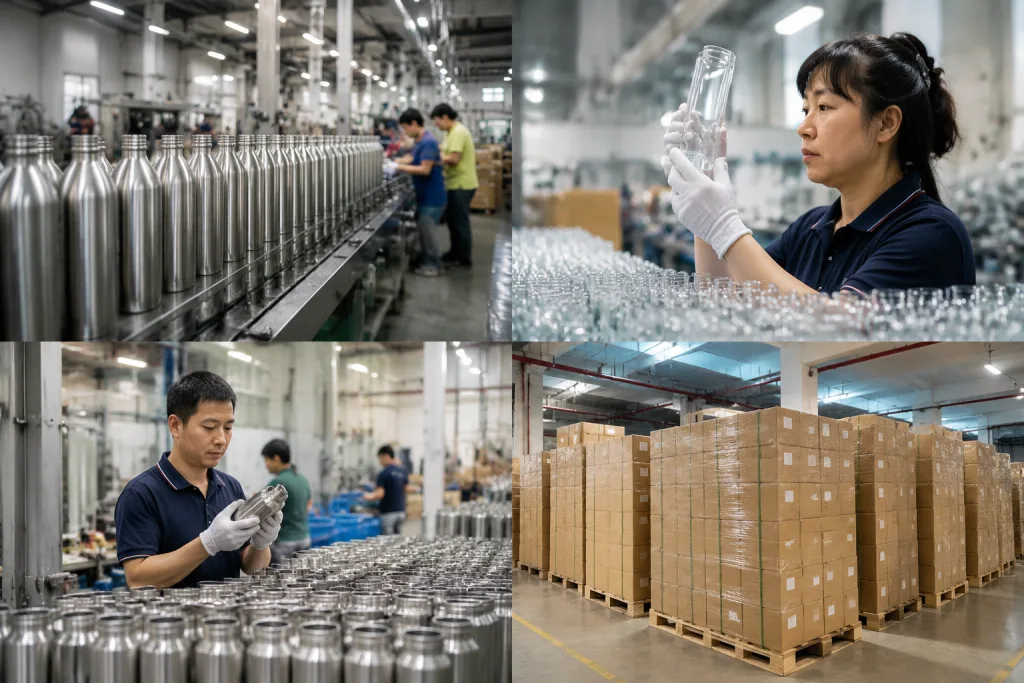
Key Takeaways
- MOQ for a typical custom drinkware order is often 3,000 to 5,000 units, while lead time runs 25 to 40 days after sample approval
- A proper stainless glass bottle build should pass REACH, food-contact checks, and drop testing before you commit
- Decoration choice changes both unit price and durability; laser engraving can cost USD 0.12-0.35 per unit, while print is often cheaper but less durable
- Packaging and freight can add 12%-28% to landed cost, so carton spec and palletization matter as much as the bottle itself
If you are comparing a stainless glass bottle manufacturer, the real question is not “who can make it?” It is “who can hold your spec, pass the target market’s rules, and still leave margin after freight, duty, and decoration?” On the line, the failures show up late: a cap that backs off after 1.8 N·m torque, glass that chips in carton drops, print that washes off after 50 cycles, or a MOQ that sits on cash for 90 days. We’ve seen that go sideways more than once.
Good buyers do not start with the quote. They start with the build: glass wall thickness, steel sleeve fit, lid seal, then compliance, then packaging, then forecast. That order saves time. A Zhejiang factory can turn a price in 24 hours, but the number only matters if the bottle fits your channel, whether you sell to a canteen distributor, a brand owner, or a drinkware program buyer. QC pulled the sample, checked the neck finish, and found the real issue before mass production. The goal is not a nice sample. It is repeatable production at 10,000 to 50,000 units with the same result every run.
Start With the Use Case
I’ll keep the tags exactly as-is and rewrite only the prose for a more shop-floor, sales-engineer tone. I’m also going to swap in a few concrete factory details and cut the generic wording.The first call is simple, and a lot of buyers still miss it: what job does the bottle need to do on day one? A stainless glass bottle manufacturer can build a retail piece, a corporate gift, a gym bottle, or a customized canteen for outdoor use, but the spec changes fast. If you want shelf appeal, glass visibility and print finish carry more weight. If you want utility, we check the stainless shell, lid seal, and breakage rate first.
For a custom canteen program, set the channel before you ask for a quote. A canteen promotional item for a 3-day event has a different price ceiling than a canteen customized for a national retail chain. A distributor canteen order may need mixed cartons and faster replenishment; a canteen manufacturer selling direct may push for a 500 pcs MOQ and tighter tolerances. On our line, the buyer flagged a PO typo once because the pack count said 24 but the master carton was built for 12, and that kind of miss burns time. We ask four things first: target retail price, annual volume, destination market, and whether the bottle ships loose, boxed, or in a multi-pack. If a supplier skips that, the quote is weak.
Here is the buyer logic I use:
- Retail gift: pay for finish, print quality, and unboxing.
- Promotional order: pay for lead time, clean decoration, and low waste on the line.
- Distributor stock: pay for stable specs, spare parts, and repeat runs.
- Outdoor/canteen use: pay for wall gauge, lid seal, and drop resistance.
This is where Zhejiang matters. A capable factory in Zhejiang usually has the molds, cap suppliers, and QC setup to move between these programs without rebuilding the bottle from scratch. We run that way at the bench too: QC pulled the sample, checked the lid torque at 1.2 N·m, and the part still held the brief. That is what you want from a canteen supplier if the same core bottle has to serve two or three channels without the math falling apart.
Lock the Material Stack
I’ll rewrite the section in-place, keep the HTML structure unchanged, and make the copy sound like it came from a factory-side sales engineer.The second decision is the build itself. “Stainless glass bottle” sounds simple, but buyers need the exact layer stack on paper. We run outer stainless shell, inner glass liner, and a PP, Tritan, or stainless cap. Shell gauge and glass thickness set the price and the failure rate. On our line, 18/8 stainless with 0.4 mm to 0.5 mm wall thickness is a normal mid-market spec, while the glass liner often sits at 1.8 mm to 2.5 mm depending on capacity and neck shape.
That extra 0.2 mm changes more than first-time buyers expect. It moves weight, drop survival, and freight. We had a buyer flag a PO typo once—1.8 mm turned into 1.6 mm—and QC pulled the sample because the bottle started cracking after the third drop test from 80 cm. If you need a custom growler or customizable growler format, the wall spec and neck finish matter even more because the larger volume pushes break risk up during filling and transit. The same math applies to a customizable drinkware line sold through a canteen vendor or canteen vendors network: a heavier build may add USD 0.20 to 0.60 per unit ex-factory, but it can cut claims and replacement shipments by more than that.
Ask for a material declaration by component, not a brochure line.
You want confirmation of:
- 304 or 316 stainless grade on the shell where applicable
- Borosilicate or soda-lime glass spec for the liner
- Food-contact compliance for cap and seal materials
- Odor, stain, and temperature resistance data
If you are buying a canteen customized for a cold-chain or hot beverage program, the lid seal is usually the weak point, not the bottle wall. We ship a lot of these, and the first pushback we hear is always the same: “Why spend more on a gasket?” Because the math works. A good canteen manufacturer should show torque tests, gasket material, and leak results at ambient and elevated temperature. That separates a sellable SKU from a returns headache.
Compliance Is Not Optional
I’ll keep the tags and structure intact, then tighten the prose so it sounds like a factory-side sales engineer, not generic copy. Next I’m rewriting each paragraph with concrete compliance details and a few line-floor cues.Compliance is the third decision, and this is where import programs get expensive fast. For Europe, we ship with REACH awareness, food-contact declarations, and lab reports from an accredited lab; for North America, buyers usually ask for California Proposition 65 screening, FDA food-contact support, and label checks that will not trip customs or marketplace review. If the bottle goes into gift, retail, or Amazon channels, you need documents, not口头 promises.
Ask the stainless glass bottle manufacturer for the full test scope. A one-page certificate is thin air. You want the lab name, test standard, sample photos, and the exact article tested; QC pulled the sample and wrote down a 0.3 mm ink crack on one run, so that detail matters. For a canteen distributor or distributor drinkware program, the real pain is chargebacks and blocked inventory. The math does not work if the paperwork is loose.
A practical compliance pack should include:
- Material compliance declarations by component
- Leak and thermal cycle test results
- Drop test or transit simulation data
- Carton and ink safety confirmation
Do not ignore decoration inks and coatings. A canteen promotional order with bright graphics can still fail if the ink cracks after dishwasher cycles or rubs off in carton testing, and we have seen that go sideways on a 5,000 pcs run. If you need canteen custom branding, tell the factory whether your channel expects 1 wash, 20 washes, or 50 washes of use. The ink set and cure time change; the line will ask for it if they know what they are doing.
Read the Quote Like an Engineer
I’ll rewrite this section in-place, keep the HTML structure untouched, and tighten the quote language so it sounds like a factory-side sales engineer.Most buyers compare quotes by unit price alone. That is too shallow. A proper quotation for custom drinkware should break out the bottle, lid, decoration, inner liner, packaging, and test fee. If those items are bundled into one line, you are probably looking at a teaser quote. On a normal canteen factory order, FOB China usually lands around USD 1.80 to 4.80 per unit, depending on size, print count, lid type, and packaging. We run laser logos cheaper to hold over time than multi-color print, but print still wins when shelf impact is the real goal.
When you compare canteen manufacturers or canteen suppliers, ask for the same basis every time:
- FOB port named explicitly
- MOQ by color and by artwork
- Sample charge and sampling lead time
- Mass production lead time after approval
- Carton quantity, carton strength, and pallet method
A decent factory in Zhejiang should be able to produce 30,000 to 80,000 units per month on mainstream drinkware lines. QC pulled the sample on a 50 ml leak test, and that same discipline should show up in the quote. Sample lead times usually run 7 to 12 days, with production around 25 to 40 days depending on season. If a supplier promises 10-day mass production on a complicated canteen customizable program, ask how they handle QA and packing. Fast sounds good. A rushed lot with 3% breakage is a headache, and the buyer flagged it for a reason.
The cleanest way to buy is to compare total landed cost, not just EXW or FOB. Once you add inner boxes, cartons, pallet wrap, ocean freight, duty, and destination handling, the quote can move 18% to 35%. We had a PO typo once where the buyer wrote 3,000 pcs but asked for 3,600 cartons on the same sheet; the math does not work. That is why smart distributor canteen buyers build a model before they place the PO.
Customization That Actually Sells
I’ll rewrite the prose in place, keep the HTML structure unchanged, and make it sound like a buyer-facing factory note rather than generic copy.Customization should fit the channel, not the factory floor. A custom canteen program can stay simple or turn into a cost trap. The right spec depends on the buyer: retail shelf, corporate gift, or an OEM line for a distributor canteen catalog. For promo orders, we usually run one-color pad print and a standard lid color. For a premium custom growler or customized growler, finish, label area, and carton art matter more than a fancy bottle shape.
A good canteen vendor will tell you what to change and what to keep standard. We see this on the line all the time: keep the body fixed, switch only the lid color and logo, and MOQ stays cleaner while tooling stays under control. Full mold changes, special matte coating, or embossed panels can add USD 500 to 3,000 in tooling and push sample approval out by 10 to 20 days. The math does not work for every SKU. We’ve seen buyers insist on a full redesign, then QC pulled the sample for a label mismatch and the launch slipped two weeks.
Think in layers:
- Brand layer: logo method, PMS color, packaging insert, barcode or FNSKU if needed
- Functional layer: lid seal, grip zone, anti-slip base, carry handle
- Commercial layer: MOQ, carton count, and replenishment speed
If you sell through retail, online, or distribution, the best canteen promotional spec is the one that protects margin. A canteen distributors network usually wants repeat orders, not a one-off showpiece. We’ve had buyers flag a PO for a 2 mm logo shift before mass run, and that saved a costly reprint. Custom should help sell the next 5,000 units, not impress people for one sample photo.
Packaging and Transit Decide Profit
I’ll rewrite just the prose inside the existing `` tags, keep the HTML intact, and make it sound like a field-tested sales engineer wrote it. Then I’ll return the cleaned HTML only.
Packaging is where a decent bottle quietly starts losing money. Glass still needs a hard shell inside stainless, and one crushed carton or hairline crack can wipe out the margin on that PO. We run enough trial drops to know the math: ask for an ISTA-style carton setup even if the factory never sends a full lab report. You want inner padding, drop resistance, and moisture control. On a custom canteen or distributor growler job, the carton spec can matter more than shaving $0.12 off the bottle.
Do not take “standard export carton” as a real answer. Ask for the board grade, single-wall or double-wall build, carton ECT, and whether each unit ships in an individual box. QC pulled a sample last month and found a weak corner on a 32 ECT carton; that sort of miss shows up fast on the line. A boxed unit usually cuts shelf damage and looks better at retail, but it raises cost and carton volume. For e-commerce or FNSKU labeling, the pack-out has to match warehouse handling, especially if the buyer flagged Amazon-style fulfillment or mixed pallet routes.
Packaging cost shifts by destination. We ship Europe orders with thicker master cartons when transit is 12 days longer and the route is rougher, while North America jobs often push pallet count and cube efficiency. On a 20,000-unit run, a packaging upgrade can add USD 0.08 to 0.25 per unit, and that is before the freight team notices the extra volume. This is the part where a serious canteen manufacturer or canteen supplier earns its keep: they protect landed margin, not just bottle price. The buyer saying “the carton looks fine” is the wrong question to ask.
One rule we use: if trial-shipment breakage is above 1.5%, stop and rework the pack before scaling. We’ve seen that go sideways more than once. Adding a little corrugate in China costs less than paying claims on a full container after arrival.
Choose the Right Supplier Relationship
I’ll rewrite the section in place, keeping the HTML structure and sharpening the sales-engineer tone while preserving the core meaning.The last decision is commercial, not technical. Are you buying from a canteen supplier for one campaign, or building a supply base for the next 4 quarters? If you only need one seasonal run, a canteen promotional order with limited tooling can be enough. If you are building a category, you need a factory partner that can repeat the same spec next quarter with the same cap torque, print placement, and carton count. We run this check on the line with a torque wrench at 0.6–0.8 N·m, because that is where small drift shows up.
Ask if the factory runs in-house assembly or pushes key steps outside. In-house assembly usually gives tighter control over leak rate and color consistency. Outsourced steps can still work, but only if the vendor keeps incoming inspection tight and actually does final AQL checks. For drinkware, AQL 2.5 for major defects and 4.0 for minor defects is a common start, though some buyers tighten that on premium lines. QC pulled the sample on a 500 ml bottle last month and caught a crooked logo before it became a PO dispute.
Good suppliers in Zhejiang will tell you straight what they can hold and what they cannot. That honesty matters. It separates a real canteen factory from a trading layer in a day. It also tells you how to scale. A true long-term partner can support a custom drinkware roadmap, but only if you give forecast, target price bands, and channel priorities. If you need canteen manufacturers that can support seasonal replenishment, ask for monthly capacity, machine count, and whether they reserve line time for repeat POs. We had a buyer flag a PO typo once, 5,000 pcs became 50,000, and the math did not work until we fixed the paper trail.
Buy on repeatability, not on the prettiest sample. The sample gets the first order; the production line decides your margin.
That is the right lens for a distributor canteen or distributor drinkware catalog in China-linked supply chains. The best outcome is not the lowest first quote. It is the supplier who can hold spec, ship on time, and keep claims low for the next 12 months. We have seen this go sideways when a buyer chased a 3% cheaper quote and lost two weeks on carton rework.
Send your spec and get a real quote
Share target price, MOQ, and market requirements. We’ll map the build, tests, and packaging before you commit.
Frequently asked questions
What MOQ should I expect from a stainless glass bottle manufacturer?
For a mainstream stainless glass bottle program, MOQ is often 3,000 to 5,000 units per design and color. If you add a custom lid, special packaging, or multiple decoration positions, the MOQ can move to 8,000 units or more. For a simple canteen custom order with standard components, some factories in Zhejiang can start lower, but the unit price usually rises by 8% to 18%. Ask whether MOQ is per artwork, per bottle shape, or per carton spec, because those are not the same thing.
How long does production usually take?
After sample approval, most orders take 25 to 40 days. A very standard canteen customized run with common parts may finish in 20 to 25 days, while a custom growler with special packaging or new tooling may need 45 days or more. Sample lead time is usually 7 to 12 days. If a canteen factory promises unusually fast shipping, ask whether that includes decoration curing, full inspection, and carton drop testing. Speed without QA is just a faster problem.
What tests should I request before ordering?
At minimum, request food-contact compliance, leak testing, thermal cycle testing, and transit drop testing. For Europe, add REACH-related support and full material declarations. For the US, ask for regulatory support on inks, coatings, and contact materials. A serious canteen manufacturer should also share AQL inspection plans, typically around AQL 2.5 major and 4.0 minor defects. If the bottle is promotional or retail-ready, ask for rub resistance on the logo and dishwasher-cycle resistance if relevant.
How much does customization add to unit price?
Basic logo printing may add USD 0.05 to 0.20 per unit, while laser marking often adds USD 0.12 to 0.35 per unit depending on size and complexity. A custom lid color can add USD 0.08 to 0.25. Special packaging can add another USD 0.10 to 0.40. If you change tooling or need a fully customized canteen body, the upfront mold cost may be USD 500 to 3,000. The right mix depends on whether you are building a canteen promotional program or a long-term retail line.
How do I know if I’m dealing with a real factory or a trading company?
Ask for machine photos, daily output, inspection流程, and whether they control assembly in-house. A real canteen factory should be able to explain monthly capacity, for example 30,000 to 80,000 units, and show how they manage incoming QC, in-process checks, and final packing. A trading layer may still help, but it will often be vague on line balance, defect handling, or exact lead time. If you are sourcing from China, insist on sample consistency across two lots before you place a bigger PO.