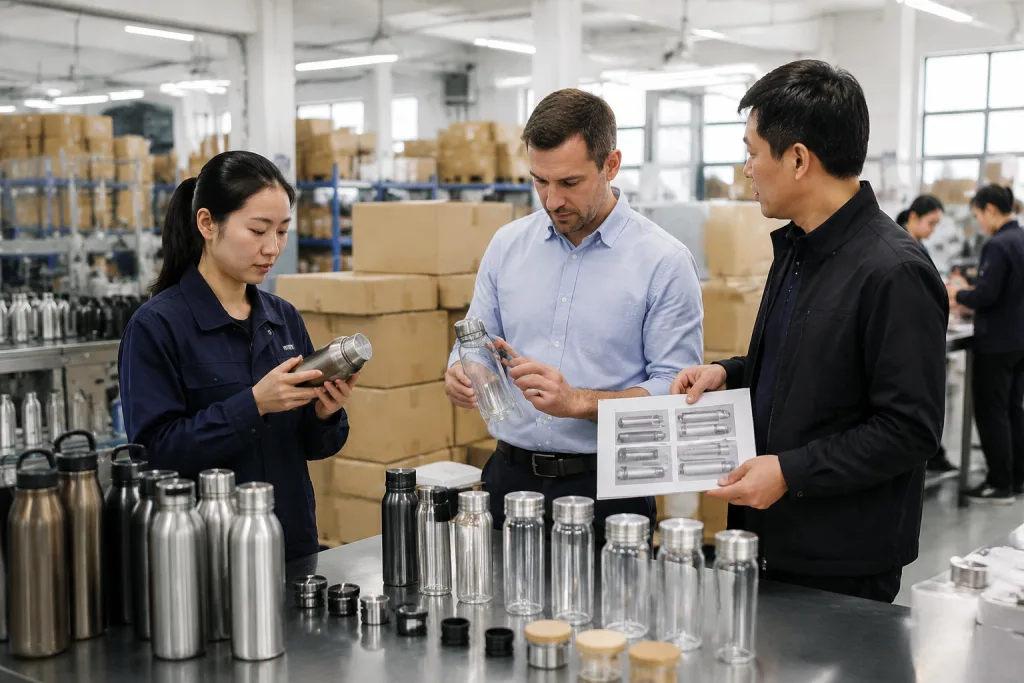
Key Takeaways
- A workable RFQ needs capacity, material grade, lid type, decoration method, packing, MOQ, and target FOB price
- Typical MOQ for customized drinkware is 1,000-3,000 units per color, depending on mold and finish
- Pre-production samples usually take 7-12 days after artwork and deposit approval
- Bulk orders should lock AQL, carton specs, barcode rules, and spare parts before production starts
A stainless glass bottle custom project sounds simple until the RFQ hits our desk. One buyer means borosilicate glass with a 304 stainless infuser. Another means double-wall stainless steel with a glass inner liner. A third wants a canteen custom program with a 1-color logo, retail box, and 3 mixed body colors for distributor drinkware. Last month QC pulled a 500 ml sample because the lid gasket was 1.2 mm off the groove, and that tiny mismatch changed the leak-test result.
If you ask for price before defining the bottle, this is the wrong question to ask. You get soft quotations, then the math breaks at sample stage or after the bulk PO. In our Zhejiang line, cost trouble usually starts with 5 items: capacity, lid material, decoration area, packing, and inspection terms. We run the RFQ path with buyers from drawing to sample to bulk PO, and we ask for details early because we have seen a “750ml” typo on a PO turn into 3 days of email cleanup before production could start.
Define the bottle before pricing
I’ll keep the HTML intact and rewrite each paragraph so it sounds like a buyer-facing sales engineer, with concrete specs and factory-floor detail.Start with the build, not the photo. For stainless glass bottle custom sourcing, we usually split the line into three buckets: borosilicate glass bottle with a stainless lid or sleeve, stainless steel outer shell with a glass liner, and stainless vacuum bottle with a transparent window or tea infuser. They quote differently, pass different tests, and pack differently. QC pulled these apart on the line before—same “glass bottle” label, three separate cost sheets.
Your RFQ needs capacity in ml and oz, body diameter, height limit, mouth width, lid material, gasket material, and whether the bottle has to fit a cup holder. For Europe and North America, 500 ml, 600 ml, 750 ml, and 1,000 ml are standard sizes. If you are ordering a custom growler or customized growler, 1.9 L and 2 L make more sense than asking a bottle factory to stretch a normal canteen mold. The buyer flagged that mismatch fast on one order, and the math did not work.
Material calls need numbers. For stainless parts, ask for SUS304 or SUS316 where needed. For glass, specify high borosilicate glass, usually 2.0-2.5 mm wall thickness for portable bottles. For silicone, request food-contact grade and no strong odor after boiling water tests. If the bottle has a stainless sleeve, call out 0.4-0.6 mm thickness, depending on forming and dent resistance. We’ve seen a 0.35 mm sleeve come back too soft after a drop test.
A clean PO line item at this stage reads like this: 750 ml borosilicate glass bottle, SUS304 stainless cap, food-grade silicone seal, matte powder-coated stainless sleeve, 1-color logo, individual kraft box, FOB Ningbo. That line gives the canteen manufacturer enough detail to quote without guessing, and it avoids the typo trap we see all the time—one missing “SUS304” can change the whole quote.
Build an RFQ factories can use
I’ll rewrite the section in-place, keep the HTML structure unchanged, and tune the prose to sound like an experienced factory sales engineer.A good RFQ is short. It is complete. When you send a one-page RFQ to canteen suppliers in China, state your annual forecast and first order quantity. A canteen factory does not need a five-year deck, but it does need to know whether you are testing 1,000 units or pushing a 60,000-unit retail program.
At BottleForge Industrial in Hangzhou, Zhejiang, we run about 450,000 drinkware units per month across stainless bottles, tumblers, glass bottles, and canteen customized jobs. Our standard MOQ starts around 1,000 units per SKU for existing shapes. For new color coating, mixed lids, or retail packaging, 2,000-3,000 units makes more sense. If the buyer asks for a new mold, the MOQ moves up fast because tooling, trial loss, and line setup all hit the cost sheet.
Ask every canteen supplier to quote the same terms: FOB Ningbo or Shanghai, EXW if you have your own consolidator, lead time after deposit, sample cost, mold cost if any, carton size, gross weight, and HS code. This is the wrong question to ask only on price. We’ve seen shipments go sideways when the master carton cube was missing; freight on one 40HQ batch changed the margin by 6-12%.
Your RFQ attachment should include artwork in AI or PDF, logo size in mm, Pantone colors, packaging dieline if available, barcode rules, and the destination compliance list. QC pulled the sample on a Germany order last month because the file had a 0.3 mm logo shift that the buyer flagged. A distributor canteen order for Germany may need LFGB and REACH, while a U.S. retail order needs FDA food-contact documentation and California Proposition 65 review. Put those details in the RFQ before price talk starts.
Compare quotes beyond unit price
I’ll rewrite the section in-place, keeping the HTML tags and the original structure intact while tightening the sales tone and adding a few concrete factory details.The lowest unit price is often the least explained price. On the line, we split every quote into product, decoration, packing, inland freight, tooling, testing, and sample charges. A bottle quoted at USD 3.10 can land at USD 3.55 once you add the color box, laser engraving, silica bag, barcode label, and reinforced carton. We’ve seen the buyer flag a PO because the carton spec was missing.
For stainless glass bottle custom work, check the lid structure first. A cheap lid uses a thin stainless cover over PP; a stronger one uses a heavier stainless shell, a thicker silicone gasket, and better thread engagement. Ask for exploded photos or component weights. QC pulled one sample at 16.4 g and another at 28.1 g, and the hand feel was not even close.
Decoration method changes both cost and risk. Silkscreen is the low-cost choice for one or two flat colors, usually adding USD 0.05-0.18 per unit depending on size. Laser engraving on stainless is durable and clean, often USD 0.10-0.25 per unit. Full-wrap heat transfer, water transfer, or UV printing can work for canteen promotional projects, but the math does not work unless you approve abrasion tests and color tolerance before mass production. We run a 600-rub test for this reason.
Useful PO line items here include: unit price based on approved sample only, price includes 1-position logo, 1 retail box, 1 barcode label, export carton, and no material substitution without written buyer approval. Put those in black and white. A PO typo on the box count can turn a clean quote into a messy claim.
Sample with production intent
I’ll rewrite the section in-place, keeping every tag and the same structure, while tightening the sales-engineer tone and adding the factory-floor details you asked for.Samples should answer production questions, not just look good in a sales deck. For customized drinkware, we split them into stock sample, logo sample, and pre-production sample. A stock sample checks shape, capacity, mouthfeel, lid seal, and packing concept. A logo sample checks decoration size, color, and position. A pre-production sample locks in the exact materials and process before the bulk line starts.
Typical sample timing from Zhejiang is 3-5 days for stock samples, 7-12 days for logo samples, and 10-15 days if special coating, new sleeve color, or new packaging is involved. International courier to Europe or North America usually adds 3-6 working days. We had one buyer flag a PO that asked for “same as sample” with no artwork file; that kind of order slows the line. If someone promises a fully custom sample in 48 hours, ask which part is actually custom.
Your sample PO should be specific: quantity, sample type, decoration method, courier account, approval deadline, and whether the sample cost is refundable against bulk order. For example: 3 pcs 750 ml bottle with laser logo, 2 pcs unprinted control samples, matte black sleeve, kraft box mockup, ship by DHL, sample fee credited after 3,000-unit PO. One missing digit can waste a day; we once saw a buyer write 7500 ml on the draft, and the math did not work.
Test samples in a boring, repeatable way. Fill with 95°C water if the product claims hot liquid use. Turn upside down for 30 minutes. Shake for 60 seconds. Check odor after 24 hours closed. For glass liner or borosilicate bottle projects, inspect bubbles, scratches, rim smoothness, and thickness consistency with a caliper. If you are developing a customizable canteen for outdoor use, drop testing in final packaging matters more than a pretty studio photo.
Lock compliance and inspection terms
I’ll rewrite the HTML in place, keep the tags and structure intact, and make the prose sound like a field-tested factory sales note.Compliance is not a certificate stuck on a quotation. It is the material spec, test report, and control point for your market. For North America, buyers usually ask for FDA food-contact declarations, ASTM-related physical checks where they apply, CPSIA for children’s items, and a Prop 65 risk review. For Europe, REACH, LFGB food-contact testing, and packaging waste rules may apply. If the bottle is for kids, do not treat it like a normal canteen promo piece.
Factory audits matter too. A BSCI or similar social audit can carry weight for retail programs. ISO 9001 helps, but it does not replace incoming material checks or final inspection. Ask canteen manufacturers for the current audit scope, not a logo on a PDF. We have seen buyers get burned by a trading office that passed the audit while the actual line sat in another plant 18 km away.
Inspection terms should be written into the PO before deposit. We run AQL Level II for general inspection, with critical defects at 0, major defects often at 2.5, and minor defects at 4.0 unless your retailer wants tighter limits. Define critical defects in plain language: leaking, broken glass, sharp edge, wrong material, failed barcode, wrong logo, mold contamination, and carton damage that hurts saleability. The math does not work if the buyer only says “good quality” and leaves the rest open.
For stainless glass bottle custom orders, add in-process checks when the order is over 10,000 units or has more than 2 colors. A mid-line inspection catches coating shade drift, crooked prints, and gasket mistakes before 30,000 lids get boxed. We once had a buyer flag a PO typo on the cap color code, and QC pulled the sample from the line before it turned into a full rework. The PO should state: final inspection before balance payment, buyer or third-party inspector allowed, factory to provide packing list and production photos 3 days before inspection.
Write the bulk PO properly
I’ll rewrite the prose to sound like a factory-side sales engineer, keep the HTML exactly as-is, and make the PO advice sharper with a few concrete shop-floor details.The bulk PO is where a distributor drinkware project either stays under control or turns into a mess. Do not write only “custom canteen, 5,000 pcs, black, logo.” Write the SKU so a new buyer, our warehouse, and the accounts team in China can read it once and ship the same thing without calling back.
A clean PO line needs product name, capacity, material, finish, decoration, packing, quantity per color, unit price, Incoterm, shipment port, lead time, payment terms, inspection terms, and the approved sample reference. Example: SKU BF-GB750, 750 ml borosilicate glass bottle with SUS304 stainless sleeve and cap, matte black powder coating, laser logo 45 x 18 mm, individual color box, 24 pcs/carton, 3,000 pcs, USD 3.42/pc FOB Ningbo, 35 days after deposit and artwork approval. QC pulled this kind of line on the line last month because the carton spec was missing 24 pcs/carton, and the pack-out sheet had to be redone.
If you need Amazon or marketplace prep, put it in the PO before we run the order. FNSKU labels, suffocation warnings, carton labels, polybag thickness, and pallet limits all change labor and packing flow. For distributor canteen shipments into regional warehouses, ask for carton marks by SKU, color, PO number, quantity, net weight, gross weight, and country of origin. The buyer flagged one PO typo on “gross wt.” vs “gross weight,” and receiving sat for 5 days because the warehouse team treated it as an incomplete instruction.
Payment terms for new buyers are usually 30% deposit and 70% before shipment after passed inspection. Repeat accounts with stable forecasts can ask for better terms, but on a first order the math does not work if you push credit before we know the artwork, the label count, and the carton test result. Bulk lead time from Zhejiang, China is commonly 30-45 days for existing molds and 45-60 days when a new mold, a complex coating, or custom retail packaging is involved; we’ve seen a 5,000 pc run slip from 32 days to 41 because the sleeve finish failed the first rub test.
Also list spare parts if the program will run more than one season. Extra lids, silicone rings, and sleeves cost little when the line is open, then get expensive after the line closes. For a canteen distributor, ordering 1-2% spare lids usually saves customer service cost later, and 100 extra lids on a 5,000 pc PO is cheaper than air-shipping replacements after launch.
Manage shipment and reorder data
I’ll rewrite the four paragraphs in place, keep the HTML unchanged, and make the language sound like a real factory-side sales engineer.After inspection passes, you still need shipping data that holds up on paper. Confirm carton dimensions, container loading estimate, actual gross weight, and the final packing list before you pay the balance. On the line, we check carton compression at 200N and the buyer usually flags any mismatch before booking. For glass and stainless mixed products, carton strength is not a side issue. A five-layer export carton works for many projects; a heavier custom growler order may need 7-layer board, dividers, corner pads, or pallet loading.
Ask your canteen supplier for the records that matter on a reorder: coating batch, logo film or laser file, approved Pantone, box dieline, carton mark, test reports, and the inspection report. Keep them in your own folder, not just in someone’s email. QC pulled the sample once and found a PO typo on the carton mark; that kind of miss costs time. If you change canteen vendors later, or your buyer asks for a repeat after 14 months, these files save you from starting from zero.
Reorders are not automatic clones. Check whether raw material prices moved, whether packaging rules changed, and whether the same factory line is open. Stainless steel, cartons, and freight all shift. The math does not work if you assume last quarter’s quote still fits. A proper reorder confirmation takes 2-4 working days, not two minutes, when the canteen manufacturers are checking coating, packing, and stock on hand.
For brand owners and canteen distributors, the long-term win is not squeezing USD 0.03 from every order. It is stable specs, clean forecasts, and fewer surprises. A canteen factory in China plans coating, assembly, and inspection better when you share a rolling 90-day forecast and keep SKU changes under control. We ship faster when the buyer sends one clear revision instead of three. That is how custom drinkware stays profitable after the sample is approved and the first order is gone.
Send your bottle RFQ for a practical quote
Share capacity, artwork, MOQ, target market, and packing needs. We will return a factory-level quotation with lead time and sampling plan.
Frequently asked questions
What is the normal MOQ for a stainless glass bottle custom order?
For existing bottle shapes, MOQ is usually 1,000 units per SKU if you accept standard colors and simple logo work. For custom coating, mixed lid colors, or retail packaging, expect 2,000-3,000 units per color. New mold development can require 5,000 units or more because tooling, trial production, and material setup must be absorbed. If you are a canteen distributor testing a new channel, ask for a pilot order using a stock mold with custom logo and box. That keeps the first PO manageable while still giving you a sellable customized canteen.
How long does sampling and bulk production take from China?
Stock samples usually take 3-5 days before courier shipment. Logo samples normally take 7-12 days after artwork approval, and pre-production samples with special color coating or packaging can take 10-15 days. Bulk lead time from Zhejiang, China is commonly 30-45 days for existing molds after deposit and sample approval. If you need a new mold, special finish, or several packaging versions, plan 45-60 days. Add ocean freight time separately: roughly 25-35 days to many North American ports and 30-40 days to many European ports, depending on route.
Which logo method is best for stainless and glass bottles?
For stainless sleeves or caps, laser engraving is the safest long-term option because it will not peel and handles dishwasher exposure better than many inks. Cost is often around USD 0.10-0.25 per unit depending on logo size. Silkscreen is cheaper for simple one-color logos, often USD 0.05-0.18 per unit, but needs abrasion and adhesion checks. On glass, screen printing or decal transfer is common; UV printing works for colorful artwork but needs scratch testing. For canteen promotional orders, do not choose by photo only. Approve the physical sample and specify logo size in mm.
What should I include in the PO for customized drinkware?
Your PO should include SKU, capacity, material grades, finish, decoration method, logo size and placement, quantity per color, unit price, Incoterm, packing method, carton quantity, lead time, payment terms, inspection standard, and approved sample reference. Add compliance requirements such as REACH, LFGB, FDA, or Prop 65 if relevant. For marketplace or distributor drinkware shipments, include barcode, FNSKU, carton labels, and pallet rules. A vague PO creates room for mistakes. A clear line such as “750 ml borosilicate glass, SUS304 cap, laser logo 45 x 18 mm, 24 pcs/carton, AQL II” is much safer.
How do I know if a canteen supplier is a real factory?
Ask for a business license, factory address, audit reports, production photos, and a live video walk-through showing forming, coating, assembly, inspection, and packing areas. A real canteen factory should answer questions about monthly capacity, MOQ, in-house processes, subcontracted processes, and defect control without hiding behind sales language. Check whether the invoice company matches the factory or whether you are dealing with a trading office. Trading companies can be useful, but you should know the role. For orders above 10,000 units, consider a third-party factory audit or at least a pre-shipment inspection under AQL terms.