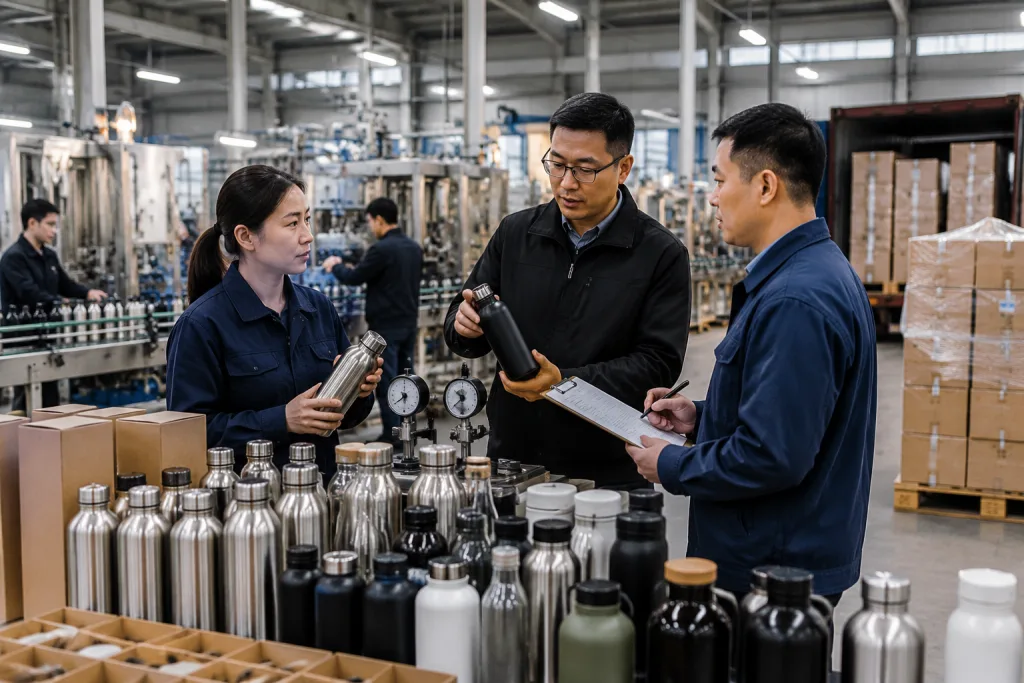
Key Takeaways
- A realistic MOQ is 1,000-3,000 pcs per SKU for custom colors and 500 pcs for some stock stainless models
- Typical FOB China prices range from USD 2.20 for basic glass bottles to USD 9.80 for 64 oz vacuum growlers
- Normal production lead time is 30-45 days after artwork and deposit, plus 20-38 days ocean freight to Europe or North America
- Decoration, lid tooling, gift box packaging, and AQL inspection can add 8-25% to the landed cost
If you search for stainless glass bottle bulk, you are likely mixing two quote baskets: 304 stainless steel bottles and vacuum tumblers on one side, glass bottles with silicone sleeves or stainless caps on the other. Same sourcing desk. Different failure points. A vacuum bottle gets rejected for heat-retention loss or a pinhole at the weld; a glass bottle gets rejected for chipped rims, sleeve fit, or a cracked inner carton after a 1.2 m drop test. Last month QC pulled 32 pcs from a pilot run because the silicone sleeve sat 1.5 mm high and blocked the cap from closing flat.
From our factory base in Zhejiang, China, we see buyers lose 5 to 12 days when they ask only for a unit price. That is the wrong question to ask first. For drinkware bulk orders, the real quote depends on MOQ, decoration method, wall thickness, lid structure, carton drop-test standard, and whether your market needs REACH, LFGB, FDA, or ASTM files. We run quotes with a caliper on the mouth diameter, a scale on the packed carton kg, and the actual PO spec in front of us; one buyer once typed “350 ml” instead of “500 ml,” and the math did not work after the mold check.
What buyers mean by this search
I’ll rewrite the prose in place, keep the HTML exactly as-is, and tighten the buyer language so it sounds like a factory-side sales engineer wrote it.The phrase stainless glass bottle bulk is not a clean factory category. Buyers throw it into RFQs when they want one China supplier to cover stainless steel bottles, glass bottles, canteen bulk programs, and sometimes growler wholesale items. That works on paper. On the line, we split it by material and use case before we price anything.
A stainless vacuum bottle gets priced on inner wall grade, outer wall gauge, vacuum retention, copper coating, lid seal, and powder coating. A glass bottle is a different game: borosilicate thickness, sleeve material, cap structure, breakage allowance, and carton protection. A bulk growler or beer tumbler bulk order adds alcohol contact, carbonation pressure, and local labeling rules. One certificate does not cover every SKU. The buyer flagged this on a 20,000 pcs order, and QC pulled the sample again.
For a brand owner, the sourcing basket usually looks like this: 500 ml stainless bottle, 750 ml glass bottle with silicone sleeve, 1 L bulk canteen, 64 oz beer growler wholesale bulk, and 12 oz alcohol flask wholesale item. Each SKU needs its own MOQ, carton size, test plan, and artwork file. If a supplier gives one blended price for all of it, the math does not work. Ask for the breakdown. We had a PO last month with a wrong lid code on the glass bottle, and that typo cost two days.
In Zhejiang, we usually quote FOB Ningbo or FOB Shanghai. Our stainless line runs about 450,000 units/month across bottles, tumblers, and canteens, and the standard custom MOQ is 3,000 pcs per color for new powder coating. Stock colors can go lower, but stock is not a sourcing plan if you need repeat retail programs. We ship better when the spec is fixed early.
FOB price ranges that are realistic
I’ll keep the tags and structure intact, then rewrite the prose to sound like a real sourcing note with cleaner pricing language and a few factory-floor specifics.FOB price shifts with steel grade, glass thickness, cap design, decoration, and order quantity. The cheapest line on a quote sheet usually leaves out carton tests, inner bags, or the lid your sales team already promised. For stainless glass bottle bulk, ask for an itemized FOB quote, not one number with no breakdown. We run into this every week at the line.
- Glass bottle, 500-750 ml: USD 2.20-4.10 FOB China with borosilicate glass, silicone sleeve, and basic PP or stainless cap.
- Single-wall stainless sports bottle, 600-800 ml: USD 2.60-4.30 depending on 201 or 304 stainless steel, wall thickness, and cap type.
- Double-wall vacuum bottle, 500-750 ml: USD 4.20-7.20 with 304 inner wall, 201 or 304 outer wall, powder coating, and laser or screen logo.
- Bulk canteen or wholesale canteen, 1 L: USD 4.80-8.50 depending on handle, cup cap, strap, and insulation requirement.
- Bulk growler, 64 oz: USD 7.20-9.80 for vacuum insulated stainless construction; beer growler wholesale bulk with swing lid or pressure-rated lid may be higher.
- Alcohol flask bulk, 6-8 oz: USD 1.35-2.80 for 201 or 304 stainless steel, with gift box and funnel quoted separately.
For drinkware wholesale, material grade drives the commercial result. 304 stainless steel is the safer default for food contact and export claims. 201 stainless steel cuts cost by 8-15%, but we’ve seen it go sideways when buyers add citrus drinks, salt water, or dishwasher cycles. For glass bottles, 2.0-2.5 mm borosilicate wall thickness is standard; thicker glass feels better in hand, though it pushes carton breakage risk and freight weight. QC pulled the sample and measured 2.3 mm with calipers—good, but not a place to guess.
If you need the best wholesale drink bottle for a retail launch, this is the wrong question to ask: don’t chase the bottom 5% of quotes. Put that money into a better lid gasket, 1.0 m drop-test packaging, and AQL inspection. The math works. One typo on a PO can flip a 304 lid to 201 and cost you the whole season.
MOQ tiers change the whole quote
I’ll rewrite the section in-place, keep the HTML tags exactly as-is, and tighten the copy so it sounds like a factory-side sales engineer wrote it.MOQ is not a factory trick; it is where raw material, coating, printing, and packing lines start to run clean. For custom drinkware bulk, most factories in China quote differently at 500, 1,000, 3,000, and 10,000 pcs. If you ask for 12 colors at 500 pcs each, that is not a 6,000 pc order in the factory’s eyes. It is 12 small runs, 12 setup fees, and 12 chances for the line to slow down.
For stainless bottles and canteens, 3,000 pcs per color is the practical MOQ for powder coating. We have run 1,000 pcs before, but the coating surcharge usually adds USD 0.25-0.60 per unit. At 500 pcs, the buyer gets stock colors, laser engraving, and plain cartons; that is the wrong question to ask if you want full customization. QC pulled one 500 pc sample once, and the carton color typo came from the PO, not the machine.
Glass bottle orders follow a different pattern. 1,000-2,000 pcs per sleeve color is common, while molded caps or bamboo lids often need 3,000-5,000 pcs. On one sleeve job, the buyer flagged a 1.5 mm print shift, and we fixed it before packing, but the numbers still mattered more than the artwork. If the cap spec changes, the math changes with it.
Growler bulk and beer tumbler wholesale orders have a different MOQ pattern because the body size is larger and tooling is less flexible. A 64 oz bulk growler may start at 1,000 pcs if the mold exists, but custom lid tooling can need USD 1,200-3,500 upfront and 5,000 pcs to amortize well. Alcohol flask wholesale bulk programs can start lower, around 1,000 pcs per logo, because the body is simple and cartons are small. We’ve seen this go sideways when a buyer split the order into four colors, then wondered why the unit price jumped.
Here is the honest purchasing advice: consolidate colors before you chase pennies. Three colors at 3,000 pcs each will usually price better and ship faster than nine colors at 1,000 pcs each. For canteen wholesale and wholesale growler programs, fewer lid variants also cut QC risk, because leakage testing on the bench is easier when we run one closure spec instead of three.
Decoration costs buyers underestimate
I’ll rewrite the section in place, keep the HTML exactly as-is, and tighten the prose so it reads like a factory-side sales engineer wrote it. Then I’ll quickly sanity-check for the banned filler and keep the decoration cost details concrete.Logo work is where wholesale drinkware budgets slip. A clean FOB quote looks fine at first, then the proforma picks up laser engraving, screen print, PMS matching, barcode labels, hang tags, and gift boxes. We see it on the line all the time. None of these items is exotic, but each one changes lead time and unit cost.
Laser engraving on stainless steel is steady work for 500-5,000 pc orders. It usually adds USD 0.10-0.35 per position, depending on logo size and whether the coating has to be stripped cleanly. One-color silkscreen printing often adds USD 0.08-0.18. Multi-color logos need screens, tighter registration, and a bigger reject allowance. Full-wrap heat transfer or sublimation on tumblers can add USD 0.45-1.20. For glass bottles, QC pulled the sample and checked adhesion, dishwasher claims, and sleeve clearance before we green-lit the run.
Packaging is the other line item buyers miss. A white box may add USD 0.12-0.25; a printed retail box is often USD 0.35-0.90, driven by paper weight and finish. For Amazon FBA or distributor warehouse handling, you may need FNSKU labels, polybag warnings, master carton labels, and a 5-ply export carton. For one 12,000-piece glass bottle bulk order, the buyer flagged a 3% breakage target, and the math did not work until we switched to inner boxes with dividers.
If you are sourcing beer growler in bulk or beer tumbler in bulk for breweries, ask early about laser marking, capacity marking, and local alcohol labeling. For alcohol flask in bulk, some markets want stainless grade and food-contact declarations in plain black and white. Decoration is not just branding. It can turn into a compliance issue or a return claim fast.
Lead time from sample to shipment
I’ll rewrite the section in-place, keep the HTML exactly as-is, and tune the copy to sound like a factory-side sales engineer with concrete lead-time details.A normal timeline for stainless glass bottle bulk projects runs 55-90 calendar days from first RFQ to vessel departure. Buyers often count only production days and then get hit by artwork approval, sample shipping, deposit waiting, carton mark confirmation, and inspection booking. We run the line on a critical path, not wishful thinking. A supplier who cannot show that path clearly is guessing.
For existing molds, quotation and technical confirmation take 2-4 working days if your RFQ includes capacity, material, lid photos, logo file, target price, order quantity, and destination country. QC pulled the sample on a 12 mm logo placement check before release. Pre-production samples take 7-12 days for stainless items with laser logo, and 10-18 days for custom coating or glass bottle sleeve colors. International sample courier adds 3-6 days to Europe or North America.
Mass production usually takes 30-45 days after deposit and approved sample. During peak season, especially August to November in Zhejiang and other China manufacturing regions, add 7-15 days. A buyer once pushed for 35 days on a 20,000-piece order, but the math does not work when custom lid parts are in the job. A bulk growler or wholesale canteen with custom lid parts may need 45-60 days if tooling is involved. Beer growler wholesale and beer tumbler wholesale orders should also leave room for leak testing and thermal performance checks.
Final inspection should be booked when goods are at least 80% packed. Allow 1-2 days for AQL inspection, plus 2-5 days if rework is needed. We have seen a PO typo on carton marks cost one extra day at the warehouse, so this is not the place to rush. Ocean freight from Ningbo to Los Angeles is often 18-25 days port to port; Ningbo to Rotterdam or Hamburg is commonly 30-38 days. Rail to Europe can move faster than sea but is not always cheaper. Air freight only makes sense for samples, launch shortages, or high-margin small cartons like alcohol flask wholesale orders.
Testing and compliance budget
I’ll rewrite the section in-place, keep the HTML tags untouched, and tune the copy to sound like a factory-side sales engineer with concrete numbers and field detail.Compliance is not a checkbox you tack on at the end. For wholesale drinkware going into Europe or North America, the test plan follows the material and the claim. Stainless steel bottles need food-contact testing on the inner wall, lid, gasket, straw, paint, and any plastic part that touches liquid. Glass bottles need food-contact testing, thermal shock checks, and package drop performance. If kids will use it, ASTM or CPSIA issues can come up fast.
For Europe, buyers usually ask for LFGB, EU 1935/2004, and REACH screening on coatings or plastic parts. For the United States, FDA food-contact expectations are standard, and some retailers ask for California Proposition 65. For Canada, French-English labeling and food-contact files may be needed. If you are selling canteen bulk into outdoor retail, do not write insulation or leakproof claims unless the factory test method is on paper. We’ve seen that go sideways on a 500 ml bottle when the buyer flagged a claim with no test record.
A third-party lab report runs about USD 250-900 per SKU, depending on how many materials are in the build. AQL inspection usually costs USD 180-320 per man-day in China, not counting travel to remote plants. Our standard call is AQL 2.5 for major defects and 4.0 for minor defects, with critical defects at 0. For vacuum bottles, add a 100% in-line leak test and a random thermal retention check, like 95°C water filled and read again after 6 or 12 hours. QC pulled one sample last month and the cap held, but the liner failed at hour 6.
BSCI, ISO 9001, or social audit files help distributor approval, but they do not replace product testing. A factory can pass a clean audit and still ship a bad gasket if the buyer never states silicone hardness, gasket fit, and leak-test procedure. Put those lines in the purchase order. One typo can cost you a lot; we once saw “gasket FITT” on a PO, and the line had to stop while the buyer clarified the spec.
Landed cost decisions before deposit
I’ll keep the HTML structure intact and rewrite the prose to sound like a factory-side sales engineer, with tighter sourcing language and a few concrete floor details.Before you wire a 30% deposit, put together a landed cost sheet with at least eight lines: FOB unit price, tooling, sample cost, lab testing, inspection, export carton, ocean freight, duty, local trucking, and defect allowance. We run this sheet on every stainless glass bottle bulk quote. The freight line can flip the deal. A glass bottle may look cheaper on paper, but the breakage wrap and heavier cartons push the total up. A stainless vacuum bottle costs more at the factory, yet it often ships cleaner in a 63 x 45 x 40 cm carton pack-out.
Incoterms are not paperwork fluff. FOB Ningbo means the supplier handles export clearance and delivers to the port, while you or your forwarder controls the ocean leg. EXW can look lower, but it puts China pickup, export docs, and pickup risk on your side. DDP is convenient for a 200 pcs trial order, not for a 5,000-20,000 pcs wholesale drinkware program. We’ve seen buyers chase the cheapest quote, then get hit by a truck fee the line never mentioned.
Duty codes should go through your customs broker, not a sales rep guessing off the cuff. Stainless bottles, glass bottles, alcohol flask bulk items, and beer growler bulk items can land in different HS codes depending on structure and destination market. If your margin is 22%, a 5% duty surprise cuts deep. One PO typo we caught had the wrong wall thickness code, and the buyer flagged it before the cargo moved.
The clean way is to approve the golden sample, signed carton layout, and QC checklist before mass production starts. Send vector artwork, confirm Pantone codes under D65 lighting, and lock the color tolerance. QC pulled the sample once and found a 1.8 mm gap at the cap seat; that kind of miss is cheap to fix before production and expensive after stuffing. Reorder business runs on repeatable specs, not firefighting when the container is already on the water.
Send your drinkware RFQ for factory pricing
Share quantity, logo, packaging, and destination. We will return MOQ, FOB cost, sample timing, and production lead time without guessing.
Frequently asked questions
What MOQ should I expect for stainless glass bottle bulk orders?
For most custom stainless bottles, plan on 3,000 pcs per color if you need powder coating, custom PMS color, or retail packaging. Some stock stainless models can start at 500 pcs with laser engraving. Glass bottles usually start at 1,000-2,000 pcs per sleeve color, while special caps or molded parts may push MOQ to 3,000-5,000 pcs. Bulk growler and wholesale canteen projects are often 1,000 pcs if the mold exists, but custom lid tooling changes the math. If you split one order into many colors, each color behaves like a separate production run.
How long does a China drinkware wholesale order really take?
A realistic schedule is 55-90 calendar days from RFQ to vessel departure. Quote clarification takes 2-4 working days. Pre-production samples take 7-18 days depending on coating, logo, and material. Mass production is normally 30-45 days after deposit and sample approval, or 45-60 days for custom lids and growlers. Inspection, rework, and warehouse booking can add 3-7 days. Ocean freight from Zhejiang ports to North America often takes 18-25 days port to port, while Europe is commonly 30-38 days. Peak season can add another 7-15 days.
Is 304 stainless steel always necessary for bulk drinkware?
For inner walls and liquid-contact areas, 304 stainless steel is the safer default for export drinkware. It handles acidic drinks better and supports stronger food-contact claims. Some buyers use 201 stainless steel for outer walls or low-cost alcohol flask wholesale orders, but using 201 inside a bottle can create corrosion complaints, especially with tea, sports drinks, salt, or dishwasher exposure. A common cost-balanced structure is 304 inner wall and 201 outer wall. The savings versus full 304 can be around 5-10%, but you should state the grade clearly on the specification sheet.
Can one supplier handle beer growler bulk and glass bottle bulk together?
Yes, but ask how the supplier controls both categories. Stainless beer growler wholesale bulk orders require vacuum insulation control, leak testing, lid torque checks, and sometimes pressure-related lid evaluation. Glass bottle bulk requires wall thickness control, thermal shock awareness, sleeve fit, and stronger carton engineering. A trading company may combine factories; a manufacturer may make stainless items directly and outsource glass. That is not automatically bad, but you need one responsible QC plan, one shipment schedule, and separate AQL criteria for each product type. Do not approve a mixed order from photos only.
What should I include in my RFQ to get an accurate FOB price?
Send capacity, target material grade, lid type, insulation requirement, order quantity by color, logo method, packaging style, destination country, compliance needs, and target ship date. Add reference photos, but do not rely on photos alone. For example, a 750 ml bottle can be single-wall stainless, double-wall vacuum, borosilicate glass, or glass with a stainless cap; the FOB price may range from USD 2.20 to USD 7.20. If you need FNSKU labels, REACH, LFGB, FDA documentation, or a 1.0 m carton drop test, state it before quotation. Late requirements usually cost more.