Key Takeaways
- A 304 inner wall with 201 outer can cut cost 10% to 18% versus full 304, but only if your market accepts it.
- MOQ for standard stainless drinkware wholesale usually starts at 500 pcs; custom color and logo often push it to 1,000 pcs.
- Typical lead time is 30 to 45 days after sample approval, with 7 to 12 days for air sample packs.
- For Europe and North America, REACH, food-contact declarations, and AQL 2.5 inspection matter more than brochure claims.
When you buy stainless drinkware wholesale, the real risk is not the catalog price. It is choosing the wrong grade, the wrong wall build, or the wrong supplier setup and finding out after the first container lands. We’ve seen buyers lose a full season on that mistake. A Zhejiang factory can make the same-looking bottle in 18/8 stainless, 304 inner, 201 outer, or a lightweight single-wall body, and the spread runs 12% to 35% depending on spec. Pick the spec first, then ask for samples.
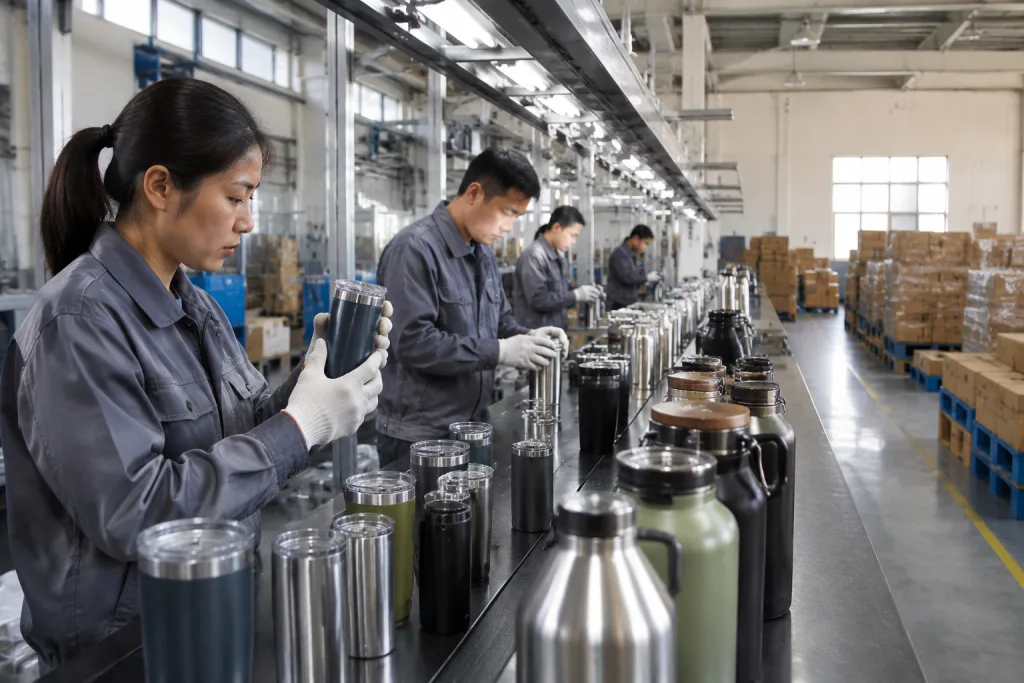
For procurement managers and brand owners, the clean way is simple: lock the use case, lock the compliance bar, lock the decoration method, and then check freight efficiency. If you are buying bulk drinkware for retail, corporate gifts, or marketplace resale, those four calls move landed cost more than the unit quote. The math does not lie. BottleForge in Zhejiang runs 120,000 units per month across drinkware lines, with MOQ starting at 500 pieces for standard stainless SKUs and 30 to 45 days for production after sample approval. QC pulled the sample at 1.2 mm wall thickness before we packed the first run.
Start with the end use
I’ll rewrite the section in-place, keep the HTML structure untouched, and make the copy sound like a factory-side sales engineer wrote it.Before you talk stainless drinkware wholesale price, lock the end use first. A 500 ml insulated tumbler for office gifting, a 32 oz beer tumbler bulk run, and a 1 L canteen wholesale order for outdoor retail do not share the same build. The use case sets the wall construction, lid, coating, and pack-out, and it hits freight too. We have seen a nested carton of 24 units cut cubic volume by 8% against a retail box with inserts.
Ask three blunt questions:
- Is this for retail shelf, promo giveaway, or private label?
- Do you need insulation, or will single-wall work?
- Will the buyer drink water, coffee, beer, or spirits?
If the customer wants a best wholesale drink bottle for sports retail, we run weight checks, lid leak tests, and cycle testing on the line. If the order is alcohol flask bulk or alcohol flask wholesale bulk for gifting, surface finish and logo placement matter more than thermal retention. The math does not work if you ignore that split; the cost shows up later in returns, rework, and slow sell-through. One PO typo on “matte black” versus “mat black” cost us a full re-sample once.
In Zhejiang, factories that know drinkware wholesale separate these channels early. QC pulled the sample, checked the spec sheet, and caught the same mistake buyers make all the time: asking one bottle to do every job. It will not. A bulk canteen for hiking, a beer growler wholesale item for taprooms, and a canteen bulk program for schools need different spec sheets even if they all start from the same stainless grade.
Choose the right steel grade
I’ve got the source section and the constraints. Next I’m rewriting it in-place, keeping the HTML exactly as-is and tightening the copy so it sounds like a factory-side sales engineer.Material choice is the first hard call. For most wholesale drinkware programs, use 304 stainless on the inner wall if you sell into Europe or North America. Full 304 works better for premium retail, but the cost jumps. A 304 inner with 201 outer is a common setup for value SKUs, and it usually cuts cost by 10% to 18%. On a low-price beer tumbler wholesale line, that spread is the difference between a listing that lands and one that never moves.
Do not let the quote bury the spec. Ask for:
- Inner and outer grade separately
- Wall thickness: common ranges are 0.4 mm to 0.6 mm for tumblers, 0.5 mm to 0.8 mm for canteens
- Base thickness and seam construction
- Surface finish: brushed, powder coat, mirror, or painted
We have seen buyers push back after QC pulled the sample and found a 0.35 mm body on a growler. Too thin. For a beer growler in bulk, I would not go below 0.5 mm on the body if the cartons will take retail handling and line-haul abuse. A heavier base adds 20 to 40 grams, and that sounds small until you ship 10,000 units and the freight line gets tight.
The same steel call matters on canteen wholesale and wholesale canteen orders. If the channel is outdoor, dent resistance and finish life beat saving half a dollar. That is the wrong question to ask. Buyers who chase unit price only usually pay it back in chargebacks, replacement stock, or bad reviews when the first dent shows up on the shelf.
Match the decoration to the channel
I’ll rewrite the prose in place, keep the HTML structure intact, and tighten the wording so it reads like a factory-side sales engineer wrote it.Logo method is a commercial call, not a cosmetic one. Screen print fits one-color logos and long runs. Laser engraving holds up when the buyer wants a permanent mark that does not rub off in transit. UV print and heat transfer handle color graphics, but they add line time and scrap risk; on our pad printer, one bad jig setup can throw the first 20 pcs. If you are comparing stainless drinkware wholesale quotes, ask what decoration is included, not just what the supplier says it can do.
For bulk drinkware sold through Amazon or DTC, laser is usually the safer pick when the box gets opened, stacked, and handled a lot. For corporate alcohol flask wholesale orders, a clean laser logo beats paint that scratches on the first office desk. For beer tumbler bulk programs, powder coat plus one-color print is the setup we run when the buyer wants decent wear and a sane unit cost.
Practical rule
If the item will be washed, handled, and resold many times, choose the decoration that survives abrasion, not the one that looks best on a sample card.
Check logo placement tolerance before you approve the PO. On standard fixtures, we hold print position within 2 to 3 mm, but a full-wrap layout can drift more if the sleeve is short or the cup taper is aggressive. If your brand needs Pantone accuracy, ask for a signed color standard and a pre-production sample. We keep the master sample in Zhejiang for repeat orders; that saves a lot of back-and-forth when the buyer flags a shade mismatch six months later.
This is where wholesale drinkware buyers protect margin without changing the cup. A simpler decoration spec can cut setup cost by $0.15 to $0.40 per unit on smaller orders, and that math matters when MOQ is only 500 or 1,000 pcs. The buyer often pushes back on this at first, then QC pulls the sample and the numbers settle the argument.
Check compliance before sampling
I’ll keep the tags intact and rewrite the prose with a more grounded sales-engineer tone, adding concrete factory details and stripping the AI phrasing.Compliance is where a lot of first-time buyers burn weeks. If your market is Europe, you need food-contact files, REACH checks for coatings and inks, and a supplier that can trace each batch back to the coil and the ink lot. For the United States, you still need clear food-safe declarations and test reports for the materials that touch the drink. Don’t take “safe” as an answer. Ask for the paper.
For stainless drinkware wholesale, the files we actually pull are:
- Food-contact declaration for stainless steel and coatings
- REACH-related material statement for Europe
- LFGB or equivalent test evidence when the channel asks for it
- Factory audit records such as BSCI if your retail customer requests them
Packaging matters too. If we ship wholesale drinkware into EU warehouses or U.S. fulfillment centers, the carton crush test, drop result, and barcode position all need to match the channel spec. On Amazon-style orders, label accuracy and FNSKU handling are strict. A bottle can pass a 12-drop function check and still get rejected at intake because the master carton print is off by 5 mm.
Factories in China are not the same. A small workshop may quote a low price and still have no batch trace, no scanner on the line, and no real incoming inspection. A serious Zhejiang plant keeps material records, process sheets, and final QC logs; on one order, QC pulled the sample and found a 0.3 mm cap gap before packing. That paperwork is not for show. It saves the fight when the buyer flags a lot six months later and asks where it came from.
Price the landed cost, not the unit
I’ll rewrite the section in place, keep the HTML structure intact, and make the copy sound like a factory-side sales engineer.Unit price is the least useful number on the sheet. Price landed cost instead: freight, packaging, duty, inspection, and defect allowance all have to sit in the same column. We saw a canteen bulk order look $0.22 cheaper on paper, then oversized cartons pushed the ocean freight up enough to wipe it out. Same story with a heavier beer growler bulk model; if it nests better, the cube drops and the total spend follows.
A workable benchmark for stainless wholesale drinkware: simple non-insulated items usually start around $1.20 to $2.80 FOB, while insulated tumblers often run $4.50 to $9.50 FOB, depending on steel grade, lid, coating, and decoration. A PO typo on one run—“18/0” printed where “304” was requested—turned into a buyer dispute fast, so don’t treat spec lines like decoration. Special shapes such as alcohol flask in bulk or high-capacity growler wholesale items sit outside that band because the tooling and wall structure are different. The math doesn’t work any other way.
When you compare suppliers, hold the assumptions fixed:
- FOB port, not vague “factory price”
- Same steel grade and wall thickness
- Same lid and accessory set
- Same packaging level
If you are buying beer tumbler wholesale bulk or alcohol flask wholesale bulk, ask for a landed-cost matrix at 1,000, 3,000, and 5,000 pcs. QC pulled the sample on a 3,000-piece tumbler run and flagged a dent rate that changed the real cost more than the unit quote did. That price break shows where the leverage sits. In Zhejiang, we run repeat orders with the same tooling and color master batches, so the second order often lands better than the first. That is where volume planning pays off.
Use QC to protect reorders
I’ll rewrite just the prose, keep the HTML structure intact, and make it read like a factory-side sales engineer wrote it.QC keeps the reorder alive. For stainless drinkware wholesale, lock the inspection plan before the first trial run, not when the container is already booked. We usually set AQL 2.5 for major defects and 4.0 for minor ones, but if your print has a 1 mm logo shift limit or the lid must seal on a 3-turn cap, tighten it. The buyer who waits until packing starts is asking for a headache.
A useful QC checklist includes:
- Capacity check within +/- 5%
- Lid and closure leak test
- 1 meter drop test for packed units
- Coating adhesion and scratch check
- Logo alignment and color tolerance
If you are sourcing bulk growler or wholesale growler programs, test pressure and closure fit first. We have seen a 64 oz growler pass visual QC and still fail at the cap ring after 12 cycles on the bench. For beer growler wholesale lines going into taproom resale, a loose lid kills the order fast. For canteen wholesale and wholesale canteen programs, handle welds and base stability matter more than fancy surface work. QC pulled the sample, and the weld held; that is the check that saves you.
Good Zhejiang factories will send pre-production samples, inline checks, and final inspection photos before shipment. Some also accept third-party inspections, which is the right move on a new SKU or after a packaging change. If a supplier pushes back on AQL, test reports, or photo proof, the math does not work in your favor. We have seen that go sideways on a PO with one typo in the carton count.
In real sourcing, the best wholesale drink bottle is not the cheapest bottle; it is the one that ships with low defect risk, clean paperwork, and enough repeatability for a second PO. That is the line between a one-off shipment and a program.
Send your spec, get a real factory quote
Share your target use, quantity, finish, and market. We’ll quote stainless drinkware wholesale from Zhejiang with MOQ, lead time, and compliance spelled out.
Frequently asked questions
What MOQ should I expect for stainless drinkware wholesale?
For standard SKUs, MOQ commonly starts at 500 pieces per color or model. If you need custom color, special lid tooling, or multiple logo versions, many factories in China will move to 1,000 pieces. For more complex insulated tumbler builds or a beer growler wholesale bulk program, 3,000 pcs is a realistic target if you want better FOB pricing. A Zhejiang factory with stable production can usually support repeat orders faster than first orders because tooling, QC standards, and packaging are already established.
How long does production usually take?
For most stainless drinkware wholesale orders, expect 30 to 45 days after sample approval and deposit. Simple canteen bulk or drinkware bulk orders can sometimes ship in 25 to 30 days if colors and packaging are standard. If you need new tooling, special coatings, or test reports for Europe, add 7 to 15 days. Air sample packs usually arrive in 7 to 12 days, while ocean freight to Europe or North America depends on the destination and season.
What compliance documents should I ask for?
At minimum, ask for food-contact material declarations, stainless steel grade confirmation, and coating or ink statements. For Europe, REACH-related documentation matters, and some channels will ask for LFGB or equivalent test evidence. If you buy through a retail chain, BSCI or another social audit may be required. For warehouse programs, carton and label compliance are also important, especially if you need FNSKU or master carton barcodes. Good suppliers in Zhejiang can prepare these files before mass production.
Is 304 stainless always necessary?
No. Full 304 is the safest choice for premium retail and strict buyers, but 304 inner plus 201 outer is often acceptable for cost-sensitive wholesale drinkware. That mix can lower your cost by 10% to 18% versus full 304. For a beer tumbler bulk or canteen wholesale item, the right decision depends on target price, expected handling, and channel standards. If the product is marketed as premium or food-contact confidence is a selling point, full 304 is easier to defend.
How do I compare two factory quotes fairly?
Compare on the same base: steel grade, wall thickness, lid type, finish, decoration, packaging, and FOB port. A quote for alcohol flask wholesale bulk that looks $0.30 cheaper may actually use thinner steel or a simpler lid. Ask for a sample, a spec sheet, and a landed-cost estimate at 1,000 and 3,000 pcs. If the supplier cannot state lead time, AQL, and test document status clearly, the quote is not comparable yet.