Key Takeaways
- MOQ for a basic custom canteen often starts at 1,000-3,000 pcs; complex decoration can push it to 5,000 pcs
- Typical sample lead time is 5-12 days, while mass production is often 25-40 days in Zhejiang factories
- Unit cost usually moves 12%-30% based on steel thickness, lid type, coating, and packaging
- FOB China pricing is only part of the landed cost; freight, duties, and FNSKU labels can add 15%-40%
If you are buying from a stainless drinkware supplier, the first mistake is asking only for unit price. We’ve quoted a $1.85 tumbler and a $3.20 tumbler for the same size, and both were right once you split out steel grade, wall thickness, finish, lid tooling, and whether the buyer wanted retail pack or a promo run. In Zhejiang and across China, the real gap is usually not the quote itself. It’s what sits inside it.
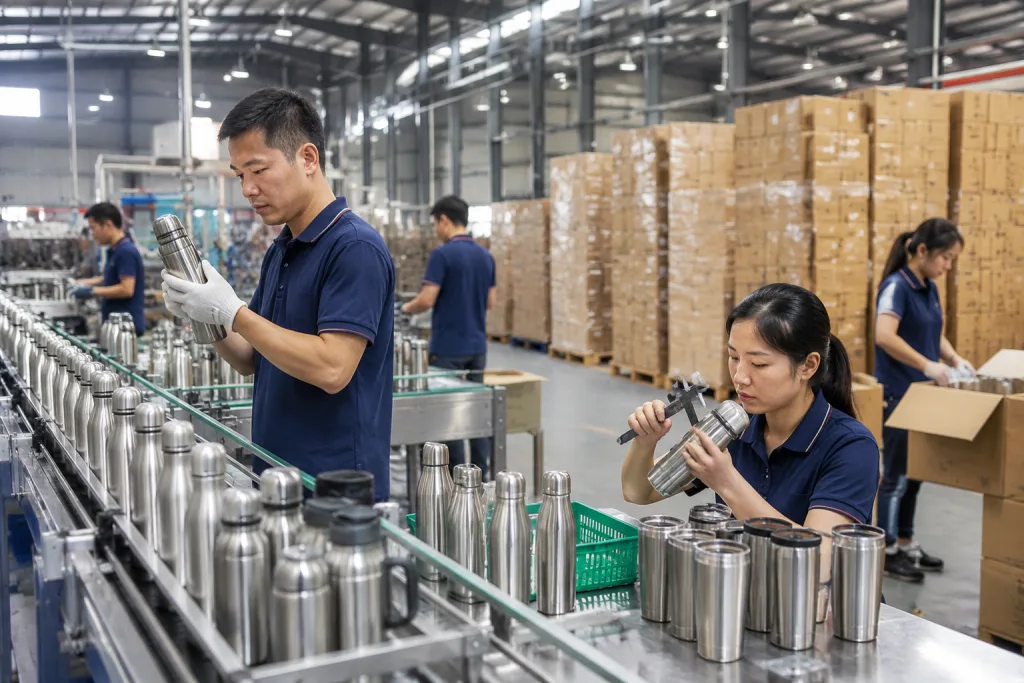
For B2B buyers, cost and lead time have to sit on the same sheet. A canteen factory running 120,000 units per month can still miss a launch if samples take 18 days, packaging takes 25 days, and sea freight booking adds another 12 days. QC pulled a sample on the line last week and flagged a 1.5 mm lid gap, so the buyer pushed back on the schedule. A solid stainless drinkware supplier will show where the money goes, where the days disappear, and which trade-offs actually matter for custom drinkware.
What drives your unit cost
I’ll rewrite the three paragraphs in-place, keep the HTML unchanged, and make the pricing drivers sound like a real factory-side sales note.Buyers usually compare the headline quote and miss the parts that push cost up or down. For stainless drinkware, the real drivers are material grade, wall thickness, forming difficulty, surface finish, decoration, and packaging. A plain 304 stainless custom canteen with one-color screen print is a different job from a powder-coated customized growler with laser engraving and a retail carton insert.
Material thickness changes the math fast. A 0.5 mm body wall costs less than 0.7 mm, but it also changes weight, hand feel, and dent resistance. On larger bottles, moving from 201 stainless to 304 stainless can add about 8%-18% to material cost. Double-wall vacuum construction adds another cost layer because the line needs tighter forming control and better vacuum sealing yield. We run this every week: a simple PP stopper may sit at $0.18-$0.35, while a stainless cap with a silicone seal can jump to $0.60-$1.20. QC pulled a sample last month because the lid thread was 0.3 mm off, and that kind of miss always eats margin.
Typical FOB China ranges for a basic 500-750 ml item often land around $2.10-$4.80, depending on spec. Add a rubberized coating, a premium gift box, or mixed-color custom drinkware packaging and the quote can move 20% or more. That is normal. The wrong question is “why is your price higher?” The better one is “which line item changed?” Good canteen suppliers should split material, labor, decoration, and packing so the buyer can see where the money goes. One PO typo on our side once turned “matte black” into “matt black,” and the buyer flagged it before production; small details like that are where cost and risk both show up.
MOQ tiers that actually matter
I’ll rewrite the section in place, keeping the HTML exactly as-is and tightening the sales tone with more concrete factory-floor detail.MOQ is not a random number. It comes from setup time, decoration method, and how many SKUs we can keep steady on one line. A 500 pcs order is possible, but the spec has to be simpler, or the unit price moves up. If you want a canteen customizable with a logo, matching lid color, and custom carton, the MOQ will climb fast.
For a standard stainless drinkware supplier in China, this is the structure we run:
- 1,000 pcs: basic single-color print, standard lid, stock carton
- 3,000 pcs: custom color, laser logo, retail-ready packaging
- 5,000 pcs+: fully customized canteen, special lid, molded box, mixed accessory kit
If you are a canteen distributor or distributor drinkware buyer, the right MOQ is the one that protects your margin and keeps dead stock off the shelf. We’ve seen buyers ask for 500 pcs on a new SKU, then the math falls apart because the price is 15%-35% higher than a 3,000 pc run. For Amazon or retail launches, one design, one colorway, and one print position is usually the safer call. That keeps the forecast cleaner and the cash cycle shorter.
Lead time from sample to ship
I’ll keep the HTML exactly as-is and rewrite only the prose, with tighter factory-floor language and concrete timing.Lead time breaks into four clocks: sample, tooling, production, and export handling. Buyers often quote only the production window, then the schedule slips. On our line in Zhejiang, a pre-production sample usually takes 5-12 days, and that jumps if you need a new color chip or a new logo method. Mold or tooling work adds 7-15 days when the lid or handle is not standard.
Mass production usually runs 25-40 days for common custom drinkware. If the order is a customized growler with special coating, extra insulation test checks, or a complex cap assembly, plan for 35-50 days. Cartons, barcode labels, and palletizing add 3-7 days. FOB Ningbo or FOB Shanghai needs another 3-10 days for booking and gate-in, and peak season will eat that window fast. QC pulled one sample last month because the laser logo was 0.8 mm off-center; that sort of miss is why we give buyers a real schedule, not a sales line.
Practical rule: if the supplier cannot show sample timing, mass timing, and packing timing separately, you are not looking at a serious export partner.
How decoration changes pricing
I’ll rewrite the section in-place, keeping the HTML tags and list structure intact while tightening the sales-engineer tone and adding concrete pricing detail.Decoration is where a lot of canteen factories make or lose margin. It also shifts lead time. A one-color silk-screen logo usually stays the cheapest route, and we run that line for promo orders every week. Laser engraving costs more per piece, but it holds up and buyers for premium custom canteen or corporate gift programs ask for it often. Heat transfer, UV print, and full wrap graphics cost more because setup and defect checks take longer; QC pulled the sample twice on a bad registration run last month.
Use this as a working comparison for custom drinkware:
- Silk screen: low setup, good for simple logos, fast on the line
- Laser engraving: mid-cost, durable, metal-visible finish
- Powder coating: stronger visual impact, extra curing time
- Full wrap print: highest setup cost, best for retail storytelling
A canteen custom project with screen print may add only $0.08-$0.18 per unit. A full-color wrap or multi-location branding can add $0.35-$0.90. On a 3,000-piece order, that gap matters more than the steel itself. We’ve seen buyers fixate on the base bottle price and miss the decoration line item; that is the wrong question to ask. For a canteen distributor selling into gift, sporting goods, or travel channels, decoration choice usually decides whether the product moves or sits.
Supplier checks that save money
I’ll rewrite the section in place, keep the HTML tags intact, and tighten the sales-engineer tone with more concrete factory details.Price only works if the canteen supplier can hold quality at scale. We ask for proof, not promises: material certificates, vacuum leak test standards, lid cycle test data, and packaging drop test records. A solid stainless drinkware supplier in China should show a QC flow with incoming material inspection, in-process checks, final AQL 2.5 sampling, and carton audit before loading. We’ve seen this go sideways when the sample passed but the line rushed the mass run.
Start with the basics. Is the factory BSCI audited, can it support REACH requests for EU shipments, and does it know ASTM or FDA buyer requirements when the PO calls for them? A buyer once flagged a lid seal typo on the PO, and that saved a 10,000 pc run from a rework mess. Many canteen suppliers can print a logo; fewer can keep odor down, stop off-gassing, and hold lid sealing consistency across 10,000 pcs. This is the wrong question to ask if you only compare unit price. For export buyers, the gap between a canteen manufacturer and a trading middleman shows up in response time, defect handling, and repeat orders. A real factory should quote a stable lead time, state the exact MOQ, and show where they can cut cost without touching the 304 stainless core spec.
If you are comparing canteen manufacturers, ask for a factory video, monthly capacity, and one live production reference. In Hangzhou and across Zhejiang, better plants will tell you whether they run 80,000 or 120,000 units per month, and QC pulled the sample before packing if the line is set up well. That number is not a brag line; it is a scheduling tool for you.
Buying for retail, promo, or distribution
I’ll rewrite the section in-place, keep the HTML tags unchanged, and tighten the prose so it reads like a factory-side sales engineer.The right spec depends on the channel. Retail buyers want color match, clean print, and packaging that survives shelf handling. Promo orders care about unit cost and lead time. For distribution, the focus shifts to carton fit, reorder speed, and mixed-SKU loading.
For retail, a customizable canteen usually works best with one hero color, one logo position, and a box that still looks decent after 3 rounds of handling at the warehouse. For promos, a cheaper custom canteen with a stock lid and one-color print keeps landed cost in line with budget. We run this all the time: if the buyer asks for seven lid colors on a 500 ml order, the math does not work. For channels that need customizable drinkware at scale, standardize the size family first—500 ml, 750 ml, 1,000 ml—so QC can pull the same gauge and the line stays on one tooling setup. The same rule applies to a custom growler program: hold the body spec steady, change the branding, and keep the carton count clean. That is how buyers cut errors and get tighter lead times from a canteen factory in China.
How to compare landed cost
I’ll rewrite the two paragraphs to sound like a real export sales engineer, keep the HTML exactly as-is, and preserve the section heading context. Then I’ll return only the rewritten HTML.FOB price is not your final cost. We always run landed cost before a buyer signs off: inland truck, export docs, ocean freight or air freight, duties, and the last-mile prep to get it into your DC. A $3.20 FOB tumbler can land at $4.10 or $5.00, depending on the lane, the port, and whether you want a full-color carton or a plain master pack. For distributor drinkware programs, freight often moves the number more than decoration does, especially on light bottles where carton space gets wasted fast.
Use a simple buyer lens: product cost + packaging cost + freight + duty + receiving labor. If you sell on Amazon, add FNSKU labels, polybags if the listing calls for them, and prep fees. If you ship to a warehouse, check pallet height, carton compression, and case pack logic. QC pulled a sample at 28 kg carton weight, and that is where the math gets real. A good canteen vendor will cut dimensional weight by changing carton counts or nesting parts tighter; we’ve seen the buyer flag a $0.08 carton change because it saved $1,200 on a 40HQ. The cheapest quote on paper is usually the wrong question to ask. The supplier you want keeps landed cost steady from first sample to second reorder.
Get a clear quote from a real factory
Send your target spec, quantity, and ship date. We will break down cost, MOQ, and lead time for your custom drinkware order.
Frequently asked questions
What is a realistic MOQ for custom stainless drinkware?
For a basic custom canteen, 1,000 pcs is a common starting point in China. If you want special coating, color matching, or retail packaging, 3,000 pcs is more realistic. Fully customized growler or complex lid projects often need 5,000 pcs to keep the unit price sensible. A canteen distributor should compare MOQ against inventory risk, not just chase the lowest number.
How long does a stainless drinkware order take to ship?
A straightforward order usually needs 5-12 days for samples and 25-40 days for production after approval. If you change the lid mold, add a custom carton, or request a canteen customized with multiple decoration steps, plan for 35-50 days. FOB booking and port handling from Zhejiang can add another 3-10 days depending on season.
Why do two canteen suppliers quote very different prices?
The difference is usually steel grade, wall thickness, lid quality, decoration method, and packaging. A 0.5 mm 201 stainless item with simple print can be far cheaper than a 0.7 mm 304 stainless version with laser engraving and gift box. Ask both canteen manufacturers to quote the same spec line by line so you can compare apples to apples.
Is a customizable canteen worth the extra cost?
Yes, if the branding supports your channel margin. A canteen customizable with color, logo, and packaging can add $0.20-$1.10 per piece, but it may improve sell-through, especially for retail or corporate gifting. For canteen promotional orders, keep the spec lean. For premium custom drinkware, the added cost is easier to justify.
What should I ask a canteen factory before ordering?
Ask for monthly capacity, sample lead time, production lead time, AQL standard, material certificates, and packaging format. If the supplier is serious, they should tell you whether they run 80,000 or 120,000 units per month and whether they can support REACH or BSCI documentation. That tells you if you are dealing with a real canteen factory in China or just a sales layer.