Key Takeaways
- A workable stainless drinkware private label program often starts at 3,000 pcs MOQ and 25-35 days lead time after sample approval.
- 304 stainless steel is common for inner walls; 316 is usually reserved for higher-margin or chemical-resistant programs.
- Ask for AQL 2.5 inspection, REACH documentation, and lid leak testing before you approve bulk production.
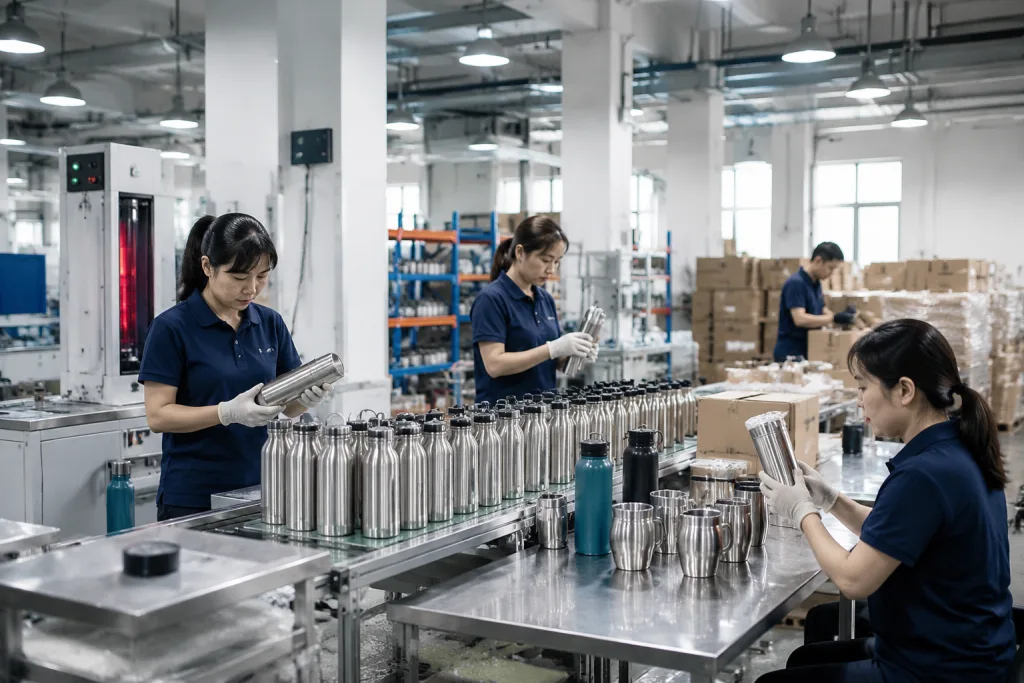
- A factory in Zhejiang with 500,000 units/month capacity can handle launch volume, but only if you lock artwork, packaging, and FNSKU details early.
If you are buying stainless drinkware private label, the hard part is not choosing a bottle shape. The hard part is dodging a bad first order: wrong steel grade, weak lid sealing, decoration that scuffs in transit, or a supplier that gives a low FOB quote and adds charges later. We’ve seen that go sideways in the first 500 pcs. In Zhejiang and across China, the difference between a clean launch and a headache usually comes down to the questions you ask before sampling.
You need a supplier who speaks in numbers, not slogans: MOQ, wall thickness, lead time, test standards, and monthly output. A solid canteen factory should tell you if your custom drinkware program is a 3,000-unit trial or a 30,000-unit run, and whether the line can hold pace after the first reorder. QC pulled the sample, checked the 0.5 mm wall, and that is the kind of answer a procurement manager can actually use.
What are you actually buying?
I’ll rewrite this section in a more field-tested sales voice, keep the HTML exactly intact, and preserve the list structure and heading.When buyers say stainless drinkware private label, they usually mean more than a bottle with a logo. You are buying a spec sheet: steel grade, body build, finish, lid system, decoration method, carton format, and the compliance file. If that sheet is loose, the order gets costly fast. A custom canteen looks simple on the sample table, but the price moves with every choice: single wall or double wall, 0.4 mm or 0.5 mm body thickness, powder coat or polished finish, laser logo or silkscreen, gift box or bulk pack. We run this every week, and the buyer flagged it as soon as the carton spec was missing.
For B2B sourcing, the first question is not “What can you make?” It is “What exact build have you already made 5,000 times?” A solid canteen manufacturer in Zhejiang should answer with standard builds and tell you what is actually custom. That matters because a customizable drinkware program works best when the base unit stays fixed and only the branding changes. If you sell to distributors, retail chains, or Amazon, a stable base makes repeat orders easier and keeps the margin from sliding. QC pulled the sample on a 12 mm lid gap once; the math did not work, and we fixed the mold before production.
Checklist:
- Confirm steel grade: 304 for most consumer use, 316 only when the market really asks for it.
- Define capacity in ml or oz, not just “standard size.”
- Specify wall thickness, lid type, and coating before sampling.
- Ask for carton count, master carton size, and gross weight.
Which supplier type fits you?
I’ll rewrite the section in-place, keep the HTML structure intact, and tighten the sales-engineer tone with concrete factory details.Not every supplier fits the same buyer. A canteen supplier serving a local promo run can do the job, but a canteen factory with export paperwork is the better pick when you need REACH, barcode labels, and repeat orders. If you are a canteen distributor, you care about range and fast turns. If you are a brand owner, you care about color match and carton consistency. If you are a distributor drinkware buyer, mixed cartons and lower MOQs matter. Different business. Different setup.
In China, Zhejiang has both trading firms and direct factories. A direct factory gives tighter control on mold slots, laser logo depth, and carton spec, but only when the sales team can keep the line moving. We have seen buyers get burned by a “vendor” who was just passing notes between the mill and the shipper. Ask one plain question: are you the maker, or just quoting? The same split applies to canteen manufacturers versus canteen distributors. If they cannot explain the production route in 30 seconds, the math does not work.
Practical rule: if the supplier cannot state daily output per line, the defect check method, and the inspection standard, they are not ready for a private label launch.
Good-fit signals:
- Monthly capacity of 300,000 to 500,000 units.
- Sample lead time under 10 days for stock shapes.
- Bulk lead time of 25-35 days after sample sign-off.
- Documented BSCI, ISO 9001, or similar audit history.
What specs should you lock first?
I’ll rewrite the section in place, keep the HTML structure intact, and make the prose sound like a factory-side sales engineer.Lock the specs that drive cost and failure rate first. For a custom drinkware or custom growler program, we fix body material, wall structure, lid type, and finish before anything else. A single-wall customized canteen comes in cheaper, but if the buyer wants heat or cold retention, that spec is the wrong place to save. A double-wall vacuum unit usually adds USD 0.80 to USD 2.50, based on size and decoration, and that extra cost buys a cleaner product story. For outdoor, tactical, and promo programs, we run that math every week, and it usually holds up.
Decoration is where buyers burn budget. Silkscreen works for 1-color logos and keeps the unit price down. Laser engraving gives a cleaner mark and better wear resistance. Full-color wrap prints look sharp, but they raise scrap risk and need tight artwork control; QC pulled one sample last month because the file had a 0.8 mm bleed mismatch. For a custom canteen or customizable canteen, lock the decoration method before sample tooling, not after. That keeps the sample line and bulk line on the same process.
Specification checklist:
- 304 or 316 inner wall, confirmed by material report.
- 0.4-0.5 mm stainless body thickness for most retail programs.
- Powder coat thickness target of 60-80 microns.
- Leak test requirement: 100% for lids, not random only.
- Drop test or vibration test if you sell through Amazon FBA or big-box channels.
If you want a custom growler or customizable growler, be stricter on lid seal and neck geometry. Growlers take more abuse than office tumblers, and a 1 mm gap at the neck shows up fast as transit claims. We’ve seen that go sideways on a PO where the buyer flagged the lid thread spec after first shipment, and the math did not work.
How do you compare quotes?
I’ll rewrite the section in-place, keep the HTML structure untouched, and tighten the copy so it sounds like a factory-side sales engineer wrote it.Two quotes can look close and still be miles apart. One says FOB Ningbo with plain carton packing and no insert bag; the other includes a branded box, barcode label, and color master carton. Do not look at unit price alone. Compare what is inside the quote. A quote for stainless drinkware private label should spell out mold cost, sample charge, tooling amortization, packaging, and the shipping term. If the supplier stays vague, the extra cost usually shows up later. We have seen that go sideways on a 5,000-piece run.
For buyers sourcing in China, FOB is usually the cleanest term for a first program because the factory responsibility is clear up to the port. If you need door delivery, ask for DDP only after the product is stable. For a launch order, a distributor canteen or distributor drinkware buyer should ask for two numbers: one with standard packing and one with retail-ready packing. That is the real math. On our line, the buyer flagged the carton spec before we even started sampling, and it saved a re-quote.
Useful quote comparison table:
- Material: 304 vs 316.
- Body thickness: 0.4 mm vs 0.5 mm.
- Decoration: silkscreen, laser, heat transfer, UV print.
- Packing: bulk, white box, color box, gift box.
- Compliance: REACH, food contact, BPA-free lid declaration.
In Zhejiang, a serious supplier usually quotes faster when your spec sheet is complete. If your inquiry includes artwork, target market, packaging, and annual forecast, you get a sharper number than if you just ask for a “stainless bottle price.” That is not sales pressure. It is how the line is scheduled. QC pulled the sample at 0.5 mm wall thickness, and the quote changed because the buyer’s PO typo had changed the lid code.
What quality checks matter most?
I’ll rewrite this section in the same HTML, keeping the structure and tightening the sales-engineer voice. First I’m checking for any repo-specific instructions, then I’ll patch the prose directly.I’ve got the target section. Now I’m rewriting it with more factory-floor detail, firmer buyer language, and fewer generic transitions.Most claims do not start with a blow-up on the line. They start with small misses: a lid that leaks only after a 15-second shake test, a powder coat that rubs off in carton-to-carton friction, or a logo that fades after 30 dishwasher cycles. A good canteen factory runs incoming material checks, in-process leak checks, and final AQL inspection before shipment. Ask for the AQL level in writing. AQL 2.5 is common for major defects, but we define critical, major, and minor defects on the PO, line by line.
For customized drinkware, the paper file matters as much as the signed sample. You need food-contact declarations, REACH where applicable, and, if your market asks for it, LFGB or FDA-aligned documents. If the supplier says “no problem” but cannot send the test reports, the buyer flagged it for a reason. A canteen promotional order for a trade show can run on a lighter spec. A retail order cannot. We’ve seen this go sideways when the artwork looked fine and the compliance file was missing one stamp.
Inspection checklist:
- Material report for 304 or 316 stainless.
- Vacuum hold test and lid leak test.
- Coating adhesion and color tolerance review.
- Drop test for packed cartons if shipping long-distance.
- Carton drop and compression tests for export freight.
When you buy from China, ask whether the factory has a real QC team or just a production foreman doing spot checks with a caliper. In Zhejiang, the better exporters keep production and inspection separate, and that split matters when you need repeat private label runs, not a one-off order. One typo on a PO, like “750 ml” written as “750mls,” can still trigger a carton label mess. That is the wrong question to skip.
How should you launch the first order?
I’ll rewrite the section in-place, keep the HTML structure untouched, and strip out the AI phrasing while making it sound like a factory-side sales engineer wrote it.The first order should prove the cup, the pack, and the reorder path. Keep it tight: 1 to 3 SKUs, clean artwork, and a forecast that matches the channel you actually sell through. We see 3,000 to 5,000 pcs per SKU work well for a first run; it tests demand without freezing too much cash. If you sell on Amazon, lock FNSKU labels, carton marks, and case pack counts before the line starts. If the buyer is a retail chain or a canteen distributor, shelf-ready cartons and multilingual packaging usually need to be fixed at sample stage, not after PO.
Do not turn the first order into a design workshop with ten open points. A strong canteen supplier or canteen vendors team should close the spec, not widen it. Same story for a custom growler line or a plain custom canteen program. We had one PO come in with “sliver” instead of “silver” on the artwork note; QC caught it before printing, and that saved a reprint. Set the sample sign-off date, the production start date, and the ship window. If those dates slide every week, your order gets pushed behind someone else’s.
Launch checklist:
- Approve the pre-production sample in writing.
- Lock artwork files in vector format.
- Confirm packaging size and carton count.
- Set the reorder trigger at 60-70% sell-through.
- Reserve budget for freight, duty, and 3%-5% claims allowance.
We run export production in Zhejiang with monthly capacity above 500,000 units, so the factory side is not the hard part. The real bottleneck is late buyer decisions. In the shop, the tape machine and carton labels move fast; the delay usually comes from the buyer, not the line. If you want a clean launch, treat the first PO like a pilot, then scale after the sales numbers come in.
Send your spec, and we’ll price it cleanly
Share your target market, MOQ, artwork, and packaging. We’ll turn it into a practical stainless drinkware private label quote from Zhejiang.
Frequently asked questions
What is a normal MOQ for stainless drinkware private label?
For stock-shaped stainless bottles and canteens, a common MOQ is 3,000 pcs per color or per SKU. If you add custom lids, special coating, or printed gift boxes, MOQ can rise to 5,000 pcs. For a simple promotional run, some Zhejiang factories will quote 1,000-2,000 pcs, but the unit price is usually higher by 10%-20%. Always ask whether the MOQ is per color, per decoration method, or per carton pack. That detail changes the real commitment.
How long does production usually take?
After sample approval, standard lead time is often 25-35 days for stainless private label drinkware. If the product needs new tooling, special packaging, or imported components, plan for 40-50 days. Sample lead time for stock shapes is often 7-10 days. In Zhejiang, a well-run canteen factory can move faster, but only if artwork, carton specs, and testing requirements are final before the PO.
Which material should I choose, 304 or 316?
304 stainless steel is the practical default for most custom drinkware and custom canteen programs. It balances cost, corrosion resistance, and availability. 316 is better if the product will face salt exposure, harsh use, or premium positioning, but it adds cost. In many cases, 316 can increase the ex-factory price by 8%-15% depending on design and volume. Ask the supplier for a mill certificate or material report, not just a verbal claim.
What inspections should I require before shipment?
At minimum, require material verification, leak testing, and final AQL inspection. AQL 2.5 is common for major defects, but you should define critical defects like leakage, sharp edges, or wrong branding as zero tolerance. If the order is for Amazon FBA or retail distribution, ask for carton drop testing and barcode verification too. A factory in China should be able to provide photos, inspection records, and packing details before the balance payment.
Can one factory handle custom canteen, growler, and tumbler lines?
Yes, if the factory has multiple forming and finishing lines and enough export experience. The better canteen manufacturers in Zhejiang often run several product families, including custom canteen, custom growler, and customizable drinkware. The key is not the number of products; it is whether they control mold, welding, coating, and packing in-house or through stable partners. Ask for monthly capacity, which may range from 300,000 to 500,000 units, and confirm whether they can keep your reorder lead time consistent.