Key Takeaways
- Start with a 1-page RFQ: capacity, lid, finish, logo, and target price in USD.
- For a standard custom canteen, expect MOQ 3000 pcs and sample lead time 7–12 days.
- Specify steel grade, wall thickness, and test standards such as REACH, LFGB, and FDA in the PO.
- A reliable canteen manufacturer in China should quote FOB and confirm AQL 2.5 / 4.0 inspection terms.
When you buy from a stainless drinkware manufacturer, finding a factory is the easy part. The real work is locking the spec, getting a sample that matches, and keeping bulk production from drifting on finish, capacity, or print quality. If you source for retail, Amazon, corporate gifting, or distribution, you know the usual mess: a canteen supplier says yes to everything, the sample looks clean, then the bulk carton lands with uneven welds or a coating that fails rub testing. We’ve seen the buyer flag a 1.5 mm lip edge after PO approval, and that small miss turned into a week of rework.
We build drinkware in Zhejiang, China, and the same rule holds on every custom program: the buyer who writes the PO line items clearly saves time and margin later. A good canteen factory should quote in 24 hours, turn samples in 7 to 12 days, and ship standard bulk orders in 25 to 35 days after deposit. If those numbers get fuzzy, the project gets fuzzy too. QC pulled a 304 stainless sample at the line last week and found a packing typo on the carton mark, not the cup itself; that is the kind of detail that keeps a shipment honest.
Write the RFQ Like a Buyer
I’ll rewrite the section in-place, keep the HTML structure exact, and tighten the sales-engineering tone with more buyer-side detail and fewer generic phrases.Do not send a casual email that says “need quote for bottle.” A stainless drinkware manufacturer can price faster when you give the exact commercial picture. Use a one-page RFQ and keep it plain: product type, capacity, lid style, surface finish, decoration, packaging, target market, and annual forecast. We once got a PO with “500ml” typed as “500 mlx”; QC caught it at the sample stage, and the buyer fixed the file before the line ran. If you want a custom canteen, say whether you need a 350 ml kids model, a 500 ml commuter bottle, or an 18 oz customized growler for craft beer channels. If you are comparing canteen manufacturers, state your target unit cost up front; otherwise factories in China and Zhejiang quote from the top of the range, and the math does not work.
A useful RFQ for customizable drinkware includes:
- Material: SS304 for body, SS201 only if you accept lower corrosion resistance
- Capacity: 500 ml ± 5%, or 750 ml if you need a custom growler format
- Wall structure: single wall, double wall, or vacuum insulated
- Finish: powder coat, satin, mirror, or color spray
- Decoration: silkscreen, laser engraving, UV print, or wrap label
- Compliance: food contact, REACH, LFGB, FDA, and packaging barcode requirements
For reference, we run simple 500 ml stainless models at USD 1.30 to 2.40 FOB, while insulated versions often land at USD 4.20 to 8.50 depending on lid and coating. On one job, the buyer flagged a missing barcode spec and the carton sample had to be reworked on the packing bench before shipment. If a canteen vendor cannot break down tooling, printing, and carton costs, your PO will get messy later.
Judge the Factory, Not the Website
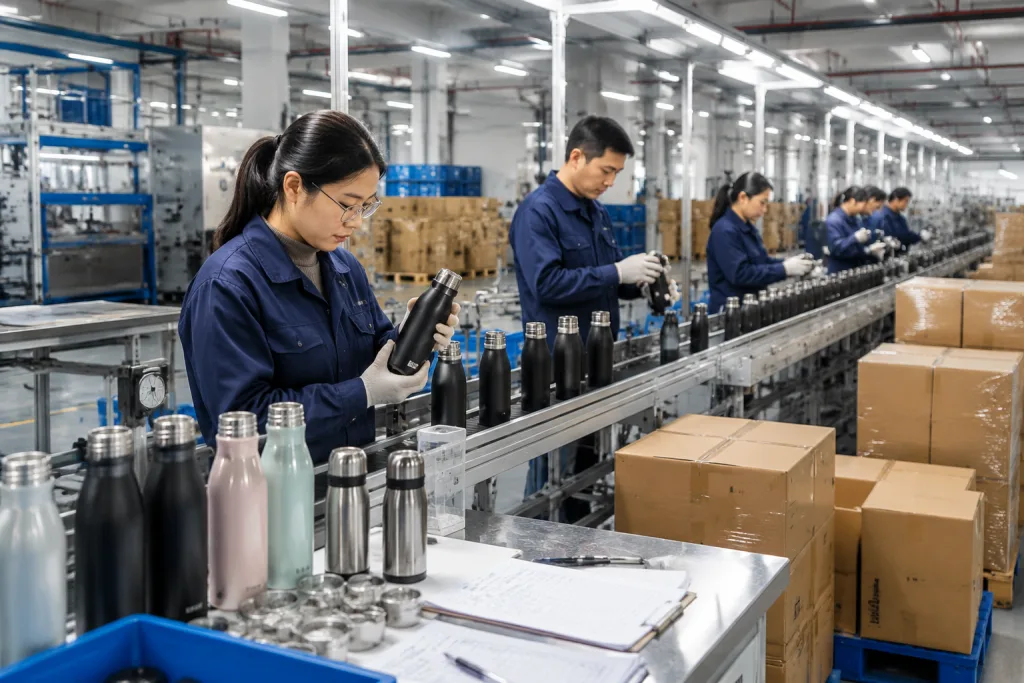
I’ll keep the tags and structure intact, rewrite the prose in a more field-tested sales voice, and preserve the numbers and factory details.Before you ask for samples, check whether you are talking to a real canteen factory or a trading layer. No detective work needed. Ask for the business license, export records, line photos, and a recent audit report. A serious canteen manufacturer in Zhejiang will usually show BSCI or SMETA if they sell to retail chains, and they should quote monthly output without looking at notes. At BottleForge Industrial in Hangzhou, our stainless line runs above 300,000 units per month across thermos bottles, sports bottles, and canteen promotional orders, so we know what a real bottleneck looks like.
Look for the basics:
- Tube cutting and shell forming equipment
- Welding and leak testing stations
- Powder coating or polishing area with controlled dust
- QC checkpoints for sealing, insulation, and print adhesion
- Warehousing space for bulk cartons, not just sample shelves
A canteen distributor can still be a good partner if they control export paperwork and stock, but for customized canteen work, factory-level answers matter. Ask who handles mold maintenance, what happens when a lid breaks in transit, and whether they can support private label or distributor drinkware programs with repeatable branding. If the reply is slow or vague, we’ve seen that go sideways. Move on.
Sample Before You Argue About Price
I’ll rewrite the section in place, keep the HTML intact, and tighten the sales-engineer voice with concrete shop-floor details and cleaner pricing language.Sampling is where a project makes money or burns it. We have seen clean quotes go bad the moment the buyer skips the sample and jumps straight to bulk, especially on anything beyond a stock bottle. For a custom stainless drinkware order, the sample has to lock down steel grade, coating thickness, lid torque, logo placement, and carton fit. If you want a promotional piece, ask for one pre-production sample with final artwork; a blank body with a sticker is not a real approval sample. QC pulled a batch last month and found the lid spun past spec by 18 degrees. That kind of miss shows up fast.
Typical sample cost sits at USD 30 to 80 for standard work, and USD 80 to 150 when the job needs new tooling, a special lid, or a custom growler shape. Sample lead time is usually 7 to 12 days with existing molds, or 15 to 25 days if we open a new mold. The buyer flagged a PO typo once and we lost two days just clarifying whether the logo position was 25 mm or 52 mm. Do not wing this part. Your approval sheet should list:
- Capacity tolerance and net weight
- Steel grade and wall thickness, such as 0.4 mm or 0.5 mm
- Logo method and exact Pantone code
- Packaging structure, including insert and master carton count
- Functional tests: leak test, thermal retention, drop resistance, and dishwasher claim if relevant
If you sell through distributors, keep one signed sample in house. A canteen distributor will ask for a reference piece later, and your own team needs the same sample when repeat orders come back 6 months later with small changes. We run that check against the archived unit, not memory. That is the wrong question to ask if someone says “can we just use the old spec?” The math does not work when the carton size or print file changed.
Lock the PO Line Items
I’ll rewrite the section in a more field-tested sales style, keep the HTML intact, and preserve all existing technical terms and structure.This is where a lot of buyers burn margin. A PO that says only “5000 stainless bottles, as sample” is too loose and costs real money. A proper PO to a stainless drinkware manufacturer works like a control sheet: one document for production, QC, and shipping. If you buy custom drinkware for retail, the PO protects margin as much as the artwork does.
Use these line items on the PO:
- Product name and model code
- Material: SS304 body, PP lid, silicone gasket grade
- Capacity and dimensional tolerance
- Decoration method, artwork file name, and placement
- Packaging: inner box, master carton quantity, drop test standard
- Incoterms: FOB Ningbo, FOB Shanghai, or EXW Zhejiang if you control freight
- Inspection standard: AQL 2.5 major, 4.0 minor
- Compliance documents: REACH, LFGB, FDA, or ASTM-based test reports if required by channel
For a canteen customized order, spell out spare parts too. Lids, straws, silicone rings, and seals need an agreed overage, usually 1% to 3%, because retail and distributor programs always need replacements. We’ve seen this go sideways when the buyer left it vague and the line packed 0 spare lids against a 3000-piece order. If your team sells to Amazon or chain retail, put FNSKU labeling and carton barcode format on the PO. One line. Fewer warehouse headaches.
Approve Bulk With Real Controls
I’ll tighten the copy, keep the HTML exactly as-is, and make it sound like a factory-side sales engineer wrote it.Bulk production should not start on trust. A canteen factory that knows its work will issue a pre-production checklist, material sign-off, and first article photos before the line runs. On stainless drinkware, the first 500 to 1000 pcs usually tells the story: coating adhesion, logo edge quality, and whether the lid threads stay consistent. We have seen a buyer skip that gate and eat a 2,000-piece rework. That is the wrong way to save time.
Ask for three checkpoints:
- Material incoming inspection: steel thickness, gasket hardness, lid component match
- In-line inspection: weld quality, vacuum retention if applicable, print alignment
- Final inspection: AQL sampling, carton drop test, and count verification
For standard bulk, 25 to 35 days after deposit is realistic. If a supplier says 12 days for a fully customized growler with new tooling and custom packaging, the math does not work. Put overrun/underrun tolerance in writing, usually +/- 3% to 5%. We also ask who holds extra units, because one PO typo on a seasonal reorder can turn into dead stock fast. A canteen manufacturer should state whether overproduction stays in stock for repeat orders or ships only after your release. That matters when you run distributor programs or a corporate gifting calendar.
Good sourcing is not about finding the cheapest canteen supplier. It is about forcing every assumption into a line item before the factory runs steel, coating, and cartons.
Plan Reorders and Distribution
I’ll keep the HTML structure intact and rewrite the prose in a more natural B2B sales-engineer voice, with concrete factory details and fewer AI-style transitions.Your first bulk order is not the finish line. If the bottle moves, the real money is in the reorder system you set up with the factory. We keep the approved sample, final PO, artwork files, test reports, and packaging spec in one folder on the line server, so a reorder does not start from zero. For canteen promo jobs, that is the whole game—logo placement and color match have to hold batch after batch. For distributor programs, the buyer may need a language swap, a regional label, or a carton change from one market to the next.
Good Zhejiang suppliers can handle mixed programs if you plan early: stock lines for fast replenishment, then custom runs for the bigger accounts. We run this split all the time. If you sell a custom drinkware range, decide which SKUs stay evergreen and which are seasonal. A 500 ml stainless bottle can sit in stock, while a brewery-branded growler ships as a 3,000-piece limited batch. That keeps dead stock down and cuts the “can you rush a reprint?” call. We’ve seen that go sideways when the MOQ was never written down.
If you are building a direct-import program, ask the manufacturer about reserved capacity, spare lid stock, and carton master file control. QC pulled one sample last month because the PO said “24 pcs/carton” and the packing spec said 20; that kind of typo burns a week. These small controls are what let you move from one-off buying to a real sourcing program in China.
Send Your RFQ, Get a Real Quote
Share your capacity, logo, target price, and carton needs. We’ll reply with a factory quote, sample timeline, and PO checklist.
Frequently asked questions
What MOQ should I expect from a stainless drinkware manufacturer?
For standard models, MOQ is often 3000 pcs per color or per design. If you need a new mold, special lid, or customized drinkware packaging, some canteen manufacturers in Zhejiang will ask for 5000 pcs or a tooling fee. Simple logo changes can sometimes start at 1000 pcs, but that is usually for stock bodies. Ask for MOQ by SKU, not by total order, because a canteen distributor program with mixed colors can look small on paper but still require separate production runs.
How much do samples usually cost?
A standard sample from a canteen factory is often USD 30 to 80, with freight extra. If you need new tooling, embossed branding, or a custom growler shape, sample cost can reach USD 80 to 150. Lead time is usually 7 to 12 days for existing molds and 15 to 25 days for new development. For canteen custom projects, always ask whether sample fees are refundable against bulk, because many canteen suppliers will deduct them once you place the PO.
What should I check in the bulk inspection?
Use AQL 2.5 for major defects and 4.0 for minor defects as a practical starting point. Check leaks, coating scratches, logo alignment, carton damage, and capacity variance. For insulated stainless drinkware, add temperature-retention testing and vacuum integrity checks. If the supplier claims compliance, ask for REACH, LFGB, or FDA reports tied to your exact material lot. A good canteen manufacturer should also confirm spare part counts, usually 1% to 3% overage for seals and lids.
Is FOB better than EXW for drinkware imports?
If you are new to importing, FOB is usually easier because the canteen supplier handles export handoff at the port and you control main freight. EXW can work if you already have a China logistics partner and want full factory pickup control. From Zhejiang, both are common. For a first custom canteen order, FOB often keeps the process cleaner because the stainless drinkware manufacturer can coordinate cartons, pallets, and customs documents before shipment.
Can one factory handle both canteen promotional and distributor drinkware orders?
Yes, if the factory has enough production capacity and disciplined scheduling. A strong canteen factory in China can split lines between fast-turn promotional jobs and repeat distributor canteen orders. The key is spec control. Promotional jobs often use simpler prints and tighter deadlines, while distributor drinkware may need barcode labeling, multilingual packaging, and stricter replenishment plans. At a plant producing 300,000+ units per month, separate planning is what keeps both channels on time.