Key Takeaways
- A workable RFQ should include capacity, steel grade, finish, lid type, artwork, MOQ target, and target FOB price within 24 hours
- For custom drinkware, expect 7-12 days for pre-production samples and 30-45 days for bulk after deposit
- BottleForge Industrial runs 450,000-600,000 stainless units/month in Zhejiang with MOQ from 1,000 pieces per SKU
- Use AQL inspection, sealed samples, and PO line items to control risk before balance payment
Finding a stainless drink bottle supplier is easy. Finding one that can quote cleanly, hold ±0.2 mm tolerance on a 20,000-piece order, and ship without carton or insert rework is harder. Most sourcing problems start before the line opens: loose RFQs, missing AI logo files, lid specs copied from an old project, or a PO with the wrong Pantone code. We saw “Panton Black” on one order last month. QC pulled the sample before mass production, luckily.
We manufacture in Zhejiang, China, and we see the same buyer mistakes from Europe and North America every month. A canteen distributor asks for a “premium bottle” but gives no steel grade, wall thickness, carton drop-test target, or logo method. That is the wrong way to ask for price. One vendor quotes 304 stainless with laser engraving, another quotes thinner material with silk print, and the math does not compare. Here is the sourcing path we run from first RFQ to bulk shipment.
Start With A Usable RFQ
I’ll rewrite the section in-place, keeping the HTML and structure intact while making the prose sound like a factory-side sales engineer wrote it.Your RFQ decides whether you get a real quote or a glossy spreadsheet. A stainless drink bottle supplier cannot price a bottle from one photo and “please give best price.” For B2B orders, send the same spec to every canteen supplier so you compare factory capability, not guesswork.
A clean RFQ should state capacity in ml or oz, bottle shape, single-wall or double-wall vacuum, steel grade, outer finish, lid material, packaging, inspection standard, delivery port, and target order quantity. If you want customized drinkware for retail, add barcode type, warning labels, carton markings, and pallet limits. For Amazon or 3PL handling, mention FNSKU, suffocation warning for polybags, and master carton weight under 15 kg if your warehouse enforces that cap.
For stainless bottles, the usual body material is SUS304 inside and SUS201 or SUS304 outside. North American buyers often push for 304/304 on premium retail, and the math usually works only when the margin can carry it. We run 0.4-0.5 mm wall thickness on many vacuum bottles; thinner walls cut cost, but QC pulled samples that dented after a 1.2 m drop test on the line. If you ask for a custom growler, state 64 oz or 2 L capacity, handle design, cap sealing structure, and whether it needs beer-grade internal polishing.
RFQ line items to include:
- Model: 750 ml double-wall stainless vacuum bottle, 304 inner / 201 outer
- Finish: powder coating, Pantone 2965 C, matte texture
- Logo: one-position laser engraving, 45 mm wide
- Packaging: kraft box plus export carton, drop test requested
- MOQ target: 3,000 pieces, FOB Ningbo, delivery to Rotterdam
This level of detail lets a canteen factory in China quote with fewer assumptions and fewer price changes later.
Compare Factories, Not Catalogs
I’ll rewrite the section in-place, keep the HTML structure intact, and make the prose sound like a factory-side sales engineer wrote it.A catalog only shows what a stainless drink bottle supplier sold last quarter. It says nothing about color drift, lid stock, or whether the line can pass a retailer audit. We ask for process ownership first. Does the factory run tube cutting, welding, vacuuming, polishing, powder coating, and final assembly in-house, or does it push half the work to outside shops?
At BottleForge Industrial in Zhejiang, China, our monthly stainless output usually runs 450,000-600,000 units across bottles, tumblers, and growlers. That number matters. A 5,000-piece distributor order needs fast line changeovers, while a 60,000-piece retail promo needs steady capacity and a clean QC rhythm. Ask any canteen vendor for the same facts: normal monthly output, peak-season lead time, current audit status, and how many QC staff are on the line.
Do not get fooled by a low FOB quote if the supplier cannot break down the cost. A 750 ml vacuum bottle can sit anywhere from USD 3.20 to USD 6.50 FOB China, depending on steel grade, coating, lid build, packaging, and inspection level. We have seen a bamboo lid add USD 0.30, a custom mold straw cap add more, and a gift box push the math out of range. For promotional orders, that is the difference between a green light and a dead margin.
Supplier comparison line items:
- Factory type: direct manufacturer, trading company, or hybrid export office
- Compliance: BSCI, ISO 9001, REACH/LFGB/FDA material declarations where applicable
- Capacity: confirmed units/month and available production window
- MOQ: standard color 1,000 pieces; custom color often 3,000 pieces
- Payment: usually 30% deposit, 70% before shipment after inspection
If two canteen suppliers quote the same bottle but one cannot show material records or the vacuum test procedure, the cheaper line is not cheaper. We had a buyer flag a PO typo once—304 was typed as 340—and QC pulled the sample before it reached packing. That saved a mess.
Lock The Sample Before Price
I’ll keep the HTML exactly as-is and rewrite only the prose, tightening the sales-engineer tone with specific numbers and a few factory-floor details.Too many buyers treat the sample like a checkbox. That is the wrong move. The sample is the physical contract. For custom canteen and customizable drinkware programs, the approved sample should lock color, weight, lid fit, logo position, coating texture, packaging, and hand feel. If it is not written on the sample approval record, the buyer flagged it later with no leverage.
For a standard stainless bottle with one-color logo, we usually run a pre-production sample in 7-10 days after artwork confirmation. A canteen customizable project with a new lid color, custom silicone boot, gift box, or private mold parts usually takes 12-25 days. New mold development for a customized growler handle or unique cap can add 20-35 days and USD 800-3,000 in tooling, depending on the part count. The math does not work if someone wants sample speed and tooling changes at the same time.
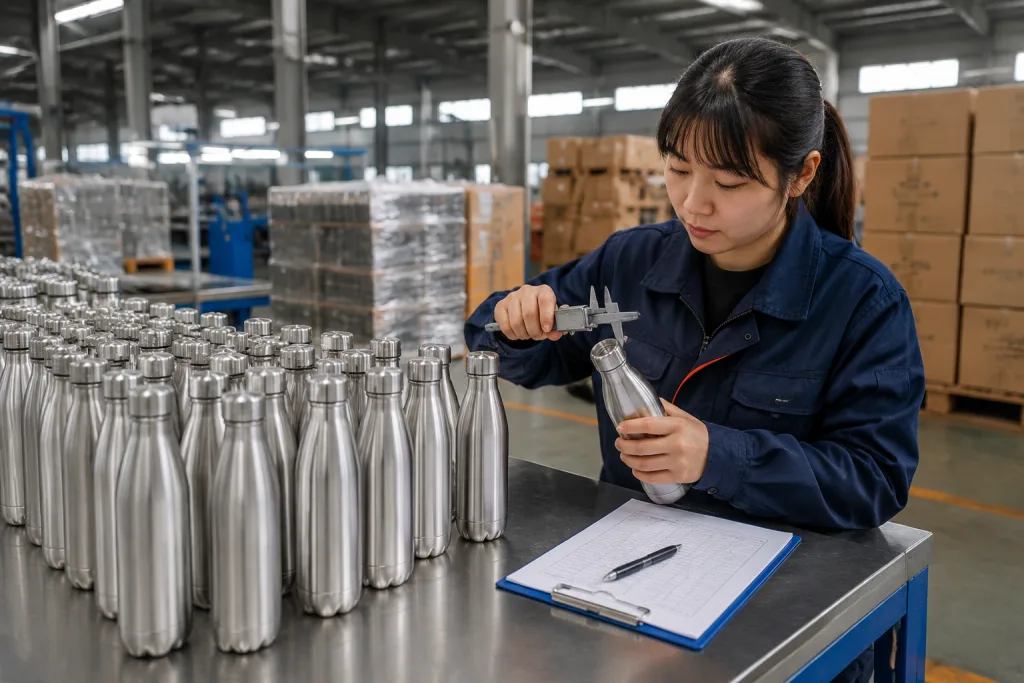
Ask for measured sample data, not just photos. You want actual capacity, net weight, coating thickness if specified, thermal performance, leak test result, and carton dimensions. QC pulled the sample with a caliper once and found a 1.2 mm lid gap that the photos hid. A 500 ml vacuum bottle should not arrive as 470 ml usable capacity because the factory measured brim-full volume differently. Define whether capacity means brim-full or practical fill line. For distributor canteen orders, that stops retail claims from drifting and saves you from returns.
Sample approval PO line items:
- Sample quantity: 2 blank samples and 2 decorated samples
- Artwork file: AI or PDF vector, logo width and position stated in mm
- Color standard: Pantone reference plus approved physical color chip
- Test request: 6-hour temperature retention, 100% leak test, coating cross-hatch check
- Approval status: signed sample, dated photos, and retained golden sample at factory
A good stainless drink bottle supplier will push you to approve details early. This is not bureaucracy; it is how we keep the line from shipping 30 cartons with the wrong shade after a PO typo on the lid color.
Specify Decoration And Packaging Early
I’ll rewrite the section in place, keep every HTML tag and list structure unchanged, and tighten the wording so it reads like a buyer-facing factory note.Decoration is where a lot of custom drinkware jobs lose days. Laser engraving, silk screen printing, heat transfer, water transfer, UV print, and powder coating all act differently on stainless steel. A small logo on brushed steel is straightforward. A wraparound gradient on a curved powder-coated bottle is a different animal. If you are building a canteen promo run with a fixed event date, pick the decoration method to match the artwork and the ship date.
Laser engraving gives a clean, durable mark, but it shows the base metal color and it does not print Pantone. Silk screen is a solid fit for one- to three-color logos on cylindrical bodies. Full-color artwork needs heat transfer or UV printing, and both need tighter setup control plus a bigger reject allowance. For large retail customized canteen orders, we usually ask the buyer to sign off on a flat artwork proof and a decorated sample before bulk coating starts. QC pulled one sample at 2.5% AQL and the buyer flagged the logo shift by 1.2 mm. Fair point.
Packaging needs the same discipline. A canteen distributor selling into retail may need an individual color box, hang tag, instruction sheet, EAN/UPC barcode, inner carton, master carton, and pallet label. A brewery growler program often chooses plain kraft boxes to keep the landed cost down. Export cartons should be sized for the bottle, not whatever carton is sitting on the line. We have seen that go sideways. For drinkware, a common carton drop test is 76 cm on one corner, three edges, and six faces, though the final spec still follows the retailer’s rule set.
Decoration and packaging PO line items:
- Logo method: laser engraving, 45 mm wide, centered 70 mm below rim
- Box: 350 gsm kraft box with black one-color print
- Carton: 24 pieces per master carton, gross weight under 14 kg
- Labels: SKU, PO number, country of origin, carton count, barcode
- Retail compliance: REACH, LFGB, FDA, Prop 65 review if required by market
Lock this before deposit. If the buyer changes the box after mass production starts, the math does not work.
Build The Bulk PO Properly
I’ll rewrite the section in-place, keep the HTML structure exactly, and tighten the language so it reads like a factory-side sales engineer.Your purchase order needs more than quantity and price. It should restate the approved spec in enough detail that production, QC, and shipping can work from it without digging through old email threads. On the line, the PO is the control sheet. If it is loose, the factory defaults to its normal standard, and that is rarely the retail standard you signed off.
For stainless bottles, define the SKU by color, capacity, logo, lid, packaging, and destination. If you order 12,000 pieces in four colors, split them into four line items. State quantity tolerance clearly, usually 0/+3% or exact quantity if your receiving system cannot take overage. State the Incoterm clearly: FOB Ningbo, FOB Shanghai, CIF, DDP, or EXW. We ship a lot of FOB Ningbo, and that keeps freight control with the buyer’s forwarder, which is the clean setup for most import programs.
Typical lead time after deposit is 30-45 days for standard stainless bottles, 45-60 days in peak season or on complex customized drinkware. A 1,000-piece MOQ works for a stock body with standard color choices; custom powder color usually starts around 3,000 pieces per color because the coating line needs setup and powder loss is real. For canteen custom orders with molded lid parts, MOQ can move to 5,000 pieces. QC pulled a sample at 2.8 kg carton weight once and the buyer flagged it, so we now write the packing spec down to the carton number.
Bulk PO line items to include:
- SKU: BF-750V-MATTE-BLUE, 750 ml vacuum bottle, Pantone 2965 C
- Unit price: USD 4.28 FOB Ningbo, including kraft box and laser logo
- Quantity: 3,000 pieces, 0/+2% tolerance
- Payment: 30% deposit, 70% after passed inspection before shipment
- Lead time: 38 days after deposit and final artwork approval
- Inspection: AQL 2.5 major / 4.0 minor, conducted before balance payment
This is not legal overkill. It is how you keep the canteen supplier, finance, warehouse, and sales team buying the same product. We’ve seen it go sideways from one typo on a PO, and the math does not work if the wrong carton count lands at port.
Inspect Before The Balance Payment
I’ll rewrite the section in-place, keep the HTML structure intact, and tune the wording to sound like a factory-side sales engineer.Inspection costs less than fixing a shipment after it lands in Hamburg, Los Angeles, or Toronto. For stainless drinkware, we run visual, functional, and packaging checks together. AQL is the standard path. A lot of buyers use AQL 2.5 for major defects and 4.0 for minor defects, and premium retail programs often go tighter. For safety issues like sharp edges, broken lids, or leaking caps, zero tolerance is the right call.
Factory QC should already be running on the line, but the final random inspection still matters when at least 80% of goods are packed and 100% are produced. Check appearance, color against the approved sample, logo position, lid torque, leak performance, vacuum insulation, inner cleanliness, odor, print quality, barcode scan, carton markings, and carton dimensions. We also pull a hot water test or thermal retention test for vacuum bottles. On powder coating, cross-hatch adhesion and rub tests catch problems fast. The buyer who skips those and only looks at carton count usually pays for it later.
A serious stainless drink bottle supplier will accept third-party inspection. If a canteen vendor pushes back and says “our QC is enough” on a first order, that is a warning sign. We’ve seen that go sideways. Good factories keep retained samples and batch QC records so claims can be traced by PO, SKU, and production date. At our Zhejiang plant, QC pulled the sample against the master carton on a 12-piece check before release.
Inspection PO line items:
- Inspection standard: ANSI/ASQ Z1.4, general inspection level II
- AQL: critical 0, major 2.5, minor 4.0
- Special tests: leak test, 6-hour insulation test, barcode scan, carton drop check
- Sampling: by SKU and color, not only total order quantity
- Release condition: balance payment after passed report and shipping document draft
If defects show up, agree on rework scope, re-inspection cost, and shipment delay in writing before you pay the balance. The math does not work any other way.
Ship With Documents That Match
I’ll rewrite the section in-place, keep the HTML structure intact, and make the prose sound like a factory-side export team wrote it.The last step is not just loading a container. Shipping documents have to match your PO, customs entry, and warehouse receiving sheet. One typo is enough to slow the file down. If the invoice says stainless bottle, the packing list says vacuum flask, and the carton mark says canteen, the broker may clear it, but the receiving team will flag it on the dock.
For exports from China, we usually ship a commercial invoice, packing list, bill of lading, certificate of origin when the buyer asks for it, material declaration, and test reports where they apply. For EU buyers, REACH and food contact paperwork can come up. For the US, FDA food contact documents and Prop 65 review may apply depending on the steel grade, coating, and claims. If the order is for children’s bottles, ASTM or CPSIA paperwork can enter the file, so an adult sports bottle pack will not pass as-is. We had one PO with “stainless btl” typed in the product line; QC pulled the sample, but the broker still asked for a clean spec sheet.
Freight planning should start before production ends. Stainless bottles are bulky, not heavy. A 40HQ container may hold about 18,000-28,000 pieces, depending on bottle size and packaging. LCL works for 1,000-3,000 pieces, but carton strength matters more because the cartons get handled 4 to 6 times. For a canteen distributor program shipping to 3 warehouses, we ask the buyer for split carton marks and pallet plans before we book space. The math does not work if you wait until the last week.
Shipping release line items:
- Incoterm and port: FOB Ningbo, vessel booking by buyer forwarder
- Documents: invoice, packing list, draft B/L, test report, COO if needed
- Marks: PO number, SKU, carton number, gross/net weight, made in China
- Palletization: optional, with pallet height under buyer warehouse limit
- Final files: barcode list, carton dimension sheet, photo record before loading
A reliable canteen manufacturer treats paperwork as part of the line, not admin work after the truck leaves. We’ve seen this go sideways on small details, and it turns into 12 days of back-and-forth. Do it clean, and the shipment lands clean too.
Send Your Bottle RFQ For A Factory Quote
Share capacity, quantity, logo, packaging, and target port. We will reply with MOQ, FOB pricing, sample timing, and practical production notes.
Frequently asked questions
What MOQ should I expect from a stainless drink bottle supplier?
For a stock stainless body with standard colors, MOQ is often 1,000 pieces per SKU. If you need custom powder coating, expect 3,000 pieces per color because coating setup, powder cleaning, and color matching take time. A customized canteen with private mold lid parts may require 5,000 pieces or more. For a mixed distributor drinkware order, some factories can combine several models, but each SKU still needs a workable production quantity. At BottleForge Industrial in Zhejiang, we usually start standard stainless bottle projects at 1,000 pieces and recommend 3,000 pieces when you need a stable custom color and lower unit cost.
How long does sampling and bulk production usually take?
For a standard custom canteen with existing body shape and one logo, sampling normally takes 7-12 days after artwork confirmation. If you need a new lid color, silicone boot, retail gift box, or special coating, allow 12-25 days. Bulk production is usually 30-45 days after deposit and sample approval. Peak season orders, complex customizable growler projects, or private mold parts can run 45-60 days. You should also add 3-7 days for final inspection, rework if needed, and vessel booking. Do not promise a retailer launch date based only on the factory production time.
What information should be on my purchase order?
Your PO should include model number, capacity, steel grade, color, finish, lid type, logo method, packaging, barcode needs, quantity by SKU, unit price, Incoterm, payment terms, lead time, inspection standard, and shipping marks. A useful line item might read: 3,000 pcs, 750 ml double-wall stainless bottle, 304 inner/201 outer, matte black powder coat, laser logo 45 mm, kraft box, USD 4.28 FOB Ningbo, AQL 2.5/4.0. Attach the signed sample approval sheet and artwork proof. If the PO only says “customized drinkware bottle,” you are leaving too much room for interpretation.
Which logo method is best for promotional canteens?
For canteen promotional orders, laser engraving is the safest choice when you want durability and a premium look, especially on powder-coated stainless bottles. Silk screen printing is cost-effective for simple one- or two-color logos and can be cheaper at 3,000+ pieces. Heat transfer or UV printing works for full-color artwork but needs tighter sample approval and may have a higher rejection allowance. For outdoor use, avoid very fine print below 0.3 mm line width because it can fill in or lose clarity. The best method depends on surface finish, logo size, retail price point, and expected handling.
Can one supplier handle bottles, growlers, and distributor packaging?
Yes, if the supplier has the right production network and packaging control. Many canteen vendors can quote a bottle, but not all can manage a custom growler, retail box, barcode labels, carton marks, and split shipment instructions in one PO. Ask whether the factory can provide stainless bottles, customized growler options, spare lids, silicone parts, and export cartons under one QC plan. For distributor growler or distributor canteen programs, you should confirm carton dimensions, pallet plan, FNSKU or EAN placement, and mixed-SKU packing before deposit. This prevents warehouse receiving problems after the goods arrive.