Key Takeaways
- For stainless drink bottle custom orders, practical MOQ starts around 1,000 pcs per color for standard models
- 304 stainless steel is the normal inner-wall choice; 316 is useful for premium or marine-positioned bottles
- Laser engraving suits 1-color durable branding, while powder-coated silkscreen supports stronger retail shelf impact
- Plan 25-35 days for bulk production after sample approval, plus 3-7 days for pre-shipment inspection
A stainless drink bottle custom project looks simple until the quotes land on your desk. One canteen supplier writes 304 stainless steel, another only says “food grade,” one price includes a laser logo, and another leaves out mold fee, inner box, and export carton cost. We’ve seen a 0.3 mm wall-thickness gap turn into a USD 0.42 cost difference per bottle after QC pulled the sample with a digital caliper. If you are buying for retail shelves or Amazon FBA, those spec gaps eat margin fast.
From our Zhejiang factory, we see buyers waste 5 to 7 days by asking the wrong first question: “What is your best price?” Wrong question. Price means little until the line knows the bottle structure, logo process, test standard, packing route, and order volume. For example, a powder-coated bottle with laser engraving and LFGB testing does not quote the same as a plain 304 stainless bottle in a bulk carton. Lock those points first, and a China canteen manufacturer can give a clean quote instead of chasing revisions after the buyer flagged a missing barcode on the PO.
Start With The Bottle Job
I’ll rewrite the section in-place, keep the HTML exactly as-is, and tighten the sales-engineer voice with more concrete factory details.Before you pick a custom canteen, lock down the job first. A 500 ml school bottle, a 750 ml sports bottle, a 1.2 L gym canteen with a handle, and a 1.9 L custom growler are different builds, not just different sizes. We run different wall thickness, lid torque, carton strength, and print risk on each one.
For retail and distributor programs, capacity is the first filter. In Europe and North America, 500-600 ml moves well for kids and office use, 750-1,000 ml fits outdoor and fitness buyers, and 1.2 L or above pushes into hydration jug or customized growler territory. The bigger bottle takes more abuse, so we watch drop resistance, base dents, and handle fatigue on the line.
Then choose insulation. Single-wall bottles stay lighter and cheaper, but they sweat with cold drinks and pick up dents faster. Double-wall vacuum bottles cost more, and the buyer sees that difference on shelf. A standard 500 ml double-wall bottle often uses 0.4-0.5 mm inner stainless steel and 0.5-0.6 mm outer stainless steel. If a canteen vendor comes in far below market, ask for gauge and net weight; steel grade alone does not pay the freight.
For a stainless drink bottle custom order, put the real use in the RFQ: retail shelf, corporate gift, subscription box, outdoor distributor growler, school program, or Amazon FBA. QC pulled a sample last week because the PO said “gift bottle” and the buyer meant “camp bottle”; that mismatch costs time. A Zhejiang factory can point you to the right mold fast when the use case is clear.
Choose Steel And Surface Honestly
I’ll rewrite the section in place, keep the HTML tags unchanged, and tighten the sales tone with concrete factory details.Most customized drinkware jobs land on 304 stainless steel for the inner wall. It handles water, tea, coffee, and normal acidic drinks without drama. We run 0.4 mm to 0.5 mm inner walls on a lot of orders, and that thickness is the real question, not the marketing label. Some buyers push for 316 stainless steel because it sounds premium. Fine, but it does not fix a rough weld bead or a lazy polish. It just raises the unit cost.
Ask the canteen manufacturer to call out each part: inner wall, outer wall, lid insert, straw, spring, and screws if there are any. A bottle sold as “304” can still use PP, silicone, Tritan-style plastic, or 201 stainless on non-contact parts. That is not a deal breaker, but you should know what you are approving. We had one PO typo where the buyer wrote “304 lid” and meant “304 body”; QC pulled the sample and caught it before tool-up. For EU orders, REACH and LFGB material declarations come up often. For US programs, buyers usually ask for FDA food-contact papers, and kids products may need ASTM or CPSIA checks.
Surface finish decides how the bottle ages on shelf and in cartons. Brushed stainless hides small marks better, but fingerprints still show after handling. Powder coating gives stronger color and better grip, and the line must pass adhesion and cross-hatch tests before we ship. Spray painting can hit bright colors at lower cost, but it wears faster in transit and retail handling. Mirror polishing looks premium, then scratches show up if the carton insert is loose. We’ve seen that go sideways on a 5,000 pcs order.
If you are a canteen distributor building a year-round range, keep one or two stable finishes and stop chasing 12 colors every season. Black, white, navy, and sand are easier to repeat than neon shades. The math works better too: a reorder after 3,000 pcs has to match the photos already on your site, and a 2 mm color shift will get the buyer flagged it on the next sample round. Repeatability wins here.
Decoration Is A Cost Decision
I’ll rewrite the section in place, keeping the HTML structure and tightening the sales-engineer tone while preserving the topic and concrete production details.Logo method drives unit price, lead time, defect rate, and how the buyer reads your brand. It is a cost decision, not just a design call. For stainless drink bottle custom work, we run laser engraving, silkscreen printing, UV printing, heat transfer, water transfer, and full-body powder coating with printed graphics.
Laser engraving is the safest pick for long-term wear. It holds up on powder-coated bottles and bare stainless, and there is no ink adhesion issue to fight. The tradeoff is color: laser usually shows the metal or leaves a tonal mark. If the buyer flags exact Pantone color, laser is the wrong tool.
Silkscreen works well for 1-2 color logos on cylindrical bottles, especially promotional canteen orders. At 1,000-5,000 pcs, the math works. Still, artwork size and bottle curve matter; we have seen a 280 mm wraparound logo go crooked because the fixture slipped. UV printing handles more colors and gradients, but QC pulled the sample after adhesion failed on a 60°C rub test on powder coat. Heat transfer and water transfer fit all-over artwork, but setup cost is higher and MOQ usually moves up with it.
For a canteen customizable program, ask for decoration samples before bulk production. A flat digital mockup does not tell you much. At BottleForge Industrial in Hangzhou, Zhejiang, we normally ship a pre-production sample with the final surface, final logo size, and final carton marking. For standard models, sample time is usually 7-10 days after artwork confirmation. If the project needs a new lid mold or a custom growler handle, sample timing can stretch to 20-30 days.
Price Only Works With A Spec Sheet
I’ll rewrite the section in place, keep the HTML exactly as-is, and tune the prose to sound like a real sales engineer with concrete sourcing details.FOB price only means something when the spec sheet is complete. A quote for “750 ml stainless bottle with logo” can swing 25-40% once you change steel gauge, cap build, coating, logo method, gift box, test items, or inspection level. If you are comparing canteen suppliers, put the same sheet in front of every canteen vendor and stop there.
A solid RFQ should list capacity, model reference or drawing, stainless steel grade, wall structure, lid material, surface finish, Pantone color, logo method, logo size, packing, target country, compliance documents, quantity per color, and Incoterm. If you sell through Amazon, add FNSKU labeling, carton size limits, drop test requirements, and whether the canteen manufacturer should ship to a forwarder or build direct FBA cartons. We had a buyer flag a PO because “matte black” was typed, but the line needed Pantone 419 C; that kind of typo changes the sample and the price.
For standard stainless bottles from China, MOQ is often 1,000 pcs per color for powder coating and 500 pcs for a simple laser logo on stocked colors. Go below that and you usually pay setup charges or accept fewer color choices. For custom molded lids or fully custom canteen shapes, MOQ can climb to 3,000-5,000 pcs because tooling, fixtures, and line setup have to be paid back. The math does not work any other way.
Our Zhejiang facility can run about 350,000 stainless drinkware units per month across bottles, tumblers, and growlers, but capacity does not replace planning. Normal bulk lead time is 25-35 days after sample approval for standard models. Peak-season orders before summer or Q4 gifting should land 45-60 days before your ship date, especially if retail packaging is involved. QC pulled the sample with a 1.8 mm wall check last week; that kind of detail is why we do not promise a “fast” lead time without a real drawing.
Control Risk Before Shipment
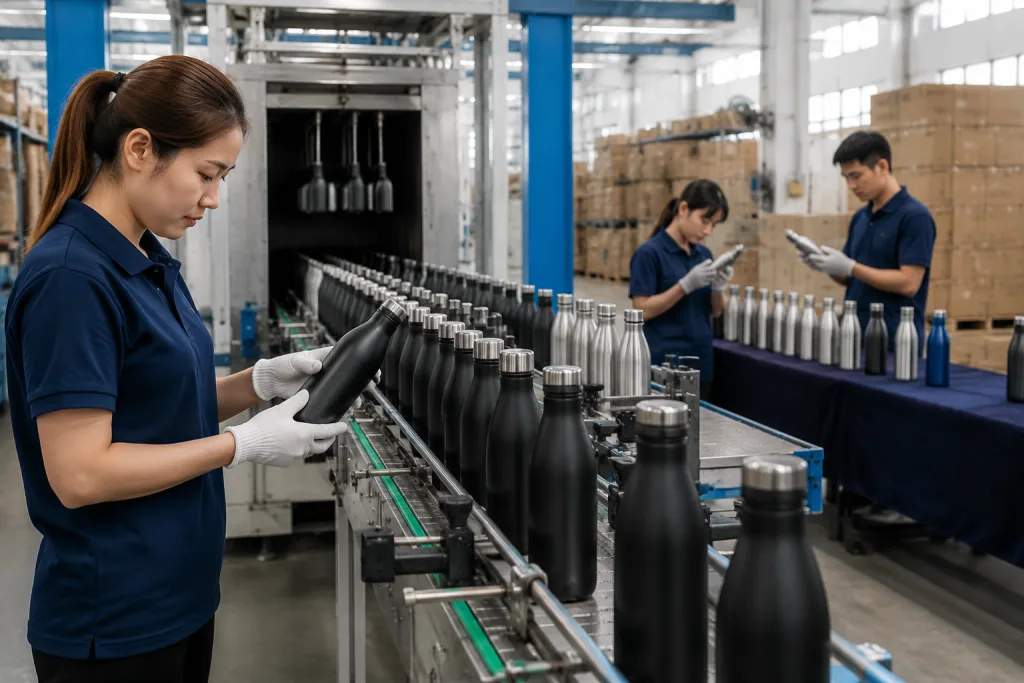
I’ll rewrite the section in-place, keep every tag and structure intact, and tune the prose to sound like a factory-side sales engineer. Then I’ll return only the HTML.Quality problems in custom drinkware usually show up before shipment if the inspection points are set right. Do not wait until cartons land in Hamburg, Rotterdam, Los Angeles, or Toronto to find lid leakage, coating scratches, a wrong Pantone, or weak retail boxes. We run this check on the line with a torque wrench and a simple water-fill test. A proper canteen factory should welcome clear QC checkpoints; it saves both sides a long argument later.
For stainless drink bottle custom orders, use three checkpoints: approved pre-production sample, in-line inspection during mass production, and final random inspection before shipment. AQL is common for final inspection. Many B2B buyers use AQL 2.5 for major defects and 4.0 for minor defects, with critical defects set to zero tolerance. One buyer once flagged a PO typo on the capacity line, and that same order would have failed if the bottle mouth was 2 mm off. Leakage, sharp edges, wrong material, contaminated interior, and unsafe lid parts should go in critical or major, not cosmetic.
Testing should match the selling channel. For vacuum bottles, ask for temperature retention testing, vacuum failure checks, lid torque testing, coating adhesion, salt spray if relevant, and carton drop testing. For kids bottles, bite valves, straws, small parts, and labeling need extra attention. For distributor growler or customizable growler projects, cap sealing and thread consistency matter more than fancy packaging. QC pulled the sample once on a 500 ml run and found a lid thread drift of 0.3 mm; the buyer pushed back, and they were right.
Documentation also matters. Ask for photos of raw material labels, production line images, packaging layout, carton marks, and pallet plan. A professional canteen supplier in China should be able to provide inspection support, but you can also use a third-party inspector if the order value justifies it. For a USD 20,000 order, a USD 250-350 inspection is cheap insurance. We’ve seen this go sideways when the buyer skipped pallet photos and the warehouse loaded 60 cartons short.
Match Packing To Sales Channel
I’ll rewrite the section in-place, keeping the HTML exactly as-is and tightening the sales-engineer tone with concrete packing numbers and factory-floor detail.Packing is not an afterthought. It moves landed cost, breakage rate, warehouse speed, and customer reviews. We once had a buyer flag a typo on the carton mark, and the line had to reprint 3,000 outer cartons that same afternoon. A corporate promotional canteen may only need a white box or bulk egg-crate packing. Retail custom drinkware needs shelf-ready color boxes, barcode placement, multilingual warnings, and a carton that survives container loading. Amazon orders need FNSKU labels, suffocation warnings if polybags are used, and carton dimensions that do not trigger extra fees.
For a standard 500-750 ml bottle, a white box can add USD 0.12-0.25 per unit, while a printed retail box may add USD 0.25-0.55 depending on paper weight, coating, and quantity. Inserts, manuals, hang tags, and spare straws add cost and assembly time. QC pulled the sample on a 0.8 mm insert once and found the bottle rattled in transit; that is the sort of mistake that shows up as a return later. If your margin is tight, do not copy premium packaging unless your selling price covers it.
Carton strength matters more than most buyers think. A common export carton might use 5-ply corrugated board, but heavy custom growler orders may need stronger board and tighter inner protection. For ocean freight, ask about gross weight per carton. Keep cartons under 15-18 kg and handling gets easier; push past that and the corners start to crush. For pallets, confirm whether your forwarder wants standard export pallets, no pallets, or floor-loaded cartons.
If you are working as a canteen distributor or distributor drinkware buyer, standardize packing across models where possible. Use the same carton mark format, the same barcode position, and the same inner box size logic. It makes the warehouse faster and cuts rework when we ship repeat orders from multiple canteen manufacturers or canteen vendors in China. That is the right question to ask, not whether every model needs a new box.
Build A Supplier Scorecard
I’ll rewrite the section in-place, keeping the HTML tags and structure intact while making the prose sound like a factory-side sales engineer.The best canteen supplier is not always the lowest FOB price. For stainless drink bottle custom jobs, score suppliers on reply time, drawing detail, sample match, compliance readiness, line capacity, and how they handle problems after the buyer flags them. If a supplier dodges material questions or won’t confirm the coating spec in writing, that’s a bad sign. We’ve seen that go sideways on a 5000 pcs order.
A scorecard can stay simple. Give 20 points for product fit, 20 for quality system, 20 for price transparency, 15 for lead time, 15 for compliance documents, and 10 for export communication. Ask if the canteen factory has BSCI, ISO 9001, or similar audit experience when your retailer wants it. QC pulled a sample with a 0.8 mm coating edge once; the certificate was fine, but the packing note had a typo, and that is the kind of detail buyers remember.
For a first order, don’t over-customize the whole bottle. Start with a proven body, then change color, logo, lid accent, and packaging. After one clean shipment, move to new molds or a more aggressive canteen customized program. The math works better that way. You protect cash flow and test sell-through before you pay tooling.
Good customized drinkware buying is not about squeezing every cent out of a quotation. It is about locking the product promise, approving the sample, holding the mass-production variables, and shipping without surprises. If your supplier can explain trade-offs in plain numbers, you are much closer to a stable long-term program. We run this every week, and the buyer who asks for exact MOQs, not vague “many,” usually gets the cleaner build.
Send your bottle spec and target quantity
We will review materials, decoration, MOQ, packing, and FOB pricing before you commit to a custom stainless drinkware order.
Frequently asked questions
What MOQ should I expect for a stainless drink bottle custom order?
For standard bottle bodies, expect around 1,000 pcs per color for powder-coated stainless drink bottles. If you choose stocked colors with laser engraving, some factories can support 500 pcs, but the unit price will be higher. For a custom canteen with a new lid, special handle, or exclusive shape, MOQ usually moves to 3,000-5,000 pcs because tooling and production fixtures are involved. If a canteen vendor accepts 100 pcs at a very low price, check whether the bottles are actually stock items with limited QC control.
How long does production take after I approve the sample?
For a normal stainless drink bottle custom project using an existing mold, bulk production usually takes 25-35 days after the approved pre-production sample and deposit. Add 7-10 days for sampling before that. Retail box printing, Pantone matching, and third-party testing can add another 5-15 days. If you need a new mold for a customized growler or unique lid, prototype and tooling work can take 30-45 days before mass production starts. For summer retail or Q4 promotional orders, build a 60-day planning window.
Is 304 stainless steel enough for custom drinkware?
Yes, 304 stainless steel is the normal choice for the inner wall of quality custom drinkware. It performs well with water, tea, coffee, juice, and most daily beverages. 316 stainless steel offers stronger corrosion resistance, but it costs more and is usually reserved for premium outdoor, marine, or specialty positioning. More important than the grade alone is the full construction: wall thickness, welding quality, polishing, lid material, and cleanliness. Ask your canteen manufacturer to confirm material by component, not only say “food grade.”
Which logo method is best for a promotional canteen?
For promotional canteen orders, laser engraving is the most durable and has a low defect risk, especially on powder-coated bottles. It is ideal for simple logos and long-term use. Silkscreen printing is better when you need a specific Pantone color or a larger 1-2 color logo. UV printing works for multi-color artwork, but adhesion testing is important. For orders above 1,000 pcs, ask for a physical decorated sample. A digital mockup does not show logo distortion, ink edge quality, or color shift on curved stainless steel.
What quality checks should I require before shipment?
Require an approved pre-production sample, in-line photos or inspection, and final random inspection using AQL. Many buyers use AQL 2.5 for major defects and 4.0 for minor defects, with critical defects at zero tolerance. Check leakage, lid fit, vacuum performance, surface scratches, coating adhesion, logo placement, carton drop resistance, barcode accuracy, and carton markings. For a USD 15,000-30,000 order, a third-party inspection costing around USD 250-350 is usually worth it, especially for a first order from a new canteen supplier.