Key Takeaways
- A workable MOQ for a custom sports water bottle is often 3,000-5,000 units per SKU, with 25-35 days lead time after sample approval
- For PP shaker bottles, normal export pricing sits around $0.85-$1.60 FOB China, depending on lid complexity and print method
- Ask for AQL 2.5 for critical defects and 4.0 for minor defects before you confirm bulk fitness water bottle production
- A Zhejiang factory that runs 30,000-80,000 units/month is easier to scale than a trader juggling mixed subcontractors
If you are buying drinkware for a fitness brand or gym chain, the hard part is not finding sports water bottle suppliers. The hard part is finding one that can hold price, branding, and delivery without turning every PO into a fire drill. We’ve seen a supplier quote $0.72 for a 750ml bottle or $1.95 for a shaker, then lose the order when the cap starts leaking, the print fails at 500 cycles, or the carton size pushes freight over the limit.
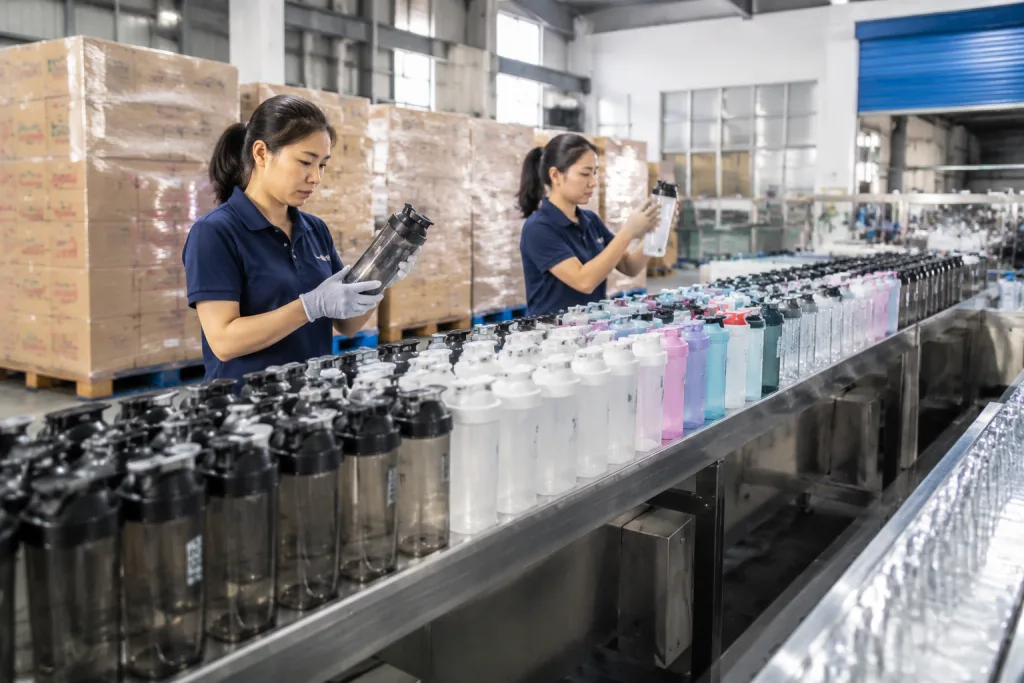
In Zhejiang and across China, the better factories run sports drinkware like an export job, not a catalog page. They talk MOQ, lead time, AQL, REACH, and carton count because that is what keeps the line moving. If you are sourcing a bulk sports water bottle, bulk gym water bottle, or bulk shaker bottle for retail or member giveaways, you want a supplier that can ship 10,000 to 50,000 units per month and still keep custom logo work clean. QC pulled the sample on a 28mm cap last week and found a print shift of 1.2 mm; that is the kind of miss that costs time fast.
What you are really buying
I’ll rewrite the section in place, keep the HTML exactly as-is, and tune the prose to sound like a factory-side sales engineer.Procurement should look at the build, not the label. A customizable shaker bottle with a flip cap and mesh insert has more weak spots than a plain sports bottle. If the buyer is a distributor, the real check is simple: will it survive pallet moves, carton rub, and resale across two or three channels? That is why distributors running fitness water bottle programs ask for 5-ply cartons, clean barcode labels, and decoration that does not crack when the line runs fast.
Practical rule: every extra part adds cost, lead time, and defect risk. We have seen one added gasket push the assembly line back 1-2 days when the tooling is not locked and QC pulled the sample late.
Supplier questions that matter
I’ll rewrite the section in place, keep the HTML intact, and tighten the language so it reads like a factory-side sales engineer wrote it.Do not start with “Can you make it?” Start with the questions that separate a real factory from a broker. A sports water bottle plant in China should answer on line capacity, materials, and test records without hand-waving. If they cannot give you a stable monthly output number, you are not buying supply; you are buying a promise.
Ask for output by product family. A mid-size Zhejiang plant may run 30,000-60,000 units/month for squeeze bottles and 20,000-40,000 units/month for shaker bottles, depending on decoration and pack-out. We’ve seen buyers ask for “30k total” across five SKUs, then act surprised when the line falls apart. That math does not work. If you need a distributor sports water bottle program across multiple SKUs, ask whether the plant can reserve line time, not just raw resin. Good sports water bottle suppliers will tell you the resin grade, cap material, and whether the bottle is BPA-free under FDA or LFGB-relevant testing for your market.
- Capacity: units/month by SKU, not one vague total.
- MOQs: separate MOQ for body color, logo print, and carton printing.
- Testing: REACH, food contact, dishwasher resistance, drop test, and leak test.
- Trade terms: FOB Ningbo or FOB Shanghai is normal in Zhejiang; get this stated early.
If you are buying a custom gym water bottle or customizable gym water bottle for North America or Europe, ask for sample photos and a production QC sheet before approval. QC pulled one sample on the line last week and found a 0.3 mm lid gap that only showed up after the hot-fill test. A good supplier should show incoming material checks, in-process inspection, and final AQL reporting. For a bulk gym water bottle order, we expect AQL 2.5 on critical defects such as leaks, misfit lids, and print contamination.
Materials, lids, and print
I’ll rewrite the section in-place, keep the HTML exactly as-is, and tighten the prose so it sounds like a factory-side sales engineer wrote it.Material choice sets the cost ceiling. PP is the base material for a bulk shaker bottle or bulk sports water bottle because it keeps unit cost down and the line runs fast. Tritan adds cost, but it gives clearer walls and a better retail shelf read. PET can fit low-cost custom fitness water bottle programs, yet it is a poor fit if the buyer wants a bottle that feels premium. For heavy daily use, we look at wall thickness and cap sealing first, not the catalog photo.
For bottle walls, we usually see 0.8-1.2 mm on PP squeeze styles and 1.5-2.5 mm on thicker reusable bodies. On shaker lids, ask what the sealing ring is made of and whether it is molded in or dropped in as a separate part. We had one buyer flag a gasket typo on the PO, and QC pulled the sample because the ring sat 0.6 mm too loose. A custom shaker bottle with a weak seal leaks fast, and the math does not work if you need it to survive gym bags. That is why custom made shaker bottle projects should start with a closed-lid inversion test and a 1-meter drop test at sample stage.
Print choices that survive use
Silk screen is the standard for one- or two-color logos. Laser engraving works on metal, not on most plastic bodies. Heat transfer can look sharp, but if the artwork sits in a grip zone, it wears down. For a custom logo shaker bottle sold through gyms, the print has to survive washing, sweat, and abrasion. Ask for a rub test, not just a nice sample. We run a 500-cycle rub test with a cotton cloth, and that catches weak ink fast. If the supplier promises a customizable fitness water bottle with full-wrap artwork, make them show how they control seam alignment and color shift.
In China, especially Zhejiang, the better suppliers will give you real decoration limits: one-color silk screen at $0.03-$0.08 per side, pad print at similar levels for small logos, and full-body wrap printing at a higher cost and longer setup. That is the kind of straight answer you want from sports water bottle suppliers. We’ve seen projects go sideways when a buyer asked for wrap print on a curved body without checking the mold split line first.
MOQ, pricing, and lead time
I’ll rewrite this section in-place, keep the HTML structure unchanged, and tune the copy to sound like a factory-side sales engineer.Procurement comes down to three numbers: MOQ, unit price, and lead time. For a basic bulk fitness water bottle, 3,000 units per color is a normal MOQ if you want custom printing. For a custom gym water bottle with a special cap color or mixed components, 5,000 units is more common. For a custom logo shaker bottle with new tooling, expect 5,000-10,000 units before the line gets booked. We’ve had buyers push for 1,000 units on a molded cap; the math does not work.
Price is never one fixed number. A standard 650ml PP squeeze bottle can sit around $0.38-$0.72 FOB China, depending on the lid and logo method. A shaker-style bottle usually starts near $0.85 and can climb past $1.95 with better materials, a thicker wall, or premium packaging. A custom sports water bottle with retail carton and barcode label adds about $0.06-$0.18 per set. QC pulled one carton at 42g over spec last month, and the buyer flagged it fast. If you sell to a distributor, that extra packaging cost changes landed cost by several points.
- Typical MOQ: 3,000-5,000 pcs for printed stock-style items.
- Typical lead time: 25-35 days after sample approval and deposit.
- Tooling: new cap or bottle tooling can add 15-25 days.
- Payment: 30% deposit, 70% before shipment is still common.
One practical note: if a supplier in Zhejiang offers 300 units, ask where the stock is coming from. In our shop, that usually means hidden setup fees or a resale channel, not a real production slot. That works for one sample order, then it falls apart on the second PO. We’ve seen a PO typo on cap color turn into a 12-day delay because nobody caught it before mold setup.
Quality checks before you pay
Quality is not a certificate. It is what lands in the carton. Before you sign off a bulk sports water bottle order, ask for a pre-production sample, a golden sample, and a signed spec sheet. We run these against capacity tolerance, color standard, logo placement, carton size, and leak criteria; for a 750 ml bottle, even a 15 ml miss can trigger a buyer complaint. If the bottle is going to Europe or North America, ask for REACH paperwork and food-contact declarations where they apply.
For shaker products, the checklist needs to be tighter. The mixer ball has to sit right, the lid threads need to run smooth, and the seal ring must not pinch. QC pulled one sample off the line last week because the cap needed two extra turns to close, and that is the kind of small fault that turns into a gym-chain return. A customized shaker bottle that leaks once hurts more than a plain bottle with a cosmetic nick, so I would rather see a supplier reject 2% more units at inspection than ship a mixed batch.
Minimum buyer checklist: artwork approval, material confirmation, leak test, drop test, AQL report, carton mark approval, and master carton sample.
If the factory says it does not keep inspection records, walk away. A real manufacturer in Zhejiang should show batch traceability, final inspection photos, and the PO with the carton mark spelling checked line by line. We once caught a buyer typo on a master carton print, and the whole shipment would have gone out wrong if we had not stopped it at 3 p.m. That is not paperwork for the desk. It is how you protect repeat orders and keep channel trust intact.
Q&A for gym and brand buyers
I’ll rewrite the prose in place, keep the HTML exactly as-is, and tighten the copy so it sounds like a factory-side sales engineer wrote it.Q: What is the best product for a gym chain giveaway?
A: Usually a plain custom gym water bottle or customizable gym water bottle in PP or PE. Keep it low-cost, easy to grip, and land it around $0.42-$0.78 FOB depending on size and print. We ran a 20,000-piece gym promo last month; once the bottle moved past that band, the giveaway math stopped working.
Q: Should I choose a custom shaker bottle or a plain sports bottle?
A: If buyers mix protein or pre-workout, go with a custom shaker bottle. If the job is hydration, a bulk sports water bottle costs less and sits better on the shelf. We’ve seen this go sideways when a brand picked shakers for a water-only campaign; QC pulled the sample, and the extra cap parts raised the defect risk.
Q: Can I order a custom made shaker bottle in mixed colors?
A: Yes, but mixed colors usually push MOQ up or trigger a color-change fee. Expect 3-5 working days extra if the line has to purge between colors. A customizable shaker bottle run with 2-3 body colors is normal; at six colors, the line slows and we need more scrap control.
Q: What should distributors ask for first?
A: Start with packing detail, barcode format, and the carton loading plan. A distributor fitness water bottle order can fail in the warehouse, not on the bottle itself. Ask for inner pack quantity, master carton count, and pallet pattern before you send the deposit; we once saw a PO typo on carton size turn a clean shipment into a rework job.
Q: How do I compare sports water bottle suppliers in China?
A: Compare factory capacity, QC discipline, and reply speed, not sample looks alone. A solid China supplier answers within 24 hours, quotes cleanly in FOB, and shares production photos from Zhejiang or another plant site. The weak ones go silent after the first sample round; that is the wrong supplier to chase.
Use this sourcing checklist
I’ll keep the HTML exactly as-is and rewrite only the prose, tightening the sourcing language with more concrete factory-floor detail and fewer AI-ish phrases.If you want the purchase to stay clean, run a short checklist before PO issue. We use this whether the buyer wants a custom fitness water bottle, a customizable sports water bottle, or a distributor sports water bottle program. Boring is good. Boring keeps the line moving.
- Confirm product type: squeeze bottle, shaker, or premium reusable bottle.
- Lock the capacity: 500ml, 600ml, 750ml, 28oz, or 32oz.
- Approve material: PP, Tritan, PET, or stainless if needed.
- Define decoration: one-color silk screen, wrap print, or logo embossing.
- Set MOQ and delivery: 3,000-5,000 pcs and 25-35 days is the normal starting point.
- Request tests: leak, drop, dishwasher, and food-contact documents where relevant.
- Check carton specs: units per carton, carton size, and pallet count.
If you are buying in China, ask where the supplier runs the line. Zhejiang factories usually stay tighter on export packing and lead-time control; we see that on the packing table and the pallet wrap. If the plant is outside Zhejiang, the same rule still applies: ask for numbers, not talk. The right sports water bottle suppliers will not push back on a checklist; the buyer who skips it is the one who gets burned by a PO typo or a carton count mismatch.
Get a real quote, not a vague promise
Send your capacity, artwork, target price, and carton spec. We’ll reply with a factory quote, MOQ, and lead time in 24 hours.
Frequently asked questions
What MOQ should I expect from sports water bottle suppliers?
For printed stock-style items, a realistic MOQ is 3,000-5,000 pieces per SKU. For a custom shaker bottle with new cap color or tooling, 5,000-10,000 pieces is more common. If a supplier in China offers 300-500 pieces, check whether you are paying a setup fee disguised as a product price. In Zhejiang, export factories usually prefer full production runs because it keeps quality and color consistency stable.
How much does a bulk shaker bottle cost FOB China?
A basic bulk shaker bottle usually starts around $0.85-$1.20 FOB China for standard PP with simple print. Better lids, thicker walls, mixer inserts, or retail cartons can push it to $1.40-$1.95. If you need a custom logo shaker bottle with full packaging, add roughly $0.06-$0.18 per set. Prices vary with resin cost and line setup, so always ask for a quoted spec sheet, not a loose range.
What tests should I ask for before confirming a bulk fitness water bottle order?
At minimum, ask for leak testing, drop testing from 1 meter, and a final AQL inspection report. For Europe and North America, request food-contact declarations and REACH-related documentation where applicable. For a custom sports water bottle used in gyms, I would also ask for cap open-close cycle testing and print abrasion checks. These are basic controls, not premium extras.
Is a custom gym water bottle better than a custom shaker bottle for fitness brands?
It depends on how your customers train. If your audience focuses on hydration classes, cycling, or general gym visits, a custom gym water bottle is cheaper and easier to distribute. If your audience buys supplements or protein powders, a custom shaker bottle sells better. Many fitness brands keep both: a low-cost customizable fitness water bottle for giveaways and a higher-margin custom made shaker bottle for retail.
How do I know if a supplier in China is a real factory?
Ask for factory capacity, production photos, QC records, and a physical address in a manufacturing area such as Zhejiang. A real factory can tell you monthly output, standard lead time, and the number of production lines without hesitation. If they only answer in vague marketing language, they are probably a trading layer. Real sports water bottle suppliers will also share sample workflow and inspection checkpoints before you place a deposit.